

 Published sources
 Product details checked
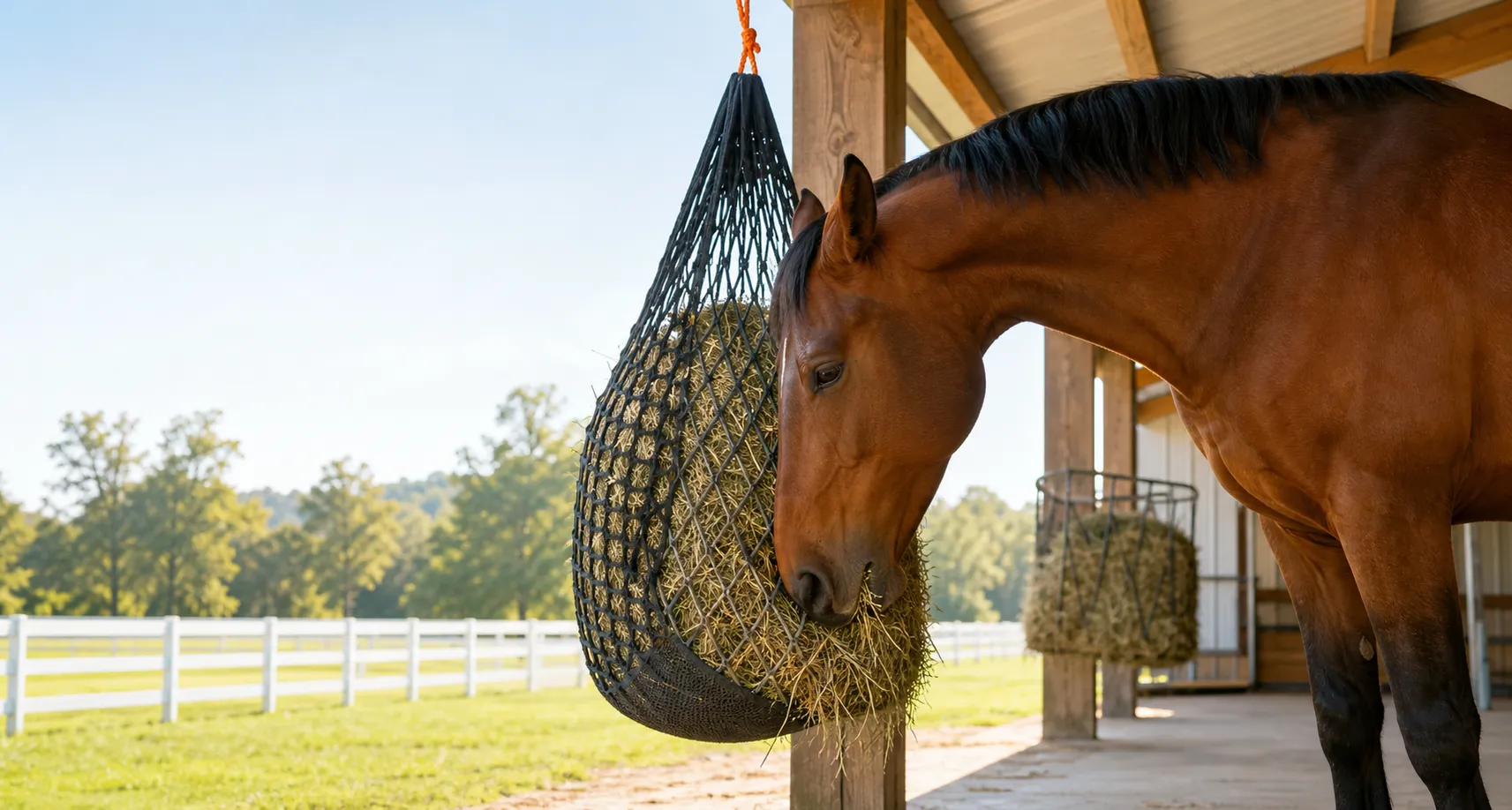
If a horse finishes a hay portion too quickly, a slow-feeder hay net can stretch the same forage over more of the day. The hard part is choosing a hole size that slows the horse without turning every meal into a frustrating or poorly monitored restriction.
Quick answer: For many adult horses, a 1.75-inch opening is a practical starting point because it slows intake without being the most restrictive option. A 1-inch net slows more and may suit an easy keeper only after a gradual transition and careful forage monitoring. Larger 2- to 4-inch openings are better for a horse that is new to nets, needs easier access, or should receive only a modest slowdown.
The University of Minnesota Extension slow-feed hay-net comparison provides unusually useful numbers: in a four-hour test, average intake was about 3.3 lb per hour from the ground, 2.4 lb per hour through a 1.75-inch net, and 1.9 lb per hour through a 1-inch net. That is a study result, not a promise for every horse or hay type. This guide turns that evidence into a practical decision process and a safe setup plan.
Slow-feeder hay net hole size at a glance
| Opening | Relative restriction | Usually makes sense when | Main watch-out |
|---|---|---|---|
| 4 to 6 inches or open feeder | Light | A horse is new to nets, needs an easier transition, or only needs a small slowdown | It may not change feeding time much, and hay can still be pulled out quickly |
| 1.75 to 2 inches | Moderate | A general starting point for an adult horse that eats too fast | A tight, sagging, or double-layered net can act smaller than its label suggests |
| 1 to 1.5 inches | Strong | An easy keeper needs more time over a meal and has already adapted to a medium net | Frustration, inadequate intake, or competition can appear if the setup is too restrictive |
| 1 inch | Very strong | A specific, monitored use case after a gradual transition | It is not automatically safer or better; never let a small opening replace the required forage amount |
The ranges above are practical categories, not formal industry standards. The IFCE Equipedia guide on slow-feeder equipment reports individual-net mesh sizes from roughly 2.5 to 10 cm, or about 1 to 4 inches. A US product page may use a nominal square opening, a stretched measurement, or a product-specific description, so compare the actual net rather than relying on the number alone.
What the hole size changes
Smaller openings reduce the amount taken per bite
A smaller opening makes the horse take smaller mouthfuls and spend more time locating and pulling hay through the mesh. It does not change the energy content of the hay. If the horse receives the same weighed amount, the main expected change is the rate and duration of consumption, plus potentially less hay spread on the ground.
In the University of Minnesota trial, eight adult horses received grass hay at 1% of body weight twice daily. Average intake over four hours was approximately:
| Feeding method | Average intake rate | Approximate amount eaten in four hours |
|---|---|---|
| Hay offered off the ground | 3.3 lb per hour | 95% |
| Large 6-inch opening | 2.9 lb per hour | 95% |
| Medium 1.75-inch opening | 2.4 lb per hour | 89% |
| Small 1-inch opening | 1.9 lb per hour | 72% |
A separate test on the same Extension page measured the time to finish a meal: about 3.2 hours with no net, just over 5 hours with a medium net, and about 6.5 hours with a small net. Those figures illustrate the direction of the effect. They should not be used to calculate an unattended horse’s exact feeding schedule because horses, forage, net shape, and access conditions vary.
The label is only one part of the restriction
Two nets marked 1.75 inches can behave differently. Before deciding that a hole size is too large or too small, check:
- Hay: Long, coarse stems are harder to pull through than short, soft, leafy hay. Haylage and wetter forage can change both resistance and spoilage risk.
- Tension: A full, tight net can present a different opening from a nearly empty net that has collapsed around the last flakes.
- Loading: A loosely packed net is easier to forage than a dense bag. Multiple layers or a net inside a feeder can increase resistance.
- Shape: A flat net, box-style feeder, and round-bale net do not give the horse the same access angle.
- Position: A high-hung net can change posture and pull force. A low net can be more natural for the neck but creates a different entanglement risk.
- Horse: Experience, bite style, motivation, dental comfort, and social rank all affect the result.
For that reason, “1 inch” is not twice as slow as “2 inches,” and a smaller number is not automatically a better welfare outcome. Treat the printed size as a starting variable that you test with the horse and the actual hay.
Which hole size fits your use case?
Start larger when the horse is new to slow feeders
If a horse has never used a net, start with an opening that allows easy success and keep a short-term backup feeding method available. The IFCE recommends a gradual progression, starting around 10 cm and then moving toward 5 cm when needed. In US terms, that is broadly comparable to starting around 4 inches and then moving toward 2 inches, although the products are not identical.
Watch the first meals rather than assuming the horse will work it out. The horse should pull hay calmly, keep eating, and finish the planned amount without pawing, striking, sweating, or abandoning the feeder. A few minutes of investigation is normal; persistent agitation is feedback that the step is too large, too small, badly positioned, or socially inaccessible.
Use 1.75 inches as a practical medium starting point
The 1.75-inch class is a useful middle ground for many adult horses: it is meaningfully slower than ground feeding in the Minnesota study, but it is less restrictive than a 1-inch net. It can work for a stall portion, a trailer, or an overnight feeding test when the horse has already accepted an easier mesh.
That does not make it a universal recommendation. A horse with dental pain, a senior horse with inadequate chewing ability, a horse that becomes frustrated, or a horse that cannot access enough forage should not be pushed into a smaller mesh just to make the net last longer. Have dental and body-condition concerns assessed by an equine veterinarian or qualified nutrition professional.
Move toward 1 to 1.5 inches only for a defined reason
A 1- to 1.5-inch opening can be useful when a healthy, adapted horse still empties a medium net too quickly and the ration, water, and behavior can be monitored. It is especially important to weigh the hay rather than estimating by flakes, because a net that lasts longer can hide an intake problem if it was underfilled.
Do not use a smaller opening to compensate for an oversized ration, a lack of exercise, or an unexplained change in body condition. The University of Minnesota weight-loss study found that a hay net slowed a meal compared with feeding from the floor, but the net itself did not create a different weight-loss outcome when horses were managed in an energy deficit. Body condition and total energy intake still required management.
Reserve 1 inch for a monitored ultra-slow setup
One-inch nets can extend feeding time further, but they are not a default setting for every easy keeper. Use them only when the horse can comfortably pull the selected hay through the mesh, the required daily forage amount is still supplied, and a person can check the horse and net regularly. A very small opening can also increase frustration or make it harder for a subordinate horse to get enough forage in a group.
If a 1-inch net is the only way to make an appropriate forage ration last, stop and review the whole plan with a veterinarian or equine nutritionist. The goal is steady access to suitable forage, not simply a bag that remains full at the next check.
How to test whether the chosen size works
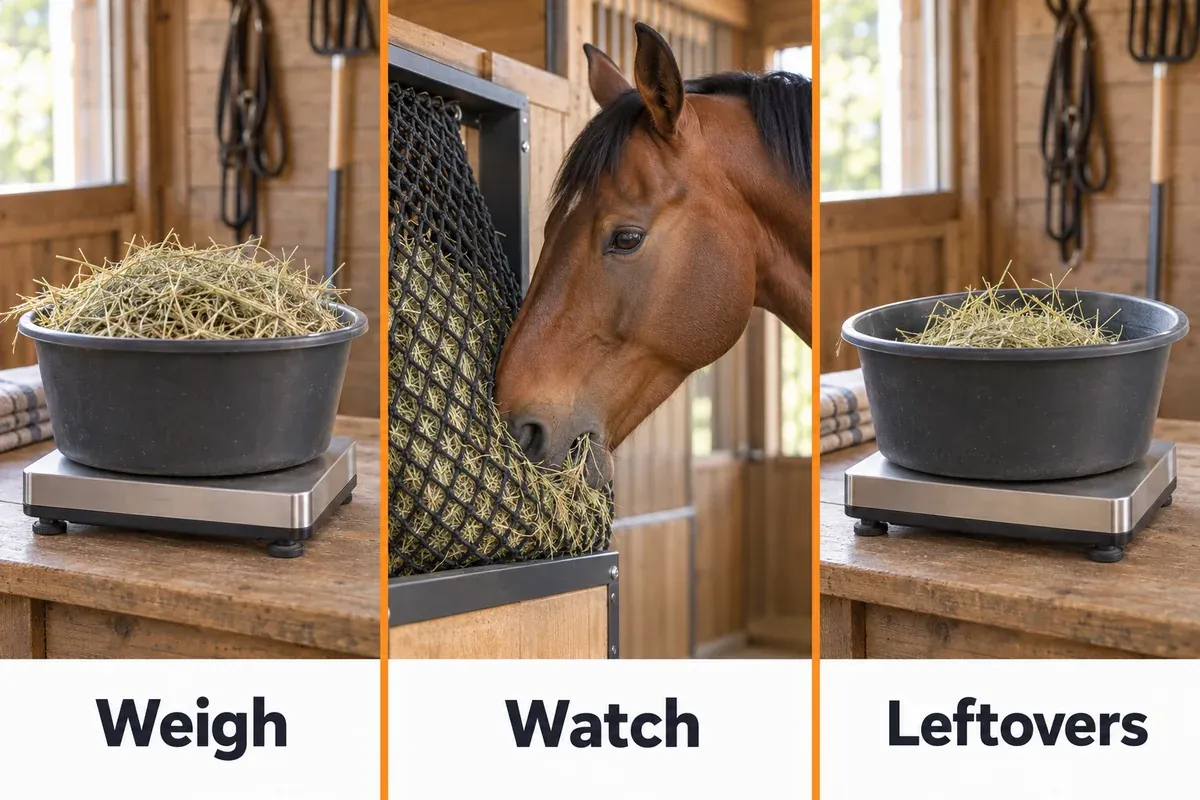
Use a short, repeatable trial instead of judging only by whether the net is empty in the morning.
- Weigh the hay going into the net and record the hay type, net opening, loading method, and start time.
- Watch the first feed for calm, continuous foraging. Check that the horse can pull hay without scraping lips or becoming upset.
- Weigh clean leftovers at the end of the planned interval. If hay is contaminated with bedding or manure, record it separately rather than counting it as edible leftovers.
- Check the horse’s water access, manure, appetite, behavior, and body condition over several days. A single meal is not enough to judge the setup.
- Adjust one variable at a time: opening, amount, loading density, or location. Otherwise you will not know what caused the change.
Measure the time to consume the planned amount, not just the time until the last strand disappears. A horse that leaves a net full because the opening is impractical is not showing a successful slow-feeding result.
A smaller opening is useful only if the horse still gets enough forage comfortably. The three checks below make that easier to judge without guessing from how long the net looks full.
Feeding duration and hay waste are related, but not identical
The purpose of a slow feeder is often twofold: keep forage available for longer and reduce hay pulled out, trampled, or contaminated. The amount saved depends heavily on where the net is used and whether hay is rationed.
The IFCE summarizes study examples in which loose hay offered on the ground had about 57% waste when fed ad libitum, while a slow feeder had about 5% waste in one comparison. In rationed feeding, the same summary reports about 13% waste on the ground and about 1% with a slow feeder. Those numbers are useful for understanding the possible direction of change, not a guarantee for a particular barn.
Waste can rise again when a round-bale net sags onto the ground, the hay gets wet, the opening is too large, or the horse can pull large clumps through. The IFCE recommends placing a round-bale net inside a rack or hay bell to reduce sagging, trampling, contamination, and entanglement. If the net saves hay but creates sharp, dirty, or inaccessible forage, the setup needs changing.
There is also a labor trade-off. A 2016 pilot study in Applied Animal Behaviour Science found that feeding small-mesh nets increased staff handling time in its setting. Fill, tie, inspect, clean, and replace a net safely; include that workload when deciding whether a mesh is practical for every meal.
Safety: hole size is only one part of the setup
Protect shod horses from low or loose nets
Ground-level feeding can support a more natural head and neck position, but a loose net near the feet can catch a shoe or leg. This matters especially for shod horses, horses that paw, and nets that become slack as the hay disappears. The Penn State Extension hay-feeder guidance also favors soft mesh over sharp metal edges and warns that feeder design affects both waste and safety.
Use a purpose-built rack or secured low setup when that is the safer option for your horse. Keep attachment points strong, remove excess loops and loose cords, and inspect the net every time it is filled. Replace frayed, stiff, sharp, or stretched material rather than tying a temporary repair where a hoof could catch.
Avoid a high, fixed feeding position
Hanging a net high can keep it away from hooves, but it may force the horse to eat with the head elevated. The IFCE review describes natural ground-level feeding and recommends varying forage sources; it cites a large study that did not find negative musculoskeletal effects at the population level, while still noting that posture concerns remain relevant to setup. A practical compromise is to secure the net at a safe, controlled height without making the horse reach upward for every bite.
Give groups more than one access point
One slow feeder is not enough for a group if a dominant horse can block it. Use multiple feeding points with space between them and enough forage for the least assertive horse. Small openings can increase competition or frustration when access is restricted, even if the same mesh works well for an individual horse in a stall.
Treat dental comfort and choking risk seriously
The UConn Extension review of slow feeders notes that recent studies of hay-net-style slow feeders have not shown a clear dental-health penalty, while also discussing potential issues from hard surfaces, net position, and irritation. Inspect lips, gums, whiskers, and the net itself, and keep routine oral examinations current.
Rapid eating, dental disease, inadequate water, and dry or poorly prepared feed can all contribute to choke risk. The UC Davis Center for Equine Health choke guidance lists spreading feed and slow-feeding methods among prevention ideas, but choke remains an emergency. If a horse shows repeated swallowing attempts, saliva or feed from the nostrils, coughing, distress, or a stream of feed and fluid, remove feed and call an equine veterinarian immediately.
Best examples by hole size and setup
-
Weaver Equine Slow Feed Hay Net 36 in
Weaver Equine
A 36-in synthetic-rope slow-feed net with approximately 1-3/4-in openings, useful as a medium-hole benchmark.
- 36-in length
- Approximately 1-3/4-in holes as intended for the selected style
- Best for
- An established 36-in net for a standard stall or trailer hay portion
- Hole size
- Approx. 1-3/4 in
-
T TEKE Deluxe Slow Feed Hay Net, 1-3/4 in
T TEKE
Product selected for the stated use case; confirm fit with the manufacturer's specifications.
- 1-3/4-in holes as documented
- Single-net format for small-square-bale portions
- Best for
- A lower-cost medium-hole net for a stall, trailer, or gradual transition
- Hole size
- 1-3/4 in
-
Majestic Ally 2-Pack Ultra Slow Feed Hay Nets, 1.5 x 1.5 in
Majestic Ally
A two-net format with 1.5 x 1.5-in openings, useful when a spare or a second feeding location matters.
- Two 40-in nets as documented
- 1.5 x 1.5-in openings
- Best for
- Two feeding stations or rotating a pair of medium-small nets
- Hole size
- 1.5 x 1.5 in
-
Country Pride Ultra Slow Feeder Hay Net, 1-in Openings
Country Pride
A top-loading woven net advertised with 1-in openings and capacity for 5 to 6 flakes, compatible with a hay hoop setup.
- 1-in openings as documented
- Advertised to hold 5 to 6 flakes
- Confirm the pack format before ordering
- Best for
- A genuinely restrictive 1-in option for an easy keeper after a gradual transition
- Hole size
- 1 in
Review the linked product page before purchasing.
Weaver Equine: established 36-inch medium-hole option
The Check current price on Amazon → is the clearest established medium-hole reference in this set.
Choose it when you want a single 36-inch net for a normal stall portion, trailer meal, or a horse that needs a moderate slowdown rather than an ultra-restrictive setup. It is not the right choice merely because the opening is smaller: verify that the color and opening match the use case, and do not treat the described capacity as a replacement for weighing the hay.
T TEKE: lower-cost 1-3/4-inch starting point
Its value is simple: it gives a horse owner a medium-hole trial without immediately moving to a two-net or ultra-slow setup.
Use it for a measured portion in a stall, trailer, or transition plan. If the horse is new to nets, begin with an easier opening or supervise the first feeds rather than expecting the 1-3/4-inch net to work for every horse immediately.
Majestic Ally: two 1.5-inch nets for rotation or separate stations
The Check current price on Amazon → lists 1.5 x 1.5-inch openings and two 40-inch nets.
This format is useful if you need two feeding stations, want a spare while one net is washed, or want to compare a 1.5-inch opening with a 1.75-inch net.
Country Pride: 1-inch ultra-slow option after adaptation
The Check current price on Amazon → was described with 1-inch openings and a capacity claim of 5 to 6 flakes.
This is the most restrictive opening in the group, so the use case is narrower. Consider it only for a healthy, adapted horse whose weighed forage ration still works through the net and whose body condition, manure, appetite, and behavior are being monitored.
Frequently Asked Questions
Is a 1-inch hay net too small?
Not automatically, but it is too restrictive for some horses, hay types, or feeding plans. Use it only when the horse can pull the forage comfortably, the required amount is supplied, and the horse remains calm and healthy. Start with a larger opening and move down only for a defined reason.
Is 1.75 inches a good hay-net hole size?
It is a sensible medium starting point for many adult horses that already tolerate nets. The Minnesota study found a meaningful slowdown compared with feeding off the ground, while the opening was less restrictive than 1 inch. Test it with the actual hay and horse rather than assuming the published size guarantees a specific number of hours.
Do smaller hay-net holes reduce hay waste?
They can, but the feeder design and management determine the result. A slow feeder may reduce pulling, trampling, and contamination, while a sagging or poorly placed net can still waste hay. The IFCE study summary shows lower waste in slow-feeder comparisons, but those percentages should not be treated as a barn-wide guarantee.
Should a hay net be on the ground?
A low feeding position can support a natural posture, but a loose net near the feet creates an entanglement risk, especially for a shod horse. Use a secure setup appropriate to the horse, keep excess loops away from the feet, and avoid high mounting that makes the horse reach upward for every bite.
How long should a slow-feeder hay net last?
There is no useful universal lifespan. Replace it when mesh, knots, rings, seams, or attachment points become frayed, sharp, stiff, or stretched enough to change access. A daily inspection matters more than a calendar replacement date.
Can a slow feeder replace a forage or weight-management plan?
No. It changes access rate and may reduce waste, but it does not make low-quality hay nutritious, correct an oversized ration, or diagnose a dental or metabolic problem. Use a weighed forage plan and professional help when body condition, insulin concerns, dental ability, or appetite is involved.
Bottom line
Choose the smallest practical opening that still lets the horse eat the planned forage calmly, comfortably, and safely. For many adult horses, 1.75 inches is a useful first test; 1 to 1.5 inches is a stronger restriction for a specific monitored need; and larger openings are better for transition or a modest slowdown. Measure the hay, watch the horse, inspect the net, and change one variable at a time.
The best hole size is therefore not the smallest number on a product page. It is the opening that keeps forage available for an appropriate duration while preserving access, posture, dental comfort, water intake, and safe behavior.
Sources and further reading
- University of Minnesota Extension: Using slow-feed hay nets
- University of Minnesota Extension: Horse weight loss
- UConn Extension: Weight management in horses: Slow feeders
- IFCE Equipedia: Feeding hay to equids in slow feeders - which equipment to choose?
- Penn State Extension: Hay feeders and the potential to reduce hay waste
- UC Davis Center for Equine Health: Esophageal obstruction (choke) in horses
- Morgan et al. 2016: Pilot study on work load management and feed intake time when feeding horses with small mesh haynets