
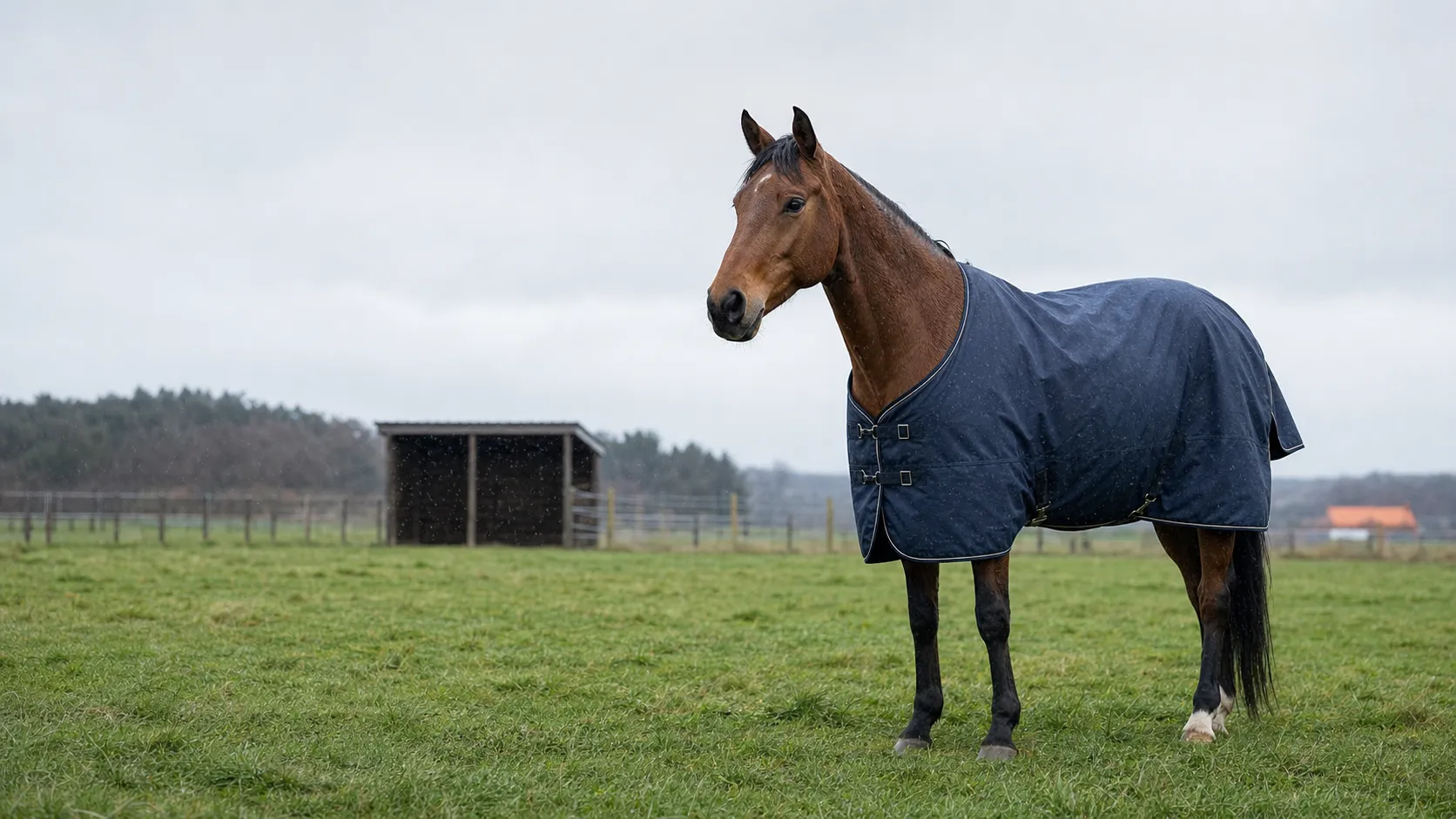

 Published sources
 Product details checked
Blanketing is not a race to find one magic number. A healthy horse with a full winter coat, good body condition, shelter, and dry weather may be comfortable at a temperature that makes a clipped, thin, or exposed horse uncomfortable. Wind and wet conditions can change the decision faster than the thermometer does.
Quick answer: Use the temperature bands below as a starting point, then adjust for coat or clip, rain, wind, shelter, age, body condition, and acclimation. A 0g sheet can block rain without adding meaningful insulation; lightweight and midweight fills usually cover the middle bands; heavyweight generally means about 300g or more. If the horse is wet, sweating, shivering, losing weight, or acting withdrawn, the chart is no longer enough—check the horse and involve an equine professional.
The guide below is based on the University of Maine Cooperative Extension’s Winter Blanketing Guide and University of Minnesota Extension’s winter horse-care guidance. Both sources emphasize that the horse and the conditions matter more than a fixed blanket rule.
In this guide, you will learn:
- How to read a clipped-versus-unclipped horse blanket temperature chart
- Why wind, rain, sleet, and shelter can move the recommendation by a full layer
- How age, body condition, acclimation, and forage change the margin for cold stress
- What 0g, lightweight, midweight, and heavyweight actually mean
- How to inspect a blanket and the horse so the starting recommendation stays safe
- Which linked options fit a no-fill, 200g, or heavy-duty turnout use case
Start with the interactive decision helper
The selector is deliberately not a “temperature in, grams out” calculator. It adds a warmer starting layer when exposure or horse-specific risk reduces the insulation your horse can create or keep. Use it for the forecasted turnout conditions, then use the inspection checklist later in this article.
Interactive starting point
Build a blanket starting point for today’s turnout
Enter the conditions your horse will actually face outside. The result starts with the University of Maine temperature bands and then adjusts for coat, rain, wind, shelter, and horses that need extra support.
Your starting point
Lightweight to midweight blanket
Adjust the fields above to see why the starting point moves.
This is a starting screen, not a promise that a particular gram weight is correct. Check the horse under the blanket, feel for sweat, and change the plan when the weather or the horse changes.
Horse blanket temperature chart: the starting bands
The table below is a starting chart for a healthy, acclimated horse with access to normal forage. It is not a guarantee for every horse or every climate. The University of Maine guide separates a full winter coat from a clipped coat and uses the following fill categories: rain sheet or liner at 0g, lightweight around 60–100g, midweight around 150–300g, and heavyweight at 300g or more.
Full winter coat
| Outdoor temperature | Dry, calm starting point | If rain, sleet, or freezing rain is expected |
|---|---|---|
| 40°F and above | Usually no blanket for a healthy, acclimated horse | Prioritize shelter and monitoring; use a 0g waterproof sheet only when the horse needs weather protection and will not sweat |
| 25–39°F | Usually no blanket | 0g waterproof rain sheet may be appropriate; move warmer only when wind, exposure, or the individual horse justifies it |
| 15–24°F | Lightweight to midweight | Midweight may be a better starting point for exposed turnout or persistent wet weather |
| 0–14°F | Heavyweight | Heavyweight with reliable waterproofing, shelter, forage, and frequent checks |
| Below 0°F | Heavyweight plus a considered liner or hood plan | Treat as a management problem, not a reason to keep adding layers without checking the horse |
Clipped or partially clipped coat
| Outdoor temperature | Starting point before individual adjustments |
|---|---|
| 50°F and above | Usually no blanket when dry; a 0g sheet or light layer may be needed for wet, exposed turnout |
| 40–49°F | 0g waterproof sheet or lightweight blanket when turnout is wet or windy |
| 25–39°F | Lightweight to midweight |
| 15–24°F | Heavyweight |
| Below 15°F | Heavyweight plus a considered liner or hood plan |
These bands deliberately overlap. A full coat at 20°F with a windbreak is not the same situation as a full-body clip at 20°F in cold rain. The University of Maine chart gives the bands; the horse’s exposure and response determine where to start within them.
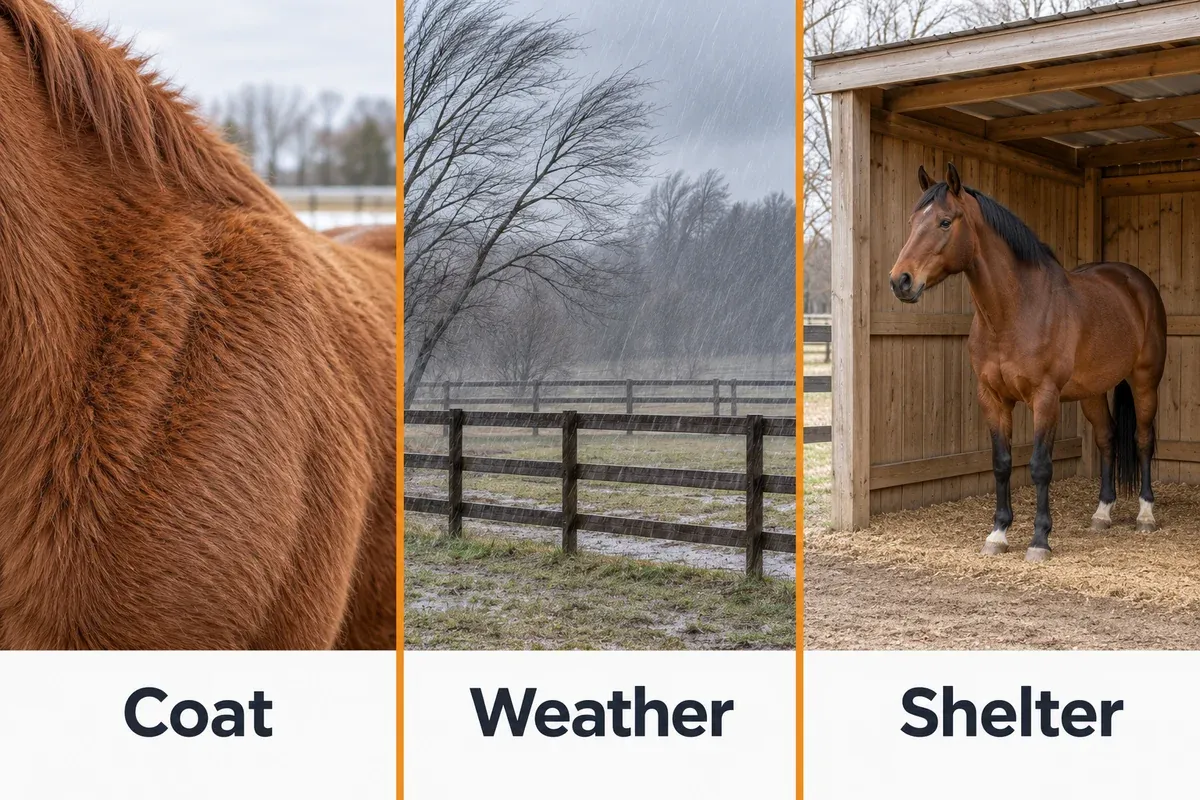
The three factors pictured below can change the same temperature reading into a different turnout decision. Check the horse again after the conditions change.
How to adjust the chart for real turnout conditions
1. Coat and clip come first
Hair traps still air. A full winter coat can provide substantial insulation, while clipping removes part of that system and makes the horse more dependent on a blanket and a dry place to stand. A trace or partial clip falls between the two, but the exact result depends on how much hair was removed and where.
If you are preparing to clip, stop if the blades become hot or start pulling hair. Work through the horse clipper checks for overheating and poor cutting before continuing.
Do not treat “unclipped” as a synonym for “always warm.” A short, thin, wet, or muddy coat can lose much of its insulating value. The University of Minnesota Extension notes that wet hair is less effective insulation and that small or young horses can lose heat more quickly than larger adults.
2. Wind increases exposure even when the air temperature is unchanged
Wind removes the layer of warmer air around the coat. A horse standing in a protected run-in is not experiencing the same conditions as a horse standing in an open field, even if both thermometers read 25°F.
Use wind as a reason to move up one starting layer when the horse is already near the edge of a temperature band. If the wind is strong and there is no usable shelter, prioritize a waterproof, well-fitted turnout blanket and a place where the horse can get out of the wind. Do not solve every wind problem by adding a heavier stable blanket that is not designed for turnout.
3. Rain and sleet can matter more than snow
Dry snow often sits on a fluffy coat without immediately soaking through. Cold rain, sleet, and freezing rain can flatten and wet that same coat, increasing heat loss. A waterproof outer shell is therefore a separate requirement from insulation: a 0g rain sheet can keep a coat dry, but it does not replace a 200g or 300g fill when the horse needs warmth.
The Maine guidance specifically warns against blanketing a wet horse. If the horse comes in damp, remove the wet blanket, dry the horse, and use a clean, dry blanket only when the horse is dry. A blanket that is wet on the inside or trapping sweat can create a colder problem later.
4. Shelter only counts when the horse can and will use it
A three-sided run-in, dense windbreak, or barn access can reduce exposure. But a shelter that is too small, blocked by herd dynamics, or ignored by the horse should not be counted as full protection. Observe where the horse actually stands during the worst weather.
Shelter can move a starting point down one layer when the horse uses it and the remaining conditions are dry or manageable. It should not be used to justify a lighter blanket for a horse that stands outside in wind-driven rain all day.
5. Age, body condition, and acclimation change the margin
Young horses, seniors, horses at a body condition score of 3 or below, hard keepers, and horses that have not acclimated to the cold deserve a more conservative plan. The University of Minnesota Extension guidance lists these situations among the reasons a horse may need blanketing, especially when shelter is poor or the horse may get wet.
That does not mean an older or thin horse should automatically wear the heaviest blanket. It means the starting band moves warmer and the checks become more frequent. Monitor weight, appetite, manure, hydration, behavior, and forage intake alongside the blanket.
6. Forage is part of the cold-weather plan
Blanketing cannot compensate for inadequate calories. The fermentation of forage produces heat, and horses in cold conditions may need more access to hay. The University of Minnesota Extension recommends paying attention to forage access and energy needs, especially for young, thin, or hard-keeping horses.
If the horse is losing weight or repeatedly shivering, do not simply add fill. Correct the broader management problem and ask your veterinarian or an experienced equine nutrition professional for help.
What 0g, lightweight, midweight, and heavyweight mean
“Grams” refer to the approximate weight of the blanket’s insulation fill, not the denier of the outer fabric. A higher denier can make a shell more abrasion-resistant without making it warmer.
| Blanket label | What it contributes | Common use |
|---|---|---|
| 0g / rain sheet | Little or no insulation; weather barrier | Rain and wind protection when warmth is not the main need |
| Lightweight, about 60–100g | A small amount of insulation | Mild cold, partial clips, or a first warmer step above a shell |
| Midweight, about 150–300g | Moderate insulation | Cold turnout when the coat or weather does not provide enough protection |
| Heavyweight, 300g+ | The most insulation in the chart | Very cold, clipped, vulnerable, or persistently exposed horses when fit and management support it |
Layering can be useful because it gives you more options as the day changes. It can also create problems: too many layers may restrict movement, hold moisture, change the fit, or make the horse sweat. A liner is not a substitute for a waterproof turnout shell, and a stable blanket should not be assumed waterproof because it is warm.
Product choices by use case, not by a universal “best” label
These product examples are included as practical reference points for the chart. They cover a no-fill sheet, a defined 200g fill, and a heavy-duty shell.
-
Tough1 600D Waterproof Turnout Sheet
Tough1
A no-fill turnout sheet with a 600D waterproof outer, shoulder gussets, fleece wither protection, and adjustable fastenings.
- 600D waterproof outer shell with no insulating fill
- Shoulder gussets and fleece wither protection
- Cross surcingles with elastic ends
- Use case
- Rain protection without added insulating fill
- Fill / weight
- 0g - no insulating fill
-
Gallopoff 1200D Ripstop 200g Fill Horse Blanket
Gallopoff
A 1200D ripstop turnout blanket with 200g fill, smooth nylon lining, fleece wither protection, and adjustable front and belly fastenings.
- 1200D ripstop outer shell
- 200g midweight insulating fill
- Smooth nylon lining and fleece wither pad
- Use case
- Midweight turnout with a ripstop outer
- Fill / weight
- 200g poly-fill
-
Tough1 1680D Turnout Blanket with SNUGGIT Neck
Tough 1
A heavy-duty 1680D turnout option with a SNUGGIT neck. Use it as a durable shell choice, but confirm the exact fill weight for the model before treating it as a heavyweight insulation layer.
- 1680D outer shell for demanding turnout conditions
- SNUGGIT neck design adds coverage at the neck and withers
- Useful when durability matters as much as fill weight
- Use case
- Rough turnout where a tougher shell and neck coverage matter
- Fill / weight
- See product page
Review the linked product page before purchasing.
Tough 1 600D Waterproof Horse Sheet: the 0g reference point
Use this type of sheet when the chart says “no insulation, but keep the horse dry,” such as mild rain for a horse with a full coat. Do not use a 0g sheet as if it were a lightweight or midweight blanket. It can also flatten the coat, so check for sweat under the shoulders and along the chest.
Best fit: A healthy, acclimated horse that needs a weather barrier, a backup turnout sheet, or a light rain layer.
Not the right tool: A clipped, thin, or shivering horse in cold weather that needs insulation rather than a shell.
Check current price on Amazon →Gallopoff 1200D Ripstop 200g: a defined midweight anchor
This is a useful middle option when the chart lands in the lightweight-to-midweight band and the horse is dealing with more than a brief shower. It is not automatically correct for every 20°F turnout: a full coat, reliable shelter, and dry weather may call for less, while a full clip, strong wind, or a thin horse may call for more.
Best fit: A horse that needs a defined 200g layer for cold, changeable turnout and whose blanket fit has already been checked.
Watch closely: A 200g blanket can be too warm when the day rises, the horse works, or a damp horse is covered before drying.
Check current price on Amazon →Tough1 1680D with SNUGGIT Neck: a durability-focused heavy shell
The Tough1 1680D SNUGGIT product information is useful for a different reason.
If your chart says 300g+, choose a model explicitly labeled 300g or more, then confirm waterproofing and fit before ordering.
Best fit: A horse that destroys lighter shells or needs extended neck coverage, when the chosen models also matches the required fill.
Do not assume: A heavy-duty shell alone will keep a clipped or vulnerable horse warm.
Check current price on Amazon →For a broader comparison of turnout construction, waterproofing, closures, and fit, see the Horse Blankets comparison guide. Use that page to compare shell and feature differences after this chart has established the weight and weather job your horse actually needs.
Fit and daily inspection: the part no chart can do
A correctly weighted blanket can still cause problems if it rubs, slips, leaks, or traps sweat. Measure from the center of the chest across the shoulder to the center of the tail dock, and follow the product’s own sizing instructions. The Maine guide also recommends checking that you can place a hand under the shoulder and withers without the blanket pressing tightly.
When the blanket is on, check:
- The chest closure sits flat without pulling the shoulders forward
- The front edge does not press into the windpipe or rub the withers
- The blanket covers the back and barrel without exposing the belly to driving rain
- Surcingles are secure but not tight enough to restrict breathing or movement
- Leg straps do not hang low enough to catch a hoof
- The inside is dry and the horse is not sweating under the chest, shoulder, or behind the elbow
- The blanket is not torn, twisted, soaked, or contaminated with mud
Remove or change the blanket when the weather warms, the horse comes inside, the horse is working, or the horse is sweating. A horse can be cold later because a blanket was too warm earlier and left the coat damp. Blanket storage also matters: clean and dry the blanket before putting it away, and repair small tears before they become large ones.
Signs that the starting point needs to change
Look at the horse, not just the forecast. Shivering, tucked posture, persistent seeking of shelter, a cold chest or shoulder, weight loss, and unusual quietness can all mean the horse needs a management change. Sweating, damp hair, agitation, rubbing, and a hot chest under the blanket point in the other direction.
Do not use cold ears by themselves as a reason to add fill. Feel the chest, shoulder, and behind the elbow, and observe the horse’s posture and behavior. If the horse is shivering continuously, seems weak, has stopped eating, is losing weight, or cannot get dry and sheltered, contact your veterinarian promptly.
Frequently Asked Questions
What temperature is too cold for a horse without a blanket?
There is no universal cutoff. Use those figures as context, not as a permission slip to skip observation.
Should an unclipped horse wear a blanket at 30°F?
Often not if the horse is healthy, acclimated, dry, in good body condition, and has shelter. At 30°F, the Maine starting chart allows no blanket for a full winter coat, with a 0g sheet as a rain option. Wind, cold rain, no shelter, or a thin or elderly horse can move the starting point warmer.
How much warmer should a clipped horse be blanketed?
Start one or more bands warmer than a full-coated horse, depending on how much hair was removed and the weather. The Maine chart places clipped horses in a rain-sheet or lightweight range at temperatures where a full-coated horse may need nothing, then moves to midweight and heavyweight sooner. Recheck the horse rather than treating the clip as a fixed gram prescription.
Does wind require a heavier horse blanket?
Wind increases heat loss, especially when the turnout is exposed or the horse cannot use a windbreak. Move up one starting layer near a chart boundary and prioritize reliable shelter. A lighter waterproof turnout blanket in a protected area can be safer than a heavy blanket that traps sweat in a sheltered barn.
Is a 0g horse blanket warm?
A true 0g sheet adds little or no insulation. Its main job is to keep rain and wind off the coat. It may be exactly right for mild wet weather, but it is not a substitute for a lightweight, midweight, or heavyweight fill when the horse needs warmth.
Can I blanket a wet horse?
Not with a wet blanket over a wet horse. Dry the horse, remove saturated or sweaty layers, and use a clean, dry, breathable blanket only when the horse is dry. If the horse repeatedly gets soaked, improve shelter and turnout management instead of stacking layers on top of moisture.
What does 300g mean on a horse blanket?
It usually describes the approximate insulation fill weight, not the outer shell. A 300g blanket is generally in the heavyweight category, but warmth also depends on fit, lining, windproofing, moisture control, and whether the horse has a clip or a natural coat.
Bottom line
A horse blanket temperature chart should narrow the starting point, not make the decision for you. Start with the coat or clip, then account for wet and wind, shelter, age, body condition, acclimation, and forage. Choose 0g when the job is keeping a horse dry, choose a defined fill when the horse needs insulation, and never confuse a tougher denier shell with more warmth. The safest plan is the one you can inspect, adjust, and explain for that particular horse on that particular day.