

 Published sources
 Product details checked
Green film on a horse water trough is more than an eyesore. Algae, hay, manure, and warm stagnant water can make a horse drink less, and a suspicious surface scum can signal a much more serious water-quality problem. The safest fix is usually simple: remove access, drain the trough, scrub the surfaces, rinse thoroughly, refill with clean water, and then change the conditions that allowed the film to return.
Quick answer: Do not try to hide algae with a random pond treatment or a home-mixed chemical. Give the horse a clean backup water source, empty the trough, and use a dedicated stiff brush on the floor, walls, rim, drain, and float housing. Shade, a stable low-mud location, less feed and manure near the water, and daily checks slow regrowth. An automatic waterer can improve water turnover, but it is not self-cleaning.
In this guide, you will learn:
- How to tell a routine green film from a water-quality emergency
- A brush-first cleaning process for plastic, galvanized, and coated troughs
- When a measured, published bleach protocol is appropriate—and why random chemicals are not
- How shade, placement, water turnover, and covers affect algae growth
- What to look for in automatic waterers, floats, drains, and brushes
- Which optional products fit a small bucket, a deep trough, or a permanent waterer installation
The 60-second decision
| What you see | Treat it as | First safe action |
|---|---|---|
| A thin green film on the empty wall or rim, with normal-looking water and no unusual odor | Routine maintenance | Keep the horse away, drain the trough, scrub, rinse, and refill |
| Green water, slime, hay, manure, or a smell that makes the horse hesitate | A water-quality problem | Provide clean backup water, empty the source, and clean it before the horse drinks from it again |
| Paint-like scum, floating mats, unexplained animal illness, or a bloom in pond or surface water | Possible harmful algal bloom | Fence off the source, do not let animals drink or lick the water, and contact a veterinarian or local water-quality authority |
Color alone cannot identify toxic cyanobacteria. Oklahoma State notes that blue-green algae can look like scum, skin, paint, fine green grains, or green blobs, and that appearance photographs are not a reliable identification method. If the water looks like a bloom rather than ordinary wall film, treat it as unsafe until a professional advises otherwise.
Why algae grows in horse water troughs
Algae needs light, water, and nutrients. A trough warms faster when it sits in direct sun, while hay dust, feed, manure, mud, and bird droppings add the nutrients that help a film return. Warm weather and low water turnover make the cycle faster; scratches and rough plastic also give biofilm more places to hold on.
The University of Minnesota Extension reports that frequent cleaning matters especially during warm months and with plastic tanks. In its stock-tank study, metal tanks had lower turbidity and chlorophyll-a readings than plastic tanks, while goldfish did not reduce algae. That is a useful material and management finding—not a reason to add fish to a horse trough.
Shade helps because it reduces direct light and slows heating, but it does not replace cleaning. The University of Minnesota’s drinking guidance also recommends keeping water sources out of sunlight and cleaning buckets, troughs, automatic waterers, and travel tanks frequently.
Safe cleaning routine: drain, brush, rinse, refill
1. Put clean water in place first
Before draining the algae-covered source, provide a clean bucket or trough that the horse can use immediately. Horses should not have to choose between questionable water and no water. In hot weather, after work, or when several horses share the source, make the backup container large enough to cover the period you will be cleaning.
If a horse is drinking unusually little, seems depressed, or shows signs of illness, stop treating this as a cleaning-only job and call an equine veterinarian. A clean trough cannot diagnose dehydration, colic, or another medical problem.
2. Shut down automatic equipment safely
Close the water supply before opening a float valve or hose connection. If the trough has a heater or de-icer, unplug it at a dry, protected receptacle before removing it from the water. Never reach into a wet tank near an energized cord, and never reset a repeatedly tripping GFCI just to keep the waterer running.
For a refill problem, leak, frozen line, or float that will not shut off, use the automatic horse waterer troubleshooting guide rather than adjusting parts at random. A running valve can be caused by debris, a waterlogged float, incorrect pressure, or a damaged seal—not simply by the float setting.
3. Empty the trough completely
Drain or tip the trough so that algae, settled sediment, and feed particles leave with the old water. Remove hay, manure, leaves, insects, and any dead wildlife with a scoop or disposable tool. Do not let the horse drink the drained water, and do not dump heavily contaminated water where another animal can reach it.
An automatic bowl may need its drain plug, valve cover, or float assembly removed according to the manufacturer’s instructions. Keep small parts in a clean tray. A waterer that cannot be drained or opened for inspection will need more frequent flushes and closer monitoring than an easy-clean model.
4. Scrub every surface where film can hide
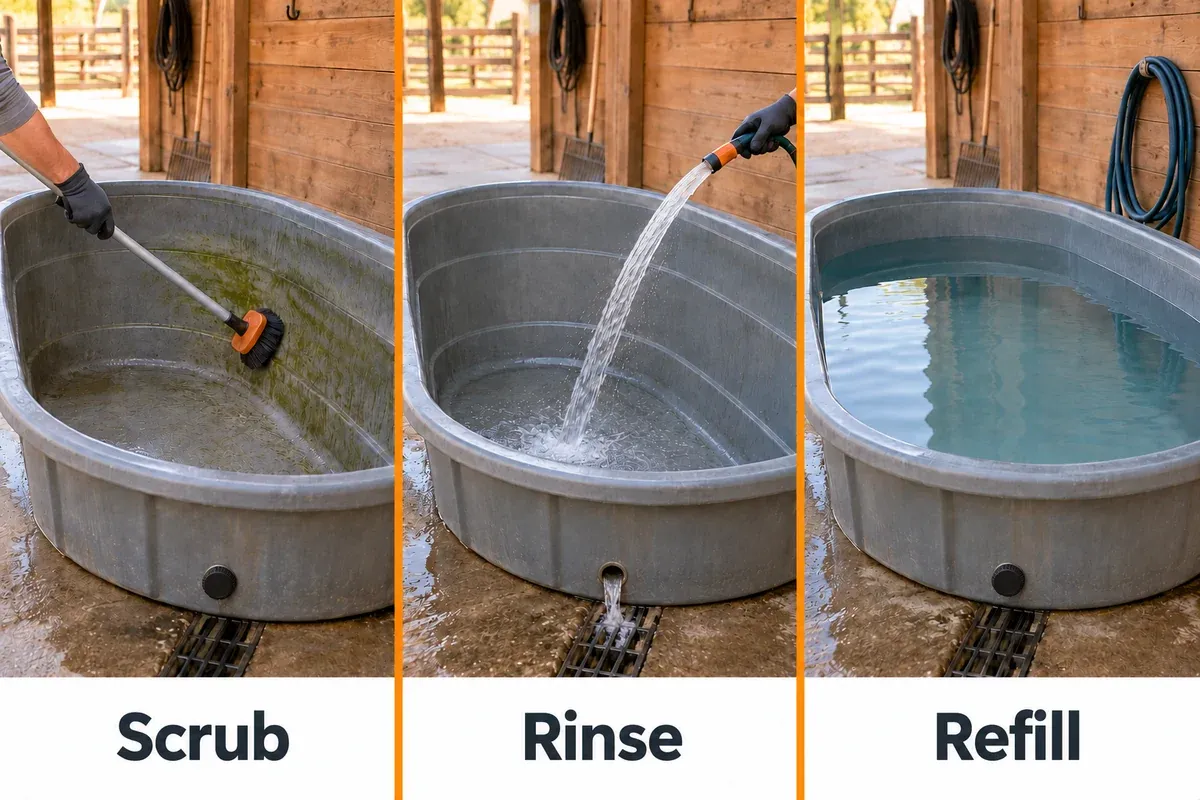
Use a dedicated stiff brush. Work from the rim down, then scrub the floor, corners, underside of the lip, drain, float cover, and the area around the water inlet. A long-handle brush is useful for a deep stock tank; a short horse-care brush gives better control in a small bowl or bucket.
Start with water and mechanical action. You are removing the film rather than spreading a chemical through drinking water. Replace a brush when its bristles shed, the head cracks, or it has been used with a product that is not approved for drinking-water equipment.
For a rough, deeply scratched plastic tank, compare the time spent scrubbing with the cost of a smoother replacement. Do not sand or paint the drinking surface with an unapproved coating. A new surface only helps if the placement and cleaning routine also improve.
5. Rinse until the water and surfaces are clean
Rinse the trough, brush, drain, float assembly, and fittings with clean water. Look at the rinse water in a light-colored bucket if the trough is large; it should no longer carry visible green flakes, dirt, or a cleaning odor. Rinse hidden channels and the underside of a float cover, not just the open bowl.
If there is a persistent odor after rinsing, do not return the horse to the tank. Repeat the rinse or use a published disinfection protocol with the correct contact time, then rinse again. Never combine bleach with acids, ammonia, detergents, or another cleaner.
6. Use disinfection only as a measured protocol
Routine algae removal does not require a stronger chemical. When a veterinarian, extension protocol, or the equipment manual calls for disinfection, use an unscented household bleach product and measure it exactly. The University of Minnesota and Penn State Extension describe a 10% bleach solution for an empty tank: 1 part bleach to 9 parts water, followed by a contact period and at least two clean-water rinses. Penn State specifies allowing the solution to sit for 15 minutes before rinsing.
That is a controlled sanitation step, not an invitation to pour concentrated bleach into a drinking trough. The University of Minnesota gives separate, very small dosing guidance for treating relatively clean water in place and requires a waiting period before horses drink. Follow that published table exactly if it is the chosen protocol; do not estimate with a cup, splash, or bottle cap.
Do not use copper sulfate, pond herbicide, algaecide, essential oils, salt, vinegar, or a homemade chemical mixture as a default horse-water treatment. Species, water volume, water hardness, and the product label matter, and some livestock can be harmed by a treatment that seems harmless in a different pond or aquarium. Penn State specifically notes that copper sulfate requires care because of copper toxicity risks in sheep and other livestock. For a recurring problem, fix light, nutrients, heat, and cleaning access first and ask a veterinarian or extension specialist before adding a treatment.
7. Refill and observe the horse
Refill with fresh water and confirm that the automatic valve stops, the drain does not leak, and the water level is accessible to every horse sharing the source. The AAEP guidelines recommend regular cleaning to prevent algae buildup and daily checks of automatic watering systems to ensure they are dispensing water properly.
Watch the horse drink from the clean source. A horse that refuses freshly cleaned water may be reacting to temperature, odor, a frightening valve, illness, or a change in taste. Do not force the issue by withholding the backup source.
The sequence below is for routine wall film. Suspected harmful blooms or unexplained contamination need the separate precautions described above.
How often should you clean a horse water trough?
There is no useful calendar that overrides what you can see and smell. Use this as a practical baseline, then shorten the interval for hot weather, direct sun, heavy use, rough plastic, high feed contamination, or a horse that drops hay into the water.
| Check | Practical baseline | What to do |
|---|---|---|
| Visual and smell check | Every day | Remove floating debris, confirm clear access, and check that an automatic valve is actually refilling and stopping |
| Light film or settled debris | As soon as it appears; often every few days in hot weather | Drain enough to remove the film, brush the affected surfaces, rinse, and refill |
| Full drain and scrub | Weekly when algae returns quickly; otherwise as needed | Empty the tank and clean the floor, walls, rim, drain, and float housing |
| Thorough seasonal service | At least once or twice a year for a stable, clean source | Inspect the tank surface, fittings, float, hose, mounting, and location; disinfect only when a published protocol is appropriate |
| Suspected contamination or illness | Immediately | Isolate the source, provide clean water, and call a veterinarian or water-quality professional |
Penn State Extension recommends regular as-needed or weekly cleaning for algae and debris, with a more thorough cleaning once or twice per year. A tank that turns green in two days needs a two-day response while you work on prevention; waiting for the annual clean is not enough.
Prevention that works better than a chemical shortcut
Shade the water without trapping the horse
A fixed roof, shade sail, or well-secured overhead shade structure is usually more useful than a loose lid over an active trough. Keep posts, edges, cords, and fabric out of reach. Avoid placing the tank directly under a tree that fills it with leaves, pollen, bird droppings, or branches.
Shade should not create a dark, cramped corner where a dominant horse can block another horse’s access. For a group, provide enough drinking space or more than one water source so a subordinate horse can leave without being trapped.
Use covers only when the tank is not accessible
A waterproof cover can keep dust and leaves out while a tank is empty, being transported, or temporarily closed for maintenance. It is not a safe substitute for a roof on a live horse trough. Loose fabric, zipper pulls, bungee cords, and hooks can be chewed, pulled into the water, or become an entanglement hazard.
Reduce nutrients near the trough
Penn State Extension recommends keeping water away from feed sources and using a stable surface that limits mud splash. Its guidance uses 150 feet from feed sources as a practical target when the layout allows it. The exact distance is less important than the mechanism: hay, grain, manure, and mud feed the film and contaminate the water.
Place the trough on firm, well-drained footing. Clean the surrounding manure and spilled feed. If a wildlife ramp or tightly woven net is needed to keep small animals from drowning, choose a design that cannot catch a horse’s hoof, halter, or lead rope and inspect it often.
Choose smooth, serviceable materials
Galvanized or coated metal can be easier to scrub when the surface remains intact. Smooth plastic can also work well, but deep scratches and a roughened interior hold film. The best tank is not the one with the most impressive coating; it is the one you can drain, brush, rinse, inspect, and repair safely.
Do not repaint a trough with a household coating or seal a crack with an unknown adhesive. If the drinking surface is peeling, badly corroded, cracked, or impossible to clean, replace the bowl or tank with a purpose-made livestock product.
Do automatic waterers prevent algae?
They can reduce the time water sits in a large open tank, but they do not prevent biofilm on their own. Hay and saliva can collect around the float cover, inlet screen, drain, and corners even when the bowl refills continuously. A faulty float can also leave a bowl empty, overflowing, or stagnant.
When choosing or maintaining an automatic waterer, check:
- Cleaning access: Can you drain the bowl and reach the float, inlet, screen, and drain without dismantling half the installation?
- Material and surface: Is the bowl smooth, intact, and free of peeling coatings or sharp corrosion?
- Capacity: Is the bowl large enough for the horse or group, with a backup source available during service?
- Connection and pressure: Does the hose or pipe size match the model, and is the pressure within the manufacturer’s range?
- Daily visibility: Can you see the water level and confirm that the valve refills and shuts off?
- Winter safety: Is the line protected against freezing without improvised heat tape, exposed cords, or an incompatible de-icer?
The existing best automatic horse waterers guide compares float-controlled models, capacity, connections, and winter limitations. For algae control, prioritize easy drainage and inspection over a claim that a bowl is “maintenance-free.”
Brushes, covers, and automatic waterers for a defined job
-
SPARTA Utility Scrub Brush, 8.5 Inch
SPARTA
An 8.5-inch utility brush with polypropylene bristles that the product documentation describes as water- and chemical-resistant, BPA-free, and FDA-compliant. Its compact head works well on smooth bowls, buckets, and reachable trough walls.
- 8.5-inch brush
- Polypropylene bristles
- Water- and chemical-resistant bristles as documented
- Best for
- Owners who want the stated features and a clear fit for their setup
- Application
- Smooth bowls, buckets, and reachable trough walls
-
Star Brite Utility Scrub Brush
Star Brite
A marine-grade utility scrub brush with stiff flagged bristles and an extra-long handle. the product documentation calls out waterlines and hard-to-reach areas, making it a useful reach-first option for a large trough, not a substitute for safe rinsing.
- Extra-long handle
- Stiff flagged Star Prene fibers as documented
- Designed for waterlines and hard-to-reach areas
- Best for
- Deep or larger troughs where a long handle helps keep hands out of dirty water
- Application
- Large troughs, waterlines, and deep corners
-
Schneiders Bucket and Trough Scrub Brush, 2 Pack
Schneiders
A two-pack of horse-care scrub brushes with a 5-inch silicone grip and 1 3/4-inch synthetic bristles.
- Two brushes per pack
- 5-inch silicone grip as documented
- 1 3/4-inch synthetic bristles as documented
- Best for
- A dedicated horse-care brush for buckets, small troughs, and feed buckets
- Application
- Horse water buckets and small troughs
-
Rubermaid 100 Gallon Oval Stock Tank Cover with Zipper
Rubermaid
A waterproof Oxford-fabric cover with zipper access and bungee-style securing for a 100-gallon oval stock tank. Use it only while livestock cannot reach the cover; it is not a livestock-rated lid for an active drinking trough.
- Designed for a 100-gallon oval stock tank
- Zipper access panel
- Bungee and hook-and-rope securing features
- Best for
- Temporarily covering an unoccupied 100-gallon oval tank during cleaning or storage
- Application
- Temporary cover for an unoccupied tank
-
Little Giant 88SW All Purpose Automatic Stock Waterer
Little Giant
Miller's instructions list the 88SW for horses and specify galvanized steel, an adjustable float, and a 1/2-inch male NPT supply at 20–50 psi. The instructions do not state a freeze rating or expected service life.
- Manufacturer lists horse use and a galvanized steel bowl
- Adjustable float; 1/2-inch male NPT at 20–50 psi
- Must be mounted on a vertical surface and tested for shut-off
- Best for
- Installations that match the 1/2-inch male NPT connection and 20–50 psi range
- Application
- See product page
-
Little Giant DuraMate Float Controlled Automatic Waterer 4 Gallon
Little Giant
Miller specifies above-freezing use, a 4-gallon impact-resistant polyethylene bowl, float control, and a 20–50 psi range through a standard 3/4-inch garden hose. Mounting hardware is not included.
- 4-gallon bowl with float-controlled refill
- 3/4-inch garden hose; 20–50 psi operating range
- Specified for above-freezing temperatures; impact-resistant polyethylene
- Best for
- Above-freezing sites with a 3/4-inch garden hose and a 20–50 psi supply
- Application
- See product page
Review the linked product page before purchasing.
Best value for a reachable bowl: SPARTA Utility Scrub Brush
The SPARTA Utility Scrub Brush is the budget pick when the brush head can reach the whole bowl. Its 8.5-inch polypropylene head and water-resistant bristles are useful for a small automatic waterer, bucket, or the near wall of a low tank.
Its limitation is reach. You still need to put your hand close to the dirty surface, and it is a general utility brush rather than a livestock-specific tool. Assign it to water equipment, rinse it after use, and do not carry it from a manure area straight to the drinking bowl.
Best reach for a deep tank: Star Brite Utility Scrub Brush
The Star Brite Utility Scrub Brush makes more sense for a deep or wide tank where kneeling at the waterline is awkward.
This is a general marine-grade brush, not a horse-water certification. Use it for intact metal or durable plastic, keep the pressure controlled on coatings, and rinse the trough until no cleaner or loosened film remains.
Best horse-specific small brush: Schneiders 2-Pack
The Schneiders Bucket and Trough Scrub Brush 2-Pack has a 5-inch silicone grip and 1 3/4-inch synthetic bristles shaped for buckets and small troughs. It is a convenient option when you want one dedicated brush at the barn and one in a trailer or wash area.
Treat it as a purpose-fit new product information, not as proof that it will outlast a better-established utility brush.
Permanent installation: Little Giant 88SW
The Little Giant 88SW is a compact galvanized automatic waterer with a 10 x 10.75 x 5.5-inch bowl, a 1/2-inch pipe or hose connection, and a described operating range of 20–50 psi.
Its easy-clean bowl and enclosed float are useful for a permanent fence or wall installation, but the small bowl is not a herd-sized reserve. Match the plumbing and pressure, mount it correctly, and check the float and water level every day. It can reduce open-tank exposure; it cannot remove the need to brush the bowl.
Budget hose connection: Little Giant DuraMate 4 Gallon
The Little Giant DuraMate 4-gallon waterer is the simpler choice when a standard 3/4-inch garden hose connection and fence or wall brackets fit the location.
Four gallons is a useful small-installation capacity, not a reason to stop checking the water. It is better suited to a single horse or pony than a large group, and the plastic bowl is not freeze-proof. Winterize it or use an approved, correctly matched protection plan rather than improvising heat tape.
What not to do
- Do not let a horse keep drinking from a trough with paint-like scum, a strong unusual odor, or unexplained contamination while you “see if it clears.”
- Do not pour concentrated bleach, copper sulfate, pond herbicide, or an aquarium algae product into drinking water.
- Do not mix bleach with vinegar, acids, ammonia, soap, or another cleaner.
- Do not use goldfish as a replacement for cleaning; the University of Minnesota study did not find that they reduced algae.
- Do not cover an active horse trough with loose fabric, cords, or a zipper cover.
- Do not scrub a galvanized, epoxy-coated, or plastic bowl with a product that can leave residue or damage the drinking surface.
- Do not assume an automatic waterer is working because the hose is connected; confirm refill, shutoff, water level, and access every day.
When algae may be a veterinary or water-quality emergency
If a pond, stream, or trough develops a surface scum that resembles paint, skin, or a floating mat, block the horses from it immediately. Cyanobacteria can produce toxins, and Oklahoma State lists horses among the animals that can be poisoned. A bloom cannot be cleared safely by guessing at an algaecide dose.
Provide clean water from a separate source and contact an equine veterinarian or the relevant local water-quality authority. If a horse has entered suspected contaminated water, Oklahoma State advises washing the animal with clean water and preventing it from licking algae from its coat. Do not wait for a home test or a visual color change before asking for help when an animal is already ill.
Frequently Asked Questions
How often should I clean a horse water trough?
Check it every day and clean it as soon as algae, debris, odor, or a slippery film appears. Weekly cleaning is a sensible warm-weather baseline for a trough that repeatedly develops film; a clean shaded tank may need less frequent full scrubbing, while a sunny high-use tank may need it every few days.
Is green algae in a horse trough always toxic?
No, but you cannot safely identify a harmful cyanobacterial bloom by color alone. A thin wall film is usually a cleaning problem; paint-like scum, a bloom in surface water, unusual odor, wildlife deaths, or sudden illness deserves an emergency response and professional guidance.
Can I use bleach to clean a horse water trough?
Only with a measured, published protocol and the correct rinse and waiting time. University of Minnesota and Penn State Extension describe a 10% bleach solution for an empty tank, followed by contact time and at least two clean-water rinses. Do not improvise a concentration or pour concentrated bleach into the trough.
Does putting a cover over the trough stop algae?
A proper overhead shade structure can reduce sunlight and heating. A loose fabric lid over an active horse trough introduces chewing, entanglement, and access problems. Use a removable cover only while the tank is inaccessible, empty, or being transported, and remove it before the horse returns.
Will an automatic waterer keep the water algae-free?
No. Automatic refill can improve turnover, but algae and biofilm still collect on the bowl, rim, float cover, inlet screen, and drain. Choose an easy-clean model, inspect it daily, and brush it on the same schedule as a manual trough.
Should I add goldfish to a horse water trough?
No. The University of Minnesota study found no reduction in algae from adding goldfish, and the fish themselves can die in hot or poorly managed water. Mechanical cleaning, shade, lower nutrient input, and good water turnover are more reliable controls.
Bottom line
The most dependable horse water trough algae plan is physical and repeatable: keep a clean backup source ready, check the water daily, drain and brush the trough when film appears, rinse until there is no residue, and refill with fresh water. Shade, firm footing, less feed and manure near the water, and an easy-clean automatic bowl reduce how often the cycle returns.
Use a measured extension or veterinary protocol only when disinfection is actually needed. If the water looks like a harmful bloom or a horse becomes ill after drinking, remove access and call a veterinarian—no brush, cover, or cleaning product can make a suspected toxin problem safe by itself.
Sources and further reading
- University of Minnesota Extension: Cleaning your horse’s water tank
- Penn State Extension: Tips for Keeping Water Troughs Clean
- AAEP: Care Guidelines for Equine Owners
- Oklahoma State University Extension: Toxic Blue-Green Algal Blooms
- University of Minnesota Extension: Encouraging your horse to drink
- Miller Manufacturing: 88SW/88ESW installation instructions