

 Published sources
 Product details checked
Humidity is one of the easiest crested gecko care parameters to misunderstand. A gauge that reads 80% can look reassuring, but if the enclosure stays wet and stagnant all day, the setup is not necessarily healthy. Your gecko needs a repeatable humidity cycle: a short, humid period with drinkable droplets, followed by ventilation and a meaningful dry-down.
Quick answer: Start with a well-ventilated, front-opening enclosure, a digital hygrometer placed away from the spray nozzle, and one thorough evening misting. Aim for a temporary rise into roughly the 80–100% range, then let the enclosure fall toward about 50–60% before the next mist. A moisture-retentive substrate can slow the drop, but it should never replace airflow or measurement.
This guide brings together current crested gecko care guidance from Zoo Med, Pangea Reptile, ReptiFiles, PetMD, and the RSPCA, then turns it into a practical routine for a typical adult enclosure. Product recommendations are included only where they solve a specific setup problem; an automatic mister is convenient, but it is not a substitute for learning what your enclosure does first.
In this guide, you’ll learn:
- What “good” humidity looks like across a full day
- Where to put hygrometer probes so the readings are useful
- How to choose between hand spraying and an automatic mister
- When coconut fiber helps—and when paper towel is the safer choice
- How to fix a tank that stays too wet, dries too quickly, or grows mold
The Humidity Target Is a Cycle, Not a Constant Number
Most reputable crested gecko care sheets cluster around moderate-to-high humidity with a daily rise after misting and a dry period afterward. Exact numbers vary by enclosure, room climate, ventilation, and sensor location, so treat the ranges below as a starting framework rather than a pass/fail test.
| Part of the cycle | What you may see | What matters most |
|---|---|---|
| After evening misting | About 80–100% for a short period, with droplets on leaves and glass | Your gecko has access to drinking droplets and the enclosure is thoroughly hydrated |
| Overnight and early morning | Often around 60–80% | Good ventilation, clean surfaces, and no standing water |
| Daytime dry-down | Commonly around 50–60%, sometimes lower for a short period | The enclosure is allowed to breathe before it is misted again |
| Before the next mist | The lowest reading of the day | The gauge is not still pinned high and the substrate surface is not permanently saturated |
The main mistake is chasing a single percentage. If humidity falls to 50% for part of the day but rises after the evening spray, that can be a healthy rhythm. If the gauge shows 85–95% for 24 hours, the number may look “tropical,” but the stagnant, constantly wet conditions increase the risk of mold and poor air quality.
Start With the Enclosure, Not the Mister
Choose a tall enclosure with controlled ventilation
Crested geckos are arboreal, so height, climbing structure, and leafy cover are more useful than a very wide, low box. A front-opening glass or PVC enclosure with upper and lower ventilation is usually easier to manage than an open screen cage. A full-screen enclosure can lose humidity too quickly unless the room itself is humid and the enclosure is densely planted.
Avoid trying to solve a ventilation problem by sealing every gap. The goal is humidity retention plus fresh-air exchange, not a permanently closed container. You should be able to see the enclosure dry between mistings, and the gecko should have dry perches and hides available.
Add cover before adding more water
Dense artificial or live foliage gives the gecko climbing routes and creates small humidity pockets without turning the entire enclosure into a wet box. Cork tubes, branches, and broad leaves also provide surfaces where droplets can collect. Arrange most of the usable cover in the upper half, where a crested gecko naturally spends much of its time.
Measure Humidity Where Your Gecko Actually Lives
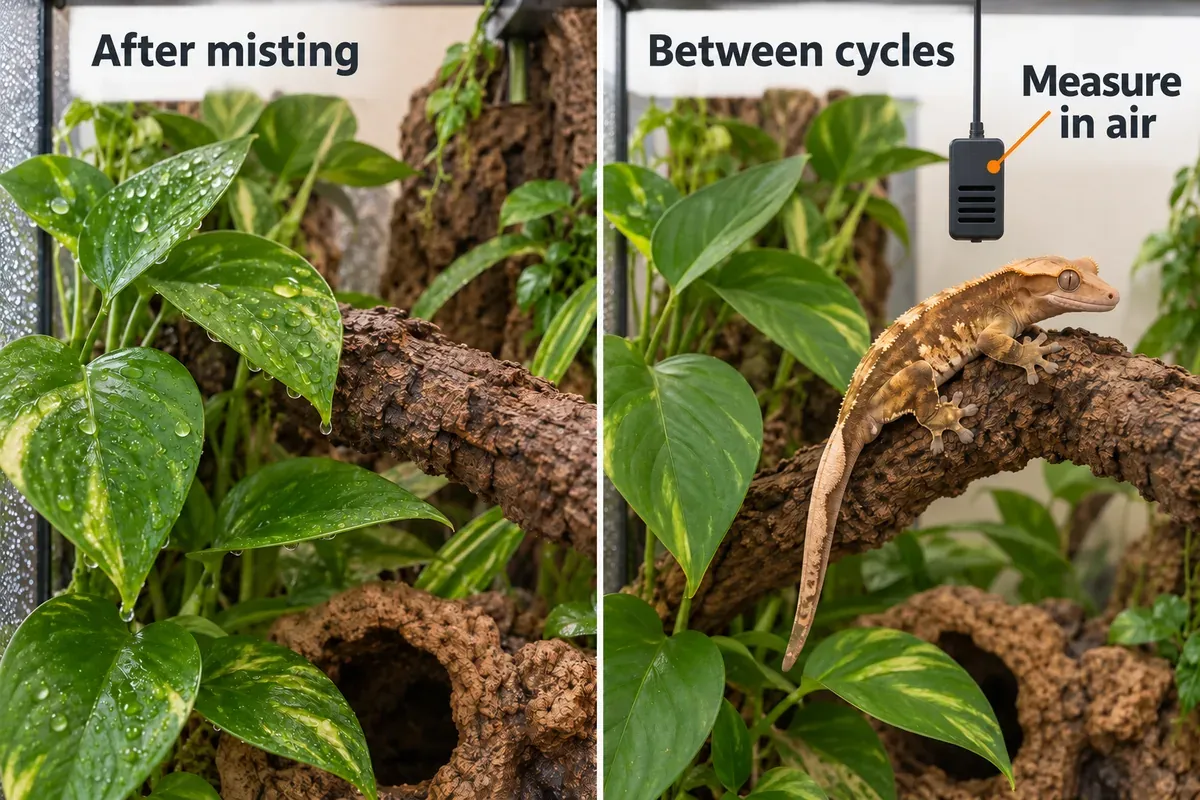
A hygrometer is more useful when it measures the animal’s activity zone rather than the wettest corner of the floor. Place the sensor or probe roughly in the middle-to-upper portion of the enclosure, near a perch but away from the nozzle and direct water droplets. If you use two sensors, place the second lower down or on the cooler side to reveal how much the enclosure varies from top to bottom.
Do not bury a probe in damp substrate or tape it directly beneath the spray path. That measures a wet surface, not the air your gecko breathes. Keep cables routed through the enclosure’s cable ports and check that suction cups or mounts cannot fall into the water dish.
Product picks for a measurable setup
-
PAIZOO Real-time Display LED Digital Reptile Thermometer and Humidity Gauge
PAIZOO
Product selected for the stated use case; confirm fit with the manufacturer's specifications.
- Large real-time temperature and humidity display
- 55.2-inch remote probe cable for flexible placement
- USB powered with simple button controls
- Best for
- A simple always-on display with a long remote cable
- Key feature
- Long wired probe for enclosure monitoring
-
Govee Smart Bluetooth Thermometer Hygrometer H5074
Govee
Product selected for the stated use case; confirm fit with the manufacturer's specifications.
- Historical readings, alerts, and export in the phone app
- Bluetooth range is described as up to 262 feet in open conditions
- Useful for spotting overnight humidity trends rather than only reading one moment
- Best for
- Trend tracking, phone alerts, and a second humidity check
- Key feature
- App alerts and historical data
-
Exo Terra Monsoon Solo II Programmable Misting System
Exo Terra
A programmable pressure misting system with a 1.5-liter reservoir, one included nozzle, and adjustable spray duration for repeatable enclosure misting.
- Programmable interval and spray-duration controls
- 1.5-liter reservoir for fewer refills
- Fine mist nozzle can be expanded from one to two nozzles
- Best for
- Consistent scheduled misting when hand-spraying is difficult
- Key feature
- Programmable misting timer
-
Fluker's Loose Coconut Fiber Bedding for Reptiles and Arachnids
Fluker's
Loose coconut-fiber bedding that can help retain moisture in a planted adult crested gecko enclosure when paired with good ventilation and clean-up routines.
- Loose, moisture-retentive coconut fiber
- Works as part of a naturalistic adult enclosure setup
- Can support humidity stability without keeping every surface wet
- Best for
- Adult naturalistic enclosures that need a moisture-retentive substrate
- Key feature
- Helps stabilize humidity between mistings
Review the linked product page before purchasing.
1. PAIZOO Digital Reptile Thermometer and Humidity Gauge – Best Dedicated Readout
Check current price on Amazon →Best For: Keepers who want an always-on display with a long remote cable
Why We Recommend It
The PAIZOO is a practical primary display for a single terrarium: the screen stays on, the sensor uses a long 55.2-inch cable, and the product documentation states ±1°F temperature accuracy. That makes it easier to position the probe near a useful perch while keeping the display visible outside the wettest part of the enclosure.
The important limitation is also the reason to be careful: the key specifications do not publish a humidity-accuracy figure. Use it to follow trends and confirm your cycle, but do not treat any consumer hygrometer as laboratory equipment.
Key Features
- Always-on LED display: Temperature and humidity are visible without opening an app.
- 55.2-inch cable: Gives you flexibility to place the probe in the animal’s activity zone and route the display safely.
- USB power: No small button-cell battery to replace, but you must plan cable routing outside the enclosure.
Pros & Cons
Pros:
- Clear, continuously visible readings
- Long cable helps avoid placing the display in the spray path
- Reptile-oriented product design
Cons:
- Requires USB power near the enclosure
- No app history or remote alerts
- Product documentation does not give a clear RH-accuracy specification
- The probe still needs protection from direct spray and standing water
Best for: A simple, visible primary gauge for a glass or PVC vivarium Skip if: You need remote alerts, data graphs, or battery-only operation
2. Govee Smart Bluetooth Thermometer Hygrometer H5074 – Best for Trend Tracking
Check current price on Amazon →Best For: Keepers who want humidity history and phone alerts
Why We Recommend It
The Govee is useful when the problem is not “what is the humidity right now?” but “what happened while I was asleep or at work?” Its Bluetooth app records temperature and humidity trends, can export historical data, and supports threshold alerts while your phone is within the product’s stated range.
It is not a reptile-specific probe and it is not a permission slip to put electronics under a direct spray nozzle. Keep the sensor dry, protect it from droplets, and use it as a data logger or second opinion alongside a terrarium gauge.
Key Features
- Swiss-made sensor: the product documentation states temperature accuracy of ±0.54°F and humidity accuracy of ±3% RH.
- Bluetooth monitoring: The advertised range is up to 262 feet in open conditions; walls reduce it.
- Data history and export: Product documentation describes recent onboard storage plus longer-term app history and export.
- App alerts: Set high and low thresholds so a failing misting routine is easier to notice.
Pros & Cons
Pros:
- Helps reveal whether the enclosure dries too quickly overnight
- Useful for comparing seasonal room changes
- Compact enough to place near, but not under, the enclosure’s wet zone
Cons:
- Bluetooth is not the same as Wi-Fi; it is not a true away-from-home monitor
- No remote probe for a deep or tall enclosure
- Not waterproof and not designed for direct misting
- A room sensor alone cannot show conditions at the gecko’s preferred perch
Best for: Data-minded keepers, second-sensor checks, and troubleshooting inconsistent humidity Skip if: You want a single reptile-specific display with no app or phone involved
3. Exo Terra Monsoon Solo II – Best for Consistent Automation
Check current price on Amazon →Best For: Keepers who cannot reliably hand-mist every evening Reservoir: 0.40 gallon / 1.5 liters
Why We Recommend It
The Monsoon Solo II is a programmable pump-and-nozzle system rather than a room humidifier. Exo Terra’s manual describes a 1.5-liter reservoir, one included nozzle with expansion to two, and programmable sprays from 2 seconds to 2 minutes. That is useful when a normal routine works but your schedule makes it hard to repeat consistently.
Set it up only after you understand how fast your enclosure dries. The timer does not measure humidity and make decisions for you. A schedule that is safe for a heavily planted, well-ventilated vivarium can over-wet a small glass tank.
Key Features
- Programmable intervals: Schedule repeated sprays through a 24-hour cycle.
- Fine mist nozzle: Delivers droplets to leaves and glass when correctly aimed.
- 1.5-liter reservoir: Gives several days of capacity in many small setups, depending on spray duration.
- Expandable nozzle setup: The unit includes one nozzle and can support a second, although added nozzles reduce performance per outlet.
Pros & Cons
Pros:
- Clear product documentation for a commonly available option
- Removes the daily “did I mist?” problem
- Flexible spray duration and timing
- More targeted for terrariums than a household humidifier
Cons:
- Timer-based, not humidity-sensor-based
- Easy to overwater a small enclosure if you copy someone else’s schedule
- Reservoir and tubing need regular cleaning
- Still requires a separate hygrometer and a safe overflow plan
Best for: Busy owners, travel planning, or enclosures that need a repeatable evening mist Skip if: You have not yet measured the enclosure or you expect the machine to regulate humidity automatically
4. Fluker’s Loose Coconut Fiber Bedding – Best for Moisture Retention
Check current price on Amazon →Best For: Adult, naturalistic setups that need a moisture-retentive floor layer Volume: 5 quarts
Why We Recommend It
Loose coconut fiber can help a mature, naturalistic enclosure hold a steadier humidity level between mistings. It is especially useful when paired with leaf litter and a drainage layer, because the substrate can retain some moisture without requiring the glass to be sprayed constantly.
This is not the right default for every gecko. Paper towel is easier to inspect and clean for hatchlings, new arrivals, quarantine, or any gecko being monitored for illness. If you use loose substrate, keep it clean, prevent it from becoming waterlogged, and confirm that the enclosure can still dry out.
Key Features
- Loose coconut fiber: Ready to spread rather than requiring a compressed brick to be expanded.
- 5-quart bag: A manageable amount for a small-to-medium terrarium or for topping up a layer.
- Moisture retention: Helps slow the daytime humidity drop when the enclosure has appropriate ventilation.
- Naturalistic appearance: Works with leaf litter, cork, and live plants in an adult vivarium.
Pros & Cons
Pros:
- Helps stabilize humidity without constant spraying
- Fits naturalistic and bioactive-style layouts
Cons:
- Not the easiest substrate for quarantine or health observation
- Must not stay saturated or develop standing water
- Loose substrate is a poor choice for many hatchling setups
- Substrate alone cannot fix a drafty enclosure or poor misting routine
Best for: Adult naturalistic setups with a drainage layer and regular spot cleaning Skip if: You are quarantining, raising a hatchling, or need the simplest possible cleaning routine
Build the Setup in Six Steps
1. Make the enclosure hold humidity without trapping stale air
Check the door seal, ventilation strips, and screen area. If the enclosure drops from 80% to 35% within minutes, the room may be too dry, the screen area may be too open, or the foliage may be too sparse. Add safe cover and adjust ventilation thoughtfully, but do not block all airflow.
If humidity stays above 80% until the next day, the solution is usually less water, better cross-ventilation, or a less saturated substrate—not a stronger fogger.
2. Create a clean, measurable floor
For a simple setup, use paper towel while you learn the enclosure and monitor the gecko. For an adult naturalistic setup, use a moisture-retentive tropical substrate over a drainage layer, add leaf litter, and keep the surface free of waste. Any drainage layer must be separated from the substrate so the gecko cannot access loose drainage media.
Never allow the bottom of the enclosure to become a bowl of stagnant water. If the drainage layer fills, remove the cause and correct it before adding more mist.
3. Aim the spray at surfaces, not at the animal
Spray the glass, foliage, and décor so your gecko can lick droplets from them. Do not blast the gecko directly with a nozzle, and do not turn the enclosure into a puddle. A short, thorough evening mist is usually more useful than a constant fine fog.
4. Start with one evening mist and observe the result
Use the hygrometer to record the reading before misting, 15–30 minutes afterward, the next morning, and again late in the day. Repeat this for several days. That simple log tells you more than copying a “10-second mist” schedule from a different tank.
If the tank dries too fast, make one small change at a time: add foliage, review the screen area, improve substrate moisture retention, or lengthen the evening spray slightly. If it stays wet, reverse those changes and improve ventilation.
5. Add automation only after you have a baseline
An automatic mister is a convenience and a consistency tool. It should not be the first purchase when you have no idea how much water the enclosure needs. Begin with the shortest useful spray, watch the full 24-hour cycle, and keep a manual backup plan for power cuts, clogged tubing, or an empty reservoir.
6. Keep water and equipment clean
Replace drinking water daily and remove visible waste promptly. Clean the mister reservoir, tubing, and nozzle on a schedule appropriate to your water quality and use. Mineral deposits can change spray patterns, and dirty standing water can contaminate the enclosure.
A Practical Daily Routine
Evening: Check the hygrometer, mist the walls and foliage until droplets form, and confirm that water is not pooling on the floor. The gecko should have access to clean drinking water as well.
Overnight: Let the gecko use the humid period. Observe whether it drinks from droplets and whether the enclosure remains ventilated rather than foggy and stagnant.
Morning: Check the reading and wipe away excessive standing water. A high reading after misting is expected; a high reading that never falls is not.
Daytime: Allow a dry-down. If the humidity is briefly near 50% and the gecko is behaving normally, that is often preferable to keeping the enclosure saturated.
Weekly: Inspect the probe, clean mineral residue from glass and nozzles, check cable routing, and replace contaminated substrate. In a naturalistic setup, look under leaves and hides rather than only at the visible front panel.
The two views below show why the leaves and the sensor position matter alongside the humidity reading.
Troubleshooting Common Humidity Problems
The enclosure drops below 40% too quickly
- Confirm the hygrometer is not sitting in a hot, dry airflow or directly under a vent.
- Add more upper-level foliage, cork, and textured surfaces that hold droplets.
- Check whether a large screen area or loose door seal is exhausting humidity.
- Use a moisture-retentive substrate only if it is appropriate for the gecko’s age and health status.
- Increase mist duration gradually and record the result instead of adding several sprays at once.
The enclosure stays above 80% all day
- Reduce spray duration or remove an unnecessary morning mist.
- Increase safe cross-ventilation and remove saturated substrate.
- Check the bottom for pooled water and the décor for areas that never dry.
- Move the sensor away from direct droplets, then compare it with a second gauge.
- Do not hide the problem with a fogger or a sealed lid.
The gauge seems to be wrong
First check the battery or USB power, then make sure the sensor is dry and not touching wet substrate. Compare it with a second digital hygrometer placed beside it for several hours. A salt-test calibration can reveal a badly drifting sensor, but it does not repair a faulty probe. Replace a gauge that repeatedly reads 99% in a visibly dry enclosure.
There is mold or a sour smell
Remove contaminated substrate and porous décor that cannot be cleaned, then wash and dry the enclosure. Reduce standing water and review the misting schedule. Mold is usually a moisture-management and cleaning warning, not a signal to spray more. If the gecko is lethargic, breathing abnormally, losing weight, or showing persistent skin or eye problems, contact an exotic-animal veterinarian.
What Not to Buy First
A fogger as your only humidity solution
Foggers can make air look humid, but they do not reliably create the broad drinking droplets that crested geckos use on leaves and glass. They can also keep the enclosure damp for too long if poorly cleaned or run continuously. Start with controlled spraying and a hygrometer.
An analog dial gauge as your only measurement
Cheap analog gauges can be useful as a rough visual backup, but a digital sensor is easier to read and compare. The most important upgrade is not a fancy app; it is a sensor placed correctly and checked against the actual daily cycle.
A large automatic system before a baseline
Automation solves missed routines, not unknown enclosure behavior. If you automate first, you can create a wet enclosure faster than you can diagnose it. Measure manually for several days, then automate the smallest routine that reliably works.
Frequently Asked Questions
Should crested gecko humidity stay at 80% all the time?
No. A short high-humidity period after misting followed by a dry-down is generally more useful than a permanently wet enclosure. The exact low point depends on your enclosure and room, but many care guides allow a drop toward roughly 40–60% before the next mist.
How often should I mist a crested gecko enclosure?
Many adult setups start with one evening mist per day, with a second shorter mist only if the enclosure dries too quickly or the gecko needs additional drinking opportunities. Use the hygrometer and the drying pattern of your tank rather than following a fixed number of sprays.
Do I need an automatic mister?
No. A good hand sprayer, a correctly placed digital hygrometer, and a consistent routine are enough for many keepers. An automatic system becomes valuable when your schedule is inconsistent, you maintain several enclosures, or you need reliable timing while traveling—with someone still checking the animal and equipment.
Is coconut fiber safe for every crested gecko?
No substrate is the best choice for every situation. Paper towel is simpler for hatchlings, quarantine, and health monitoring. Loose coconut fiber can suit an adult naturalistic setup when it is kept clean, not waterlogged, and paired with appropriate ventilation and drainage. Ask a reptile veterinarian about substrate if your gecko has a history of ingestion or digestive problems.
Where should the hygrometer go?
Place the probe in the middle-to-upper activity zone, near a perch but away from direct spray and wet substrate. In a tall enclosure, a second sensor lower down can show whether the floor remains much wetter than the air near the gecko’s favorite perch.
What if humidity briefly falls to 40%?
A brief dry period is not automatically an emergency if the gecko is eating, active at its normal times, shedding normally, and has access to clean water. If the reading remains low for long periods, the enclosure dries immediately after every mist, or you notice signs of dehydration or illness, correct the setup and contact an exotic veterinarian.
Care References
The husbandry ranges in this guide are cross-checked against the following care resources:
- Zoo Med: Crested Gecko care and humidity guidance
- Pangea Reptile: Crested Gecko Care
- ReptiFiles: Crested Gecko temperatures and humidity
- PetMD: Crested Gecko Care Sheet
- RSPCA: Crested Gecko Care Sheet (PDF)
These are general husbandry guidelines, not a diagnosis. A reptile veterinarian should evaluate a gecko with persistent dehydration, breathing changes, weight loss, abnormal shedding, or other signs of illness.
The Bottom Line
A good crested gecko humidity setup is calm and repeatable: measure the air, mist the surfaces, let the enclosure dry, and adjust one variable at a time. Start with a digital hygrometer and a reliable hand-spraying routine. Add moisture-retentive substrate only when it fits the gecko’s life stage and cleaning needs, then add an automatic mister if consistency—not a lack of water—is the problem.
The goal is not to keep the gauge at the highest possible number. The goal is a clean, ventilated enclosure that gives your gecko drinkable droplets at night and a genuinely breathable dry period during the day.