

 Published sources
 Product details checked
A reptile heat mat can make a warm hide possible in a glass terrarium, but it is not a complete heating system by itself. The safe setup depends on the species, the enclosure material, the warm-zone size, a correctly placed thermostat probe, and independent temperature checks. The same mat that helps a leopard gecko settle into a warm hide can be the wrong primary heat source for a bearded dragon or an arboreal tropical species.
Quick answer: Choose a heat mat only when your species-specific care plan calls for one, place it under one end of the enclosure rather than across the whole floor, and control it with a thermostat every time. Use a separate digital thermometer at the animal’s level to verify the warm hide and another reading for the cool side. A mat should support a thermal gradient, not eliminate it.
This guide focuses on practical setup decisions for common glass terrariums and compatible product options.
In this guide, you’ll learn:
- What heat mats can and cannot do for a reptile enclosure
- Which species commonly benefit from supplemental belly heat and which usually need overhead basking heat
- How to match mat size to the warm zone instead of blindly matching gallons
- Why an adjustable power knob is not the same as a thermostat
- Where the thermostat probe belongs and how to test a setup before the animal moves in
- Which products are sensible starting points for different budgets and enclosure sizes
What a Reptile Heat Mat Actually Does
A heat mat, also called an under-tank heater or UTH, transfers heat through the enclosure floor or wall. In a suitable setup, it warms the surface of a hide so the reptile can choose a higher-temperature resting spot and then leave it whenever it needs to cool down.
That is different from a basking lamp. A lamp creates a visible overhead heat source and can warm a basking surface, nearby air, and parts of the enclosure from above. A heat mat is much better at creating a localized warm surface than at heating the whole air volume. It also provides no UVB, no visible daylight, and no guarantee that the cool side will remain cool.
The Merck Veterinary Manual’s reptile husbandry guidance recommends that heat sources be thermostat-controlled, screened from the animal, and placed to create a thermal gradient. Its reptile housing guidance also warns against covering too much of the floor with an under-tank heater. Those two points are the foundation of every setup in this article.
The Four Parts of a Safe Setup
- A species-appropriate target: Use a care guide or reptile veterinarian for the actual warm-hide, basking, and cool-side ranges.
- A warm zone: The heat source stays on one end, leaving the other end meaningfully cooler.
- A thermostat: The thermostat switches the heater off when the probe reaches the set point.
- Independent measurements: A second thermometer tells you what the animal actually experiences rather than what the controller assumes.
If one of these pieces is missing, the mat is not a controlled heating system. It is simply an electrical heat source.
A Safe Heat-Mat Layout at a Glance
| Enclosure area | What belongs there | What you are checking |
|---|---|---|
| Warm end | A snug warm hide, the thermostat probe at animal level, and the heat mat outside the glass | The hide reaches the species-appropriate target without becoming the only usable space |
| Middle zone | Open movement space, clutter, and a route between hides | The reptile can move away from the heat without crossing an exposed heater |
| Cool end | A separate cool hide and water dish when practical | The cool side stays below the warm target and is not accidentally heated |
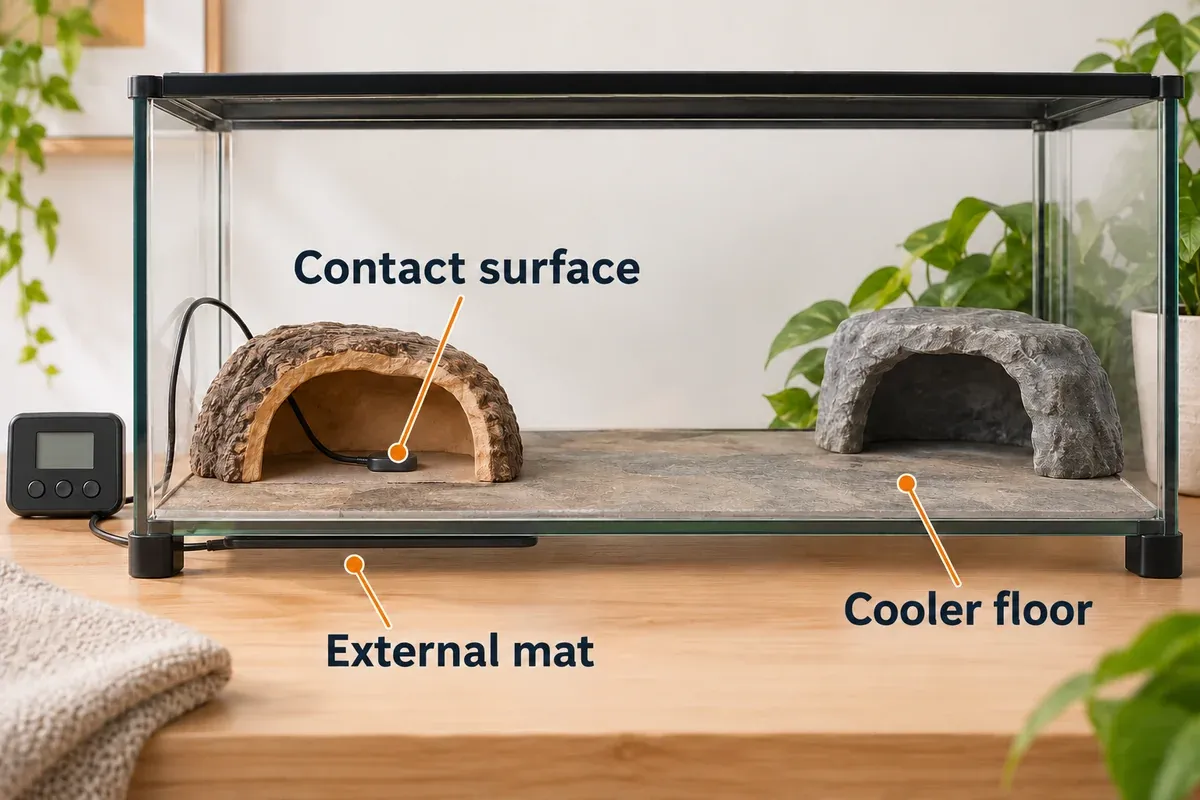
Think of the arrangement as cool end → open choice → warm hide → heat mat outside the enclosure. The animal should be able to choose a temperature, not be forced to sit on the warmest surface.
Which Reptiles Are Heat Mats For?
There is no universal “reptile temperature” and no universal heat source. Use the species column below as a starting point, not as permission to skip a species-specific care plan.
| Species or group | Where a mat may fit | What not to assume |
|---|---|---|
| Leopard gecko | Supplemental heat for a warm hide, especially when the enclosure needs a localized floor-level heat source | A mat is not a substitute for a complete lighting and temperature plan. ReptiFiles recommends measuring the warm hide at animal level and commonly cites about 90–92°F for that surface. |
| Ball python | Secondary heat for a warm hide when the enclosure needs help maintaining the belly-level zone | A mat should not be the only source of ambient heat. The ball python temperature guidance from ReptiFiles emphasizes a thermostat-controlled probe inside the hide rather than a probe reading the mat itself. |
| Bearded dragon and other diurnal baskers | Usually not the primary heater | These animals generally need an overhead basking zone and UVB. A mat cannot replace a measured basking surface, a thermal gradient, or the light plan. See our bearded dragon enclosure guide. |
| Tropical or arboreal species | Only if the species plan specifically calls for localized side or floor heat | A floor mat can dry a small area, fail to warm the upper enclosure, or create a hot spot where the animal cannot use it safely. |
For leopard geckos, the ReptiFiles temperature guide is useful for understanding warm-hide measurement and probe placement. For any species, adjust for enclosure size, ventilation, substrate, room temperature, age, and health. A number copied from a care sheet is not a measurement of your terrarium.
How to Choose the Right Heat-Mat Size
Start With the Warm Zone, Not the Gallon Label
Gallon ratings are rough product categories. Two enclosures with the same stated volume can have very different floor dimensions, ventilation, glass thickness, and room-temperature behavior. Measure the actual floor or side area where a warm hide will sit, then choose a mat that warms that zone while leaving a generous cool area.
As a safety starting point, the Merck Veterinary Manual recommends keeping an under-tank heater to no more than about 30% of the enclosure floor. That is not a substitute for temperature testing, but it is a useful guardrail against turning the entire floor into a heat source.
Zoo Med’s U.T.H. Size Guide
Zoo Med’s ReptiTherm U.T.H. product page lists these pairings for its RH line:
| --- | --- | --- | --- | | RH-4 | 6 x 8 inches | 8W | 10–20 gallons | | RH-5 | 8 x 12 inches | 16W | 30–40 gallons | | RH-6 | 8 x 18 inches | 24W | 50–60 gallons |
These pairings are helpful when comparing products, but they are not a universal sizing rule. A 50-gallon enclosure in a cold room may need a different heating strategy than the same enclosure in a warm room. If the mat must cover most of the floor to reach temperature, stop and reassess the enclosure, insulation, ventilation, and species plan instead of simply buying a larger mat.
Check the Enclosure Material
Only install a mat exactly as its manufacturer allows. The Zoo Med U.T.H. line reviewed here is designed for exterior mounting on glass, and bottom-mounted glass enclosures need space or feet underneath so heat is not trapped. Do not assume that a glass-tank product is safe under a wooden, PVC, foam, or plastic enclosure. Heat can be trapped, soften materials, damage adhesive, or distort a panel.
Linked Heat-Mat Options
The two bundled kits are convenient starting points, Zoo Med is the mat-only established-brand option, iPower is a lower-cost large mat that still needs real temperature control, and the separate VIVOSUN controller is useful when a mat does not include one.
Product options at a glance
-
VIVOSUN 8 x 12 Inch Reptile Heat Mat with Thermostat
VIVOSUN
An 8 x 12 inch reptile heat mat paired with a digital thermostat controller for a straightforward warm-hide setup.
- 8 x 12 inch mat size is aimed at smaller and medium terrariums
- Digital controller with an advertised 40-108°F range
- Manufacturer guidance pairs this size with roughly 30-40 gallon enclosures
- Best for
- A simple 30-40 gallon setup needing a bundled thermostat
- Key feature
- Bundled digital thermostat
-
BN-LINK 8 x 12 Inch Reptile Heat Mat with Digital Thermostat
BN-LINK
An 8 x 12 inch under-tank heat mat with a digital thermostat, grounded cord, and a longer warranty claim than many entry-level bundles.
- 8 x 12 inch format for a warm zone in small-to-medium glass enclosures
- Digital thermostat with a display and probe
- 6-foot grounded power cord intended for easier placement
- Best for
- Budget-conscious keepers who want mat and digital control together
- Key feature
- Digital display and probe
-
Zoo Med ReptiTherm U.T.H. RH-6 8 x 18 Inch Under Tank Heater
Zoo Med
An established 24W, 8 x 18 inch mat-only heater for keepers who prefer to choose their thermostat separately.
- 8 x 18 inch RH-6 format with 24W output
- Zoo Med sizes the RH-6 for approximately 50-60 gallon enclosures
- UL/cUL-described product line with solid-state nichrome heating element
- Best for
- A larger 50-60 gallon glass enclosure with a separate thermostat
- Key feature
- Established mat-only design
-
iPower 8 x 18 Inch Reptile Heat Pad, 24W with Adjustable Knob
iPower
A large 24W reptile heat pad with an adjustable power knob, best treated as a mat-only component rather than a temperature safety system.
- 8 x 18 inch footprint for a larger warm zone
- 24W heating element with an adjustable power knob
- Best for
- A lower-cost 8 x 18 inch mat used with an independent thermostat
- Key feature
- Low-cost 24W large mat
-
VIVOSUN Digital Heat Mat Thermostat Controller, 40-108°F, 1000W
VIVOSUN
A separate digital controller for heat mats, useful when the mat you choose does not include a thermostat.
- Advertised 40-108°F control range
- 1000W maximum load intended for the controller
- Separate probe lets the set point be controlled near the warm hide
- Best for
- Adding basic on/off temperature control to a mat-only setup
- Key feature
- Add-on thermostat controller
Review the linked product page before purchasing.
1. VIVOSUN 8 x 12 Inch Heat Mat With Thermostat
Best for: A 30–40 gallon glass setup where you want a mat and basic digital control in one purchase
Check current price on Amazon →Why It Made the Guide
The VIVOSUN 8 x 12 inch combo is the easiest starting point in this group when the enclosure needs a localized warm hide and you do not already own a thermostat. The size is manageable for a small-to-medium glass terrarium, and the included controller removes one common beginner mistake: plugging a heat mat directly into a wall outlet.
The controller is not the reason to stop measuring temperatures. A controller can be set correctly while its probe is taped to the wrong location, buried under substrate, or moved by the reptile. Treat the included thermostat as a control layer, then confirm the warm hide with an independent digital thermometer.
Key Features
- 8 x 12 inch mat for a defined warm-side footprint
- Advertised thermostat range of 40–108°F
- Manufacturer guidance places this size around 30–40 gallon enclosures
- One purchase includes the mat and digital controller
Pros and Cons
Pros:
- A practical all-in-one starting point
- Reasonable size for many small and medium glass setups
- More affordable than buying a mat, controller, and separate accessories individually
Cons:
- A bundled thermostat still needs independent verification
- The 8 x 12 footprint will not fit every enclosure’s warm-zone geometry
- Match the mat dimensions and wattage to the enclosure and thermostat instructions
Bottom Line
Choose this bundle when convenience matters and the species genuinely benefits from a localized warm hide. It is a useful starter component, not a complete lighting, humidity, or monitoring plan.
2. BN-LINK 8 x 12 Inch Heat Mat With Digital Thermostat
Best for: Budget-conscious keepers who want a similar all-in-one setup with a long cord
Check current price on Amazon →Why It Made the Guide
BN-LINK is the value-oriented alternative to the VIVOSUN combo. The bundle also includes a 15-month warranty claim that should be checked in the manufacturer documentation.
The main decision is not whether the display looks precise. It is whether the probe is secured at the temperature the reptile actually experiences.
Key Features
- 8 x 12 inch warm-zone mat
- Digital display and probe-based control
- 6-foot grounded power cord for the model described
Pros and Cons
Pros:
- Lowest estimated price among the two complete starter bundles here
- Digital control is included rather than an afterthought
- Long cord offers more placement flexibility
Cons:
- The display is not a substitute for a second thermometer
- Probe placement can create a meaningful difference between the set point and the animal-level temperature
Bottom Line
This is the sensible budget bundle if the 8 x 12 footprint fits the warm end and you are willing to test the result for a full day before adding the reptile. Buy a separate digital thermometer if you do not already have one.
3. Zoo Med ReptiTherm U.T.H. RH-6, 8 x 18 Inches
Best for: A larger glass terrarium where you want to choose the thermostat separately
Check current price on Amazon →Why It Made the Guide
The RH-6 is the established mat-only choice in this lineup. Its 8 x 18 inch, 24W format is designed for approximately 50–60 gallon enclosures, and the separate-thermostat approach is useful for experienced keepers who want to choose their controller rather than accept whichever controller is bundled with a mat.
Zoo Med identifies the ReptiTherm line as an exterior heater for glass enclosures. That makes installation details important: a bottom-mounted tank needs an air gap or feet, the mat must not be placed inside with the reptile, and the warm-zone footprint must still leave a cool retreat. The manufacturer’s instructions and size chart should take priority over a generic setup diagram.
Key Features
- 8 x 18 inch RH-6 format
- 24W described output
- Approximate 50–60 gallon enclosure pairing from Zoo Med
- Exterior glass mounting and a mat-only design
Pros and Cons
Pros:
- Established reptile-heating product line
- Clear size family makes replacement and comparison straightforward
- Mat-only format lets you select a thermostat and monitoring setup intentionally
Cons:
- Thermostat, thermometer, and mounting hardware are separate
- Too large for a small enclosure or a species that needs only a compact warm hide
Bottom Line
Pick the RH-6 when the enclosure really needs an 8 x 18 warm zone and you already plan to use a proper thermostat. Do not choose it simply because the tank is labeled 50 gallons; measure the floor and verify the gradient.
4. iPower 8 x 18 Inch, 24W Heat Pad With Adjustable Knob
Best for: A lower-cost large mat used with a separate thermostat
Check current price on Amazon →Why It Made the Guide
The iPower option is attractive when you need a large 8 x 18 inch footprint without spending much on the mat itself.
The important distinction is in the word knob. A power knob reduces or increases output; it does not measure the warm hide and shut the heater off when the target is reached. Room temperature, substrate, ventilation, and the animal’s hide can all change the result. Use an independent thermostat with this mat, even if the knob appears to offer temperature control.
Key Features
- 8 x 18 inch footprint
- 24W heating element for a larger warm zone
Pros and Cons
Pros:
- Inexpensive way to add a large mat to an existing controlled setup
- Useful size for a larger glass enclosure when the warm zone has been measured
Cons:
- The knob is not a thermostat
- Included control hardware can differ by model option
- Buying it without a separate thermostat creates an avoidable overheating risk
Bottom Line
This is a component purchase, not a complete heating solution. It makes sense only when you already own—or are buying—a compatible thermostat, two thermometers, and an enclosure where 8 x 18 inches will not remove the cool side.
5. VIVOSUN Digital Heat-Mat Thermostat Controller
Best for: Adding basic on/off control to a mat-only setup
Check current price on Amazon →Why It Made the Guide
If you already have a suitable mat—such as the Zoo Med RH-6 or iPower 8 x 18—the separate VIVOSUN controller can provide a straightforward control layer without buying another bundled mat. The advertised 40–108°F range covers the warm-hide temperatures commonly used in many beginner setups, but the controller still depends entirely on correct probe placement and a correctly sized heater.
This is basic on/off control. It is not a proportional or dimming thermostat, and it cannot fix a mat that is too large, an enclosure that holds too much heat, or a probe that the reptile can move. Pair it with an independent thermometer and inspect the setup regularly.
Key Features
- Advertised 40–108°F control range
- 1000W maximum load described
- Separate probe for measuring the controlled zone
- Useful as an add-on for mat-only products
Pros and Cons
Pros:
-
Low-cost way to add control to an existing mat
-
Compact and simple for a basic on/off setup
Cons:
- Not proportional or dimming control
- Does not replace a second thermometer or an IR surface check
- Cannot compensate for a poor warm-to-cool gradient
Bottom Line
Use this controller when you want simple on/off protection and the electrical load is compatible. If your species needs especially precise or complex heat management, ask an exotics veterinarian or experienced reptile specialist whether a more advanced thermostat is appropriate.
What to Buy as a Safe Heat-Mat Bundle
The mat is only one part of the setup. A useful shopping list looks like this:
For a Small Warm-Hide Setup
- A 6 x 8 or 8 x 12 inch mat that fits one end of the enclosure
- A thermostat with a secured probe
- Two digital thermometers, or one dual-probe unit
- A warm hide and a separate cool hide
- Substrate and enclosure materials approved for the heat source
This pattern is commonly considered for leopard geckos and similar ground-dwelling species, but the species plan still comes first. If you are building a complete habitat, pair heating research with our UVB lighting guide rather than treating a heat mat as the whole lighting system.
For a 30–40 Gallon Glass Terrarium
An 8 x 12 inch mat is a reasonable starting size when the floor dimensions allow it. A complete VIVOSUN or BN-LINK bundle can reduce the number of separate purchases, while the Zoo Med size guide shows why the footprint should remain limited to the warm end. Test the empty enclosure for at least 24 hours.
For a Larger 50–60 Gallon Glass Terrarium
An 8 x 18 inch mat may fit a larger warm zone, but the increased surface area also increases the consequences of a bad probe location or poor airflow underneath the tank. A mat-only product such as the Zoo Med RH-6 or iPower can work as part of a carefully measured system; the thermostat and independent thermometers are not optional accessories.
How to Install a Reptile Heat Mat Safely
- Read the model-specific instructions first. Confirm enclosure material, mounting surface, permitted orientation, and whether the product is designed for bottom or side mounting.
- Mount the mat outside the enclosure. A reptile should never be able to touch the heating element, adhesive, cord, or controller probe directly.
- Use only the warm end. Keep the mat to a limited portion of the floor and leave an unheated cool side with a usable hide.
- Create an air gap under bottom-mounted glass. Use the manufacturer’s feet or a stable stand so heat is not trapped between the mat and the furniture. Never cover the mat with insulating material unless the manufacturer explicitly allows it.
- Place the thermostat probe where the animal rests. For a warm hide, that usually means secured inside the hide at the reptile’s body level, not taped directly to the mat. Follow the thermostat instructions and species-specific care plan.
- Prevent probe movement. Use a method that the animal cannot dislodge or chew. A controller cannot regulate a temperature it is no longer measuring.
- Keep water and spill risk away from the heater. A water dish is usually safer on the cool side or in a location approved by the enclosure plan; do not position it directly over the heated area.
- Test the empty enclosure for at least 24 hours. Check the warm hide, middle zone, and cool side at different times of day. Room temperature often changes the result.
- Recheck after adding substrate and décor. A deeper substrate layer, a tighter hide, or a new background can change how heat is retained.
- Inspect the system regularly. Replace a mat, cord, adhesive, or controller that shows peeling, discoloration, cracking, hot spots, or damage.
In the example below, the heater stays outside the glass and only one end is warmed. Check the usable floor temperatures independently.
Thermostat vs. Rheostat: Why the Difference Matters
A thermostat measures temperature and switches the heater off—or back on—around a set point. A rheostat or adjustable power knob only changes how much power the heater receives. It does not know whether the enclosure is 70°F or 90°F.
That difference is why the iPower knob should be treated as a manual output control, not as a safety device. A room can become warmer, ventilation can change, or a hide can trap heat while the knob stays in the same position. A thermostat responds to the measured temperature; a rheostat does not.
For a simple heat-mat setup, use a compatible thermostat with a probe and verify the result using a separate thermometer. For more complex setups with multiple heat sources, ask an experienced reptile veterinarian or specialist about the appropriate control type instead of plugging several heaters into a basic controller without checking the load.
How to Check Temperatures Correctly
- Measure at animal level: A probe on the glass or directly on the mat does not tell you the temperature inside the hide.
- Measure both ends: The warm hide and cool side are both part of the reptile’s usable climate.
- Use an IR thermometer for surfaces: An IR gun is useful for checking a basking surface or hide floor, but it does not replace a probe thermometer for air temperature.
- Check after the enclosure stabilizes: Take readings after the lights or heater have been running long enough for the enclosure to reach a stable pattern.
- Record changes: Note room temperature, substrate depth, and readings after cleaning or rearranging décor.
If the reptile never leaves the warm hide, do not respond by automatically increasing the heat. First verify that the cool side is usable, the warm hide is not too cool, and the animal is not showing signs of illness. Persistent lethargy, appetite changes, abnormal posture, or repeated avoidance should be discussed with an exotics veterinarian.
Common Heat-Mat Mistakes to Avoid
- Plugging a mat directly into the wall: This removes automatic temperature control.
- Covering the whole floor: The reptile needs a choice between warm and cool conditions.
- Using a power knob as a thermostat: Manual output control cannot react to a changing room.
- Putting the probe on the mat: This can produce a misleading reading that does not match the warm hide.
- Putting the mat inside the enclosure: The animal must not be able to contact the heater or its adhesive.
- Using a glass-tank mat under an unapproved enclosure: Follow the exact model instructions for PVC, wood, foam, and plastic.
- Relying on one display: A controller can fail, drift, or measure the wrong location. Verify it independently.
- Replacing a basking setup with a mat: Bearded dragons and many other diurnal reptiles need overhead heat and UVB as part of their care plan.
- Ignoring the water dish: Spills and heat sources are a poor combination; plan the dish location deliberately.
- Skipping the empty-enclosure test: Temperature problems are easiest to fix before the reptile is inside.
Frequently Asked Questions
Does every reptile heat mat need a thermostat?
Yes. A heat mat should be controlled by a compatible thermostat, and the controlled temperature should be verified with an independent thermometer. The thermostat is not optional just because a mat has an adjustable knob or a digital display.
Can a heat mat replace a basking lamp?
Usually not. Some nocturnal or ground-dwelling reptiles may use a heat mat for a localized warm hide, but diurnal baskers such as bearded dragons typically need overhead basking heat and an appropriate UVB setup. A mat does not provide UVB or recreate the same above-to-below heat pattern.
How much of the enclosure should a heat mat cover?
Use the smallest footprint that can create the required warm zone while leaving a clear cool side. About 30% of the floor is a useful upper-bound starting point from veterinary housing guidance, not a guarantee that every enclosure should use exactly 30%.
Where should the thermostat probe go?
Place it at the hottest location the reptile can actually use—often inside the warm hide at animal level—and secure it so the animal cannot move it. Do not assume that the mat surface or the outside of the glass represents the temperature inside the hide. Always follow the controller’s instructions and verify the result with a second thermometer.
Can I use a heat mat under a PVC or wooden enclosure?
Only when the specific manufacturer approves that material and mounting method. A mat designed for exterior glass mounting may trap heat or damage another material. If the product instructions are unclear, choose a different heating method or ask the manufacturer before installing it.
What should I do if my reptile is burned?
Turn off the suspected heat source, move the animal to a safe temperature-controlled enclosure, and contact an exotics veterinarian promptly. Burns can be deeper than they first appear. The Merck Veterinary Manual’s reptile emergency guidance describes thermal burns as a veterinary problem rather than something to manage by simply turning the heater down.
Final Heat-Mat Checklist
Before putting the reptile into the enclosure, confirm:
- The species care plan actually calls for a heat mat or supplemental floor heat.
- The mat is outside the enclosure and mounted exactly as instructed.
- The warm zone is limited to one end and a cool side remains usable.
- A thermostat controls the mat.
- The probe is secured at animal level in the intended warm hide.
- Independent thermometers confirm both warm and cool readings.
- The empty enclosure has been tested for at least 24 hours.
- The water dish, substrate, décor, cords, and ventilation do not create a new heat or spill hazard.
Related Reptile-Care Guides
Final Takeaway
The best reptile heat-mat setup is not the mat with the biggest wattage or the most impressive knob. It is the smallest correctly mounted heater that creates a measurable warm hide, leaves the reptile a real cool retreat, and is controlled by a thermostat you have independently checked.
For a convenient starting bundle, compare the VIVOSUN and BN-LINK 8 x 12 inch kits. For a larger glass enclosure, the Zoo Med RH-6 or iPower 8 x 18 inch mat can make sense only with a separate thermostat and careful testing. If the species needs overhead basking heat or UVB, keep the heat mat in its proper supplemental role instead of asking it to do a job it cannot do.