

 Published sources
 Product details checked
Choosing a reptile thermostat is not mainly a brand decision. It is a heat-source decision. A heat mat, ceramic heat emitter (CHE), deep heat projector (DHP), and visible basking bulb do not respond to power control in the same way, so the wrong thermostat mode can create unnecessary temperature swings, visible flicker, premature bulb failure, or an unsafe setup.
Quick answer: Use on/off control as the simple starting point for a heat mat. Use pulse proportional control for a lightless ceramic heater when you want tighter regulation. Use dimming control for a DHP or a light-emitting basking lamp; a visible lamp should also be on a daytime schedule so it is not glowing at night. If one controller must cover several heat-source types, a true multi-mode thermostat can be useful, but only when its voltage, load rating, and mode instructions match the exact North American model.
This guide focuses on the decision that is easy to get wrong: matching the thermostat’s output to the heater’s electrical behavior. It is not a substitute for a species-specific care sheet or an exotic-animal veterinarian. The enclosure still needs a thermal gradient, an animal-safe guard, independent temperature checks, and a probe that cannot be moved or chewed.
In this guide, you’ll learn:
- What on/off, dimming, and pulse proportional thermostats actually do
- Which control mode fits a heat mat, CHE, DHP, or visible basking lamp
- Which options are sensible for a budget or multi-mode setup
- How to place the probe and test the gradient before the reptile moves in
- Which common thermostat shortcuts are unsafe or simply the wrong tool
The Heat-Source Decision Matrix
The matrix below is the practical starting point. “Preferred” means the control pattern usually gives the cleanest result for that heater; it does not remove the need to read the heater and thermostat instructions.
| Heat source | Preferred thermostat mode | Why it fits | Main caution |
|---|---|---|---|
| Heat mat | On/off; pulse can also work | A mat is a resistive, lightless heater. Full-power cycling is simple and normally does not disturb a day/night cycle. | Keep the warm footprint limited, use the exact mounting method the mat allows, and never treat an adjustable knob as a thermostat. |
| Ceramic heat emitter (CHE) | Pulse proportional; on/off is workable | A CHE emits no visible light, so rapid power pulses do not create a visible flicker. Pulse control can reduce the larger swings of a simple on/off controller. | Use a ceramic-rated fixture and guard. The controller must be rated for the heater’s load and compatible with the element. |
| Deep heat projector (DHP) | Dimming | Arcadia recommends dimming control for its DHP even though the lamp produces virtually no visible light. | Follow the exact controller’s probe-placement instructions and check the basking surface independently with an infrared thermometer. |
| Visible basking lamp | Dimming plus a day timer | A compatible dimming controller adjusts output without the repeated full-power cycling of an on/off thermostat. | Confirm that the bulb supports dimming and that the controller supports that bulb. Turn visible lighting off at night. |
The one-line rule
Start with dimming for a compatible visible basking bulb or DHP. For a heat mat or CHE, choose an approved on/off or proportional mode according to the heater and controller manuals.
That rule is more useful than choosing a thermostat because it has the highest wattage or the most buttons. A 1,000W on/off controller is still the wrong controller for a visible basking bulb, while a 300W dimming controller can be the right choice for one 75W halogen lamp or a 50W DHP.
What the Three Modes Actually Do
On/off thermostats: simple full-power cycling
An on/off thermostat supplies full power until its probe reaches the set point, then cuts power until the temperature drops far enough for heating to resume. This is the least complicated control method and usually the least expensive.
It is a sensible match for a heat mat because the mat is lightless and has thermal inertia: it does not instantly go from cold to hot every time the relay switches. It can also be acceptable for a CHE when the temperature swing is small enough for the species and enclosure. The trade-off is a wider rise-and-fall pattern than proportional control, especially in a highly ventilated enclosure or a room with large temperature changes.
On/off control is not the same as a timer or a manual dimmer. A timer knows the time, and a manual dimmer changes output without reading the enclosure. A thermostat must read temperature at the controlled point and react to it.
Dimming thermostats: continuously adjustable output
A dimming thermostat changes the electrical output sent to a compatible heater as the measured temperature approaches the set point. Instead of repeatedly driving a lamp at 100% and then cutting it, the thermostat can reduce the lamp’s output while preserving a steady light source.
This is the preferred starting point for a visible halogen or incandescent basking lamp. It is also the most useful default for a DHP, which is an overhead lamp-style heater even though it produces virtually no visible light. Arcadia specifically says its DHP should be used with a thermostat and that a dimming thermostat provides accurate control of the thermogradient.
Do not confuse a reptile dimming thermostat with a household wall dimmer. The reptile controller combines output control with temperature feedback, has a probe, and is rated for a specific load. A household dimmer has no idea whether the basking surface is overheating.
Pulse proportional thermostats: short power pulses for lightless heaters
A pulse proportional thermostat controls heat by sending short bursts of full power. The heater is not dimmed in the same way as a lamp; it receives pulses whose timing or duration changes as the temperature approaches the target.
Pulse control is a strong fit for a CHE and other compatible lightless resistive heaters. It can hold a steadier temperature than a wide on/off cycle without creating a visible change in the room. It can also be useful for a heat mat when the controller and mat are explicitly compatible, but it is not mandatory for every mat setup.
For a visible basking bulb, use a compatible dimming thermostat as the starting point. A pulse controller may produce visible changes in brightness, depending on its output and the bulb. Compatibility must be established for the exact pair; the word “pulse” alone does not tell you whether a controller supports a lamp.
The Exo Terra PT2461 North American manual specifically identifies dimming as the preferred setting for incandescent or infrared heat bulbs. Follow the operating instructions for your model and the lamp’s instructions when selecting a mode. A general description of proportional control does not establish compatibility with every basking bulb.
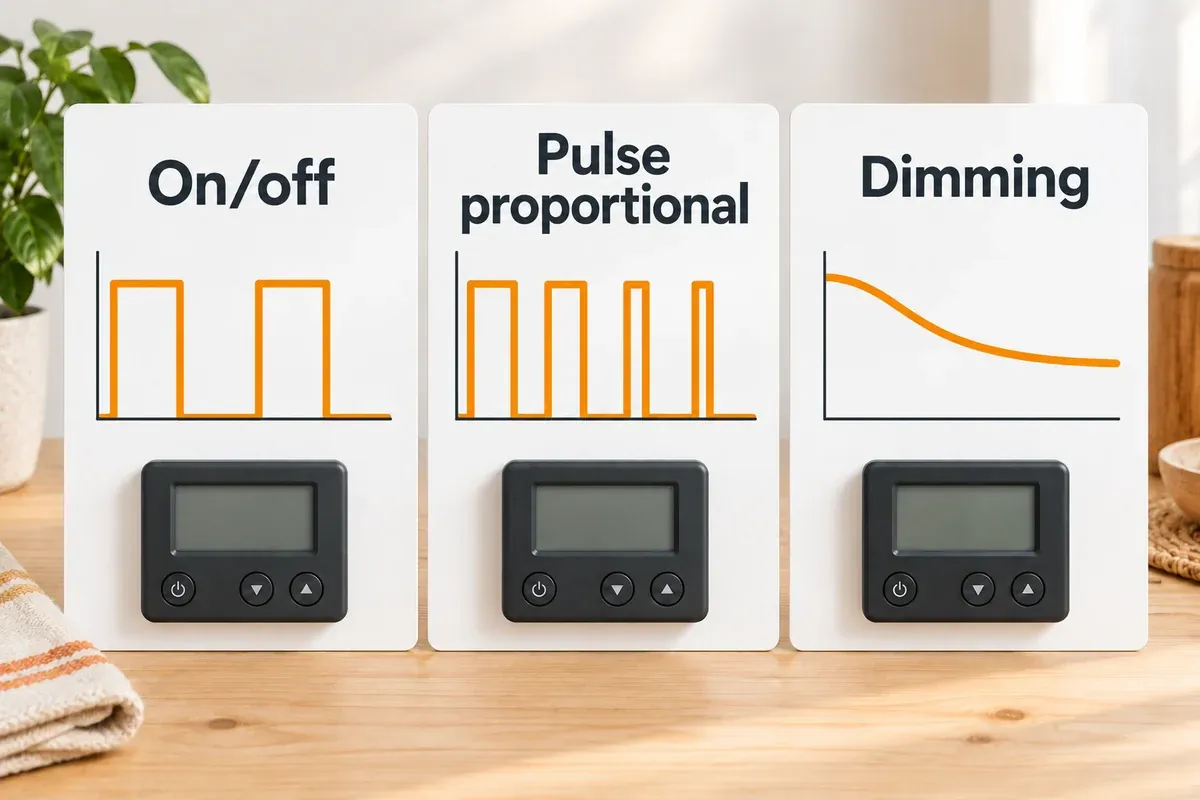
These simplified sketches compare how output changes. They do not show a temperature trace or tell you which mode an individual heater supports.
Thermostat options for common heat sources
The four options below cover the most useful buying paths rather than pretending one controller is ideal for every enclosure.
Thermostats matched to the job
-
BN-LINK Reptile Thermostat Temperature Controller, 1000W
BN-LINK
A compact digital heating controller with a 40-108°F range, 1000W described heating capacity, probe sensor, and ETL-described marketplace description.
- 40-108°F temperature range intended for heating applications
- Long probe and three-button programming keep the setup simple
- Control type
- Digital on/off thermostat
- Best for
- Budget heat-mat setups that need simple on/off control
-
Zoo Med ReptiTemp Digital Thermostat RT-600
Zoo Med
A digital on/off thermostat with a 50-122°F control range, six-foot remote sensor, memory after power loss, and a high/low temperature alarm.
- Controls up to 600W of heating devices according to Zoo Med
- Six-foot remote sensor cable and LCD display
- Built-in memory resumes settings after a power interruption
- Control type
- Digital on/off thermostat
- Best for
- An established-brand on/off thermostat for mats or ceramic emitters
-
REPTIZOO TC02 Dimming Thermostat
REPTIZOO
PID-style dimming thermostat with a digital display, memory function, and probe for controlling light-emitting reptile heat sources.
- Dimming output is better suited to overhead lamps than a simple on/off switch
- Digital display makes the set point easy to check
- Memory function helps preserve settings after a power interruption
- Control type
- Dimming / proportional control
- Best for
- Dimming control for an overhead halogen or deep-heat projector
-
Exo Terra PT2459 600W Dimming & Pulse Proportional Thermostat
Exo Terra
A 600W day/night thermostat with separate temperature settings, LCD readout, waterproof probe, and selectable dimming/pulse proportional control.
- Dimming and pulse proportional modes in one controller
- Separate daytime and nighttime temperature settings
- 600W described capacity for heat mats, ceramic heaters, and heat bulbs
- Control type
- Dimming + pulse proportional, day/night
- Best for
- A multi-mode controller for keepers who need both dimming and pulse settings
Review the linked product page before purchasing.
1. BN-LINK 1000W Reptile Thermostat — budget on/off control
Best for: A heat mat or other compatible lightless heater where you want inexpensive digital temperature control
Check current price on Amazon →Why it fits
The BN-LINK is the practical budget route when your main need is a probe-based on/off controller for a heat mat. Product documentation describes a 40–108°F range, 1,000W heating capacity, remote probe, three-button programming, and an ETL-described controller.
The large load number should not drive the purchase. Most reptile heat mats and small CHEs use a fraction of that capacity. The useful part is the simple temperature feedback, not the ability to plug in a large bank of heaters.
Pros:
-
Lowest-cost standalone controller in this comparison
-
Straightforward fit for a mat-only warm hide setup
-
Remote probe and visible heating indicator
Cons:
- On/off control creates wider swings than proportional control
- No dimming, pulse, or day/night light schedule
Bottom line: Choose it when a mat needs a basic thermostat and you are willing to validate the warm hide with a second thermometer. Do not use its high wattage rating as permission to run several unrelated heat sources from one outlet.
2. Zoo Med ReptiTemp RT-600 — established-brand on/off control
Best for: Keepers who want a reptile-specific on/off controller with an alarm and memory function
Check current price on Amazon →Why it fits
Zoo Med’s official product page describes the RT-600 as a digital thermostat that turns heating devices on and off, controls up to 600W of heating devices, and uses a six-foot remote sensor. It also includes a memory function for power interruptions and an alarm for extreme high or low temperatures. That makes it a more feature-complete on/off choice than a bare plug controller, especially for a heat mat or a ceramic emitter where a visible-light cycle is not a concern.
The RT-600 is still an on/off thermostat. It is not a dimming controller for a basking bulb and it is not a pulse proportional controller. If the lamp visibly brightens and goes dark whenever the relay changes state, you chose the wrong control pattern.
Pros:
- Reptile-specific product with a clear official instruction page
- 50–122°F temperature range and 600W heating capacity described by Zoo Med
- Memory after power loss plus high/low temperature alarm
Cons:
- No dimming or pulse mode
- No built-in day/night light timer
- Marketplace product options can expose models or power details inconsistently; confirm the exact North American RT-600 product information before checkout
Bottom line: This is the better on/off pick when you value the alarm and established reptile-brand support. It is still best matched to a mat or lightless heater, not to the normal control of a visible basking lamp.
3. REPTIZOO TC02 — affordable dimming for a DHP or basking lamp
Best for: One compatible DHP, halogen, or incandescent heat bulb up to the controller’s 300W limit
Check current price on Amazon →Why it fits
The TC02 is the most accessible dimming option in this group. Its product information identifies the model as a dimmable PID controller with a digital display, memory function, Fahrenheit/Celsius selection, and a 300W maximum load. For one 50W DHP or a single halogen basking lamp, that is typically enough capacity, provided the fixture and thermostat are compatible.
The product documentation also says not to use it with a sunlamp. Treat that warning seriously: a mercury-vapor or other UV-producing bulb is not interchangeable with an ordinary dimmable basking bulb just because both screw into an E26 socket. Check the lamp instructions before connecting it.
Pros:
- Dimming output suits a visible basking bulb and is a strong fit for a DHP
- Inexpensive compared with multi-mode controllers
- Digital display, memory function, and a broad described temperature range
Cons:
- 300W limit leaves little reason to use it for multiple heat sources
- No pulse mode
- Probe placement is especially important; the product documentation’s own instructions warn against placing it directly under the heat source
Bottom line: For one compatible DHP or basking lamp, the TC02 is the sensible value choice. Confirm the lamp type, stay below 300W, secure the probe, and use a separate infrared thermometer to verify the basking surface.
4. Exo Terra PT2459 600W — multi-mode dimming and pulse
Best for: Keepers who genuinely need selectable dimming and pulse proportional modes plus separate day/night temperatures
Check current price on Amazon →Why it fits
The PT2459 is the only option here that intentionally covers both proportional control styles. Exo Terra lists a 600W Dimming & Pulse Proportional Thermostat with separate daytime and nighttime temperatures, an LCD showing actual and set temperatures, a waterproof probe, a built-in light sensor, and support for heat mats, ceramic heaters, and heat bulbs. That is useful when a keeper wants one controller that can be configured differently after changing the heat source.
In the US, confirm that you are buying the North American PT2459/120V version. Follow its operating instructions; a 230V model requires the electrical supply specified for that model.
Pros:
- Dimming and pulse modes in one controller
- Separate day/night temperature settings
- 600W described capacity and waterproof probe
- Official North American PT2459 manual available from Exo Terra
Cons:
-
Much more expensive than a single-mode controller
-
Marketplace models and voltage checks are essential
Bottom line: Choose it when you need selectable proportional modes or separate day/night temperature settings for a compatible heater. Its single output controls one location; independent zones need separate control channels. For one heat mat, a simpler compatible controller may be sufficient.
Match Each Heat Source Correctly
Heat mats: keep the warm zone controlled, not the entire floor
A heat mat is a localized surface heater. Mount it only as the manufacturer allows, usually outside the glass, and keep it under one end or one defined warm area. The MSD Veterinary Manual advises that under-tank heaters cover no more than about 30% of the available enclosure space so the reptile can move away from the heat.
For most mat setups, an on/off thermostat is a reasonable baseline. Pulse proportional control can make the temperature steadier, but it is not a reason to cover more floor area or set a higher temperature. Follow both manuals for probe placement. A surface-control setup may specify the warm-hide surface inside the enclosure; do not copy that position to a controller that specifies a different control point. Independently check the warm hide and the hottest accessible floor surface.
Our reptile heat mat guide covers mat sizing, exterior mounting, warm hides, and the 30% floor-area guardrail in more detail.
Ceramic heat emitters: lightless heat with a proper ceramic fixture
A CHE produces infrared heat without visible light, so it can be used at night when the species needs supplemental heat. Zoo Med describes its ReptiCare Ceramic Heat Emitter as a 24-hour, lightless heat source and says a thermostat or rheostat can control it.
For a CHE, pulse proportional control is often the cleanest default because the controller can moderate a lightless resistive heater without making a room visibly flicker. On/off control remains workable when the enclosure’s temperature swing is acceptable and the heater is sized correctly. Dimming may be supported by a particular controller, but do not assume that a household dimmer or an unapproved output is safe.
Use a porcelain or ceramic-socket fixture rated for the emitter, a guard that prevents contact, and enough clearance from plastic, wood, decor, and bedding. Ceramic emitters become extremely hot even when they look inactive.
Deep heat projectors: use the dimming path
A DHP is a focused overhead heat source that emits virtually no visible light. Arcadia says its Deep Heat Projector should be used with a thermostat and that a dimming thermostat provides accurate control of the thermal gradient. It also recommends checking the temperature with a suitable non-contact infrared thermometer.
That makes the REPTIZOO TC02 a logical budget pairing for one compatible DHP and the Exo Terra PT2459 the more flexible multi-mode option. A DHP is not a heat mat just because it is lightless: its overhead beam and basking surface need to be measured from the animal’s usable position, and the lamp must be protected from contact.
Visible basking lamps: dimming plus a daytime schedule
A compatible visible halogen or incandescent basking lamp should normally use dimming control. The thermostat reduces output as its probe approaches the set point. The probe may measure a surface or suspended air, depending on the controller, so verify the actual basking surface separately.
Temperature control does not replace the lamp’s day/night schedule. Use a timer or a controller function that explicitly switches the light off after the photoperiod. Separate day/night temperature settings alone do not guarantee darkness. Exo Terra’s PT2461 manual instructs keepers to switch visible bulbs off at night, manually or with a timer.
For a species that needs heat after the lamp goes out, use a separate lightless source such as a CHE or DHP only when its care plan calls for it. Do not leave a colored “night bulb” glowing as a shortcut.
Probe Placement and the First-Day Test
The thermostat is only as accurate as the temperature it is sensing. A controller may display a perfect set point while the reptile is sitting on a surface that is several degrees hotter or cooler because the probe is in the wrong place.
Use this setup sequence before the reptile enters the enclosure:
- Set the species-specific target first. Use a current care guide or veterinarian, not a generic thermostat number.
- Install the heater and guard. Keep the source inaccessible and follow the heater’s required clearance, fixture, and mounting instructions.
- Secure the probe where the exact controller’s manual specifies. A surface-control setup and an overhead-air setup use different positions. Check the heater’s instructions too, and secure the sensor so the animal cannot move or cover it.
- Run the setup empty for at least a full day/night cycle. Room temperature, enclosure ventilation, substrate, and decor all change the result after the lamp or mat has had time to heat the surrounding materials.
- Measure more than one point. Check the warm surface, warm-side air, cool-side air, and the highest or lowest usable retreat with independent instruments. An infrared thermometer reads surfaces; it does not replace an air-temperature probe.
- Change the physical setup before chasing the thermostat number. Raise or lower the lamp, change the wattage, improve ventilation, or adjust the warm-zone footprint according to the manufacturer’s instructions. Never cover the cool end just to force the display to match a target.
- Recheck after every change. Temperature, humidity, and the animal’s access to shade are a system. A successful reading at the basking spot is not proof that the cool end is safe.
Probe placement varies even between controllers used for similar heaters. The Exo Terra PT2459 manual describes placing the sensor where the set temperature is needed, including substrate, a branch, or a basking structure. Spyder Robotics’ Herpstat overhead-lamp guidance specifies a suspended probe beside the lamp, typically 3–4 inches below the bulb. Those instructions belong to their respective controllers.
An overhead-air probe reading is not the basking-surface temperature. Set up the controller as instructed, then use independent surface and air measurements to establish the required conditions at animal level. Our probe-placement guide explains the two approaches in more detail.
The MSD Veterinary Manual recommends thermostat control, protection from animal contact, heating toward one end to create a thermal gradient, and at least two thermometers, one near each end.
Common Thermostat Mistakes to Avoid
Buying by wattage instead of control type
A 1,000W label does not tell you whether a controller dims, pulses, or simply switches. Start with the heater’s required control mode and then check the controller’s load rating.
Using a manual dimmer as a thermostat
A manual dimmer can reduce a lamp’s output, but it cannot respond to a cold room, a hot afternoon, a moved lamp, or a failed fan. It is not a temperature safety device.
Copying another controller’s probe position
A suspended air probe can be correct for an overhead controller. A probe on a basking structure can be correct for a surface-control setup. The problem is using either position without checking the exact manual. Secure the probe as instructed and measure the temperatures the animal experiences with separate instruments.
Using a bulb with an unsuitable control mode
If a basking bulb flashes or repeatedly switches between bright and dark during its daytime schedule, check the lamp and controller compatibility, selected mode, and probe placement. Use the supported dimming mode for an ordinary compatible basking bulb. Do not dim a UV-producing lamp unless its own instructions explicitly permit it.
Running more than one independent zone from one controller
Two heaters connected to one thermostat share one sensor and one target. That can be appropriate only when the manufacturer allows the configuration and both heaters are part of the same controlled zone. Separate warm and cool zones, separate enclosures, or different species need separate control.
Treating the thermostat as the entire safety system
Use a guard, a ceramic-rated fixture where required, intact cables, a stable enclosure, independent thermometers, and a plan for power interruptions. A thermostat reduces risk; it does not make an unsafe installation safe.
Frequently Asked Questions
Can I use a dimming thermostat with a heat mat?
Only if the thermostat and the mat are explicitly compatible. An on/off thermostat is the simpler baseline for most heat mats. A dimming output intended for a lamp is not automatically interchangeable with every mat controller, so follow both instruction manuals and verify the temperature independently.
Is pulse proportional better than on/off?
Pulse can hold a lightless heater closer to its target with less pronounced cycling, but “better” depends on the source, species, enclosure, and controller compatibility. For a small heat mat, a correctly installed on/off setup can be completely reasonable. For a CHE that cycles noticeably, pulse may be worth the extra cost.
Can I use an on/off thermostat with a DHP?
Arcadia recommends a dimming thermostat for its DHP. Choose that control method rather than assuming an on/off controller is suitable because its wattage rating is high enough. For another brand of heat projector, follow that lamp’s instructions and confirm compatibility with the exact controller.
Does a basking lamp always need a dimming thermostat?
For an ordinary dimmable halogen or incandescent basking bulb, dimming is the preferred starting point. Confirm that both devices support the pairing and use a daytime schedule. UV-producing lamps have their own control restrictions; do not assume every bulb can be dimmed.
Do low-wattage heaters still need a thermostat?
Yes. Low wattage reduces the amount of heat available; it does not guarantee that the heater cannot overheat a small hide or enclosure. Room temperature, insulation, ventilation, distance, and enclosure material can change the result.
Where should the thermostat probe go?
Use the position specified by the exact controller and heater instructions. Some setups regulate the warm-hide or basking surface; others require a suspended air probe near an overhead lamp. Secure the sensor and cable, then check the basking surface, warm-side air, and cool retreat independently. Do not assume the thermostat display should match a surface reading when its probe is controlling air.
Can one thermostat control a heat mat and a basking lamp together?
Usually, that is not the best arrangement. The two sources behave differently and may need different day/night schedules. Use separate controllers unless the thermostat manufacturer explicitly supports the combination, the sources share one zone, and the total load remains within the controller’s limits.
Sources and Further Reading
- MSD Veterinary Manual: Management and Husbandry of Reptiles
- MSD Veterinary Manual: Providing a Home for a Reptile
- Exo Terra: PT2461 North American operating instructions
- Exo Terra: 600W Dimming & Pulse Proportional Thermostat
- Exo Terra: PT2459 North American operating instructions
- Zoo Med: ReptiTemp Digital Thermostat
- Zoo Med: ReptiCare Ceramic Infrared Heat Emitter
- Arcadia Reptile: Deep Heat Projector
- Arcadia Reptile: Halogen Infrared Heater
- Spyder Robotics: Herpstat overhead basking lights and probe placement