
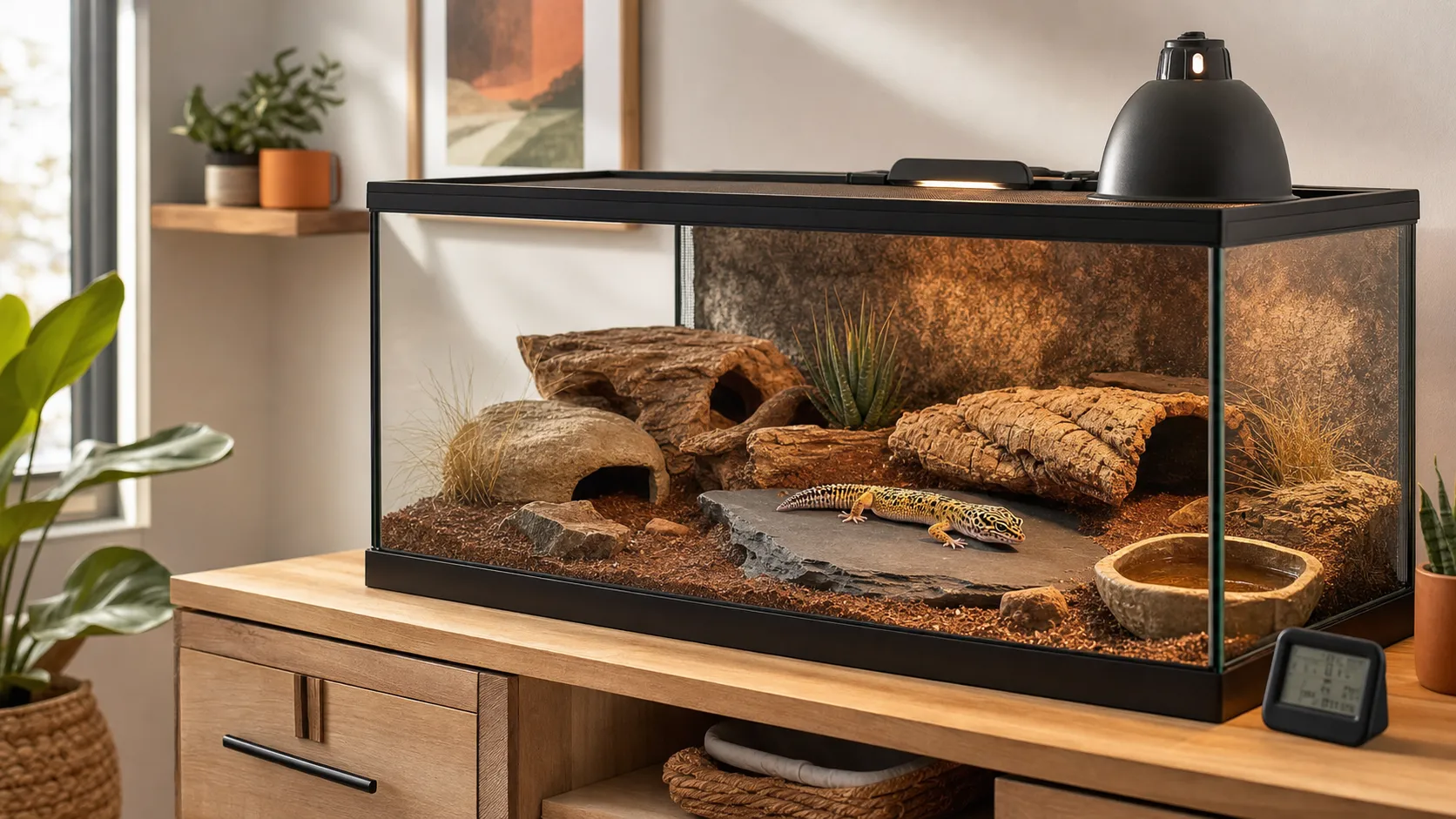

 Published sources
 Product details checked
Leopard gecko tank advice often starts with a 10- or 20-gallon aquarium. That shortcut misses the most important part of the habitat: usable floor space. A wider enclosure gives your gecko room to move between warm and cool areas, choose different hides, explore, and retreat without being forced into one temperature.
Quick answer: For one adult leopard gecko, plan around a 36 x 18 x 18 inch enclosure or larger, with the heat and linear UVB on one side, a warm hide, a cool hide, and a humid hide in the middle-to-cool zone. Use a dimming thermostat and verify the actual basking surface with an infrared thermometer before the gecko moves in.
This guide focuses on the setup decisions that affect daily welfare: space, thermoregulation, security, humidity, and measurement. Product links are included where a piece of equipment solves a specific problem, but no product can compensate for an untested gradient or an unsafe installation.
Quick Setup Shopping List
The table below is a practical starting list for an adult enclosure. Product terms can change, so confirm the linked product details before buying.
Core leopard gecko setup components
-
Phailozoo 50 Gallon Reptile Tank
Phailozoo
50-gallon enclosure with an aluminum frame, mixed panels, front-opening glass doors, and a ventilated top. Too small for permanent adult bearded dragon housing.
- 36"L x 18"W x 18"H overall dimensions; check usable interior space
- Aluminum columns, steel screen top, PVC back and base, acrylic sides
- Sliding tempered-glass doors and a substrate barrier
- Best for
- Leopard geckos and other reptiles whose space requirements fit this 36 x 18 inch footprint
-
REPTIZOO TC02 Dimming Thermostat
REPTIZOO
PID-style dimming thermostat with a digital display, memory function, and probe for controlling light-emitting reptile heat sources.
- Dimming output is better suited to overhead lamps than a simple on/off switch
- Digital display makes the set point easy to check
- Memory function helps preserve settings after a power interruption
- Best for
- Dimming control for an overhead halogen or deep-heat projector
-
Zoo Med ReptiSun 5.0 T5 HO UVB Lamp 22 inch
Zoo Med
22-inch, 24-watt ReptiSun 5.0 T5 HO replacement tube that must be paired with a compatible T5 HO fixture.
- 5.0 UVB output is a sensible starting point for many leopard gecko setups
- 22-inch tube can cover part of a 36-inch enclosure while leaving shaded retreats
- Linear coverage is more useful than a tiny coil bulb for a thermal-gradient layout
- Best for
- Low-output linear UVB for a wide leopard gecko enclosure
-
Zoo Med Digital Thermometer Humidity Gauge TH-31
Zoo Med
Compact digital combination gauge with a probe for tracking the enclosure environment without relying on analog dials.
- One display shows temperature and relative humidity
- Probe can be positioned where the reading matters instead of stuck to the glass
- Min/max memory helps reveal overnight swings
- Best for
- Simple daily checks of ambient temperature and humidity
-
Etekcity Lasergrip 774 Infrared Thermometer
Etekcity
Non-contact infrared thermometer with laser targeting, adjustable emissivity, and a 12:1 distance-to-spot ratio.
- Reads surface temperature quickly without moving hides or touching the reptile
- 12:1 distance-to-spot ratio is practical for a terrarium
- Adjustable emissivity improves readings across slate, glass, and other surfaces
- Best for
- Calibrating basking and cool-side surface temperatures
-
Zoo Med Repti Shelter 3-in-1 Cave Medium
Zoo Med
Resin cave with a removable lid that can serve as a secure retreat or a humid microclimate when used with appropriate, cleanable substrate.
- Removable lid makes it easier to inspect and clean the hide
- Resin construction is washable and less fragile than many hollow decorations
- Naturalistic shape gives a gecko a dark, covered retreat
- Best for
- A washable warm, cool, or humid hide with a removable top
Review the linked product page before purchasing.
What a Good Leopard Gecko Tank Setup Has to Do
A good enclosure is not just a box with a heat source. It should let the gecko make choices:
- Move from a warm basking area to a genuinely cooler end without leaving the enclosure.
- Hide completely on the warm side, cool side, and in a humid microclimate.
- Walk, turn, and explore without furniture blocking the entire floor.
- Drink from a shallow dish and access stable, easy-to-clean surfaces.
- Experience a predictable day-night cycle without bright colored night bulbs.
Leopard geckos are terrestrial and crepuscular. Their enclosure should therefore prioritize horizontal floor area, cover, and a usable temperature gradient over height, decorative clutter, or a visually empty display tank.
1. Choose the Right Enclosure Size
Adult target: 36 x 18 x 18 inches or larger
For a single adult, 36 x 18 x 18 inches is a practical minimum target used by modern care guides and veterinary-hospital guidance. It provides roughly 4.5 square feet of floor area and enough length to create separate thermal zones.
The gallon label can be misleading. A common 20-gallon long tank is about 30 x 12 x 12 inches, or roughly 2.5 square feet of floor area. It may work as a short-term grow-out enclosure when heavily furnished and closely monitored, but it leaves much less room for three hides, a basking zone, and a meaningful cool end. I would not treat it as the preferred forever home for an adult.
The Royal Veterinary College care sheet and the RSPCA leopard gecko guide both emphasize a spacious enclosure and a gradient rather than a single fixed temperature. The ReptiFiles size guide explains why more floor area improves the gecko’s ability to regulate itself.
Enclosure features that matter
- Front opening: Makes cleaning and handling less startling than reaching down from above.
- Secure doors and lid: Leopard geckos are excellent at finding small escape routes.
- Ventilated top or equivalent airflow: Helps keep the general enclosure dry while still allowing a humid hide.
- Room for cable routing: Heat, UVB, and probe wires should not be pinched by doors or accessible to the gecko.
- A level, sturdy stand: A 36-inch glass or framed enclosure becomes heavy once filled with substrate and décor.
The Check current price on Amazon → is the adult-sized option in the table because its 36 x 18 x 18 inch footprint is more useful here than a taller but narrower tank. It is not waterproof, so keep the setup semi-arid and wipe spills promptly.
2. Build a Measurable Heat Gradient
Heat is the part of the setup that turns decoration into a functional habitat. Put the heat source over one end, not in the center. The gecko should be able to warm up, move away, and choose a hide without crossing the entire enclosure.
Use these as working targets, not as a substitute for an exotics veterinarian’s advice for a particular age, morph, or medical condition:
| Zone | Starting target | How to measure it |
|---|---|---|
| Basking surface | 94-97°F | Infrared thermometer aimed at the surface |
| Warm hide | About 88-92°F | Probe thermometer inside or at the hide entrance |
| Cool end | About 70-77°F | Digital probe on the shaded end |
| General daytime humidity | About 30-40% | Digital hygrometer in the open air |
| Humid hide | About 70-80% locally | Hygrometer or a damp-hide check |
WARM END COOL END
[heat + UVB] -> [basking slate] -> [warm hide] -> [humid hide] -> [cool hide + water]
 94-97°F surface target 88-92°F 70-80% local 70-77°F air
Overhead heat is the default starting point
An overhead halogen-style basking bulb or a deep heat projector better resembles the way warmth reaches a ground-dwelling lizard outdoors. A heat mat can be useful in some circumstances, but it should not be the only safety plan or the only place the gecko can get warm.
If you use a light-emitting basking bulb, control it with a dimming thermostat, not a bare plug timer. The Check current price on Amazon → is a budget-oriented option with a digital display and a probe. Its probe belongs at the basking surface, secured so the gecko cannot move or chew it. A thermostat setting is only a starting point: confirm the surface temperature with a separate thermometer.
For a low-cost spare bulb, the Check current price on Amazon → is easy to replace and uses a standard E26 base. Treat 75W as a starting wattage, not a promise. Distance, screen, room temperature, reflector shape, and enclosure material all change the result. Use a ceramic-socket fixture and adjust the output only after measuring.
Night temperatures and colored bulbs
A natural night-time drop is generally preferable to a bright red or blue “night” bulb. If your room becomes too cold, use a lightless heat source only with appropriate thermostat control and follow a species-specific care plan. Never leave an unregulated heat emitter running overnight.
3. Add Low-Level Linear UVB Carefully
Leopard geckos are not sun-basking lizards in the same way as bearded dragons, but low-level UVB can support natural behavior and vitamin D3 production. A linear tube also gives you a more predictable zone than a small compact bulb.
The Zoo Med ReptiSun 5.0 T5 HO 22-inch tube in the table is a low-output option for a wide enclosure. It is the replacement lamp only; you still need a compatible T5 HO fixture. Mount the UVB on the same side as the heat so the warm zone and lit zone overlap, then leave shaded hides and cover available across the rest of the tank.
Check current price on Amazon →UVB strength at the gecko’s back depends on the tube, reflector, distance, mesh, and the animal’s access to shade. Albino and other light-sensitive morphs deserve extra care with output and placement. Do not place glass or acrylic between the lamp and the gecko, and replace the tube according to the manufacturer’s schedule rather than waiting for it to look dim.
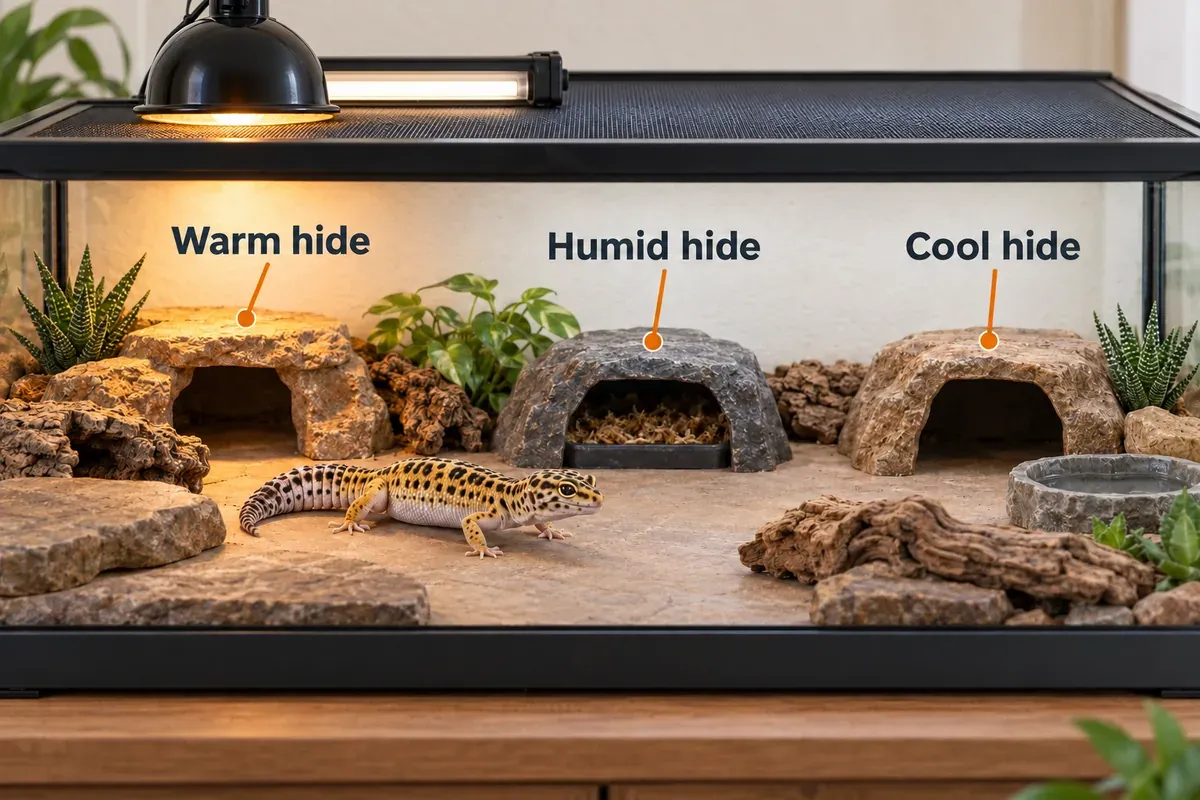
4. Use Three Functional Hides
Three hides are more useful than one oversized cave:
- Warm hide: Under or immediately beside the warm zone. It should be dark and snug, not an open platform.
- Cool hide: At the far end, away from the heat. This gives the gecko a true retreat when the warm side is too hot.
- Humid hide: In the middle-to-cool zone, with a controlled damp microclimate for shedding. Do not raise the humidity of the entire enclosure to achieve this.
Each hide should have a stable base, a smooth interior, and an entrance large enough for the gecko’s widest point. The Check current price on Amazon → is useful because the removable lid makes inspection and cleaning easier, but one cave is still only one cave. Add two more appropriately sized retreats and enough visual cover that the gecko does not feel exposed when moving between them.
For the humid hide, use a cleanable liner or substrate that stays damp without becoming soggy. Check toes and retained shed regularly, especially during the first few sheds after the gecko arrives. If shedding problems persist, ask an exotics veterinarian rather than turning the whole enclosure into a humid box.
The example below keeps damp material inside one retreat while preserving dry routes between the hides.
5. Choose Substrate for the Gecko in Front of You
There is no single substrate that makes every leopard gecko setup safe. The right choice depends on age, health, enclosure temperatures, hydration, and whether the animal is likely to ingest loose material.
Practical starter option
Paper towel or another easily replaceable liner makes the first weeks simple. You can see droppings, check appetite, monitor shedding, and confirm that the gecko is using each zone. This is especially useful after a move, during quarantine, or when a veterinarian is monitoring a problem.
Naturalistic option for a healthy, established adult
A well-drained, firmly packed soil-like mix can support digging and more natural movement when the gecko is healthy and the heat, hydration, and UVB are correct. Use a reputable recipe or a product recommended by an experienced reptile veterinarian. Avoid calcium sand and dusty, perfumed, or sharp materials. Loose substrate is not automatically dangerous in every healthy, well-managed setup, but it becomes a poor choice when the animal is ill, dehydrated, too cool, or actively eating the substrate.
Whatever you use, keep food out of the loose substrate, remove waste promptly, and replace contaminated areas rather than masking them with extra material.
6. Measure the Setup Instead of Guessing
The most useful equipment is the equipment that tells you what is actually happening at gecko level.
- Put the thermostat probe where the basking surface gets hottest, secured against movement.
- Put a separate digital probe on the cool end, not directly under the lamp.
- Use a hygrometer to monitor the general air and the humid hide separately.
- Use an infrared thermometer to scan the slate, hide floors, and cool end during the day.
The Check current price on Amazon → is a straightforward daily monitor. The Check current price on Amazon → is more useful during setup because it lets you map several surfaces quickly. The infrared tool measures surfaces, not air, and cannot read accurately through glass, so use it alongside probes rather than instead of them.
7. Assemble and Test the Tank Before Arrival
Set the enclosure up before the gecko comes home. Give yourself several days to find problems while the tank is empty.
- Place the enclosure on a level, weight-rated stand away from drafts and direct sun.
- Add the chosen liner or substrate and make sure doors still close securely.
- Build the warm, cool, and humid hide zones before adding decorative clutter.
- Mount the heat and UVB on one side, with cables routed outside the gecko’s reach.
- Install the thermostat probe and independent monitoring probes.
- Run the lights and heat on the intended day-night schedule.
- Scan the basking surface and hides at different times of day; adjust height or dimming until the gradient is stable.
- Only add the gecko once the warm and cool zones are both available and the humid hide is working as intended.
Do not tape a probe to the outside of the glass and assume it represents the basking surface. Do not use the manufacturer’s wattage or a dial gauge as proof that the enclosure is safe. Measure the actual surfaces your gecko will touch.
Common Leopard Gecko Tank Setup Mistakes
Treating a 20-gallon tank as the adult endpoint
Gallons do not show floor area. If the enclosure cannot fit three hides and a real warm-to-cool transition, it is too limiting for a long-term adult setup.
Putting the heat in the middle
Center heat creates one broadly warm box instead of a gradient. Move the heat to one side and verify the cool end with a probe.
Using a heat source without a thermostat
A bulb can run hotter than expected when room temperature changes or the fixture is moved. Dimming control and independent checks are basic safety equipment, not luxury upgrades.
Making the whole enclosure humid
The gecko needs a humid retreat, not a permanently damp tank. Keep the general enclosure ventilated and localize moisture to the humid hide.
Forgetting shaded retreats
UVB and visible light should not eliminate choice. Use hides, cork, and visual barriers so the gecko can retreat from light and activity.
Reviews still cannot confirm that a bulb produces the right heat in your enclosure or that a hide fits your gecko. Use the product data as one reference point, then measure and inspect the actual setup.
Frequently Asked Questions
Is a 20-gallon tank enough for a leopard gecko?
A 20-gallon long tank can be a temporary or closely managed juvenile setup, but it is not my preferred adult target. A 36 x 18 x 18 inch enclosure provides substantially more floor area for a useful gradient, three hides, and enrichment.
Does a leopard gecko need UVB?
Care standards differ in how strongly they describe UVB as essential, but current welfare-focused guidance supports providing a low-level linear UVB zone with plenty of shade. The exact lamp, distance, and exposure should match the enclosure and morph. UVB is not a substitute for correct heat, calcium, hydration, or veterinary care.
Are heat mats safer than heat lamps?
Neither is automatically safe without measurement and thermostat control. Overhead heat is the better starting point for creating a sun-like warm zone and a clear gradient. If you use a heat mat for a specific reason, it must be thermostat-controlled, protected from direct contact, and checked at the surface.
What humidity should a leopard gecko tank have?
Aim for a generally dry enclosure around 30-40% relative humidity, while offering a humid hide around 70-80% locally for shedding. A temporary spike is different from a whole tank that stays wet and poorly ventilated.
How many hides does one leopard gecko need?
Plan for at least three: warm, cool, and humid. Add clutter or additional shelters if the enclosure still feels exposed. The gecko should be able to move between zones without crossing an open, empty floor.
Can two leopard geckos share one tank?
I do not recommend cohabitation as a default setup. Separate enclosures make feeding, weight monitoring, heat access, and illness checks much easier and prevent bullying or competition over hides.
Leopard Gecko Tank Setup Checklist
- Enclosure is at least 36 x 18 x 18 inches for an adult, or there is a clear upgrade plan.
- Doors and lid close securely; wires are outside the gecko’s reach.
- Heat is positioned over one side and controlled by a dimming thermostat.
- Basking surface, warm hide, and cool end have been measured with probes or an IR thermometer.
- A low-level linear UVB zone is installed with shaded retreats.
- Warm, cool, and humid hides are stable, smooth, and correctly sized.
- General humidity is dry while the humid hide stays locally damp.
- Water is available in a shallow, stable dish.
- Substrate matches the gecko’s health, age, and keeper experience.
- The enclosure has run for several days before the gecko arrives.
Research Notes and Sources
For appetite loss, repeated stuck shed, lethargy, weight loss, burns, or other health concerns, contact a veterinarian experienced with reptiles.