

 Published sources
 Product details checked
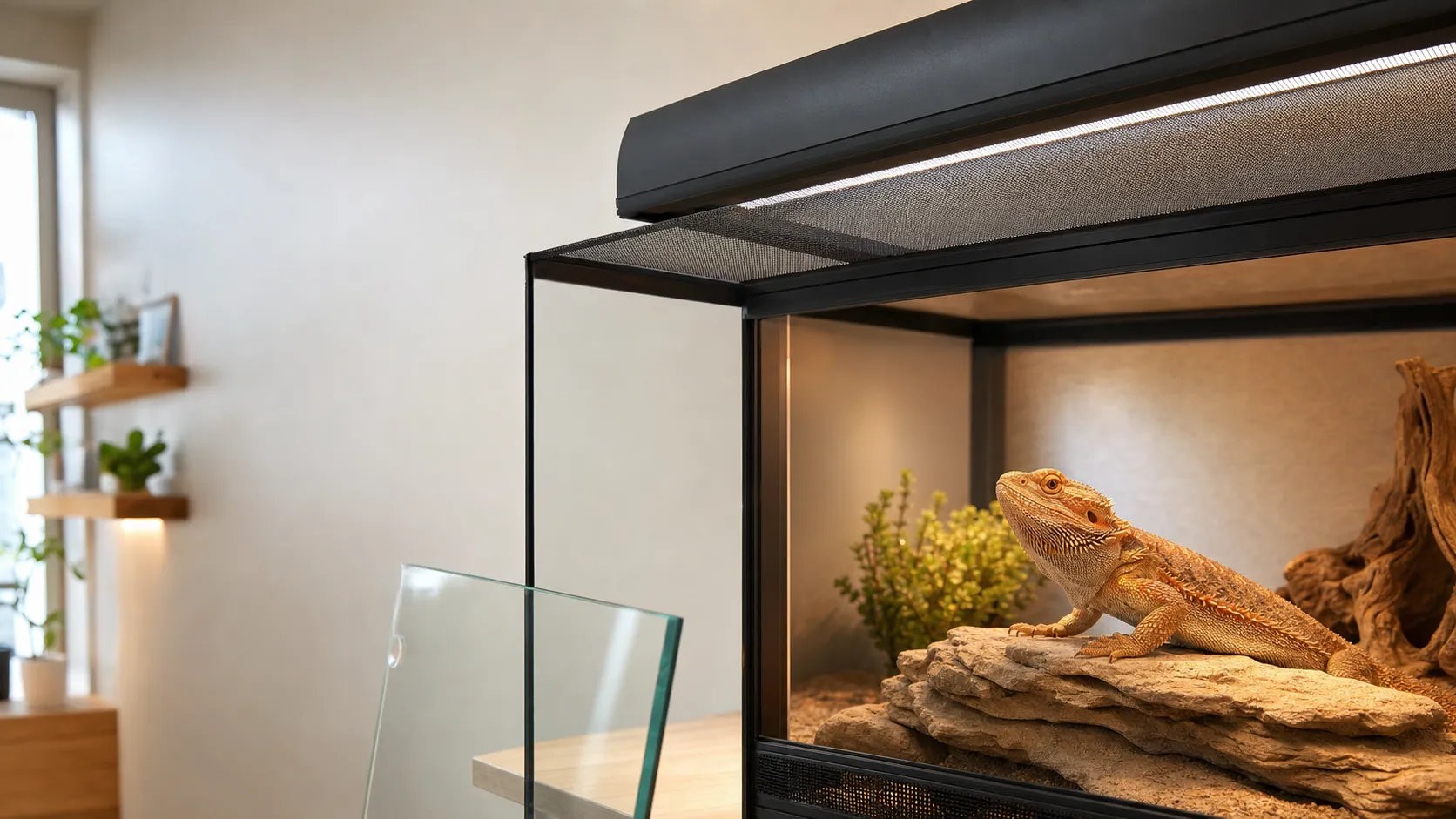
Yes, some UVB passes through mesh. Ordinary glass is a different situation: for reptile lighting, normal enclosure or window glass should be treated as a UVB barrier. A clear panel can look bright while blocking the UVB your reptile needs.
The useful question is therefore not simply “Does UVB pass through?” It is: What UVI reaches the animal at its highest basking position after this exact lamp, reflector, screen, and distance are assembled? This guide shows how to answer that question without treating every mesh top or every UVB bulb as interchangeable.
Quick answer: Mesh usually reduces UVB by a variable amount, so a lamp above the screen can work when the final setup is measured. Ordinary glass blocks useful UVB and should not sit between the lamp and the reptile. UV-transmitting specialty acrylic is a separate product category and still needs verification with the manufacturer’s data and a meter.
Mesh and glass are not the same barrier
The distinction matters because a screen is an open-air filter, while a solid pane is a material barrier. The percentage of open area, wire or strand thickness, material, coating, color, hole pattern, and even a second layer all change how much UVB gets through a mesh top.
The peer-reviewed study on UVB reduction by enclosure materials tested 14 materials used in reptile cages. Its results are a useful warning against copying one screen percentage from one enclosure to another: air-permeable wire screens generally behaved differently from solid materials, and a UV-transmitting acrylic sample even exposed limitations in meter-only assumptions.
| Material or component in the UVB path | What it usually does | Practical placement decision | How to verify it |
|---|---|---|---|
| Fine metal or coated mesh | Allows some UVB through but can attenuate a lot, depending on open area and construction | A fixture above the screen can be appropriate if the animal’s UVI is in range | Measure through the installed screen at the highest basking position |
| Coarse screen or open wire top | Often presents less obstruction than fine mesh, but still changes the reading | Do not use a generic “mesh loss” percentage; use the actual top | Measure with the final reflector, lamp height, and screen in place |
| Double mesh, overlapping screen, or a screen plus guard | Adds another obstruction and can create a meaningful drop | Count every layer between the lamp and the animal | Take a reading with all layers installed |
| Ordinary glass | Should be treated as blocking useful reptile UVB even when it looks perfectly clear | Do not place the lamp above a glass top and expect UVB to pass through | Remove the glass from the beam or replace it with a suitable ventilated top, then measure |
| UV-transmitting specialty acrylic | Product-specific; not the same as ordinary glass or acrylic | Use only when the panel’s UV transmission is documented and the setup is safe | Verify the finished enclosure with a UVI meter |
| Reflector or solid fixture shield | Can redirect, concentrate, or block part of the output | Evaluate the complete fixture, not the tube by itself | Test the exact assembled fixture |
Zoo Med’s lighting and UVB education guide makes the same practical point: screen reduction varies by screen type and size, while glass and most plastics filter out UVB. The manufacturer also notes that a reflector can increase measured output by 30% or more. That is why a lamp chart is only meaningful when the lamp, reflector, barrier, and distance match your enclosure.
What changes the UVB dose in your enclosure?
1. Lamp type and output
Start with the animal and the enclosure, not with the strongest percentage printed on a box. A linear T5-HO tube with a proper reflector usually creates a broad, useful beam across a basking area. A T8 tube, compact fluorescent, mercury-vapor lamp, or a small spot-style UVB source has a different output pattern and distance range.
Do not copy a T5-HO distance chart for a T8, compact lamp, or mercury-vapor bulb. A “10.0” or “14%” label describes the lamp’s product class; it does not tell you the UVI at the animal’s back.
For many medium and large terrestrial enclosures, a linear tube is easier to position because the animal can move across a gradient instead of sitting under a small, intense hotspot. Shade, enclosure height, animal size, and species-specific UV needs still determine whether a particular output is suitable.
2. Reflector shape and fixture design
A bare tube and the same tube in a polished or curved reflector are not the same setup. The reflector sends more of the lamp’s output toward the enclosure and can change both the peak reading and the width of the usable beam.
The Arcadia Reptile Lighting Guide bases placement on UVI, species needs, lamp distance, and a suitable reflector rather than on a universal percentage rule. It also emphasizes that the distance is from the lamp to the animal’s head or top shell, not from the fixture to the enclosure floor.
Treat a clear plastic cover on a fixture with caution. Unless the manufacturer explicitly documents it as UVB-transmitting, do not assume that “clear” means “transparent to UVB.” A wire guard is a different issue: it protects the animal but adds another mesh layer that should be included in the measurement.
3. Mesh construction
Mesh labels are not precise enough on their own. Two screens described with the same mesh count can have different wire diameters and different open-area percentages. A black coating, fiberglass strand, nylon strand, unusually fine ventilation screen, or a second overlapping panel may change the reading again.
The New Zealand Herpetological Society’s enclosure guidance explains why hole size and wire diameter both matter when interpreting screen openness. In practice, the screen already fitted to your enclosure is more useful than a percentage found in a forum post about another brand of lid.
Never assume that a stronger lamp automatically fixes a restrictive screen. A stronger fixture may raise the basking reading but can also create a dangerous peak close to the screen or at a raised basking branch. First measure, then change one variable at a time.
4. Distance and basking height
UVB falls rapidly with distance. Measure from the underside or emitting face of the lamp to the highest point your reptile can actually reach, usually the head or top of the back while basking. Include the screen, guard, or panel in the path.
The substrate-to-lamp distance is not the animal’s exposure distance. A branch, rock, shelf, or hammock can move the animal several inches closer without changing the lamp mount. Recheck whenever you change the décor or raise the basking platform.
Published numbers can be useful starting points, but they are not universal. For example, ReptiFiles gives different starting distances for an Arcadia Dragon 14% system with and without mesh in a bearded-dragon example. Those numbers depend on that lamp, reflector, screen assumption, species target, and basking arrangement. Use the bearded-dragon UVB example as a model for the reasoning, not as a distance chart for every reptile.
Equipment for a measured UVB setup
The table includes different jobs, so it is not a ranked “best UVB” list. A replacement tube is only useful with a compatible fixture. A lamp stand is not automatically a safe mount for a linear T5 hood. A UVI meter measures the result rather than increasing it.
Equipment for a measured UVB setup
-
Arcadia Pro T5 UVB Kit Dragon 14% UV-B, 34" (39W)
Arcadia
Complete 34" T5-HO UVB kit with a 14% Dragon lamp and curved reflector for large, high-UVB desert setups.
- 14% Dragon UVB lamp in a 34" T5-HO fixture
- Curved reflector helps direct the beam onto the basking zone
- 39W format for larger or more open desert enclosures
- Type
- T5 HO UVB
- Best for
- Large desert setups that need a high-output linear UVB system and a measured basking gradient
-
Zoo Med ReptiSun T5 HO Terrarium Hood with 10.0 Bulb 24" L
Zoo Med
Complete 24-inch ReptiSun T5-HO hood with a 10.0 lamp and curved polished reflector for a straightforward fixture-and-bulb setup.
- 24-inch T5-HO hood with an included ReptiSun 10.0 lamp
- Curved polished reflector helps direct light downward
- Complete fixture reduces the risk of buying an incompatible ballast
- Type
- T5 HO UVB hood
- Best for
- A 24-inch hood when its 10.0 lamp meets the species' measured UVI target
-
REPTI ZOO T5 HO UVB Combo Kit, 24W Desert 10.0
REPTI ZOO
Entry-priced T5 HO fixture bundled with a 24W Desert 10.0 lamp for a 24-inch enclosure footprint.
- Fixture and Desert 10.0 UVB lamp included
- 24W format suits a 24-inch enclosure footprint
- Curved reflector helps direct light into the enclosure
- Type
- T5 HO UVB combo kit
- Best for
- Budget-conscious keepers who want a complete 24W T5 HO kit
-
Zoo Med ReptiSun 10.0 T5 HO UVB Lamp, 24W (2-Pack)
Zoo Med
Two Zoo Med ReptiSun 10.0 T5 HO replacement lamps for keepers who already own a reliable reflector and ballast.
- 24W, 22-inch OS5-24 lamp format
- Two-pack makes the annual replacement routine easier
- Manufacturer distance and UVI charts are available
- Type
- T5 HO UVB
- Best for
- Replacing bulbs in a compatible 22-inch T5 HO fixture
-
BOURDSERK Reptile Heat Lamp Stand, Adjustable 16"-31"
BOURDSERK
Adjustable all-metal reptile lamp stand for compatible dome fixtures, with a height range described at roughly 16 to 31 inches.
- Adjustable height described at approximately 16-31 inches
- All-metal holder for compatible dome-style fixtures
- Useful when a dome lamp needs repeatable height adjustment
- Type
- Adjustable reptile lamp stand
- Best for
- Raising or repositioning a compatible dome-style heat or UVB fixture
-
Solarmeter Model 6.5R Reptile UV Index Meter
Solarmeter
Handheld reptile radiometer for measuring the UVI reaching the animal after the lamp, reflector, screen, and distance are assembled.
- 0-199.9 UVI display range with 0.1 resolution
- Measures the 280-400 nm range used for reptile UV exposure assessment
- Designed for animal UVI checks rather than lamp-aging output checks
- Type
- Reptile UVI radiometer
- Best for
- Verifying the actual UVI gradient at the animal's basking height
Review the linked product page before purchasing.
A repeatable UVI measurement workflow
If you can measure the finished enclosure, do that before changing bulbs. The Solarmeter 6.5R specification sheet describes a handheld UVI meter for the UV range relevant to vitamin D3 synthesis, with a 0–199.9 UVI range, 0.1 resolution, and a stated ±10% reference to NIST. It is an expensive tool, but it answers a different question from an infrared thermometer or lux meter.
- Define the species target. Use a current veterinary, zoological, or species-specific lighting guide to establish the appropriate Ferguson Zone or UVI range. A bearded dragon, leopard gecko, crested gecko, tortoise, and snake should not all receive the same target simply because they share a room.
- Record the complete system. Write down the lamp model, output rating, fixture, reflector, lamp age, screen type, number of layers, and distance from lamp to animal height. Photographing the setup can make later changes easier to audit.
- Install the lamp over one side. Put UVB on the warm or basking side when the species’ care plan calls for that arrangement, but leave a genuine lower-UV retreat. Avoid bathing the entire enclosure in the same intensity.
- Let the lamp stabilize. Follow the meter and lamp instructions. The Solarmeter guidance recommends allowing lamps to warm for at least 15 minutes before recording a reading. Use eye protection while looking toward a bright lamp.
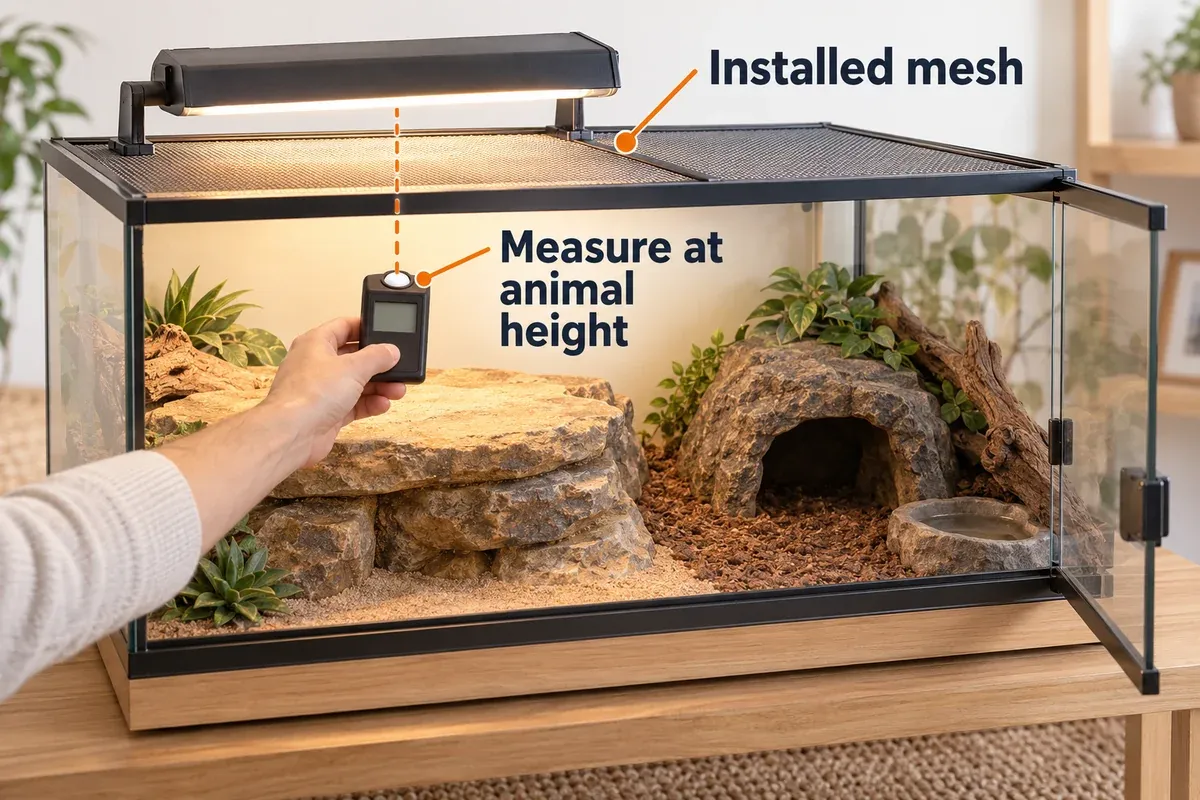
- Measure at animal height. Hold the sensor at the highest basking position, aimed toward the lamp, with the screen, guard, and reflector in their normal positions. Do not measure from the floor and do not remove the screen for convenience.
- Map the gradient. Take another reading at the middle of the enclosure and in the shaded retreat. Record the distance and location for every number. The animal needs the ability to choose exposure, not just one acceptable peak.
- Adjust one variable. If the basking reading is too low, check for glass or a solid shield first, then consider a closer mount, a suitable reflector, a less restrictive screen, or a lamp that fits the species and enclosure. If it is too high, increase distance, add usable shade, or choose a more appropriate output. Recheck after every change.
- Repeat after maintenance. Recheck after replacing the lamp, changing the fixture, moving a branch, adding a guard, replacing the screen, or changing the enclosure height. A tube can continue to produce visible light after its UVB output has changed.
The 6.5R is intended for measuring animal exposure. Do not confuse it with a lamp-output or lamp-aging meter such as the Solarmeter 6.2R. An infrared thermometer is still useful for basking temperature, but it cannot tell you whether UVB reaches the animal.
Keep the screen and fixture in their normal positions for the check. The sensor belongs at the height of the animal’s head or back while basking, aimed toward the lamp.
Placement by enclosure type
Fixture above a mesh top
This is the simplest starting arrangement for many screen-top enclosures. Place a linear fixture over the basking side, keep the distance within the lamp manufacturer’s guidance, and measure through the actual mesh. Do not rely on a “30% loss” or “50% loss” rule unless it was measured for the same screen and fixture.
The fixture should be stable and protected from falling. If the hood has to span a large opening, support it according to the manufacturer’s instructions rather than balancing it on a removable lid. Make sure the animal cannot climb into the lamp or chew a cord.
Fixture inside the enclosure
Mounting below the mesh can remove one obstruction, but it creates new safety requirements. The fixture needs a secure mount, a guard where contact or climbing is possible, protected wiring, appropriate moisture clearance, and the manufacturer’s minimum distance. A guard can also reduce UVI, so measure again after installing it.
Inside mounting is not automatically better than above-mesh mounting. It is better only when the complete system produces the intended UVI gradient and the animal cannot reach a hot or electrical component.
Enclosure with a glass top
Do not place a UVB fixture above a solid glass top and assume the light will pass through. The practical solutions are to replace the UVB portion with an appropriate ventilated screen, mount the fixture inside with proper protection, or use a documented UV-transmitting specialty panel that is tested in the finished setup.
Front glass doors are not automatically a problem. They block UVB only when they sit between the lamp and the animal. A lamp mounted above an open mesh top can still work in a front-opening glass enclosure because the front doors are outside the direct beam.
Full-screen or open mesh enclosures
An all-screen enclosure may need a different distance and output from a wooden vivarium with a fine top. Wind, room temperature, animal height, and the ability to create shade also change the setup. Measure the basking spot and the retreat rather than escalating to a high-output lamp by default.
Which product fits which problem?
You need a complete, high-output linear system
It makes sense for a large, open desert setup only when the species, enclosure height, and measured UVI justify that output. It can be too much for a small enclosure or a shade-adapted reptile.
You need a complete 24-inch 10.0 hood
You want a lower-cost complete kit
The Check current price on Amazon → bundles a fixture and Desert 10.0 lamp as a practical starting point. That does not prove that its output matches a premium reflector. Confirm the exact lamp and fixture version, then measure at the basking surface.
You already own a compatible hood
The Check current price on Amazon → is for replacing compatible 22-inch, 24W T5-HO tubes. It does not include a reflector or ballast. Check the markings on the existing fixture before ordering; a similar-looking T8 or different-length T5 lamp is not interchangeable.
You need to reposition a compatible dome fixture
The Check current price on Amazon → is useful for raising or repositioning compatible dome-style heat or UVB fixtures. It is not a universal mount for a long linear T5 hood.
You need to know what the animal actually receives
The Check current price on Amazon → is the most direct way to turn lamp placement into a UVI reading. If that cost is outside your budget, use the exact manufacturer chart conservatively and plan a meter purchase or professional check rather than pretending a phone app can measure UVB.
Common placement mistakes
- Treating clear as UVB-transparent. Ordinary glass and many plastics are not a harmless window for reptile UVB.
- Using a mesh percentage from another enclosure. Mesh count, wire diameter, coating, open area, and double layers change the result.
- Measuring to the substrate. The reptile’s head or back at its highest basking point is the relevant distance.
- Measuring the bare lamp. Use the final reflector, guard, screen, and fixture.
- Using a lux meter or phone camera as a UVI meter. Visible brightness is not a measurement of biologically useful UVB.
- Centering the fixture with no retreat. A usable UVB setup needs an intentional gradient and shade.
- Raising output before checking obstructions. A glass lid, clear shield, second screen, or excessive distance may be the real problem.
- Replacing a lamp by appearance alone. Visible light can remain after UVB output has changed; follow the lamp schedule and recheck the setup.
Frequently Asked Questions
Does UVB pass through a mesh screen?
Usually some UVB passes through, but the screen reduces the reading by an amount that depends on its construction. Measure through the exact top instead of applying one universal percentage.
Does UVB pass through glass?
Ordinary enclosure or window glass should be treated as blocking useful reptile UVB. A specialty UV-transmitting panel is a different material and needs product documentation plus a finished-setup measurement.
Is UVB above mesh enough for a reptile?
It can be. Use a suitable lamp and reflector, place it at the species-appropriate distance, measure through the mesh at animal height, and provide a lower-UV retreat. Above-mesh placement is not automatically correct or incorrect.
Should the fixture go inside the enclosure?
Not automatically. Inside mounting may remove a screen obstruction, but it also adds contact, heat, moisture, wiring, and guard concerns. Choose the safer arrangement that produces the correct measured gradient.
How far should a UVB lamp be from the reptile?
There is no single safe distance for every lamp and species. Start with the exact manufacturer chart, measure from lamp to the animal’s highest basking position, and adjust from the UVI result.
Can an infrared thermometer measure UVB?
No. An infrared thermometer measures surface temperature. It is useful for checking basking rocks and branches, but UVI requires a radiometer designed for reptile UV exposure.
Bottom line
Mesh is a variable filter; ordinary glass is a practical UVB barrier. The fixture, reflector, lamp type, mesh, distance, basking height, and shade all work together, so the same bulb can be too weak in one enclosure and too strong in another.
For a reliable setup, use a species-appropriate linear system where practical, keep the beam on one side, preserve a genuine retreat, and measure the final enclosure at the animal’s height. If the reading is wrong, change one part of the system and measure again. That process is safer and more useful than choosing a bulb by its percentage label.
Sources and research notes
- Zoo Med: Lighting & UVB Education — manufacturer guidance on distance, gradients, reflectors, mesh, and glass.
- Arcadia Reptile Lighting Guide — UVI-based placement and reflector-specific distance guidance.
- Evaluation of UVB reduction by materials commonly used in reptile husbandry — peer-reviewed study of cage-top materials and UVB attenuation.
- Solarmeter Model 6.5R specification sheet — measurement range, warm-up, repeatable distance, and safety guidance.
- New Zealand Herpetological Society: Enclosures — practical explanation of mesh openings and wire diameter.
- ReptiFiles: Bearded Dragon Temperatures and UVB — a species-specific example of how mesh and lamp distance alter a starting setup; not a universal chart.