

 Published sources
 Product details checked
A reptile misting system that runs but does not spray needs a water-path check before another timed cycle. Switch it off and check the actual water level, intake filter, and connections. A full tank alone does not prove that water reaches the pump: a filter can be exposed, disconnected, or blocked. Do not keep cycling an unverified pump in the hope that it will prime.
The next step depends on the model. MistKing uses a separate reservoir, bulkhead, and external pump; its reference manual specifies the pump at or below the bulkhead. Exo Terra’s Monsoon SOLO II and MULTI II draw water through a filter inside their own tanks and must not run dry. Moving a Monsoon reservoir above its pump is not a priming procedure.
Stop before wet work. Disconnect power before moving tubing, opening a connector, cleaning a nozzle, or lifting a Monsoon top. Keep water away from plugs and adapters. If a socket is wet, turn off its circuit at the breaker before touching it, as the Monsoon manuals instruct. Stop for a damaged cord, leak near electrics, overheating, or abnormal pump noise.
Which intake and priming method does your system use?
| System | Intake arrangement | Permitted first check | Stop condition |
|---|---|---|---|
| MistKing Starter 5th Gen and other external-pump MistKing kits | Water leaves a separate reservoir through a bulkhead. The pump is self-priming in design, but MistKing requires it to sit level with or below that bulkhead because nozzle check valves resist an air-filled start. | Fill the reservoir, verify the bulkhead feed, then purge at the tube before the first nozzle into a container, following the MistKing manual. | No water is available at the inlet, a fitting leaks, the pump heats or sounds wrong, or a brief supervised purge yields no water. |
| Monsoon SOLO II, PT4200 | A filter and short intake tube sit inside the 1.5 L tank beneath the control unit. | With power off, seat the filter and top, fill the tank, keep it level, then briefly select ON to observe the supplied nozzle. Return to O afterward. | The filter is out of water, the unit leaks, or no water appears during the short check. ON runs continuously and the pump must not run dry. |
| Monsoon MULTI II, PT4201 | The same integrated arrangement uses an 8 L tank and two supplied nozzles. | Check filter, top seating, fill level, and level surface. Briefly select ON, observe both nozzles, then return to O. | Stop for an exposed filter, leak, or no water during the short check. Its thermal cut-off is not a substitute for stopping. |
Neither Monsoon manual calls its pump self-priming or gives the MistKing open-tube purge as a Monsoon procedure. For another model, identify its model number and consult its own instructions for intake position, priming, and dry-run limits before energizing it.
Match the symptom to the next safe check
| What you observe | Most likely area | Safe first check |
|---|---|---|
| The timer display works, but the pump is silent | Controller mode, power connection, adapter, or pump | Confirm the model’s manual mode with water available; stop if a cord or adapter is damaged |
| The pump hums but no water reaches a nozzle | Interrupted intake, trapped air, blocked outlet, or pump fault | Inspect the model-specific intake above; use only its permitted purge or brief observation |
| A MistKing sprays after purging, then fails at the next cycle | Water drains back or air enters at the reservoir bulkhead, inlet fitting, or tube end | Inspect the bulkhead feed and pump height before touching the nozzles |
| One nozzle is weak while another sprays normally | Local clog, loose branch, partial plug, or damaged nozzle | Swap only the nozzle or branch and see whether the problem follows the part |
| All nozzles became weak after adding outlets | New branch leak, restriction, or greater demand | Return to the last working layout, then add branches back one at a time |
| Water appears around the pump or a connector | Leaking tube, seal, reservoir, or fitting | Power off, dry the area, find the first wet joint, and repair it before testing again |
If a manual run sprays normally but scheduled runs do not, inspect timer settings and cycle mode. Increasing the run time cannot fix an empty intake. The Monsoon ON mode sprays continuously regardless of the programmed duration; CYCLE follows the settings in its SOLO II or MULTI II manual.
Follow the water path
The system has two different sides, and they fail differently:
- Intake or suction side: reservoir, intake filter, inlet tube, and pump inlet. The manufacturer-specified feed must supply water; an air leak here may leave no visible puddle.
- Pressure side: pump outlet, pressure tubing, Y-connectors, plugs, and nozzle tips. A loose fitting may leak water, while a blocked tip or added branch changes the spray.
- Controller side: timer, manual button, and power adapter. This side decides when the pump runs, but it cannot compensate for air, scale, or a restricted nozzle.
A no-spray symptom does not by itself locate the fault. A pump with a full inlet may still have a blocked pressure tube, damaged nozzle, or internal failure. Trace only the parts the model permits you to inspect.
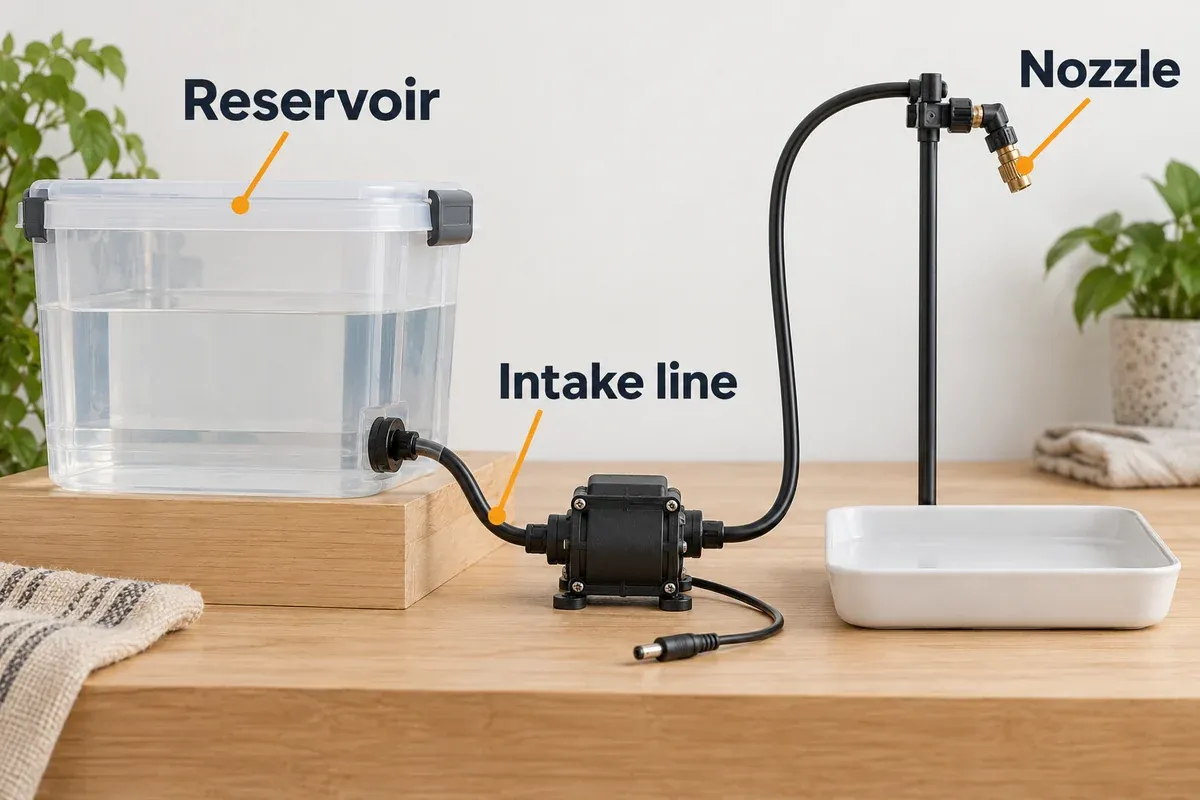
The illustration follows a bulkhead-fed external pump. An integrated Monsoon reservoir has a different intake arrangement, so use the checks for your exact system.
A safe isolation sequence
Work from the reservoir toward the nozzle. Stop at a leak, electrical hazard, empty intake, or abnormal motor sound. Keep a towel and catch container ready for the MistKing purge.
1. Power down before wet work
Unplug the power adapter before removing a filter, cutting tubing, opening a quick-connect, or moving the reservoir. Keep plugs, power strips, and timer housings away from the catch container. Do not test a leaking system while it is energized.
If a unit has been left running without water, stop it and check its manual before restarting. The Exo Terra Monsoon MULTI II manual specifically says that its pump must not run dry. Some MistKing pumps are designed differently, but that is not a reason to assume that every reptile mister tolerates a dry run.
2. Confirm the reservoir and intake filter
Check the actual water level and make sure the intake filter sits in water. On a MistKing, confirm that water reaches the reservoir bulkhead and pump feed. On a Monsoon, unplug the unit, check that the filter is attached to the spigot beneath the control unit, seat the top on the reservoir, and keep the complete unit level. Both Monsoon installation instructions and the SOLO II instructions show this arrangement.
Look for debris, a loose filter, a split inlet tube, or visible deposits. Clean or replace a clogged filter before judging the pump. A filter outside the water can interrupt flow even while the reservoir contains water.
Use the water type specified for the model. Exo Terra instructs owners to use demineralized or distilled water and fill no closer than 1 in / 2.5 cm below the reservoir rim. MistKing recommends reverse-osmosis water to protect its fine nozzles. Do not add medicines or cleaning chemicals to spray water; the Monsoon safety instructions expressly prohibit chemical and medicinal additives.
3. Check the pump’s height and inlet direction
For a MistKing external pump, the reservoir bulkhead and pump belong at the same height or with the pump lower. Both must stay below the nozzles. MistKing’s placement instructions reject pulling water over the reservoir top as a substitute for the bulkhead. Its self-priming pump can still fail to open the check-valved nozzle if the feed drains back and the pump head fills with air.
The MistKing manual calls for a gravity-fed bulkhead connection even though its pumps can self-prime. This installation rule belongs to MistKing’s external-pump arrangement, not to every mister.
On a Monsoon, leave the internal intake as designed. Do not drill, extend, or relocate it to imitate a separate-pump system.
4. Clear air only by the model’s permitted method
MistKing: With reservoir, bulkhead, and inlet correctly connected, unplug the pressure tube before the first nozzle and point it into a container. Use the manual override described for your controller. The reference manual says to reconnect once water sputters and then becomes steady. Stop the pump before reconnecting. If a brief supervised attempt yields no water, stop and recheck the feed line, pump flow-direction arrow, and fittings. The manual also describes drawing water through the line by mouth; avoid that hygiene risk and ask MistKing support about a stubborn air-filled pump head.
Monsoon SOLO II or MULTI II: With the filled tank, submerged filter, seated top, and supplied pressure tube in place, briefly choose ON and observe the nozzle or nozzles. Then select O. If nothing appears, stop immediately. ON is continuous and both manuals prohibit dry running; the thermal cut-off is not an operating method. Recheck the filter, tubing, and nozzle as the matching SOLO II or MULTI II manual describes. Do not copy the MistKing open-tube purge to a Monsoon by default.
If there is still no spray after the correct intake and permitted check, stop. A blocked line or failed pump remains possible; repeated starts will not distinguish them. Do not open an electrical housing or put a finger over a pressure outlet.
5. Add one short branch and one clean nozzle
On MistKing, steady water from the disconnected tube before the first nozzle proves that water crosses the reservoir, pump, and that length of pressure tubing. It does not prove every downstream branch is clear. Reconnect one compatible, clean nozzle, close unused fittings with compatible plugs, and run a supervised cycle.
On Monsoon, compare the supplied nozzles with the tank filled. If one sprays and one does not, the weak head or its branch is the next place to work. If neither sprays after the short check, return to the intake and ask Exo Terra for service guidance if the manual’s filter and nozzle maintenance do not restore flow. For either system, add branches back one at a time after a working single-nozzle test; never leave an outlet uncapped.
Air after maintenance or a leak that returns?
An air-filled line immediately after a reservoir change or tube repair may clear through the model’s permitted startup procedure. A fault that returns after the system sits needs a different check. MistKing explains that a pump mounted above its reservoir can lose the water column between cycles; its nozzle check valves then resist restarting. Follow the MistKing bulkhead placement guide before replacing a nozzle.
If the MistKing pump is already level with or below the bulkhead, switch it off and inspect the bulkhead seal, filter connection, inlet tube ends, and any valve between reservoir and pump. A suction leak can admit air without leaving a puddle. MistKing’s opaque tubing may hide bubbles, so the repeated loss of prime matters more than trying to see through the feed tube. A crushed, split, or partly seated end needs a square cut and a fully seated compatible fitting.
On a Monsoon, check that the filter is still attached beneath the control unit and stays in water after reassembly. Do not add an external valve or lift the whole tank to solve a supposed gravity-feed problem. If the filled, correctly assembled unit repeatedly produces no spray, stop testing and use the service route in the matching SOLO II or MULTI II manual.
If water moves but the mist is weak
One nozzle drips or makes a coarse jet
A single affected nozzle points to its own spray head or branch. With power off, check for a kink, wet fitting, or deposits at the tip. MistKing warns that its check-valved nozzle cannot be judged by blowing through it: the valve opens under pump pressure. Its reference manual advises against dismantling the precision tip and suggests soaking the whole nozzle for 12 hours in a 50/50 mixture of water and vinegar for mineral buildup, then rinsing thoroughly.
Exo Terra’s MULTI II maintenance instructions and SOLO II instructions call for an overnight 50/50 water-and-vinegar soak, a thorough rinse, and replacement of the spray head with the supplied tool if the pattern remains irregular. Do not poke a pin or wire into a precision opening or dismantle the small nozzle parts. Keep the cleaning solution out of the enclosure.
Test a known-clean, compatible head on the same branch. If the problem follows the head, replace it. If the problem stays with that branch, inspect its tube, connector, and any plug. Restore the full schedule only after a supervised spray test shows the expected pattern and no leaks.
Every nozzle weakens after a branch is added
Start again at the water level and filter, then check the shared outlet tube and Y-connector for leaks. Each added nozzle draws from the same pump. Exo Terra states that extra nozzles reduce performance at each installed outlet and allows up to two on the SOLO II and six on the MULTI II. MistKing lists up to ten for the Starter configuration. These limits do not promise identical spray through every long or branched installation.
Return to the last layout that worked. Close unused fittings with compatible plugs. Add branches back one at a time; the first branch that changes the spray deserves a closer look for a leak, blockage, kink, or incompatible nozzle. Do not infer a failed pump from the published maximum pressure. The Monsoon SOLO II’s 2.5 bar and MULTI II’s 4.5 bar are pump specifications in their manuals, not measurements at the nozzle in your enclosure.
Water leaks from a push fitting
Stop the pump, unplug it, and dry the connection. On a Monsoon, the MULTI II manual says to press the blue ring to release tubing, reseat it fully, and trim about 1/2 in / 1.5 cm squarely from a leaking end if needed. The SOLO II manual gives the same procedure. Do not force apart a locked connector or assume a tube from another brand will seal. If the leak is at a reservoir bulkhead, inspect that seal and the surrounding tank before switching on again.
When a part or the whole unit needs replacement
Repair the identified fault when you can obtain a model-compatible filter, tube, fitting, or spray head. Exo Terra identifies PT2500 as its Monsoon filter and PT2501 as its Monsoon nozzles. MistKing’s bulkhead, filter, tube, pump, and nozzle assembly are separate serviceable parts. Measure the existing tube and confirm the exact model before ordering; a generic 1/4-inch label alone does not prove fitting or check-valve compatibility.
Consider a pump or integrated-unit replacement after its documented inlet is filled and correctly assembled, electrical connections and manual mode work, the accessible filter and nozzle have been checked, and output remains absent or the unit shows abnormal noise, heat, or leakage. For a MistKing, the first-nozzle line test can help locate the fault. For a Monsoon, use its own short filled-tank check and service instructions. Do not open an electrical housing or bypass the specified adapter. If only one nozzle or branch fails, replace that part first.
Choose a repair or replacement by the water path
Replacing a nozzle will not repair an air leak before the pump. Replacing the pump will not open a clogged spray head. Once you locate the fault, match the part to the original model and fitting. The systems below use different reservoir and pump arrangements.
Misting systems by reservoir layout
-
MistKing Starter Misting System, 5th Gen
MistKing
An external 24 V diaphragm-pump system with a seconds timer, reservoir bulkhead and filter, opaque 1/4 in tubing, and a check-valved fine-mist nozzle. MistKing describes the Starter configuration as supporting up to 10 nozzles.
- External low-voltage diaphragm pump with vibration-dampening feet
- Reservoir bulkhead and filter keep the intake path serviceable
- Check-valved nozzle and seconds timer for repeatable misting
- Best fit
- A repairable, expandable setup where gravity-fed plumbing and replaceable parts matter
- Nozzle setup
- 1 included; up to 10 in Starter configuration
-
Exo Terra Monsoon Solo II Programmable Misting System
Exo Terra
A programmable pressure misting system with a 1.5-liter reservoir, one included nozzle, and adjustable spray duration for repeatable enclosure misting.
- Programmable interval and spray-duration controls
- 1.5-liter reservoir for fewer refills
- Fine mist nozzle can be expanded from one to two nozzles
- Best fit
- Consistent scheduled misting when hand-spraying is difficult
- Nozzle setup
- 1 included; expandable to 2
-
Exo Terra Monsoon MULTI II Programmable Misting System
Exo Terra
A programmable system with an 8-liter reservoir, pressure-resistant tubing, leak-resistant connectors, and a 4.5 BAR pump specification. The manufacturer supplies two nozzles and allows expansion to six, while warning that each added nozzle reduces performance at the outlets.
- 8 L / 2 gal reservoir with refill access
- Two included nozzles with expansion to up to six
- Multiple daily cycles with 2-second to 2-minute spray durations
- Best fit
- A contained reservoir-and-timer system serving more than one nozzle or terrarium
- Nozzle setup
- 2 included; expandable to 6
Match the model, adapter, tubing, reservoir design, and compatible service parts to your enclosure before ordering.
MistKing Starter 5th Gen: the serviceable, expandable option
The MistKing Starter 5th Gen has an external low-voltage diaphragm pump, reservoir bulkhead, filter, 1/4-inch tubing, seconds timer, and check-valved nozzle. The manufacturer’s Starter specifications describe expansion to ten nozzles in the standard configuration.
It suits a setup where you can install the bulkhead and keep the pump at or below its level. Individual filters, fittings, and nozzles can then be serviced. The official reference manual explains the gravity-fed placement and first-nozzle purge.
The reservoir and bulkhead are part of the installation. A separate external pump is a poor fit if you cannot provide a stable, dry position and the specified feed line.
Exo Terra Monsoon MULTI II: a contained multi-nozzle layout
The Monsoon MULTI II combines an 8-liter reservoir, programmable cycles, pressure-resistant Polyether tubing, and a published maximum pump pressure of 4.5 BAR / 65.25 PSI. Exo Terra supplies two nozzles and describes expansion to up to six. Its controller allows multiple cycles in a 24-hour period with spray durations from 2 seconds to 2 minutes.
It makes sense when you want a contained unit and more than one outlet, or when you need a direct replacement for an existing Monsoon layout. The important troubleshooting limitation is in the official product information: additional nozzles reduce performance at each outlet. The North American manual also says not to run the pump dry and warns that the terrarium must be able to drain or evaporate the water added by each cycle.
Exo Terra Monsoon Solo II: a compact single-enclosure replacement
The Monsoon SOLO II manual specifies a 1.5-liter integrated reservoir, one included nozzle, expansion to two, and programmable 2-second to 2-minute spray durations. It fits a one-enclosure layout where a separate bulkhead and external pump are unnecessary.
Keep its filter submerged and the unit level. Adding the second nozzle reduces output at each outlet, so this is not a capacity upgrade for a layout already weak with several branches.
Buying or Repairing: Check These Specifications First
Before ordering a system or pump, record the details of the setup that actually failed:
- Reservoir design: Is the tank integrated, or does the system require a bulkhead and external reservoir?
- Pump position: For MistKing, can the pump sit level with or below the bulkhead while both remain below the nozzles? For Monsoon, can the complete unit stand level with its internal filter submerged?
- Tubing standard: Confirm the specified tube and connector for the exact model. A similar outside diameter alone does not establish a watertight seal.
- Nozzle load: How many outlets are active, and are unused ports capped? Treat every additional branch as a possible flow restriction.
- Check-valve behavior: For a MistKing, do the original check-valved nozzles work after the prescribed bulkhead feed and purge?
- Filters and parts: Can you clean or replace the intake filter, nozzle, tubing, plugs, and pump fittings without replacing the whole unit?
- Controller behavior: Does manual spray work when the scheduled cycle does not? If so, verify timer programming, power memory, and cycle duration separately.
- Drainage: Can the enclosure absorb or drain the water from a full scheduled cycle without pooling around the animal or electrical equipment?
- Watering plan: Can the enclosure drain or dry between cycles without pooling near the animal or electrical equipment? For a chameleon screen cage, use the humidity and drying guide after restoring the spray.
Exo Terra identifies PT2500 as its Monsoon filter and PT2501 as its Monsoon nozzles. A larger published maximum pressure is not a measurement at the nozzle in your enclosure and cannot identify an intake, fitting, or spray-head fault.
Maintenance Routine That Prevents Repeat Priming Problems
Once the system works again, prevent the same fault from returning:
- At each refill: Check the water level, filter position, tubing kinks, nozzle direction, and wet spots around fittings.
- While refilling: Keep dust and substrate out of the tank and wipe debris from its opening. Use the water type specified for the model: MistKing recommends reverse-osmosis water; the Monsoon MULTI II manual specifies demineralized or distilled water and permits clean, debris-free rainwater in its maintenance section.
- After changing tubing: Cut the tube squarely, seat every fitting fully, cap unused ports, and run one manual cycle while watching the entire path.
- After a nozzle clean: Rinse it thoroughly, then test the spray and fittings before restoring the full schedule. The SOLO II and MULTI II manuals advise replacing the filter at least every six months, depending on use and water quality; inspect sooner if flow changes.
- Before a long absence: Run enough supervised cycles to confirm that the reservoir, drainage, timer, and enclosure can handle the programmed routine. Do not rely on a thermal cut-off or an automatic shutoff as the only flood protection.
- After enclosure changes: Recheck spray direction and drainage. A nozzle that used to wet leaves can begin soaking a hide, substrate pocket, heat fixture, or electrical cable after one decor change.
Frequently Asked Questions
Why does my reptile mister hum but not spray?
The filter may be out of water, the inlet may contain air, a tube or nozzle may be blocked, or the pump may be faulty. Inspect the correct intake arrangement first. For MistKing, use the prescribed first-nozzle purge with a bulkhead-fed pump. For Monsoon, seat the internal filter and use only a brief filled-tank ON check. Stop if no water appears; do not run an uncertain pump repeatedly.
Can a self-priming MistKing pump sit above its reservoir?
MistKing calls its pump self-priming, yet its placement instructions put the pump level with or below the reservoir bulkhead. Air in a raised pump and resistance from check-valved nozzles can prevent a reliable restart. Install the feed as specified instead of relying on the self-priming label.
Why does adding one more nozzle reduce pressure?
The pump has to supply another opening, branch, fitting, and length of tubing. Exo Terra explicitly warns that each added SOLO II or MULTI II nozzle reduces individual outlet performance. Return to the last working layout, then add branches one at a time to find a leak, blockage, or capacity limit.
Should I blow through the nozzle to see whether it is blocked?
Do not use this as a MistKing blockage test. Its reference manual says the check valve opens under pump pressure and warns against tampering with the precision tip. Use the model’s cleaning method or a compatible spare instead.
What water should go into a reptile misting system?
Use the model’s specified water. MistKing recommends reverse-osmosis water; Exo Terra specifies demineralized or distilled water and allows clean, debris-free rainwater in its maintenance instructions. Never add cleaning agents or medication to the spray reservoir. Rinse a descaled nozzle fully before it goes back in the enclosure.
Is the timer responsible for pressure loss?
The timer can prevent the pump from running, stop a cycle too early, or lose its programmed schedule. It cannot create pressure in a blocked or air-filled line. Compare a manual cycle with a scheduled cycle: strong manual output points to controller setup, while weak manual output points to the water path or pump.
Should I leave a Monsoon on until it clears an airlock?
No. Fill the tank, attach the submerged filter, seat the top, and put the unit level. Use ON briefly to check output, then switch to O. The SOLO II and MULTI II manuals forbid dry running, and ON runs continuously. Stop if no water appears; inspect the filter, line, and nozzle before seeking Exo Terra service guidance.
How do I know when to replace the entire system?
Consider replacement after the documented inlet is full and assembled correctly, the manual mode works, the accessible filter and nozzle have been checked, and output remains absent or the unit overheats, sounds abnormal, or leaks internally. For MistKing, the first-nozzle line test helps locate the fault. For Monsoon, use its own short filled-tank check and service instructions. If only one branch or nozzle fails, replace that part first.
What if my reptile depends on a missed watering cycle?
Provide water by a species-appropriate manual method while the equipment is off, then repair or replace the mister promptly. For a chameleon, the screen-cage guide covers water availability alongside temperature, ventilation, and drying. If the animal is weak, breathes abnormally, or shows other signs of illness, contact a reptile-experienced veterinarian rather than trying to treat it with extra mist.