

 Published sources
 Product details checked
Choose a ball python enclosure by its usable internal length first. Your snake should be able to stretch out fully, with room left for sheltered movement, separate warm and cool retreats, and safe climbing. A nominal 4 × 2 × 2 ft enclosure is a useful size to investigate, but its interior may be shorter than four feet. A five-foot snake needs a longer enclosure than any of the four models below.
For a snake that fits, the Phailozoo REPMAC-120G offers more height for furnishing than the REPMAC-85G. Reptile Habitats 4x2x2 is worth considering if you prefer opaque PVC side walls, although its screen roof still needs careful humidity management. The 48-inch New Age Pet Mojave has documented internal dimensions and a shorter usable length than its name suggests. None earns an unconditional recommendation for every adult ball python.
This is a comparison of manufacturer documentation and published husbandry evidence. We have not conducted hands-on enclosure tests, measured their heating efficiency, or verified their service life. Missing dimensions are identified rather than estimated. The size criterion follows RSPCA royal python guidance; the practical checks below help you apply it to a furnished enclosure.
Jump to the size check, model comparisons, heating guide, humidity guidance or setup checklist.
Quick comparison: four enclosures and their limits
-
Phailozoo REPMAC-120G, 48 × 24 × 24 in
Phailozoo
Mixed-material enclosure with clear acrylic sides and front glass doors. Its screen roof needs a suitable heating and humidity arrangement.
- 24-inch nominal overall height
- Front access
- Internal dimensions need confirmation
- Consider it for
- A taller furnished layout
- Interior (inches)
- Not specified; request clear internal measurements
-
Reptile Habitats 4x2x2 PVC enclosure
Reptile Habitats
PVC panels in an aluminum frame with a screen roof. V1/V2 interior measurements are documented separately from V3 exterior dimensions.
- Opaque PVC sides
- Screen roof
- Identify the generation before sizing
- Consider it for
- Opaque side walls
- Interior (inches)
- V1/V2: approx. 47.5 × 23.5 × 23.5; V3: confirm separately
-
New Age Pet ECOFLEX Mojave 48-inch Large
New Age Pet
Composite enclosure with side vents, a mesh roof and locking sliding doors. Check usable length before choosing it for an adult.
- Separate interior measurements
- Removable glass doors
- Heat lamps must not rest on ECOFLEX
- Consider it for
- A snake shorter than the documented interior
- Interior (inches)
- 46.5 × 22.3 × 21.4; model EHRML17-05L
-
Phailozoo REPMAC-85G, 48 × 24 × 18 in
Phailozoo
The same stated footprint as the 120G with six inches less overall height. A more constrained choice for permanent furnishing.
- 18-inch nominal overall height
- Screen roof and front access
- Base is not leakproof
- Consider it for
- A lower installation, with limited headroom
- Interior (inches)
- Not specified; request clear internal measurements
Dimensions are length × depth × height. Published dimensions describe an empty enclosure, not the space remaining after furnishing. Match the model and generation to its documentation before purchase.
The Phailozoo figures come from its REPMAC-120G and REPMAC-85G specifications. New Age Pet provides separate exterior and interior measurements for the Large Mojave, EHRML17-05L. Dubia’s inside-dimensions FAQ explicitly covers V1 and V2. Its 4x2x2 product page describes V3; the older interior measurements must not be assumed to apply to that generation.
How much usable space does your ball python need?
Start with the snake’s length
The RSPCA calls for an enclosure long enough for full extension, with width and height each at least one-third of the snake’s length. Treat that as a minimum spatial criterion, then allow additional room for furnishings. It is not a reason to choose the smallest possible box.
Use the clear internal length, measured between the inside surfaces, when applying that rule. Thick backgrounds, end-wall ledges and other permanent structures can reduce the usable distance. A long diagonal across a cluttered enclosure is not a substitute for an adequate long side in this comparison.
The consequences are straightforward:
- A snake measuring 48 inches (121.9 cm) is longer than the Mojave’s published 46.5-inch (118.1 cm) interior. That model fails the length criterion for that animal.
- The Reptile Habitats V1/V2 interior is approximately 47.5 inches (120.7 cm) long. A nominal four-foot label does not supply a full four feet inside.
- A 60-inch (152.4 cm) snake needs at least that much clear internal length, plus sufficient depth and height for its furnished habitat. Even a nominal five-foot enclosure needs its interior checked.
Measure or estimate the snake’s length from a relaxed, extended posture without pulling it straight. Leave room for growth and uncertainty. If the fit depends on a fraction of an inch, choose the longer enclosure.
Check the layout before choosing the shell
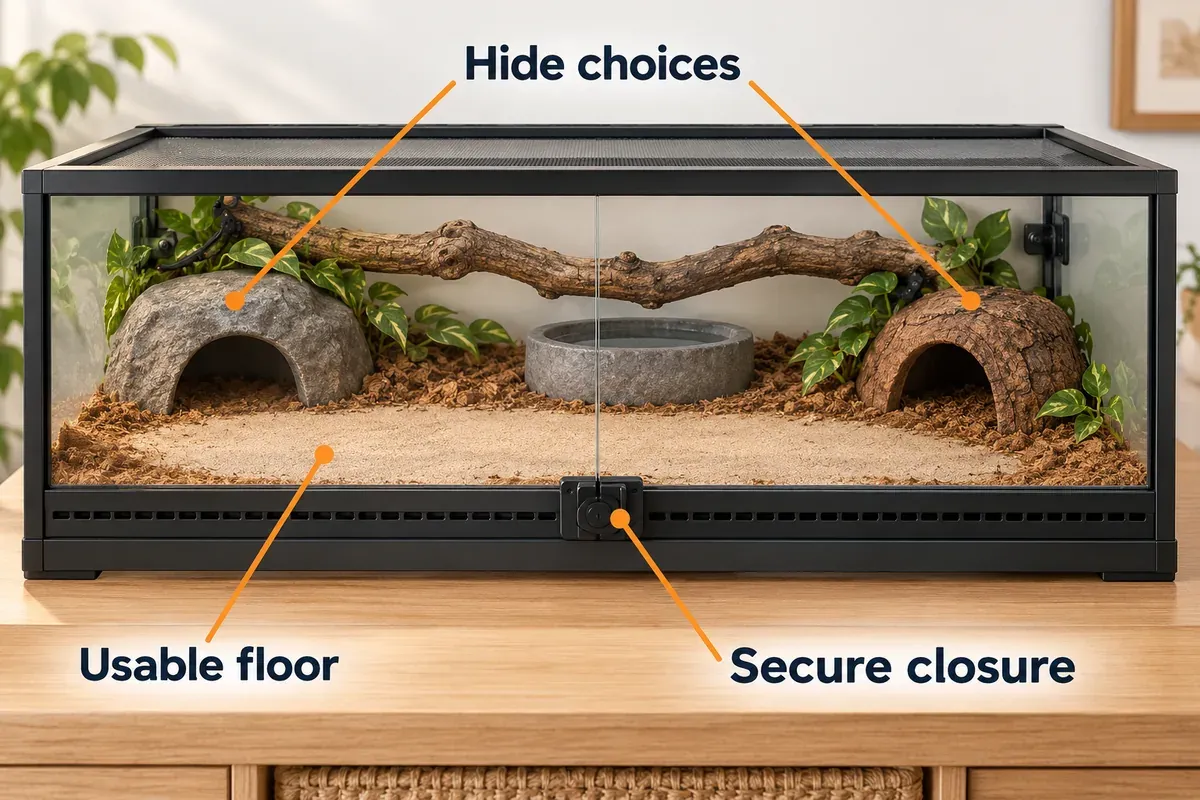
Sketch the internal floor plan at scale. Place the actual footprints of the warm hide, cool hide and water bowl on it. Add the bases of branches and any large decorations. Can the snake travel between sheltered areas without squeezing behind a bowl or climbing over every object?
Both hides need to accommodate the whole snake. A decorative cave with a large exterior footprint may have a surprisingly small internal chamber. Check its opening and interior separately. Positioning two hides together at one end does not provide the same choice as shelter at both temperatures.
Height also disappears quickly. Substrate raises the floor; a branch raises the snake toward the heater; an internal lamp guard projects down from the roof. Work from the highest place the snake can reach when checking lamp clearance. The empty-box height alone cannot establish a safe installation.
Gallons do not describe the layout
“85 gallon” and “120 gallon” are product labels, not measures of useful floor area. The two Phailozoo models have the same stated 48 × 24-inch footprint; the taller one adds six inches of overall height. That extra height can make furnishing easier, but it does not accommodate a longer snake.
Nor does a gallon label mean the enclosure can hold that volume of water. A ventilated reptile habitat with panel joints must not be treated as an aquarium.
The four models: where each fits and where it does not
1. Phailozoo REPMAC-120G: more height for a furnished setup
The REPMAC-120G has nominal dimensions of 48 × 24 × 24 inches (121.9 × 61 × 61 cm). Its construction combines an aluminum frame, PVC back and bottom, acrylic sides, tempered-glass doors and a coated steel screen roof. Calling it an all-glass tank would be misleading.
The extra height over the 85G gives you more room to arrange branches and shelter while planning the heating system. Clear sides let you observe the enclosure from several directions. You still need to provide cover inside so the snake can move out of view.
Advantages
- Twenty-four inches of stated overall height leaves more design room than the 18-inch model.
- Front access can make bowl changes and spot cleaning easier to reach.
- The manufacturer identifies the individual panel materials, so you can check cleaning and equipment compatibility for each surface.
Limits and exclusion cases
Phailozoo does not distinguish a measured usable interior in the cited specification. Get that measurement before buying for an animal approaching four feet long. Treat the screen roof as an open ventilation surface; PVC at the back and base does not make the enclosure behave like a solid-roof vivarium.
Confirm the closure hardware for the exact enclosure. Phailozoo’s help center provides lock suggestions for snake keepers. A sliding door that feels stiff is not a substitute for an appropriate lock.
Choose it if its confirmed interior fits your snake and you want the taller of these two Phailozoo models. Rule it out if you cannot secure the doors, establish safe lamp clearance, or maintain the required environment through the screen roof. For a snake longer than its usable interior, buy a longer enclosure.
Check current price on Amazon →2. Reptile Habitats 4x2x2: opaque PVC walls, with a generation check
Reptile Habitats uses PVC panels in an aluminum frame with a screen roof. The V3 product documentation describes glass doors and an acrylic front viewing panel. The opaque sides can be useful when you want to limit exposure to activity outside the enclosure.
The strongest size evidence applies to V1 and V2: Dubia gives their approximate empty interiors as 47.5 × 23.5 × 23.5 inches, or 120.7 × 59.7 × 59.7 cm. The V3 product page lists exterior dimensions of 48 3/16 × 24 3/16 × 24 3/16 inches. Those are separate specifications for separate generations. Confirm which one you are buying; a product-family name or photograph is insufficient.
Advantages
- V1/V2 have an explicit internal-size reference for planning.
- Opaque side and back panels provide a different viewing arrangement from the Phailozoo acrylic sides.
- Dubia’s heating and lighting guidance describes mounting fixtures on support bars or above the screen. Equipment-specific clearance and guarding still apply.
Limits and exclusion cases
This is a screen-top PVC enclosure, not evidence that every PVC habitat retains humidity equally well. Its materials do not establish an electricity-saving percentage or prove it will work in an unheated room. Before planning a wet substrate bed, confirm the base’s sealing requirements and support the fully loaded enclosure as instructed.
Choose it if you prefer opaque walls and can verify the dimensions and equipment arrangement for the exact generation. Rule it out if your snake exceeds that interior length, or if the seller cannot identify the generation when your purchase depends on its size or mounting hardware. Do not substitute V1/V2 figures for unconfirmed V3 interior measurements.
Check current price on Amazon →3. New Age Pet ECOFLEX Mojave 48-inch: useful dimensions, a shorter interior
The Large Mojave EHRML17-05L measures 48 × 24 × 24 inches outside and 46.5 × 22.3 × 21.4 inches (118.1 × 56.6 × 54.4 cm) inside. Its wood-plastic composite panels, side vents, mesh roof and removable sliding doors with a lock make it a different construction from either PVC/aluminum model.
The interior dimensions are useful precisely because they expose the limit. You can check the fit before purchasing. A snake shorter than that usable length may fit with a suitable layout; an animal already measuring four feet does not meet this guide’s length criterion here.
Advantages
- Separate internal and external measurements make planning more reliable.
- Removable doors provide access for maintenance.
- The manufacturer publishes assembly guidance and distinct warranty terms for the composite and other parts.
Limits and exclusion cases
The Mojave FAQ gives an approximate 2.5-inch (6.4 cm) bottom depth for the 48-inch unit. That matters when planning substrate containment. It is not a water-depth rating. A deeper planted bed needs a suitable retaining arrangement without burying vents or interfering with the doors.
The 48-inch assembly manual, printed page 2, warns of fire risk if heat lamps sit directly on ECOFLEX material. Make sure a fixture cannot contact the composite rim. Follow both the enclosure and heater instructions.
Choose it if its shorter interior still provides your snake with adequate room and your setup works with the ventilation and substrate barrier. Rule it out for a 48-inch snake, a lamp arrangement that rests on the composite, or a deep substrate plan that obstructs the enclosure’s intended openings.
Check current price on Amazon →4. Phailozoo REPMAC-85G: a lower enclosure with less room above the substrate
The REPMAC-85G has nominal dimensions of 48 × 24 × 18 inches (121.9 × 61 × 45.7 cm), with the same broad mix of PVC, acrylic, aluminum, glass and coated steel used in the taller model. The cited page does not provide separate usable internal dimensions.
The lower profile may fit a particular installation, but it is a compromise for a new long-term habitat. Substrate, climbing structures and heating clearance must all share the reduced height. An enclosure fitting a shelf is not enough if the lamp above it has inadequate clearance from that shelf.
Advantages
- The stated floor footprint matches the 120G.
- Front access remains available in a lower enclosure.
Limits and exclusion cases
Phailozoo expressly states that the 85G bottom is not leakproof and calls for secondary silicone sealing for a bioactive build. Use only a sealant suitable for the intended materials and animal enclosure, following its full curing instructions before occupancy. Sealing joints does not establish a load rating or approval for standing water.
Consider it only if the snake fits and your finished layout preserves useful climbing space and safe heating distances. For a new setup with enough installation height, we would favor the taller model on layout grounds. Rule out the 85G if an internal guard, deep substrate or raised hide leaves inadequate clearance. Its long side is no longer than the 120G’s.
Check current price on Amazon →Heating: check the whole gradient, not just the thermostat display
The RSPCA care sheet uses 30–32°C (86–90°F) at the basking zone and 24–26°C (75–79°F) at the cool end, checked at animal level. See the RSPCA care sheet.
The Merck Veterinary Manual describes thermostat-controlled heaters, screened from the animal and positioned toward one end to create a gradient. A warm reading in one spot does not demonstrate that the rest of the enclosure is suitable.
Plan the heater before buying the enclosure
Decide where the fixture mounts, how its cable exits and what prevents contact with the hot element. Check the fixture’s wattage limit, the heater’s required orientation and the minimum distances specified for surrounding materials and the animal. Include access for replacing the bulb without dismantling the habitat.
Use a compatible thermostat for every heat source. Control types are not interchangeable for all heaters. For example, Arcadia’s Deep Heat Projector guidance specifies thermostat control and recommends a dimming thermostat. Its published temperature-versus-distance table also shows why moving a branch closer to a heater can change exposure substantially. Those manufacturer figures are not temperatures measured in your enclosure.
With the habitat fully furnished, check:
- The warm retreat and basking area at snake level.
- The cool retreat after the heating has run for several hours.
- The highest accessible branch or hide roof beneath the heater.
- Overnight temperatures with the normal light schedule.
- Whether the probe stays securely in its intended position when doors are opened and furnishings serviced.
Use digital thermometers for air or probe measurements and an infrared thermometer for accessible surface checks. An infrared thermometer does not measure air temperature. Read surfaces directly rather than through the glass, and do not assume its reading equals the temperature inside a closed hide.
The thermostat display is not a substitute for these measurements. Depending on the installation, its probe may be nearer the heater than the snake’s resting place. Follow the probe-placement instructions and confirm the resulting habitat temperatures with separate instruments.
A material label cannot solve an unsuitable room
A thermostat can reduce heater output; it cannot cool an enclosure below an overheated room. Similarly, one strong hot spot can coexist with an excessively cold cool end. Record the room’s daytime and overnight conditions before buying equipment.
If the intended room stays too cold or too hot, address the room or choose a different location. Do not rely on promises that PVC automatically makes a basement suitable. There are no comparative heat-loss measurements here that justify a fixed wattage, a percentage saving, or a payback period for these models.
Heat mats are also not universally compatible with every base. Check both manufacturers’ instructions for material, placement, airflow beneath the unit and thermostat-probe position. The fact that a mat physically fits underneath a panel does not establish safe use. Our reptile heat mat guide covers the equipment checks in more detail.
Humidity and ventilation: keep moisture without losing air exchange
Merck lists 50–80% relative humidity for ball pythons. The RSPCA describes a cool-end baseline of 50–60%, with temporary boosts toward 80% and a drop between misting. These are different ways of expressing a care range and routine, not proof that one fixed percentage must appear everywhere all day. Merck husbandry reference, RSPCA humidity guidance.
All four enclosures in this comparison have mesh or screen roofs. The Mojave also has side ventilation. In a dry room, those openings can make retaining moisture harder; in a damp setup, air exchange helps the enclosure dry. The useful question is whether you can maintain the intended conditions with the ventilation and heating installed as directed.
Run the enclosure through its normal day
Use a hygrometer in a consistent position at the cool end, away from direct spray, the wettest substrate and water splashes. Record the accompanying temperature. Relative humidity depends on temperature, so a lower reading near the heater does not necessarily mean the whole enclosure needs more water.
Look underneath hides as well as at the display. A wet resting surface and a humid air reading describe different conditions. You need to know whether moisture stays in the substrate’s lower layers, pools at the base, leaks through a joint, or leaves the surface persistently wet.
If humidity falls too quickly, check the gauge, substrate, room and enclosure openings in that order. Use only ventilation adjustments permitted by the enclosure manufacturer, preserving the heater’s clearances. There is no universal safe percentage of mesh to cover. Blocking every opening to hold a number can create a different problem.
If acceptable humidity requires repeated soaking or compromises the heating installation, choose a different enclosure design. A purpose-built solid-roof vivarium with planned vents may better suit that room. It still requires measurement and suitable equipment.
For a step-by-step diagnosis, use our ball python humidity troubleshooting guide. Recurring shedding problems or signs of illness need a reptile veterinarian’s assessment; changing enclosures is not a diagnosis.
Glass, acrylic, PVC, ECOFLEX and tubs: compare the construction
The enclosures above are mixed-material products. Evaluate each part rather than treating “glass” or “PVC” as a complete specification.
| Construction | What to examine | Practical limit |
|---|---|---|
| Glass panels or doors | Edges, tracks, locks, support and cleaning access | A glass door does not make a panel-built habitat watertight; damaged glass needs replacement |
| Acrylic panels | Manufacturer-approved cleaning tools and chemicals; panel movement in its frame | Avoid assuming that cleaners or sealants intended for glass are suitable for acrylic |
| PVC panels with an aluminum frame | Panel thickness, seams, mounting points, floor support and roof design | A screen roof still exchanges air; no measured insulation value is established by the word PVC |
| ECOFLEX composite | Internal size, vents, substrate barrier and heat-lamp placement | The Mojave manual prohibits resting heat lamps directly on the composite |
| Plastic tub with a lid | Clear dimensions, secure closures, ventilation, heat compatibility and enrichment space | Storage volume and snap handles alone do not establish suitability as permanent housing |
A well-designed enclosure should let you inspect and clean the joints where waste collects. Think about whether you can remove a large bowl through the door, reach beneath a hide and replace a damaged closure. These daily tasks affect long-term usefulness more directly than a claimed assembly time.
Why a shallow rack tub is a different proposition
Plastic itself does not decide whether housing is appropriate. A shallow tub that prevents full extension or cannot accommodate useful climbing structures fails the same checks as an undersized glass enclosure.
In a 2021 study by Hollandt, Baur and Wöhr, 35 ball pythons were observed first in rack housing and later in furnished terrariums. The terrariums allowed a broader range of behaviors, including climbing, burrowing, bathing and basking; abnormal behaviors were observed predominantly in the rack system.
The study changed several conditions together, including space, furnishings and lighting. It does not isolate PVC versus glass, prove a particular commercial model is best, or quantify a benefit from front-opening doors. Its practical value here is the case for providing behavioral opportunities when assessing a habitat.
For permanent housing, apply the same size, environment, security and enrichment requirements to a tub. A transport container or a veterinarian-directed temporary setup has a different purpose and should not become the long-term plan by default.
The layout below highlights the space and closure checks to make before selecting the shell; heating and humidity still need their own assessment.
Rule out an enclosure when any of these checks fails
These are purchase exclusions, not minor disadvantages to balance against color or price.
| Finding | Decision |
|---|---|
| The clear internal length is shorter than the snake | Choose a longer enclosure; extra height or diagonal space does not fix this criterion |
| The seller gives only outside dimensions and the snake is close to that length | Obtain the usable interior measurement before ordering |
| The finished habitat cannot contain both a suitable warm retreat and a cool retreat | Increase usable space or change the layout before considering the setup complete |
| The heater, lamp guard or elevated furnishings cannot meet required clearances | Choose a taller enclosure or a documented alternative heating arrangement |
| Humidity works only with soaked resting surfaces or blocked required ventilation | Change the setup or enclosure design; do not accept the display number alone |
| Doors can move, ports remain open or panels disengage under normal handling | Repair or replace the enclosure before introducing the animal |
| A planned water feature depends on an unverified panel base holding water | Use a purpose-built, appropriately supported watertight design |
| The room becomes too hot for a cool retreat or too cold for the system to maintain it | Resolve the room conditions or relocate the habitat |
There is no universal “escape-proof” door-gap measurement established for all snakes and all these models. Assess the actual animal, every opening and the assembled hardware. Check cable ports after routing probes; an unused opening or a poorly fitted cover can defeat an otherwise secure enclosure.
Set up and check the habitat before the snake moves in
The RSPCA recommends running a new vivarium for a week before occupancy. Use that time with the final substrate, hides, bowl, branches and equipment in place. An empty enclosure’s readings are not a complete check of the habitat the snake will use.
- Inspect the assembled shell. Check joints, screen fixings, panel seating, door travel and closures. Confirm that the stand supports the enclosure as required and remains stable when doors are opened.
- Fit the habitat. Secure branches against rolling or falling. Keep access to hides and water clear. Make sure heavy furnishings cannot shift when substrate is disturbed.
- Install and control the heat. Follow the heater, thermostat and enclosure manuals together. Secure probes and cables without leaving accessible sticky surfaces, loops or open ports.
- Record a complete day and night. Note the warm area, cool retreat, accessible surfaces, cool-end humidity and room conditions. Repeat after each meaningful adjustment.
- Check routine maintenance. Remove and refill the bowl, open and lock the doors, and reach the areas that need spot cleaning. Verify that none of these tasks displaces a probe or leaves a gap.
- Confirm the final arrangement. Do not introduce the snake while temperature, moisture, sealing or escape-prevention problems remain unresolved.
Plan a day/night lighting cycle with shaded retreats. If installing UVB, follow the specific lamp’s guidance for the species, distance and intervening mesh. A bulb percentage or a claim of “full light penetration” does not tell you the exposure at snake level. Our guide to UVB through mesh and glass explains those placement checks.
Before stacking enclosures, confirm the support system, access and fixture clearance for the exact model. The space between two boxes must accommodate the permitted installation, including cables and ventilation. Stacking compatibility does not mean a lamp can be squeezed into any remaining gap.
Long-term suitability: growth, repairs and running costs
An enclosure can remain physically intact after the animal outgrows it. Recheck usable space as the snake grows and whenever you add a background, larger hides or a deeper substrate bed. Plan an upgrade around the animal’s measured needs rather than a fixed birthday or a claimed adult gallon size.
We found no comparative service-life testing that supports promises such as “this tank lasts 15–20 years” or “PVC pays for itself in two years.” Warranty coverage is useful, but it answers a different question. New Age Pet’s written warranty gives ten-year limited coverage for specified ECOFLEX defects and one-year defect coverage for non-ECOFLEX parts, with exclusions. It does not promise that every part will last ten years.
Before buying, find out how to obtain replacement doors, tracks, locks, port covers and screen parts for the exact generation. Keep the model number and instructions. A replacement listed for another size or revision may not fit even when the brand is the same.
Check locks, screen fixings and cable ports during normal care, and inspect joints whenever you clean. Repair any loss of security before the animal returns. Follow both enclosure and disinfectant instructions; use the required contact time, rinsing and drying procedure, and keep the snake in secure temporary housing while cleaning.
Budget for the complete habitat
Compare the cost of the enclosure together with its stand or support, compatible heating, thermostat, measuring instruments, lighting, guards, hides, water bowl and furnishings. A shell with a lower purchase price may leave more equipment to buy. None of the four should be assumed to be a complete, ready-to-use ball python setup.
For electricity, measure actual consumption across representative day/night cycles with a suitable energy meter. Multiply the measured kilowatt-hours by your electricity tariff. A heater’s rated wattage tells you its maximum draw, not how long a thermostat will run it. Seasonal room changes affect consumption, so a short measurement in mild weather is not a reliable annual forecast.
Frequently asked questions
Is a 4x2x2 enclosure big enough for an adult ball python?
Only if the snake fits the usable interior and the furnished habitat provides adequate depth, height and environmental choices. Many products are named for outside or nominal dimensions. Measure before deciding. A snake longer than the clear internal long side needs a longer enclosure under the criterion used here.
Can a baby ball python live in a large enclosure?
The RSPCA allows for sheltered spaces within a larger vivarium. Check every opening for the smaller animal, fit suitably sized hides, and verify that water and thermal retreats are accessible. Do not assume that extra floor space itself causes feeding refusal.
Is PVC always better than glass for humidity?
No. Roof design, vents, seams, substrate and room conditions all matter. The Reptile Habitats model here has a screen roof, and the Phailozoo models already contain PVC panels. Compare complete constructions and measured conditions rather than relying on the material in the product name.
Can I use a 40-gallon enclosure permanently?
The gallon label cannot answer that. Check the actual clear length against the animal, then assess the full layout. If a particular enclosure is shorter than the snake, it fails this guide’s length criterion regardless of its nominal capacity. Feeding normally does not by itself demonstrate that the enclosure provides enough space or behavioral opportunities.
Is the Phailozoo 85G equivalent to the 120G?
They have the same stated footprint, but the 85G is six inches lower overall. That reduces space for branches, substrate and heating clearance. Choose by the finished arrangement; the smaller model does not save floor space.
Does a bioactive setup make any of these suitable?
No. Plants and cleanup organisms do not solve inadequate size, unsafe heat or insecure doors. Check substrate containment, wet weight, base sealing and ventilation first. If the manufacturer has not approved a planned wet installation, do not assume moisture-resistant panels are enough.
Which enclosure is most escape-resistant?
We have no comparative escape testing to rank them. A suitable lock, correctly seated panels, secured roof and closed cable ports all matter. Inspect the assembled enclosure and continue checking it during use; no product label replaces those checks.
Can two ball pythons share a larger enclosure?
Choose separate housing, as recommended by the RSPCA. The layouts in this comparison are for one snake. Plan and monitor a complete habitat for each animal.
Which enclosure should you choose?
For a snake that fits the verified interior, start with the taller Phailozoo REPMAC-120G or a correctly identified Reptile Habitats 4x2x2 if you want more room to furnish vertically. Their different side panels may influence your choice, but both need a workable screen-top heating and humidity arrangement.
The Mojave 48-inch is an option only within its smaller internal dimensions and installation limits. The Phailozoo 85G needs a more constrained layout; for a new permanent habitat, its reduced height deserves particular scrutiny.
Before ordering, write down the snake’s length, the enclosure’s clear internal dimensions, the hide and bowl footprints, and the planned heater clearance. If a candidate fails one of those checks, move to a larger or more suitable design, even if that means choosing outside this shortlist.
Sources and further reading
- RSPCA: royal python care and detailed care sheet: space, shelter, environmental checks and individual housing.
- Merck Veterinary Manual: management and husbandry of reptiles: humidity ranges, thermal gradients and heating safety.
- Hollandt, Baur and Wöhr, 2021, PLOS ONE: behavioral comparison of rack housing and furnished terrariums; not a commercial enclosure test.
- Phailozoo REPMAC-120G, REPMAC-85G and help center: model specifications, materials and closure guidance.
- Dubia V1/V2 interior dimensions, V3 product specification and fixture installation guidance: generation-specific dimensions and mounting arrangements.
- New Age Pet Large Mojave, Mojave FAQ, 48-inch assembly manual and written warranty: dimensions, substrate barrier, heat warning and coverage limits.
- Arcadia Deep Heat Projector guidance: thermostat compatibility and the effect of lamp distance.