

 Published sources
 Product details checked
Ball python humidity is easy to misread because the number on the display is only one part of the enclosure. A cool-side reading of 55% can be reasonable in one setup, while the same number may be misleading in another if the probe is buried in wet bedding, sitting under a heat source, or reading a room instead of the snake’s activity zone.
Quick answer: First verify the hygrometer, then record the cool side and warm side across a full day. A practical starting point is the 50–60% cool-end range described by the RSPCA’s royal python care guidance, with a controlled rise during shed or after adding moisture. Persistent readings below roughly 40% or above 80% deserve investigation, but duration, temperature, wet substrate, ventilation, and the snake’s condition matter more than one isolated reading.
This guide keeps both directions on one page: how to tell whether the enclosure is genuinely too dry or too wet, what to check in the hygrometer, substrate, ventilation, water bowl, heat source, and room, and how to reset the setup without swinging from one extreme to the other.
In this guide, you’ll learn:
- Which humidity ranges are useful working bands—and why reputable guides do not all use the same number
- How to find a bad reading before changing the enclosure
- How substrate, ventilation, the water bowl, heat, and room climate change relative humidity
- A safe reset for humidity that is too low or too high
- Which inexpensive tools help diagnose the real cause and which problems need a reptile veterinarian
-
Zoo Med Digital Thermometer Humidity Gauge TH-31
Zoo Med
Compact digital combination gauge with a probe for tracking the enclosure environment without relying on analog dials.
- One display shows temperature and relative humidity
- Probe can be positioned where the reading matters instead of stuck to the glass
- Min/max memory helps reveal overnight swings
- Best for
- Simple daily checks of ambient temperature and humidity
-
Govee Smart Bluetooth Thermometer Hygrometer H5074
Govee
Product selected for the stated use case; confirm fit with the manufacturer's specifications.
- Historical readings, alerts, and export in the phone app
- Bluetooth range is described as up to 262 feet in open conditions
- Useful for spotting overnight humidity trends rather than only reading one moment
- Best for
- Trend tracking, phone alerts, and a second humidity check
-
Boveda One-Step Hygrometer Calibration Kit 75% RH
Boveda
A sealed 75% RH test pack for checking digital or analog hygrometers before changing a ball python enclosure.
- Controlled 75% RH calibration test
- Useful for digital and analog hygrometers
- Helps identify a bad sensor before a substrate or ventilation reset
- Best for
- Checking whether a hygrometer is reading accurately
-
Etekcity Lasergrip 774 Infrared Thermometer
Etekcity
Non-contact infrared thermometer with laser targeting, adjustable emissivity, and a 12:1 distance-to-spot ratio.
- Reads surface temperature quickly without moving hides or touching the reptile
- 12:1 distance-to-spot ratio is practical for a terrarium
- Adjustable emissivity improves readings across slate, glass, and other surfaces
- Best for
- Calibrating basking and cool-side surface temperatures
-
REPTIZOO TC02 Dimming Thermostat
REPTIZOO
PID-style dimming thermostat with a digital display, memory function, and probe for controlling light-emitting reptile heat sources.
- Dimming output is better suited to overhead lamps than a simple on/off switch
- Digital display makes the set point easy to check
- Memory function helps preserve settings after a power interruption
- Best for
- Dimming control for an overhead halogen or deep-heat projector
Review the linked product page before purchasing.
Humidity Is a Cycle, Not a Single Pass/Fail Number
There is no single number that every ball python enclosure must display every minute. The Merck Veterinary Manual’s husbandry table lists 50–80% for ball pythons. The RSPCA gives a more specific operational routine: measure at the cool end around 50–60%, raise humidity to about 80% when misting, and allow it to fall again. PetMD’s veterinary care sheet uses a lower 40–60% range and suggests a rise during shedding, while the ReptiFiles humidity guide describes a more humid 60–80% approach.
Those recommendations are not identical, so do not turn one source into a magic cutoff. The useful common ground is a measurable gradient, access to a more humid microclimate during shed, clean and ventilated air, and no permanently saturated floor. Use the following as working bands for diagnosis, not as a substitute for species- and snake-specific veterinary advice:
| What you observe | What it usually means | First move |
|---|---|---|
| Cool end around 50–60% for most of the day | A reasonable RSPCA-style baseline | Keep the routine stable and continue recording trends |
| A temporary rise toward 70–80% after misting or during shed | A controlled humid period can be useful | Check that surfaces dry and fresh air still moves through the enclosure |
| Below 40% for several hours or most of the day | Too dry for many ball python setups | Verify the gauge, room humidity, substrate, and screen coverage |
| Above 80% for long periods with wet bedding, mold, odor, or no dry-down | Too wet for this enclosure, even if the number is otherwise tolerated briefly | Stop adding water and improve drying and ventilation |
Relative humidity also changes with temperature. A warm-side sensor can read lower than a cool-side sensor even when both are in the same enclosure. That is why the cool end is a useful reference point, while a separate thermometer confirms the heat gradient.
Start With a 24-Hour Baseline
Changing three things at once makes humidity problems harder to solve. Before adding water, covering mesh, or replacing substrate, record what the enclosure is doing:
- Write down the room temperature and room humidity.
- Note the hygrometer’s exact position, including height and distance from the water bowl.
- Record the cool-side humidity and temperature after the lights or heat source have been on for a while.
- Record the warm-side temperature at the hide or basking surface, not just the air near the ceiling.
- Check the readings after any misting, watering, spilled bowl, or substrate change.
- Repeat the cool-side reading before the next mist or water adjustment.
If the number jumps from 45% to 95% whenever the sensor is sprayed, the gauge is measuring droplets rather than enclosure air. If a room sensor reads 35% while a properly placed enclosure sensor stays at 60%, the room is not the whole answer. The goal is to find the pattern that the snake actually experiences.
1. Hygrometer: Is the Reading Trustworthy?
Place the sensor where the snake lives
Use a digital thermometer/hygrometer rather than relying on a small analog dial. Place the humidity sensor near the middle of the enclosure, around the snake’s normal activity height, and away from the spray path, water bowl splash, direct heat, and the wettest substrate corner. An external probe is useful because the display can stay outside the enclosure while the sensor sits in the right zone.
Do not bury the probe in bedding. That measures a damp material, not the air around the snake. Do not put the sensor directly below a lamp or on a warm glass wall either; warm air can produce a lower relative-humidity reading and make you overcorrect with water.
Calibrate or cross-check before rebuilding the enclosure
A new gauge can be wrong, and a correct gauge can drift. A 75% salt-based calibration kit such as the Boveda One-Step Hygrometer Calibration Kit gives you a controlled test in an airtight bag or container. Follow the kit instructions, wait the full test period, record the offset, and retest if the sensor allows adjustment. Do not place the calibration pack inside the snake’s enclosure.
The Zoo Med TH-31 is a straightforward always-on display with an external probe. It is a sensible primary gauge when you want to see the reading without opening the doors, but it is not a laboratory reference. The Govee H5074 is more useful for trend tracking: its Bluetooth app can reveal whether humidity falls sharply overnight or stays high all day. Bluetooth is not the same as an away-from-home Wi-Fi alarm, and neither device should sit in direct mist.
Fast diagnosis: If two sensors placed side by side disagree by more than a few percentage points, pause enclosure changes. Test or replace the suspect sensor first.
2. Substrate: Moisture Retention Without a Wet Floor
Substrate is the enclosure’s moisture reservoir. A shallow layer of dry paper bedding or aspen in a dry room may let humidity collapse quickly. A deeper, moisture-retentive substrate such as suitable cypress mulch, coconut fiber, or a reptile-safe soil mix can slow the drop and create a more stable lower layer.
The surface should not be muddy, dripping, or permanently cold and wet. A good setup can have a slightly more humid lower layer while the snake still has dry resting surfaces. A local humid hide is often safer than making the entire enclosure wet, especially outside of shedding.
Clues that substrate is causing low humidity
- The top layer is thin, dusty, or bone dry within a few hours.
- The enclosure has a large screen top and little moisture-retentive material.
- Humidity rises briefly after spraying and then collapses.
- The snake repeatedly has a poor shed while the room is dry.
Correct it gradually. Use a suitable substrate at an appropriate depth, add measured moisture to the lower layer rather than spraying the snake, and keep the surface clean and usable. A controlled humid hide can provide a shed-time option without turning every hide into a damp box.
Clues that substrate is causing high humidity
- Bedding is wet when squeezed rather than merely moist below the surface.
- Water has pooled under the hide or in a corner.
- You see mold, a sour smell, or waste staying wet for too long.
- The gauge stays high all day and the enclosure never has a dry-down.
Remove saturated or soiled material, clean the affected area, and replace only what is needed. Never use cedar or pine shavings. PetMD’s ball python care sheet also warns against those woods and notes that wet or molded substrate needs attention.
3. Ventilation: The Most Common “Too High” Clue
Humidity retention and ventilation are not opposites. A good enclosure holds moisture in the substrate while exchanging stale air through deliberately placed vents. The RSPCA recommends a well-ventilated vivarium and specifically warns that constantly high humidity needs more ventilation to limit bacterial and mold buildup.
If humidity is too high
Increase cross-flow gradually. Remove a cover from part of a screen, open an adjustable vent, or use the enclosure’s designed ventilation rather than sealing the tank tighter. Check whether the water bowl is splashing or sitting in the warmest area. A fan blowing directly into the enclosure is not a substitute for correct vent placement and can dry one zone too quickly.
Do not seal every gap to force a number down or up. The snake needs fresh air, and heat equipment needs the clearances specified by the enclosure and fixture manufacturers. If high humidity returns after every cleanup, the enclosure may be too closed for the amount of water being added, or the room may already be very humid.
If humidity is too low
A full-screen enclosure in a dry, heated room may simply exchange air faster than the substrate can release moisture. Retain some moisture with suitable substrate and cover only the portion of the screen that is safe to cover, keeping the manufacturer’s ventilation and heat clearances open. A solid-sided PVC enclosure can be easier to stabilize than a bare screen setup, which is one reason material matters when choosing a ball python enclosure.
The target is controlled retention, not a sealed container. If the enclosure smells stale or the glass stays wet constantly, you have gone too far.
4. Water Bowl: Small Placement Changes Matter
Provide a sturdy bowl with fresh, clean water. The RSPCA care sheet recommends a drinking dish at the cool end and says it should be large enough for the snake to bathe if it chooses. In practice, a bowl on the warm side evaporates faster and can push humidity up; a bowl on the cool side usually gives you more control.
When humidity is too high, inspect the bowl before changing the enclosure. Look for a slow leak, a snake that has displaced it, damp bedding underneath, or a bowl large enough to create constant evaporation in a small tank. Move it to the cool side, replace wet substrate, and keep the water fresh.
When humidity is too low, moving the bowl a little closer to—not directly under—the warm zone may add evaporation, but it should not be your first or only fix. Do not raise the heat beyond the snake’s safe temperature range just to evaporate water faster. A larger bowl is not automatically better if it gets tipped or turns the floor into a wet tray.
5. Heat Source: Humidity and Temperature Must Be Read Together
Relative humidity is temperature-dependent, so a heat-source problem can look like a humidity problem. A warm enclosure can show a lower relative-humidity percentage even when the amount of water in the air has not changed. A cool, wet enclosure can show a high percentage while drying poorly.
Check the warm hide surface and cool side independently. The RSPCA’s care sheet recommends daily temperature checks at the animal’s level and notes that thermostats are not always accurate. An infrared thermometer such as the Etekcity Lasergrip 774 helps compare the hide and cool-side surfaces quickly, but it reads surfaces—not humidity or air temperature—and it cannot accurately measure through glass.
Use an independent thermometer to verify the thermostat probe. For a typical ball python setup, many keepers work around a warm hide in the high 80s to low 90s Fahrenheit and a cool side in the mid-to-high 70s; the exact target depends on the enclosure, heat source, and veterinary care plan. The reptile thermostat guide explains why a thermostat is control equipment, not proof that the enclosure is actually at the displayed temperature.
The REPTIZOO TC02 dimming thermostat can be useful with a compatible dimmable heat source, but it does not control humidity. Do not connect a heater to a thermostat without checking the device’s load, probe placement, and heater compatibility, and do not skip the independent temperature check.
6. Room Climate: The Enclosure Is Not an Island
The same enclosure behaves differently in a dry winter room, an air-conditioned apartment, and a humid basement. Measure the room near the enclosure, not beside a radiator, open window, or direct sun. The RSPCA also advises keeping a vivarium away from drafts and external heat sources because they change temperature and humidity behavior.
A dry room usually creates “too low” symptoms
Heating and air conditioning remove moisture from room air. If your enclosure falls quickly after every correction, check the room before buying a fogger. A room humidifier can help the overall climate in some homes, but it must be kept clean and should not blow mist directly into the enclosure. Adding a humidifier without measuring the room and enclosure can simply create a wet, poorly ventilated corner.
A damp room can hide an enclosure problem
High room humidity does not guarantee healthy enclosure air. If the enclosure has little cross-flow, waste and wet substrate can keep the floor damp even when the room reading looks normal. Clean the enclosure, improve fresh-air exchange, and look at the snake’s actual zone rather than using the room gauge as a proxy.
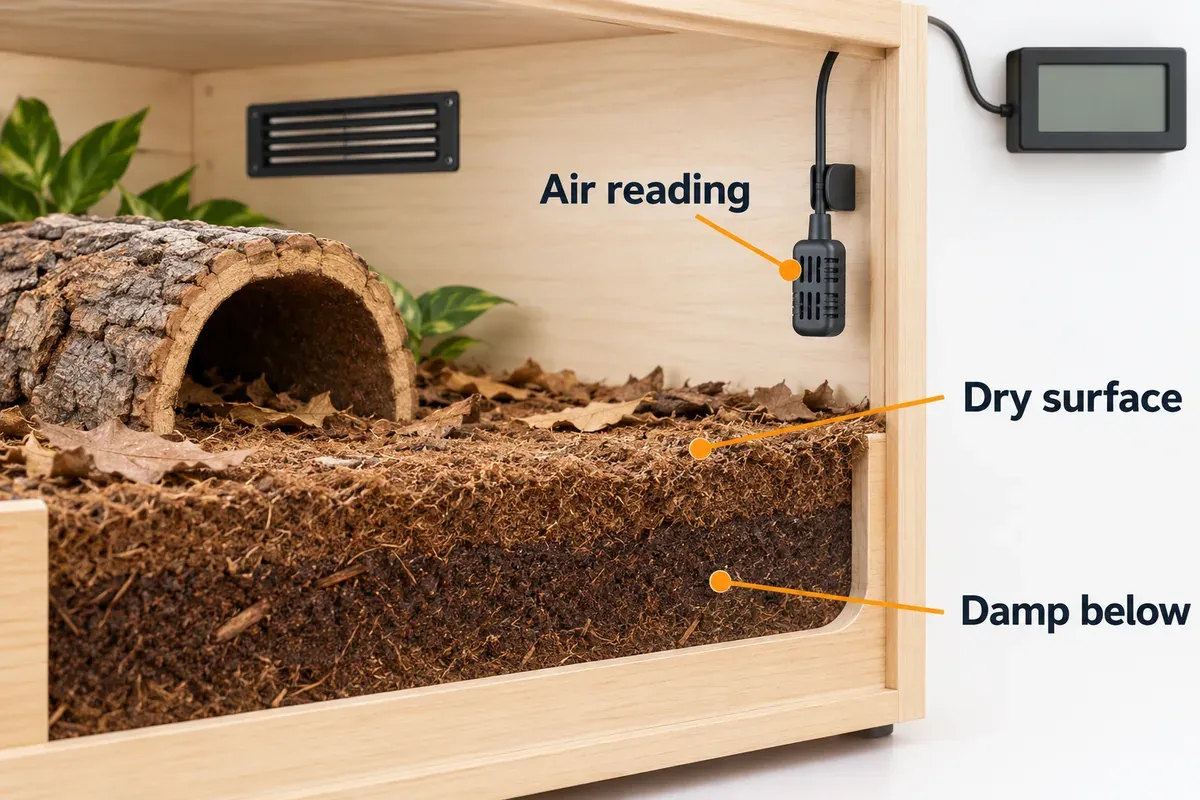
The air reading and the condition of the bedding answer different questions. Check both before adding water or changing ventilation.
Safe Reset When Humidity Is Too Low
Use this order so you do not create a new problem while fixing the first one:
- Verify the reading. Cross-check the hygrometer or run a calibration test.
- Check temperatures. Confirm that the thermostat and independent thermometers are working before adding water.
- Improve the moisture reservoir. Use an appropriate, clean moisture-retentive substrate at a sensible depth.
- Reduce unnecessary moisture loss. Cover only a safe portion of the screen or adjust the enclosure’s designed vents while preserving fresh-air exchange.
- Check the water bowl. Keep it stable, clean, and on the cool side; move it only in small steps if evaporation is part of the measured plan.
- Add a humid hide for shedding. Keep the hide clean and moist, not flooded, and let the rest of the enclosure remain usable.
- Recheck for 24 hours. Record the lowest and highest readings before making another change.
Avoid making a fogger the default solution. Fogging can create wet surfaces and fine droplets without fixing a dry substrate, a screen-heavy enclosure, or a bad hygrometer. If a mister is used for a specific routine, it should be controlled by measured results and paired with cleaning and ventilation—not used on autopilot. If the pump loses prime, leaks, or stops delivering the planned mist, use our reptile misting system troubleshooting guide to test the water path before changing humidity targets.
Safe Reset When Humidity Is Too High
Persistent high readings call for drying the enclosure safely, not overheating the snake:
- Stop adding water temporarily. Pause misting and do not pour more water into the substrate.
- Remove the wettest material. Replace saturated bedding and clean waste immediately.
- Open the intended airflow path. Adjust vents or screen coverage so stale air can leave.
- Inspect the bowl. Move it to the cool side and check for spills or leaks.
- Verify heat and ventilation together. A correct warm zone should support normal drying; do not raise heat past the care plan.
- Watch for dry-down. The enclosure should not remain at the same high reading around the clock.
- Recheck after a full day. If the reading remains high with wet surfaces, revisit the room, enclosure design, and sensor location.
Temporary humidity spikes are not automatically dangerous. The concern is a persistently wet, dirty, stagnant enclosure or a snake showing illness. If there is mold, scale damage, or a sour smell, prioritize cleaning and veterinary advice rather than trying to balance a percentage alone.
When a Humidity Problem Becomes a Health Problem
Humidity changes can contribute to abnormal shedding, dehydration, skin irritation, and respiratory stress, but they do not diagnose disease. Merck explains that low humidity can contribute to abnormal shedding and that moist, contaminated bedding can contribute to scale disease. VCA’s snake disease guide lists nasal discharge, excess mouth mucus, lethargy, wheezing, gurgling, and open-mouth breathing as respiratory warning signs.
Contact a reptile-experienced veterinarian promptly if your ball python has open-mouth breathing, repeated wheezing or clicking, bubbles or mucus around the nose or mouth, marked lethargy, loss of appetite with other symptoms, red or blistered scales, or skin that remains stuck in rings. Do not try to treat a suspected respiratory infection by guessing at humidity, using medication intended for another species, or forcing a bath. Correct the enclosure while arranging professional care.
Diagnostic Tools: What Each Product Can—and Cannot—Tell You
The product choices below are tools for answering a specific question.
Zoo Med TH-31 — Best for a simple primary readout
The Zoo Med TH-31 is the least complicated option in this group: a digital temperature-and-humidity display with an external probe.
Use it when you want a visible reading near the enclosure and a probe that can sit in the cool-side activity zone. It does not give you a humidity history, and its number is only useful if you keep the probe out of direct water and wet substrate.
Best for: A single enclosure and simple daily checks. Not for: Remote alerts, data logging, or replacing a thermostat probe.
Govee H5074 — Best for finding overnight swings
This is useful when the enclosure looks fine at 8 p.m. but dries out by morning, or when you suspect the humidity stays high while you are away. It is a room-style sensor rather than a waterproof reptile probe, so protect it from spray and treat it as a trend logger or second opinion.
Best for: Diagnosing timing and seasonal changes. Not for: Direct misting, water exposure, or true away-from-home monitoring without a compatible connection.
Boveda 75% Calibration Kit — Best for testing the gauge itself
Use it in an airtight bag or container according to the instructions, then compare the sensor’s displayed value with the expected test value. It is especially useful when two gauges disagree. Remember that a calibration check at 75% does not prove perfect accuracy at every lower humidity, but it can expose a major sensor error before you rebuild the enclosure.
Best for: Separating a real enclosure problem from a bad gauge. Not for: Leaving inside the terrarium or adding humidity to the snake’s air.
Etekcity Lasergrip 774 — Best for checking heat surfaces
The Etekcity Lasergrip 774 helps diagnose whether the warm hide or cool-side surface is actually in the expected range.
The limitation is important: infrared thermometers measure surfaces. They do not measure relative humidity or the air inside a hide, and glass can distort the reading. Use the laser to compare accessible surfaces, then use a properly placed probe thermometer for ongoing checks.
Best for: Finding heat-source and thermostat errors that distort humidity readings. Not for: Measuring humidity or reading a surface through glass.
REPTIZOO TC02 — Best for controlled dimming of compatible heaters
This product belongs in the heat-source part of the diagnosis, not the humidity part. A thermostat can help keep a stable warm zone, but it cannot tell whether the hygrometer is correct, whether the substrate is saturated, or whether air exchange is adequate. Follow the model’s load and heater-compatibility instructions and verify the result with an independent thermometer.
Best for: A compatible dimmable heat source that needs controlled output. Not for: Controlling humidity or proving that the enclosure is safe without independent measurements.
A Simple Decision Tree
When the displayed humidity looks wrong, ask these questions in order:
- Is the sensor reading air at snake level? If not, move it before changing the enclosure.
- Do two sensors agree? If not, calibrate or replace one.
- Is the cool end different from the warm side? Compare zones instead of chasing the lowest number.
- Is the substrate slightly moist below the surface or wet throughout? Correct the substrate before changing the room.
- Is the water bowl spilling or evaporating in the warmest zone? Fix placement and leaks.
- Is the heat gradient correct? Correct temperatures with a thermostat and independent checks.
- Does the room explain the pattern? Check HVAC, drafts, sunlight, and seasonal humidity.
- Is the snake showing respiratory or skin signs? Stop experimenting and call a reptile veterinarian.
If you follow the questions in order, most humidity problems become a setup problem that can be measured and corrected—not a reason to swing between a dry tank and a saturated one.
Frequently Asked Questions
Is 50% humidity too low for a ball python?
Not automatically. The RSPCA describes 50–60% at the cool end as a normal baseline, while other care sources recommend a more humid range. If 50% is a brief warm-side reading and the snake sheds normally, the number alone is not a diagnosis. If the cool side stays near 40% or lower, the substrate is dry, or sheds are repeatedly retained, investigate.
Is 80% humidity too high for a ball python?
An 80% reading can occur during a controlled humid period or shed, but it is concerning when it stays high with wet bedding, mold, poor airflow, or no dry-down. Check the sensor location and substrate before deciding whether the enclosure is genuinely too wet.
Should I mist a ball python enclosure every day?
Not by default. Misting frequency depends on the enclosure, room, substrate, and measured cycle. Add only enough moisture to achieve a stable, clean humidity pattern, and let the enclosure dry appropriately between humid periods.
Where should a ball python hygrometer go?
Place the humidity sensor near the middle of the enclosure at the snake’s normal activity height, away from direct spray, the water bowl, the heat source, and the wettest substrate. Use another sensor if you need to compare zones.
Can a water bowl raise humidity too much?
Yes. A bowl on the warm side, a leaking bowl, or a bowl that is repeatedly tipped can add more moisture than a small enclosure can ventilate. Start with a stable, clean bowl on the cool side and inspect the substrate beneath it.
Does a thermostat control humidity?
No. A thermostat controls a compatible heat source. It may change relative humidity indirectly by changing temperature, but it does not measure or regulate moisture. Use a hygrometer for humidity and independent thermometers for the heat gradient.
What should I do if my ball python is wheezing?
Treat wheezing, clicking, gurgling, open-mouth breathing, nasal discharge, or mouth mucus as a veterinary concern. Check the enclosure while arranging a reptile-experienced veterinarian; do not attempt to cure respiratory disease by guessing at humidity or medication.
Care References and Related Guides
- RSPCA: How to care for a royal python — humidity, ventilation, water bowl, and temperature guidance.
- Merck Veterinary Manual: Important husbandry requirements for selected reptiles — a veterinary reference table that lists a 50–80% ball python humidity range.
- Merck Veterinary Manual: Disorders and diseases of reptiles — abnormal shedding, respiratory disease, and scale disease context.
- VCA Animal Hospitals: Common diseases of pet snakes — veterinary warning signs for respiratory, skin, and mouth disease.
- Ball Python Enclosure Guide — compare glass, PVC, and tub-style enclosure trade-offs.
- Reptile Thermostat Types — choose control equipment for heat sources.
- Reptile Heat Mats Guide — understand safe mat sizing, thermostat probes, and independent temperature checks.