

 Published sources
 Product details checked
A screen cage does not need to hold the same humidity all day. For a veiled or panther chameleon, first check whether the low reading occurs during the warmer daytime drying period or the cooler nighttime humidity period. Then verify the sensor and compare cage conditions with the room. A full-screen enclosure exchanges air readily, so humidity often falls toward the room level after misting. Chameleon Academy’s screen-cage guide explains why adding more spray may leave more water on the floor without maintaining a different air humidity.
Start with the species and day/night table, measure temperature beside each humidity reading, and watch what happens to leaves and climbing branches after a cycle. Choose the next adjustment from those observations. A stronger pump is useful only when water delivery is actually failing.
This guide covers healthy adult veiled chameleons (Chamaeleo calyptratus) and panther chameleons (Furcifer pardalis) in indoor screen or ventilated hybrid enclosures. Hatchlings, sick animals, and animals with a veterinary care plan need individual guidance. The ranges below do not apply to Jackson’s, montane, or other chameleon species.
Breathing trouble takes priority over a humidity log. If your chameleon is gasping, breathing with its mouth open while resting, or struggling to stay on a perch, contact a reptile-experienced veterinarian urgently. Nasal or mouth discharge and other signs of illness also require prompt advice. The Merck Veterinary Manual’s respiratory disease guidance identifies open-mouth breathing, discharge, and difficult breathing as warning signs. Do not wait for several days of cage measurements before seeking help.
In This Guide
- Veiled and panther day/night conditions
- Why temperature changes the humidity reading
- Sensor placement and hygrometer checks
- Find the cause of low or persistent humidity
- Misting, fogging, and drinking water
- Plants, room conditions, and enclosure panels
- Drainage and equipment hygiene
- A practical observation log and stopping rules
Veiled and Panther Chameleon Humidity by Day and Night
Use a complete species care plan that pairs humidity with temperature, water access, and ventilation. These are husbandry reference ranges for the air in the occupied enclosure, not readings taken inside a spray plume, temperatures directly under a basking lamp, or medical treatment settings.
The table follows the separate ReptiFiles care sheets for each species. Fahrenheit values are retained from those guides; Celsius equivalents are rounded to the nearest whole degree. Short peaks after misting need to be recorded separately from the background reading.
| Species and phase | Relative humidity | Ambient air temperature | Ventilation, surfaces, and source |
|---|---|---|---|
| Veiled chameleon: day | 40–50% RH | 72–78°F / about 22–26°C, with a separate basking area | Maintain air exchange and allow leaves and climbing branches to dry after watering. Veiled care sheet |
| Veiled chameleon: night | 80–100% RH | 55–65°F / about 13–18°C | Higher humidity belongs to the cooler sleeping period, with ventilation still open and drainage working. Veiled care sheet |
| Panther chameleon: day | 50–60% RH | 72–77°F / about 22–25°C, with a separate basking area | Keep usable shaded perches and air exchange; provide daytime drying after watering. Panther care sheet |
| Panther chameleon: night | 75–100% RH | 60–70°F / about 16–21°C | Pair the humidity increase with the nighttime temperature drop, continued ventilation, and a clean water system. Panther care sheet |
The dry daytime surfaces and moving-air requirements are also explained in Chameleon Academy’s separate veiled and panther guides. Reaching the upper end of a nighttime humidity range does not justify sealing the cage or leaving branches wet throughout the following day.
Veiled chameleon: check the cooler night before adding more water
For a healthy adult veiled chameleon, a daytime reading within the veiled row is not a reason to keep the mister running. Check the shaded daytime air separately from the basking zone, and confirm that the overnight temperature actually falls. A room that remains warm all night needs a temperature review before you add heavier nighttime humidification.
Chameleon Academy’s veiled care guidance pairs cool nights with higher humidity and emphasizes drying the cage during the day. Keep that whole cycle in view when a screen cage appears unable to hold moisture. A humid night followed by a dry daytime perch is a different setup from warm, wet branches around the clock.
Panther chameleon: use a panther plan, not a veiled setting
The panther rows use ReptiFiles’ published panther humidity and temperature ranges. Chameleon Academy’s written panther guidance pairs a lower daytime RH range of 40–50% with ambient days in the mid-to-upper 70s°F (about 24–26°C), nights in the 60s°F (about 16–21°C), moving air, and dry daytime surfaces. Published care recommendations differ; their boundaries are not medical cutoffs at which an animal becomes sick.
Choose a complete panther care plan and evaluate it with the animal’s condition and measured enclosure cycle. Do not combine the lowest daytime value from one guide with the warmest night from another and treat the result as a validated recipe. An established veterinary plan takes priority, especially when the animal has a health problem.
Nighttime targets do not describe the whole room
Both species’ nighttime rows describe the enclosure microclimate. They are not instructions to make a bedroom or living room equally humid. The US Environmental Protection Agency’s home-humidifier guidance advises against raising indoor room RH above 50% and identifies damp walls, windows, and furnishings as reasons to reduce humidifier use.
If your room cannot support the cage’s nighttime conditions without becoming damp, improve the enclosure’s controlled moisture retention. Watch the wall behind the cage and the floor beneath it as well as the reading inside.
Why Temperature Changes the Humidity Reading
Relative humidity measures water vapor in relation to saturation at the measured temperature. It is not a fixed quantity of water. The UK National Physical Laboratory’s explanation of relative humidity and dew point defines this relationship.
When air warms without an accompanying increase in water vapor, its RH falls. When it cools, RH rises. For either veiled or panther chameleons, the lower reading near a daytime heat source and the higher reading near a cooler sleeping perch can therefore have a physical explanation. You need the temperature beside each sensor to interpret the difference.
Condensation is another useful observation. Water forms when a surface is cool enough to reach the dew point. A wet panel tells you that condensation occurred there; it does not tell you the average humidity throughout the cage. Likewise, a droplet on the hygrometer does not establish what the animal is breathing.
Record RH, temperature, location, and time together. A percentage without those details cannot distinguish a suitable cool nighttime pocket from an overheated daytime enclosure or a sensor that has just been sprayed.
Measure the Air Your Chameleon Actually Uses
Use a fixed mid-cage measurement position, then add a nighttime position if your chameleon sleeps elsewhere. Compare the same locations through time so that moving the sensor does not change the test each time you read the display.
Place the sensing element at perch height
For either species, place the primary sensor in the occupied middle of the cage, near a usual shaded perch. ReptiFiles specifies a mid-enclosure digital probe in its veiled and panther humidity guidance. Check the actual sensing element: an outside display may show data from a remote probe, while a self-contained gauge measures where its body sits.
Keep the probe out of direct mist, the fog outlet, the heat beam, contact with a wet leaf, and contact with a wall. Mount it securely so a change in foliage or a loose cable cannot move it into another zone. Follow the instrument’s moisture limits; a remote probe is not automatically suitable for being soaked.
| Measurement position | What to record | What it helps you decide |
|---|---|---|
| Usual shaded daytime perch | RH and air temperature before watering and during daytime drying | Whether the occupied daytime area matches the chosen species plan |
| Sleeping-perch height | RH and air temperature after nighttime cooling and before lights come on | Whether the nighttime humidity increase reaches the sleeping area |
| Room beside the cage, outside escaping spray or fog | RH and temperature at the same times as the cage readings | Whether the screen cage is following the room climate |
| Basking area, measured separately | Temperature at the branch and at the height the animal’s head and back occupy | Whether a panel or lighting change has altered the heat exposure |
You do not need to buy four humidity sensors. A verified extra probe can map locations in turn while the primary sensor stays fixed. Keep the time and position in the log so you do not compare a morning room reading with an afternoon cage reading.
Compare sensors before comparing locations
Place two gauges together in the same shaded, unsprayed air space and let them settle according to their response time. Check batteries and keep both sensing openings exposed. If the displays disagree, leave the cage controls alone until you have checked the instruments.
Agreement shows that the gauges behave similarly in that location. It does not establish that either is accurate. Do not average two unverified readings and use the resulting number to program a controller.
For more detail on remote probes, warm and cool positions, and comparing instruments, use the reptile hygrometer placement and calibration guide.
Check the hygrometer against a known reference
A reference check tells you how the gauge behaves at a known humidity. For the Boveda 75% RH calibration kit, the manufacturer’s kit instructions specify a sealed bag, at least 24 hours, and a stable room temperature of 65–75°F, approximately 18–24°C. The 75% value is the instrument’s test point, not a chameleon target.
- Remove the gauge or probe from the cage and follow its instructions for drying and handling.
- Put it in the calibration kit and seal the bag completely. Keep it away from sun, heaters, and temperature swings.
- Leave the bag closed for the specified time, then read the display before opening it.
- Record the reference value, displayed value, date, and test temperature. The reference value minus the displayed value gives the offset in percentage points at that test point. Adjust the instrument only if its manufacturer provides a calibration control.
- Repeat the reference check after an adjustment. Return the sensor to its marked cage position once the check is complete.
A single reference point cannot establish accuracy across the entire measuring range. Keep that limit in mind when comparing a nighttime reading with a much lower daytime reading. If the sensor repeatedly sticks near its maximum after getting wet, or will not settle after drying, check its manual and use a verified replacement for decisions about the cage.
Use the Symptom to Choose the Next Check
Compare the observation with the appropriate species and phase in the climate table. The patterns below suggest what to investigate; they do not diagnose the animal or prove that a particular component has failed.
| What you observe | What to investigate | Next check |
|---|---|---|
| RH jumps only when spray hits the gauge | Wet sensor or a local spray plume | Move the sensing element out of direct spray and repeat at the same time in the normal schedule |
| Leaves receive droplets but cage RH soon matches the room | Rapid air exchange, sparse foliage, or dry room air | Compare room and cage readings through a complete night, including the sleeping-perch position |
| Cage RH is low and leaves never receive water | Nozzle direction or a water-delivery fault | Watch one normal cycle; if the spray is weak, use the separate pump troubleshooting guide |
| The floor is soaked while upper foliage stays dry | Water falling straight down, poor spray coverage, or failed drainage | Correct where the water lands and where runoff exits before lengthening the cycle |
| Nighttime RH is high but the sleeping area remains warm | Insufficient nighttime cooling | Review room temperature and the lighting/heating schedule against the chosen species plan |
| Branches remain wet throughout the day | Excess watering, retained runoff, or insufficient air exchange | Check the drain and vents, then reduce unnecessary water while preserving drinking access |
| Only the air beside the fog outlet reaches the nighttime range | A narrow fog stream or a poorly placed sensor | Map the sleeping area separately; check distribution without directing a strong stream at the animal |
| RH and temperature rise after fitting a side panel | The panel has changed both heat and moisture retention | Recheck the shaded retreat, basking area, night conditions, and daytime drying before keeping the change |
Make the smallest change that addresses the observed problem. If a gauge was in the spray stream, moving it is the first step. If the room is dry but the spray is sound, replacing the pump leaves the room-air problem in place.
Match Water Delivery to the Day and Night Cycle
A mister wets surfaces and supplies droplets. A fogger produces a fine airborne mist that can raise local humidity. A dripper supplies a slower source of drinking droplets. Chameleon Academy’s hydration strategy treats these as parts of a daily routine with different jobs.
Humidity readings alone cannot show whether a chameleon has enough drinking water. Keep accessible drinking opportunities while you adjust the enclosure, and observe the animal without forcing it toward a nozzle or dripper.
Morning: leave accessible droplets, then check daytime drying
For both healthy adult veiled and panther chameleons, the species care sheets describe morning and evening misting, preferably while it is dark. Position the spray to wet reachable foliage. Use the separate veiled watering guidance or panther watering guidance with the matching daytime and nighttime conditions above.
Watch where the droplets land before changing duration. A spray aimed through an empty central shaft can drain to the floor while missing the leaves beside the animal’s route. A nozzle aimed directly at the resting chameleon also gives you little information about useful leaf coverage.
After the morning watering, inspect the same leaves and branches at 15, 30, and 60 minutes, then again later in the day. Those are convenient observation checkpoints, not a requirement that every cage dry within an hour. Note when drinking droplets disappear and when the climbing surfaces become dry. This gives you a result you can compare after a nozzle or foliage adjustment.
Daytime: preserve water access without keeping every surface wet
Use a dripper over reachable leaves if additional daytime drinking access is part of the animal’s care plan. Catch the runoff and keep the dripping area clean. Chameleon Academy’s hydration strategy includes a daytime dripper as a drinking opportunity and a way to observe drinking behavior.
For both species, evaluate this daytime watering separately from the lower background RH and dry-perch conditions in the table. The presence of some drinking droplets does not require repeatedly soaking all climbing surfaces. An animal that suddenly drinks much more, eats less, or behaves differently needs its overall care and health reviewed; changing one timer setting cannot explain the cause.
Evening and night: verify cooling before increasing humidity
For either species, link the nighttime humidity increase to the cooler air measured near the sleeping perch. Check when the enclosure actually cools, not simply when a timer says the lights are off. The species-specific conditions remain those in the table and the veiled or panther care plan you are following.
If nighttime RH is already within that plan, adding a fogger is not automatically useful. If you do use one, check that the humidity reaches the sleeping area without a strong stream striking the chameleon. Chameleon Academy’s fogging guidance recommends cool-night use, a gently circulating cloud, and continued monitoring when fogging is added to an existing hydration routine.
Do not remove reliable drinking access just because the hygrometer now shows a high nighttime value. The result to review is the full combination of measured climate, water access, surface condition, and the animal’s health.
There is no universal misting duration
The same timer setting can give different coverage in a leafy cage, an almost empty cage, and a cage with solid sides. Nozzle pattern, water delivery, room conditions, and drainage also change the result. Set duration by observing the normal watering cycle and the subsequent drying period, not by copying someone else’s pump run time.
If the pump runs but produces no useful spray, or one nozzle becomes weak, use Reptile Misting System Not Priming or Losing Pressure?. That guide covers the reservoir, pump intake, tubing, and nozzle path. Follow the specific equipment manual for servicing and priming; stop a no-water test rather than repeatedly running an uncertain pump dry.
Help a Screen Cage Retain Humidity Without Trapping Air
For veiled and panther chameleons, evaluate enclosure changes against both the cool nighttime conditions and the daytime drying conditions above. A change that improves the overnight RH can also alter daytime temperatures or keep a sheltered branch wet.
Improve foliage where the animal rests and drinks
Look at the occupied middle of the cage, not just the number of pots on its floor. Foliage should provide shelter near usable branches and receive droplets where the chameleon can reach them. Leave open routes to the basking area and avoid packing leaves tightly across every ventilation opening.
The LafeberVet Old World Chameleon Care handout recommends sturdy, nontoxic plants, sheltered spaces, and a planted middle layer. It also stresses ventilation and dry perches. Choose plants safe for the animal and remove pesticide residues before introducing them.
Keep pots and supports secure. Check behind dense foliage after watering: a sheltered pocket can dry differently from the exposed front perch. Photograph the layout before changing it so the next set of readings has a clear point of comparison.
Check the room and the cage’s position
Measure room air while the heating or air conditioning is operating, and at night as well as during the day. Look for a vent aimed at the screen, direct sun warming one side, or escaping spray wetting the wall. A daytime room reading alone cannot explain the sleeping conditions later that night.
If moving the cage away from a direct draft is practical, compare the new position through a complete day and night before changing the mister as well. Keep the enclosure clear of direct sun and check temperatures after moving it. Chameleon Academy’s screen-cage guide explains how strongly an open enclosure follows its surroundings.
A room humidifier may help an exceptionally dry room, but its setting needs to respect the room’s own moisture limits. Use the EPA’s room-humidifier precautions, rather than the chameleon’s enclosure nighttime range, to judge wet windows, walls, carpets, and furnishings.
Add solid panels only with an air-exchange plan
Solid sides can reduce escaping spray and help retain a local humidity pocket. Chameleon Academy’s hybrid-cage guide describes this combination of solid panels and screen ventilation. A hybrid cage still needs a route for fresh air to enter and leave.
For either veiled or panther chameleons, assess a proposed panel through the following checks:
- Identify the remaining intake and outlet before fitting it. Do not cover every screened surface.
- Keep the panel and any fasteners clear of lamps, electrical equipment, and the animal’s usable space.
- Check that foliage and room walls do not block the remaining vents.
- Measure the daytime shaded retreat and basking area after installation.
- Measure the cooled nighttime sleeping area and inspect daytime drying after the next watering cycle.
- Remove or revise the panel if heat accumulates, runoff becomes trapped, or the cage cannot dry its climbing surfaces.
The MSD Veterinary Manual’s reptile husbandry guidance warns that reducing ventilation to hold humidity can contribute to skin and respiratory disease. Treat a panel as a controlled enclosure change, with those checks built in.
Choose enclosure construction by what the measurements show
| Enclosure approach | When it can fit either species’ complete care plan | What to verify |
|---|---|---|
| Full screen | Room conditions support the occupied daytime area and the cooler, more humid nighttime period | Whether the sleeping-perch conditions persist after moisture delivery stops |
| Ventilated hybrid | The room temperature is suitable, but local nighttime humidity is difficult to retain | Open intake and outlet, temperature after adding panels, and dry daytime branches |
| More enclosed, purpose-built arboreal enclosure | More control of the interior is needed and ventilation is deliberately designed | Usable space, heat gradient, drainage, air exchange, and the complete day/night cycle |
These are construction choices, not a ranking of brands. The screen and hybrid guides explain the retention and ventilation trade-off. An ordinary aquarium is a poor substitute for a ventilated arboreal enclosure; the LafeberVet chameleon handout specifically cautions against housing medium and large chameleons in glass or plastic aquariums with insufficient ventilation.
A fan is not proof that a covered cage has a fresh-air path. First identify the vents. If a fan is needed to support gentle exchange, keep it guarded, outside the animal’s reach and splash area, and avoid a direct blast at the sleeping perch. Recheck drying and temperatures after introducing it.
Keep Drainage and Water Equipment Working
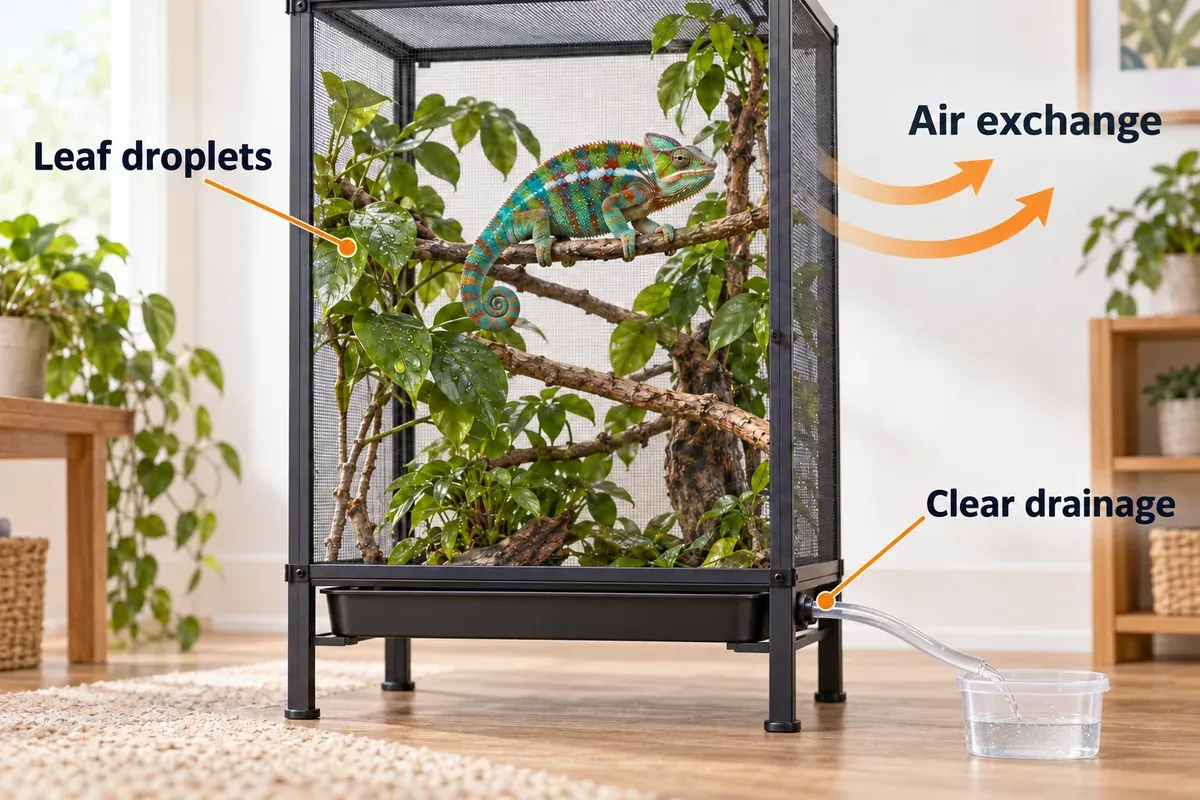
Runoff is part of every watering test. During a supervised normal cycle, follow the water from the leaves to the enclosure floor, through the drain, and into the collection container. Check for a pot, fallen leaf, or bent drain tube stopping that path. Empty the collection container before it can overflow, and keep the floor beneath the cage dry.
The humidity reading cannot tell you whether the drain is blocked. Inspect hidden corners and the underside of the tray as well as the visible floor. Before leaving an automatic system unattended, observe repeated scheduled cycles and confirm that water continues to exit the enclosure.
Keep electrical connections away from mist and runoff. Switch off and unplug wet equipment before handling it, and follow its installation and servicing instructions. A humidity problem does not justify using a lamp or electrical device outside its rated conditions.
Clean the equipment that puts water into the air
For either species’ nighttime fogging routine, clean water and clean equipment matter alongside the humidity setting. Ultrasonic humidifiers can disperse minerals and microorganisms from their tanks; the EPA’s humidifier guidance explains this equipment risk and recommends fresh water, regular cleaning, and thorough rinsing after cleaners are used.
Use distilled water for a reptile fogger where specified by its manual and the species care guidance. Low-mineral water reduces deposits, but it does not keep a dirty reservoir hygienic. Clean the tank, outlet, and accessible hose sections on the equipment’s schedule; check for slime, deposits, trapped water, and a musty smell. Do not aerosolize cleaner, fragrance, essential oil, or medication through ordinary humidity equipment.
Keep a dated maintenance note beside the observation log. If the tank is dirty or the hose cannot be cleaned as instructed, correct that problem before increasing fog output.
Follow the water path in the example below, from reachable leaves to the separate collection tray, while keeping the screened air path open.
Record a Complete Day and Night Cycle
Use this log to investigate the setup while a healthy adult veiled or panther chameleon continues to receive its normal care and drinking opportunities. It is an observation tool, not a period during which you should tolerate obviously unsuitable conditions or postpone veterinary advice.
Write the species, age, sex, chosen care guide, sensor identity, reference-check date, and exact probe positions at the top. Photograph the nozzles, foliage, vents, lamps, and drain. Record the programmed watering times and what actually runs.
Take readings at useful points in the routine
| Checkpoint | Readings and observations | Question it answers |
|---|---|---|
| Before morning watering or lights-on | Room and perch RH/temperature; overnight minimum/maximum if available | Did the cool nighttime period reach the species plan at the sleeping area? |
| During and just after a normal watering cycle | Where droplets land, whether the sensor is sprayed, and whether runoff drains | Is the system delivering useful water or simply wetting the gauge and floor? |
| At 15, 30, and 60 minutes afterward | RH/temperature at the fixed probe; wetness of the same leaves and branches | How quickly does this setup change after watering? |
| Later in the daytime | Shaded-perch conditions, dry climbing surfaces, and available drinking water | Does the warmer daytime phase provide both drying and water access? |
| After evening cooling | Sleeping-perch and room RH/temperature; operating lamps and humidity equipment | Is higher nighttime humidity being paired with the intended temperature drop? |
| Before the next lights-on | Sleeping-perch conditions, condensation, drain, and collection-container level | Did the overnight arrangement work through the full period? |
If you have only minimum/maximum memory, note that the highest value may have occurred during a spray. It does not show how long the cage stayed at that humidity. A history graph or repeated readings are more useful for duration, provided the sensor remains out of direct water.
Copy these fields into your care notes
- Date, time, species, and daytime/nighttime phase
- Sensor position and whether the displayed value needs a recorded correction
- Cage RH and air temperature at the same position
- Room RH and temperature measured at the same time
- Mister, fogger, and dripper activity; lamp and heating status
- Wet, damp, or dry condition of the marked leaves and climbing branches
- Drain flow, collection-container level, and any dampness outside the cage
- Drinking observed, appetite, activity, and any fresh droppings available to inspect
- The single change made since the last comparable observation
A note that no drinking was seen means exactly that. It does not establish that the animal did not drink. Fresh droppings are also more useful than material that has dried for hours or been soaked by the mister. Chameleon Academy’s hydration strategy discusses drinking behavior and droppings as observations; neither replaces examination when an animal appears unwell.
Decide what to keep after a change
Keep a nozzle, foliage, position, timing, or panel change only when the next comparable day/night cycle shows the intended improvement and acceptable temperatures, continued air exchange, useful drinking access, and dry daytime climbing surfaces. If the nighttime number improves but the daytime retreat becomes too warm, the result still needs correction.
For a stable, healthy animal, several comparable cycles can help distinguish an adjustment from a one-off change in room weather. Correct an obvious fault immediately. Do not wait for a full week if a drain is blocked, water is missing, the enclosure is overheating, or the animal shows a warning sign.
Repeat the room and cage comparison when household heating, air conditioning, cage position, plant growth, or nozzle layout changes. A routine that worked in one set of room conditions may need adjustment when those conditions change.
When to Stop Adjusting Humidity and Call a Vet
For either veiled or panther chameleons, seek urgent veterinary help for gasping, labored breathing, or open-mouth breathing at rest. Contact a reptile-experienced veterinarian promptly for discharge from the nose or mouth, unusual breathing sounds, marked weakness, loss of normal grip, or persistent inactivity. The Merck Veterinary Manual’s pneumonia guidance describes respiratory signs and explains that ventilation, sanitation, temperature, concurrent disease, and other factors can be involved.
A repeatedly raised nose while resting or eyes closing during the daytime also deserves prompt attention. Chameleon Academy’s respiratory warning-sign guide describes these observations in chameleons. They do not let you identify the cause at home.
Check the temperature promptly if the animal is gaping, because overheating is one possible cause. Persistent gaping or difficult breathing still needs urgent assessment. Do not treat it by sealing the cage, adding steam, forcing water into the mouth, or starting medication yourself. A veterinarian may prescribe conditions that differ from a healthy animal’s normal nighttime plan.
Bring the log, clear enclosure photographs, equipment schedule, and a video of abnormal breathing if one can be taken without delaying care. These help the veterinarian assess the setup alongside the animal.
Frequently Asked Questions
Is a quick drop after misting always a problem?
No. In a full-screen cage, air readily exchanges with the room. Judge the dry daytime period separately from the cooler nighttime period, using your species plan and fixed probe positions. If the overnight sleeping area repeatedly misses the plan, investigate retention and room conditions even when daytime watering works.
Does 100% on the hygrometer mean the cage is working well?
It shows the sensor’s reading at that moment. Direct water, condensation, or a local fog stream can dominate it. Check the unsprayed sleeping-area temperature and RH, how long the condition lasts, ventilation, and the following daytime drying period.
Can I cover every side and leave a fan running?
Do not replace open ventilation with air circulating inside a sealed cage. Identify where fresh air enters and where it leaves. Keep any panel only after checking daytime heat, nighttime conditions, and drying through a complete cycle.
Should a humidity controller run the mister whenever RH falls?
A threshold alone does not account for species, phase, temperature, or wet branches. Repeatedly triggering a mister during the daytime drying period can add unnecessary runoff. Use the appliance’s manual and a schedule that supports the complete care plan; observe its actual effect before relying on automation.
Should I add more mist when my veiled chameleon sheds?
Do not increase misting simply because shedding starts. The ReptiFiles veiled care sheet specifically advises against extra misting to assist shedding. Keep the normal species-appropriate cycle; persistent retained shed or other signs of illness need individual advice.
Where should I start if the cage stays dry and the nozzle only drips?
Start with the separate misting-system troubleshooting guide and the equipment’s manual. Establish reliable water delivery before changing enclosure panels or programming longer cycles. Once the spray works, use the observation log to assess the day/night climate.
Sources and Further Reading
- ReptiFiles: Veiled Chameleon Care Sheet — veiled humidity, temperature, watering, and shedding guidance.
- ReptiFiles: Panther Chameleon Care Sheet — separate panther humidity, temperature, and watering guidance.
- Chameleon Academy: Veiled Chameleon Care and Panther Chameleon Care — species care plans, drying, and air movement.
- Chameleon Academy: Screen Chameleon Cages and Hybrid Chameleon Cages — enclosure construction and room-air dependence.
- Chameleon Academy: Creating a Chameleon Hydration Strategy and Fogging for Chameleons — water delivery and monitoring.
- LafeberVet: Old World Chameleon Care — planting, sheltered perches, and ventilation.
- MSD Veterinary Manual: Management and Husbandry of Reptiles — humidity and ventilation risks.
- Merck Veterinary Manual: Bacterial Diseases of Reptiles and Chameleon Academy: Respiratory Infection — warning signs and the need for veterinary assessment.
- National Physical Laboratory: Relative Humidity and Dew Point — interpreting humidity with temperature.
- Boveda: Hygrometer Calibration Kit Instructions — reference-check conditions.
- US EPA: Use and Care of Home Humidifiers — room moisture, aerosol hygiene, and equipment cleaning.