

 Published sources
 Product details checked
A safe bearded dragon UVB setup is about more than choosing a bulb marked “10.0” or “14%.” The result your dragon receives depends on the lamp, reflector, distance, mesh, basking height, and whether the enclosure still has a shaded retreat.
Quick answer: For most indoor bearded dragons, start with a quality linear T5-HO system covering roughly half of the enclosure and place it on the same side as the basking heat. A 22-inch, 24W lamp is a practical starting point for a 4 × 2 × 2-foot enclosure. Use the manufacturer’s distance chart, then verify the basking UVI with a Solarmeter 6.5/6.5R when possible. UVB and heat are separate jobs, so you also need a controlled basking lamp.
This guide focuses on the decisions that prevent the two common failures: too little UVB because the lamp is weak, too far away, or blocked by glass; and too much UVB because a strong lamp is mounted too close without a way to retreat.
UVB equipment options
UVB equipment options
-
Arcadia ProT5 Dragon 14% UVB Kit, 39W (34" lamp)
Arcadia
The Dragon 14% ProT5 kit pairs a 34-inch, 39W UVB tube with its fitting and removable curved reflector. Set exposure by measured UVI, not the 14% label.
- 34-inch, 39W Dragon 14% T5-HO lamp included
- Removable curved reflector
- Linkable system listed
- Best for
- A larger habitat when the 14% lamp and measured distance fit the species' UVI target
- Key feature
- Removable curved reflector, linkable system
-
Zoo Med ReptiSun 10.0 T5 HO UVB Lamp, 24W (2-Pack)
Zoo Med
Two Zoo Med ReptiSun 10.0 T5 HO replacement lamps for keepers who already own a reliable reflector and ballast.
- 24W, 22-inch OS5-24 lamp format
- Two-pack makes the annual replacement routine easier
- Manufacturer distance and UVI charts are available
- Best for
- Replacing bulbs in a compatible 22-inch T5 HO fixture
- Key feature
- Replacement lamps for a compatible T5 HO reflector
-
REPTI ZOO T5 HO UVB Combo Kit, 24W Desert 10.0
REPTI ZOO
Entry-priced T5 HO fixture bundled with a 24W Desert 10.0 lamp for a 24-inch enclosure footprint.
- Fixture and Desert 10.0 UVB lamp included
- 24W format suits a 24-inch enclosure footprint
- Curved reflector helps direct light into the enclosure
- Best for
- Budget-conscious keepers who want a complete 24W T5 HO kit
- Key feature
- Complete fixture and lamp with curved reflector
Review the linked product page before purchasing.
The Target Is a UVB Gradient, Not a Bulb Label
UVB helps a bearded dragon produce vitamin D3, which supports calcium metabolism. The useful question is not “Which percentage is strongest?” It is “What UVI reaches the dragon at basking height, and can the dragon move into lower-UVI shade whenever it wants?”
For a normally pigmented central bearded dragon, ReptiFiles uses a basking-area reference of roughly UVI 4.0–4.5, with the gradient dropping toward 0 in the far retreat. Arcadia’s Dragon guide uses Ferguson Zones 3–4 and publishes different distance readings for its own reflector and lamp. Those numbers are not interchangeable: brand, reflector, mesh, lamp age, and animal height all change the result.
Treat any distance as a starting point, not a universal rule. If you cannot measure UVI yet, use the lamp manufacturer’s chart, choose a conservative distance, and make sure the dragon has a genuine shaded retreat. A meter is the better long-term investment because it turns guesswork into a repeatable setup.
Why the “10.0” or “14%” Label Is Not Enough
The number printed on a lamp describes its product range, not the UVI at your basking rock. A 14% lamp mounted high above a screen may deliver less usable UVB than a lower-output lamp mounted at the correct height. The same fixture can also be too strong after a basking platform is raised.
Use these factors together:
- Lamp type: T5-HO tubes project farther than many standard T8 systems.
- Reflector: A shaped reflector directs more light downward than a bare tube.
- Distance: UVB falls quickly as the animal moves away from the lamp.
- Mesh: Screen can reduce output substantially, and the percentage depends on the mesh pattern and wire thickness.
- Lamp age: A tube can still look bright after its useful UVB output has declined.
- Animal height: Measure to the dragon’s back at the highest basking position, not just to the substrate.
What a Complete Bearded Dragon Lighting Setup Contains
Think of the lighting system as several coordinated parts rather than one “magic” bulb:
- Linear T5-HO UVB: This provides the UVB gradient. For a typical adult 4 × 2 × 2-foot enclosure, a 22-inch lamp covers about half the length and can be placed on the warm side.
- Separate basking heat: A halogen flood or another suitable basking source creates the thermal gradient. UVB bulbs are not a substitute for a thermostat-controlled heat source.
- Dimming thermostat: Use a thermostat that is rated for the heater and can regulate the basking source without allowing dangerous temperature spikes.
- Temperature checks: Use a digital probe at the basking surface and a second probe in the cool zone. An infrared thermometer is useful for checking multiple surfaces, but it does not measure air temperature or UVI.
- Timer: Run UVB and visible daytime lighting on a consistent day-night schedule. A timer also makes bulb replacement and troubleshooting easier.
- Shade and structure: A hide, solid décor, and a lower-light retreat are part of the UVB setup, not optional decoration.
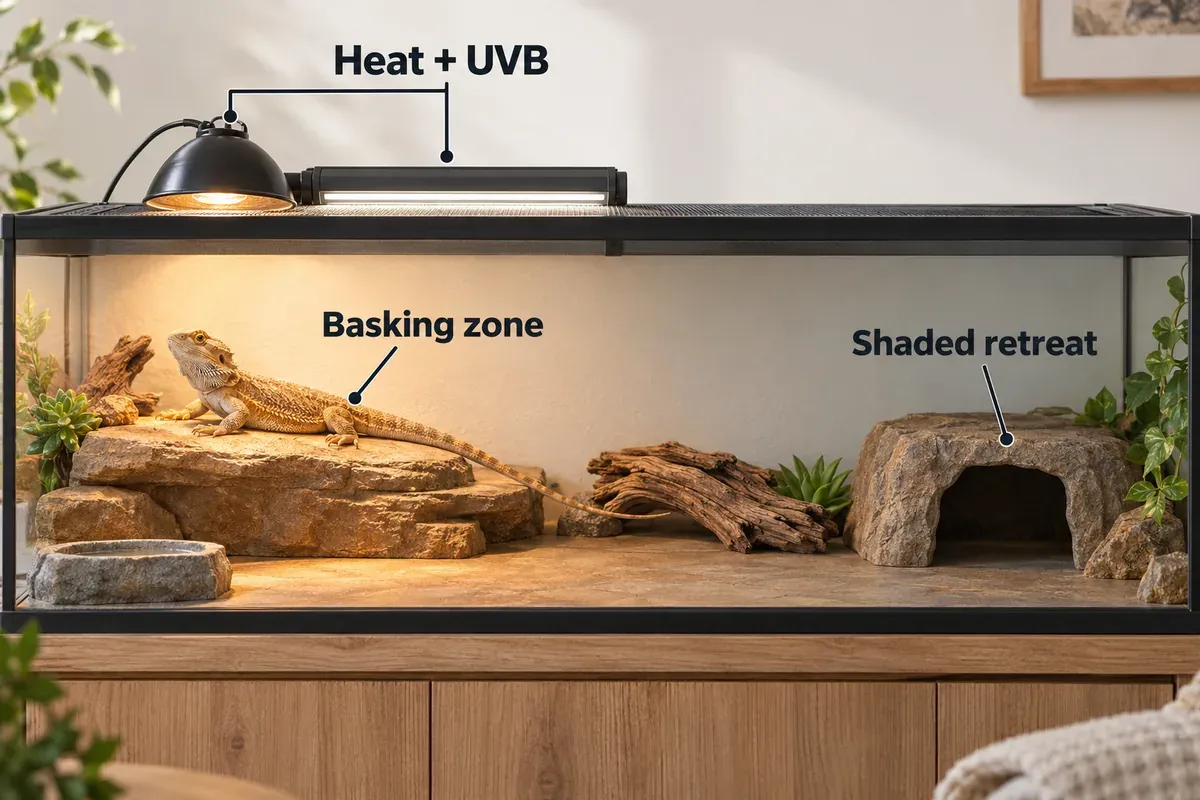
The UVB and basking zones should overlap so the dragon can warm up while receiving UVB, but the tube should not flood the entire enclosure. The cool end should remain bright enough for normal daytime activity while still offering shade and distance.
The example below pairs the basking sources at one end and preserves a separate shaded retreat.
Which UVB Format Fits a Bearded Dragon?
Linear T5-HO: The Most Forgiving Indoor Starting Point
A linear T5-HO tube gives a broad, controllable strip of UVB and visible light. That makes it easier to create a basking zone plus a retreat than a small compact bulb. A good reflector also makes the output more predictable than a bare tube.
For a standard adult enclosure, choose the lamp length by coverage and the fixture by the lamp’s exact wattage and length. A 24-inch hood normally holds a 22-inch, 24W tube; a 36-inch fixture normally holds a 34-inch, 39W tube. Never force a different length or wattage into a fixture.
T8: Possible, but More Distance-Sensitive
T8 systems can work when the lamp is paired with a reliable reflector and the distance is verified. They usually need to be mounted closer than T5-HO systems, so they are less forgiving in a tall enclosure or after décor changes. If you choose T8, follow that lamp’s chart rather than copying a T5-HO distance.
Compact Coil and “UVB” LED Bulbs: Poor Primary Choices
Compact coil bulbs cover a small area and can create a narrow hotspot. They are not my first choice for a bearded dragon’s primary indoor UVB source. Similarly, do not buy an LED simply because the product documentation says “UVB.” The output and safety data need to be demonstrated for reptiles, not inferred from marketing language.
Mercury-vapor lamps can provide UVB and heat together, but their heat and UVB output are more difficult to separate. They can be appropriate in a carefully measured setup; for most keepers building a predictable 4 × 2 × 2-foot habitat, a linear T5-HO plus a separately controlled basking lamp is easier to adjust.
Recommended UVB Products
1. Arcadia T5 UVB Fixture Kit — Best for a Strong, Measurable 4 × 2 × 2 Setup
Best for: Adult bearded dragons, larger enclosures, keepers willing to measure UVI
The Arcadia kit is the premium option in this comparison. The 39W Dragon lamp is commonly described as a 34-inch tube in the manufacturer’s specifications, while the fixture housing is described as 36 inches. That distinction matters when you are matching the tube to a hood.
Its 14% output and curved reflector can be useful when a screen top or taller enclosure reduces the available UVI. They can also overshoot a low basking platform, so the strength is an advantage only when the lamp is installed with enough distance, shade, and measurement.
Why it stands out:
- Strong linear coverage for the warm side of a large habitat
- Curved reflector concentrates UVB and visible light where the dragon basks
- Linkable design can simplify multi-enclosure installations
- Manufacturer documentation includes lamp-specific distance readings
Trade-offs:
- Highest upfront cost of the three options
- A 14% system is not automatically better for every enclosure or morph
- Requires secure mounting and careful distance planning
- Replacement tubes are an ongoing cost
Bottom line: Choose it when you want a durable, high-output system and are prepared to calibrate it. It is a good fit for a spacious adult habitat, but it is not a reason to mount the basking platform closer than the measured UVI allows.
Check current price on Amazon →2. Zoo Med ReptiSun 10.0 T5-HO 24W Two-Pack — Best Replacement-Bulb Path
Best for: Replacing lamps in a compatible 22-inch T5-HO hood
This is a bulb pack, not a complete fixture. The Zoo Med OS5-24 is a 24W, 22-inch T5-HO 10.0 lamp, so it is a practical choice if you already own a compatible reflector and ballast. The two-pack also makes it easier to keep a fresh replacement on hand instead of running a tube well past its useful UVB life.
Why it stands out:
- Clear lamp size and wattage for matching a 24-inch hood
- Manufacturer UVI and distance charts are available for the product family
- Two lamps support a simple annual replacement routine
Trade-offs:
- You still need a suitable T5-HO fixture and reflector
- The 10.0 label does not tell you the final UVI inside your enclosure
- A damaged or incompatible tube is not fixed by moving the basking rock
Bottom line: This is the sensible path for a keeper who already has a good fixture. If you are buying everything from scratch, compare the total cost with a complete kit rather than looking only at the two-bulb price.
Check current price on Amazon →3. REPTI ZOO T5-HO Combo Kit, 24W Desert 10.0 — Best Budget Complete Kit
Best for: Budget-conscious keepers who need a fixture and lamp together
The REPTI ZOO kit is attractive because the fixture and a 24W Desert 10.0 lamp arrive together. Its 24W format is intended for a 24-inch enclosure footprint, making it a reasonable budget candidate for a shorter habitat or for keepers who are building a measured juvenile setup.
The lower price comes with a responsibility: do not assume that an inexpensive combo kit produces the same UVI as a premium fixture. Use the included lamp as a starting point, follow the manufacturer’s distance guidance, and verify the basking point when you can.
Why it stands out:
- Complete fixture-and-lamp package for a straightforward starting setup
- Curved reflector helps direct light downward
- 24W format is easy to match to a 24-inch enclosure
- Manufacturer lists a 12-month quality guarantee
Trade-offs:
- Output can vary with version, reflector position, mesh, and lamp age
- You may spend the savings again if the fixture fails or the replacement lamp is hard to source
Bottom line: It can be a reasonable entry point when budget is the deciding factor, but it is not a “set it and forget it” product. Buy a UVI meter or use a careful chart-based setup, and plan a replacement path before the included lamp ages out.
Check current price on Amazon →How to Build the Setup Step by Step
1. Start with the Enclosure and the Dragon’s Highest Point
Measure the enclosure before ordering the lamp. The Zoolory bearded dragon enclosure guide covers size and ventilation choices in more detail. A 4 × 2 × 2-foot enclosure is a useful reference, but the basking platform may place the dragon much closer to the lamp than the empty-tank height suggests.
Write down three distances:
- From the UVB tube to the top of the basking surface
- From the UVB tube to the dragon’s back at the highest basking position
- From the UVB tube to the floor or deepest retreat
The second measurement is the one that matters most for exposure.
2. Put UVB and Heat on the Same Side
Place the linear UVB fixture over the warm side, with its basking end overlapping the heat lamp. This lets the dragon choose the natural combination of warmth and UVB that it needs. Do not center a short tube over the entire top just because it looks symmetrical; the far end should remain a lower-exposure retreat.
3. Account for Mesh, Glass, and Plastic
A screen top is usable, but it changes the lamp’s output. ReptiFiles gives an approximate starting range for an Arcadia Dragon 14% lamp of about 11–12 inches through mesh or 17–18 inches without mesh for its recommended basking exposure. Those are not universal instructions for every brand or fixture; mesh thickness, reflector shape, lamp age, and the dragon’s height can change the result.
Never place ordinary glass or a solid plastic cover between the lamp and the dragon. These materials can block the UVB you bought the lamp to provide. If the fixture is mounted inside the enclosure, protect the cord and ballast from chewing, moisture, and direct animal contact, and follow the manufacturer’s mounting instructions.
4. Build a Real Shade Gradient
At least one part of the enclosure should let the dragon get farther from the UVB and out of the direct beam. Use a hide, solid branch, ledge, or other stable structure to make that retreat meaningful. A fake gradient made only by moving the dragon to the other side of an otherwise exposed tank is not enough if the whole top is covered by intense light.
5. Set the Heat Independently
Use the basking heater to reach the temperature range recommended by your veterinarian or a current species care guide. Check the basking surface with a probe and an infrared thermometer, and check the cool zone separately. A dragon that is cold may not use UVB normally, while an overheated dragon may remain in the shade and still have a badly calibrated setup.
The thermostat controls the heat source. It does not measure UVB and it should not be used as a substitute for a UVI check.
6. Set a Consistent Daytime Schedule
Run UVB and visible daytime lighting for a consistent 10–12 hours per day, then turn visible lighting off at night. Avoid red or blue night bulbs that keep the enclosure visibly lit; if overnight heat is necessary, use a heat source that emits no visible light and control it safely.
Record the installation date on the fixture or a phone reminder. A tube can continue producing visible light after its UVB output has declined.
How to Check the UVI in Practice
The most useful tool for this job is a Solarmeter 6.5 or 6.5R. A normal lux meter, phone light sensor, or inexpensive “UV detector” does not tell you the UVI your dragon receives.
Measure at the dragon’s back height in at least three places:
- The highest basking position directly under the useful end of the tube
- The middle of the enclosure where the dragon can pause and choose distance
- The shaded retreat or cool end
Write the readings down with the lamp model, distance, mesh type, and date. Repeat the check after raising décor, changing the mesh, moving the fixture, or replacing the lamp. The target is a usable gradient, not one impressive number under the center of the tube.
If you cannot buy a meter immediately, use the exact manufacturer chart for your lamp and reflector, mount the fixture conservatively, and create more distance and shade than you think you need. Treat that as temporary uncertainty, not proof that the setup is correct.
Common UVB Setup Mistakes
Choosing the Strongest Number
“14%” is not a care plan. A strong tube can be excellent in a tall, screened habitat and excessive in a short enclosure. Choose the lamp and distance as a pair.
Using a Heat Bulb as the UVB Source
A basking lamp can make the dragon warm without providing reliable UVB. Conversely, a UVB tube can provide radiation without bringing the basking surface to a safe digestion temperature. Use separate, controllable functions.
Covering the Tube with a Clear Shield
Clear does not mean UVB-transparent. Ordinary glass and many plastics filter UVB. Use a fixture designed for reptile UVB and keep the lamp unobstructed except for the enclosure mesh the manufacturer’s chart accounts for.
Copying an Internet Distance
“Twelve inches” is not a universal setting. The lamp, reflector, mesh, animal height, and lamp age all matter. Copying a number from a different fixture can create too little or too much exposure.
Forgetting the Retreat
A bearded dragon should be able to self-regulate. If every hide is directly beneath the tube, the animal cannot choose lower UVB even if the basking area is correctly calibrated.
Replacing the Tube Only When It Looks Dim
Visible brightness is not a UVB measurement. Mark the date and replace the T5-HO tube on the manufacturer’s schedule; many current care guides use roughly 12 months as the replacement interval for T5-HO lamps.
Maintenance Schedule
| When | What to do |
|---|---|
| Daily | Confirm the timer, basking heat, and cool-zone readings are behaving normally. |
| Monthly | Inspect the fixture, cord, reflector, mesh, mounting points, and the tube for damage or darkening. |
| After any enclosure change | Re-measure the dragon’s basking distance and check the UVI again. |
| Every 12 months | Replace the T5-HO tube unless the manufacturer’s instructions or a qualified reptile professional specify a different interval. |
| After a health concern | Stop guessing and ask an experienced reptile veterinarian to assess the dragon and the setup. |
Frequently Asked Questions
Does an indoor bearded dragon really need UVB?
Yes. Indoor glass and plastic do not provide a dependable substitute for a properly installed UVB system. Supervised outdoor sunlight can be useful, but it should not be treated as the only plan unless you can provide safe, consistent exposure and avoid overheating.
Is a 10.0 lamp always better than a 5.0 lamp?
No. A 10.0 or 14% lamp may be appropriate for a desert species, but its usefulness depends on distance, reflector, mesh, and shade. The best lamp is the one that produces the right gradient for the enclosure when measured at the dragon’s height.
How far should a T5-HO lamp be from a bearded dragon?
There is no single safe distance for every product. Use the chart for the exact lamp and fixture. As one example, ReptiFiles’ Arcadia Dragon guidance starts around 11–12 inches through mesh or 17–18 inches without mesh for its recommended basking exposure, then advises adjusting for the specific enclosure and animal. Measure rather than treating those numbers as universal.
Can UVB go through a screen top?
Yes, but the screen reduces output and the loss varies. Use a chart that accounts for mesh or measure the UVI through the installed screen. Keep the lamp and basking zone on the same side, and make sure the dragon can retreat into lower exposure.
Do UVB and heat need to overlap?
They should overlap at the warm basking end so the dragon can warm up while receiving UVB. They do not need to cover the entire enclosure. The far end should offer distance and shade.
What about translucent, hypomelanistic, or silkback dragons?
Some reduced-pigment and scaleless morphs may be more sensitive to UVB. Do not copy a standard adult setup without checking the morph-specific guidance. A reptile veterinarian or experienced lighting professional should help set a lower basking target when appropriate.
How long should UVB stay on each day?
Use a consistent 10–12-hour daytime schedule for a typical indoor setup, synchronized with visible daytime lighting. Seasonal schedules may vary, but consistency is more useful than changing the timer randomly.
What signs suggest a UVB problem?
Weakness, tremors, a soft jaw, swollen limbs, poor growth, or persistent lethargy can be signs of serious health problems, including metabolic bone disease. They are not a substitute for measuring the setup. Arrange veterinary care promptly if you see them.
Related Bearded Dragon Guides
- Best bearded dragon enclosures: size, ventilation, and setup options
- Best UVB lights for reptiles: T5 vs. T8 and fixture comparisons
- More reptile care guides from Zoolory
Sources and Further Reading
- ReptiFiles: Bearded Dragon Temperatures & UVB
- Zoo Med: T5-HO ReptiSun 10.0 UVB
- Zoo Med: ReptiSun T5-HO Terrarium Hood with 10.0 Bulb
- Arcadia Reptile: Dragon UVB lighting guide