
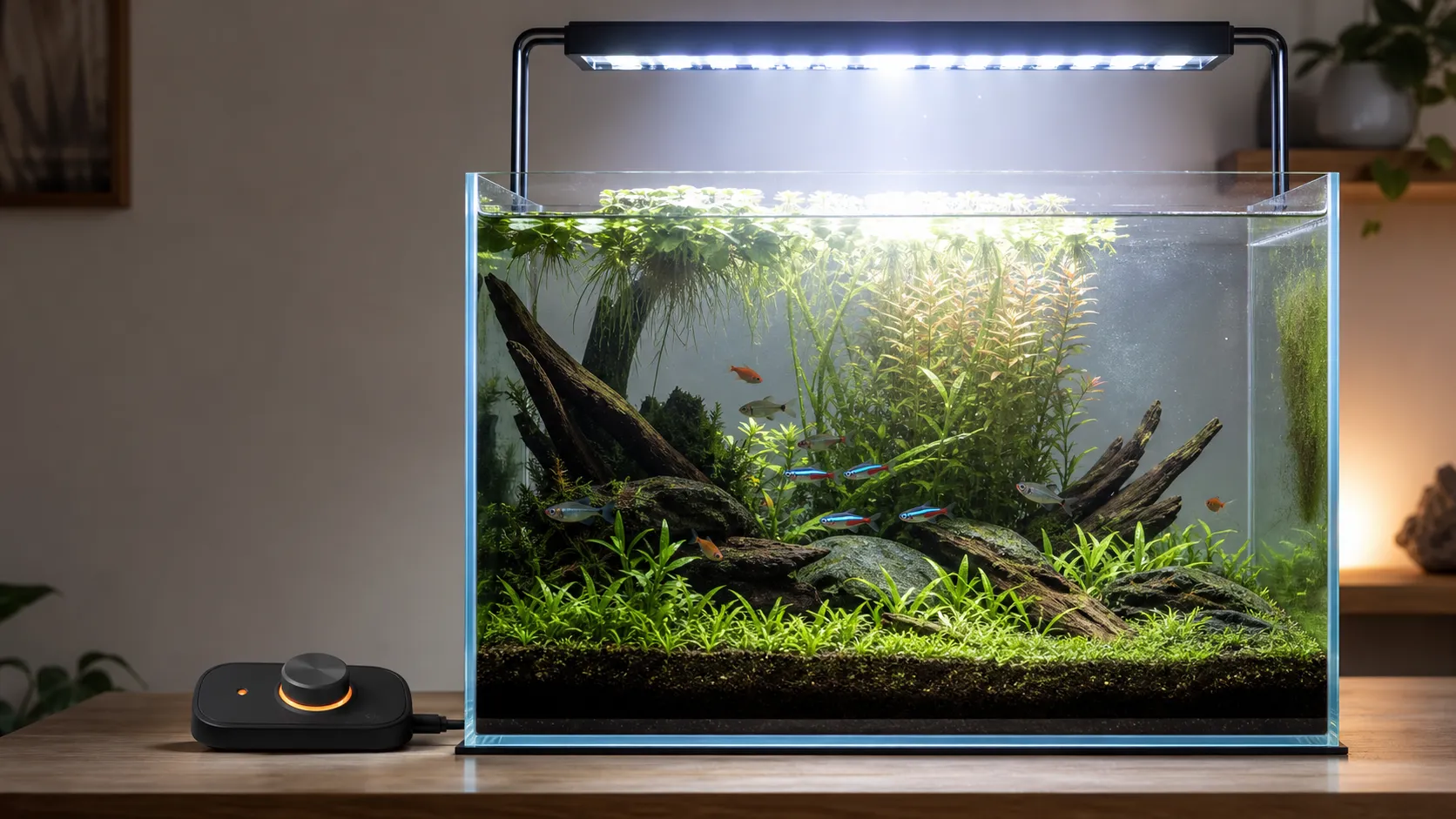

 Published sources
 Product details checked
A bright aquarium is not automatically an overlit aquarium. The real question is whether the light intensity and daily schedule match your fish, plants, tank depth, nutrients, and the distance between the fixture and the leaves.
Quick answer: Aquarium lighting is probably too strong or too long when timid fish spend nearly all daylight hours hiding, low-light plants collect algae on their leaves while growth stalls, or algae accelerates after you increase brightness or photoperiod. Start by reducing intensity to a moderate setting, run the light for about 6–8 hours while you stabilize a problem tank, and give the fish a genuine dark period. Add floating plants or other shade only if you keep enough open surface for gas exchange and enough light for the plants below. If the fixture has no usable dimmer or timer, replace it with a better-matched light rather than trying to solve every problem with shorter hours.
In this guide, you’ll learn:
- How excessive light can show up in fish, plants, and algae
- How to separate brightness from an overly long photoperiod
- A low-risk test that changes one lighting variable at a time
- When to use dimming, a timer, floating plants, or a replacement fixture
- Which linked products fit each of those jobs
Is your aquarium light actually too strong?
Light intensity is only one part of the equation. A fixture can be appropriate at 30% brightness for ten hours and excessive at 100% brightness for the same tank. The same light can also be right for a carpet plant but too intense for Anubias or Java fern placed directly beneath it.
Tank depth and distance matter as well. Light is strongest near the surface and directly below the fixture. A shallow nano tank can receive much more light at the leaves than a deeper aquarium with the same lamp. Aquarium Co-Op’s PAR guide explains why plant-level light changes with depth, surface ripples, lids, shadows, and floating plants.
Do not diagnose from a single symptom. Fish may hide because they need cover, because another fish is bullying them, or because the water quality is poor. Plants may melt after a transition from emersed to submerged growth. Algae may be driven by excess nutrients, direct sunlight, overfeeding, or an unstable carbon supply. Use the pattern and timing of the changes together.
Quick symptom check
| What you see | What it can suggest | First check |
|---|---|---|
| Timid fish stay under wood, plants, or a cave whenever the light is on | The tank may offer too little shade, or the light may be uncomfortable for that species | Add a shaded refuge and watch whether the fish use the rest of the tank at lower intensity |
| Fish startle or scatter when the fixture switches on | A hard on/off transition may be more stressful than the steady daytime level | Use a gradual ramp, or switch the light on before the room becomes completely dark |
| Low-light plants have algae-coated leaves while new growth is slow | Light may be high relative to plant demand, nutrients, or available carbon | Reduce brightness first and inspect nitrate, phosphate, and plant placement |
| Algae appears mainly on surfaces facing the lamp or speeds up after a lighting change | More usable light is reaching the algae than the plants can use | Compare the light schedule with feeding, fertilizing, water changes, and direct sunlight |
| The aquarium has green water or a sudden cloud of suspended algae | A light-and-nutrient imbalance is possible, but water quality and the biological cycle also need checking | Test ammonia and nitrite, block direct sunlight, and reduce the photoperiod temporarily |
| Plants are bleaching, melting, or developing holes | This is not proof of excessive light | Check nutrients, temperature, carbon, pests, and the plant’s transition history before changing the lamp |
Aqueon’s fishkeeping guide notes that very intense light can encourage algae and make more timid fish hide in the shadows. It also lists leaving the aquarium light on 24/7 as a stressor. That makes behavior a useful warning, but not a stand-alone diagnosis.
Signs in fish
Fish cannot tell you whether the lamp is delivering 20 or 50 PAR. Their behavior is an indirect signal that the tank does not offer a comfortable light-and-cover pattern.
Hiding all day instead of choosing shade sometimes
One cave or a patch of floating plants is normal enrichment. The concern is a change: fish that used to swim and feed in the open now disappear during the entire light period and become active only after the fixture goes off. This is more meaningful when the behavior began immediately after a brighter lamp, a fixture moved closer to the water, or a longer schedule.
Lower the intensity and add a stable refuge at the same time. If the fish resume normal feeding and use both shaded and open areas, the lighting environment was probably part of the problem. Keep checking water parameters because poor water quality can create the same withdrawal.
Startle responses and a harsh on/off transition
A powerful lamp that turns on at full output in a dark room creates an abrupt visual change. Some fish will scatter even if the final daytime intensity is acceptable. A dimmable sunrise period is useful here, but a simple timer still helps if it gives you a consistent schedule.
Fluval describes gradual dimming as a way to imitate increasing and decreasing natural light and avoid the unnatural shock of a hard on/off transition. The important part is not a decorative “storm” effect; it is a predictable ramp and a genuine dark period.
When hiding is not a light diagnosis
Rapid breathing, surface gasping, clamped fins, loss of appetite, or several fish deteriorating at once should not be blamed on the lamp. Test ammonia and nitrite, check temperature and oxygenation, and look for disease or an aggression problem. Turn the light down for comfort, but treat those signs as a broader aquarium-health issue.
Signs in plants
Plants need light, but “more” is not automatically better. A high-light setup usually needs matching carbon, nutrients, maintenance, and plant selection. If the plants cannot use the available light, algae can take advantage of the excess.
Algae on slow-growing leaves
Anubias, Java fern, Bucephalandra, and many Cryptocoryne varieties can grow under relatively low light. When a strong fixture is placed close to their leaves, the leaves may become a convenient surface for green spot algae or film algae even while the plant itself grows slowly.
Try moving those plants into the shade of wood or taller stems before replacing the entire fixture. If the whole aquarium is affected, lower the intensity and shorten the schedule. Aquarium Co-Op’s planted-light guide makes the same broader point: low-, medium-, and high-light plants need different conditions, and high light often requires more carbon and nutrient management.
Pale, stressed, or melting leaves
Bright light can be part of a mismatch, but pale leaves and melting are not a reliable “too much light” indicator on their own. New plants often lose emersed leaves while they adapt underwater. Holes can point to nutrient deficiencies. Melting Cryptocoryne can follow a move, a temperature change, or a major water-chemistry shift.
Before increasing or decreasing the lamp repeatedly, inspect new growth, roots, water temperature, fertilizer use, and the time line. If only the leaves closest to the surface show damage after a lighting increase, dimming becomes a sensible test. If every plant is melting after a move, the lamp may not be the primary cause.
Plants leaning toward or away from the fixture
Direction and distance often explain a visual imbalance better than wattage. A tall plant directly under the fixture may receive much more light than a low plant at the corner. Repositioning the fixture, adding hardscape shade, or moving low-light plants away from the hotspot can solve the mismatch without starving the rest of the tank.
Avoid using watts-per-gallon as the decision rule for modern LEDs. Aqueon’s aquatic plant guide explains why wattage measures electricity use rather than the light actually reaching the leaves. PAR, distance, spread, and plant needs are more useful.
Signs in algae
Algae uses light and nutrients just as plants do. A strong lamp can expose an existing imbalance, but it is rarely helpful to treat algae as proof that the lamp is the only cause.
Watch for a sequence such as: you increase brightness or add an extra evening period, then green film, green dust, hair algae, or green water grows faster within the next one to two weeks. That timing supports a lighting contribution. Also check for a sunny window, excess food, decaying leaves, high nitrate or phosphate, and inconsistent maintenance.
The first response is simple and reversible:
- Block direct sunlight from reaching the tank.
- Set a consistent aquarium schedule with a real night period.
- Reduce brightness or shorten the photoperiod, but do not make five other changes on the same day.
- Test ammonia and nitrite in a young or unstable tank, then review nitrate and phosphate if algae persists.
- Remove dead leaves and excess algae without sterilizing every surface or replacing all biological media.
Aqueon’s algae guidance stresses that nutrients, feeding, water changes, and direct sunlight matter alongside light. This is why a two-week lighting test is more useful than repeatedly buying a brighter or bluer fixture.
The safest 10-minute lighting test
Use this test when fish are otherwise stable and there is no immediate water-quality emergency. Make one lighting change at a time and observe the trend for 7–14 days. Aquarium Co-Op recommends waiting about two weeks between changes in a low-tech aquarium so you can tell which change helped.
1. Record the current setup
Write down the fixture, tank length and height, distance from the water, brightness setting, start and stop time, direct sunlight, plant list, and recent changes. A phone photo taken from the same angle every few days is more useful than memory.
2. Remove uncontrolled light
Close blinds during the sunniest part of the day or move the aquarium’s visual exposure if possible. Do not use room daylight as a substitute for the aquarium’s schedule; it changes with weather and can heat the tank.
3. Reduce intensity before changing everything else
If the light has a dimmer, try about 20–40% for a low-tech or algae-prone tank as a starting point, not a universal target. If the lamp has only broad steps, choose the next lower setting. Keep the fixture at a safe height and make sure the controller is protected from splashes.
4. Set a consistent photoperiod
For a new or visibly algae-prone planted tank, 6–8 hours is a reasonable temporary starting range. Tropica recommends 6 hours during the first two to three weeks of a new aquarium and then increasing to 8–10 hours as the tank grows in. Once the aquarium is stable, increase gradually only if the plants need it.
| Tank situation | Practical starting point | What to watch |
|---|---|---|
| New, recently replanted, or algae-prone low-tech tank | 6 hours per day | Plant recovery, fish behavior, and algae speed over two weeks |
| Established low-light planted tank | 7–8 hours per day | Whether plants make healthy new growth without a spreading algae film |
| Established medium-light planted tank | 8–10 hours per day | Whether nutrients and carbon keep up with the light |
| High-light, CO₂-injected aquascape | Start conservatively and follow the plant response | CO₂ stability, nutrient dosing, algae, and plant color—not the clock alone |
| Fish-only or artificial-decor tank | About 6–8 hours per day | Fish activity and algae, with a full dark period |
Guidance varies because tanks vary. Aqueon’s FAQ gives 10–12 hours for live plants and 5–8 hours for artificial décor, while Aquarium Co-Op and Tropica emphasize shorter starting schedules for new or low-tech tanks. The consistent message is to match the schedule to the setup, avoid 24/7 light, and adjust gradually.
5. Observe before escalating
Give the fish a choice between shade and open water. Watch feeding, normal cruising, and rest. Check the newest plant growth rather than judging only old leaves. If algae slows and fish use more of the tank, keep the new setting for another week before making a further change.
The three controls below change different parts of the light environment; adjust one at a time and watch the tank response.
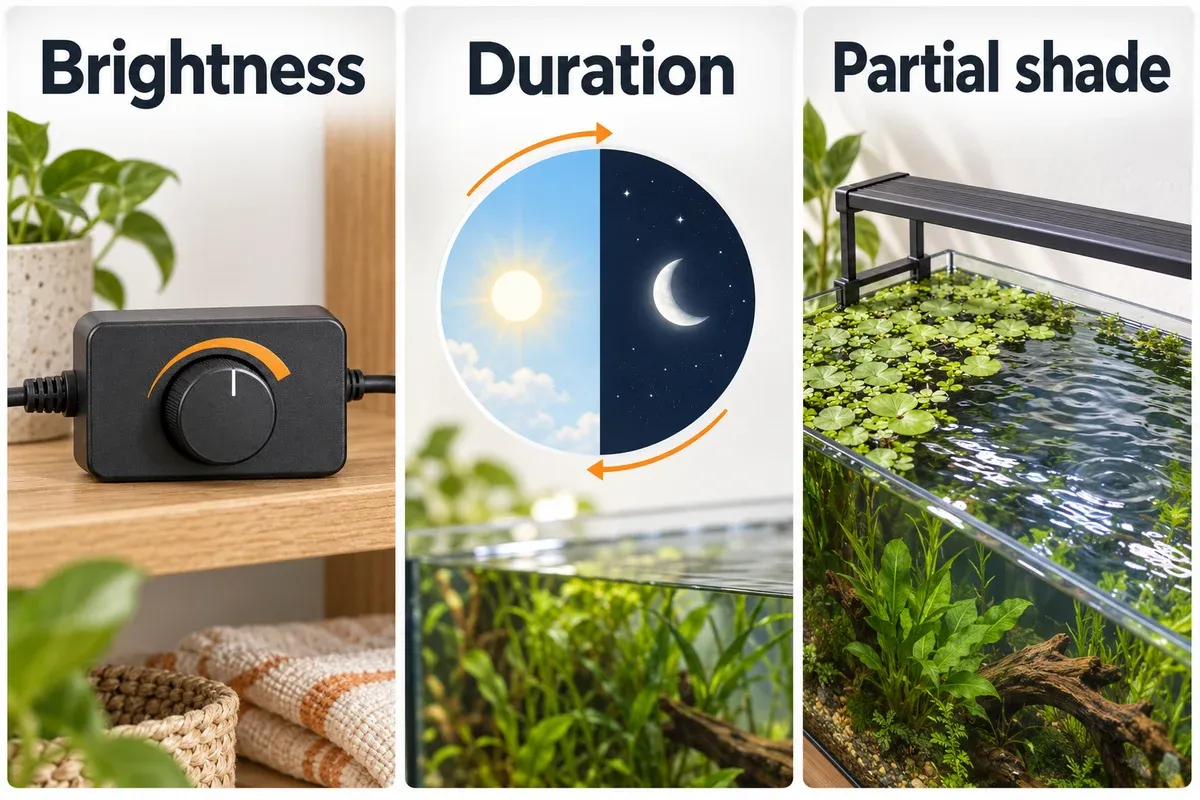
How to fix aquarium lighting that is too strong
Use dimming when the fixture is otherwise a good fit
Dimming is the cleanest fix when the tank length, spectrum, and spread are appropriate but the output is excessive. Reduce intensity before replacing the lamp. A dimmer also lets you adjust the light when plants grow taller, floating plants thin out, or you change from low-light to more demanding species.
Do not confuse color controls with intensity control. Turning a light from white to blue may change the appearance without reducing the usable light enough. Use a real brightness setting or measure plant-level light with a PAR meter if the setup is demanding.
Use a timer for a consistent schedule
A timer solves forgotten lights and inconsistent start times, but a basic outlet timer only switches power on and off. It does not dim a fixture or create a sunrise. If your lamp has its own controller, confirm whether it remembers settings after power is cut; some lights restart their countdown when power returns.
Place every electrical connection in a dry, accessible area with a drip loop, and use the protection recommended for aquarium equipment. Never put a general AC dimmer on an aquarium light unless the manufacturer explicitly supports it.
Add floating plants as shade, not as a full blackout
Frogbit, Salvinia, duckweed, and water sprite can create natural shade and give timid fish cover. Floating plants also make the light pattern visible: when all of them crowd under the return or become trapped in one corner, surface flow or the outlet may be the real problem.
Keep part of the surface open. Aquarium Co-Op’s planting guide warns that complete surface coverage can reduce oxygen exchange and light for submerged plants. Use a loop of airline tubing or another aquarium-safe corral to keep floaters away from the filter return, then thin them regularly. Do not introduce plants from unknown outdoor waterways.
Raise or redistribute the fixture if the manufacturer allows it
Light intensity falls with distance. Raising the fixture, using its proper mounting brackets, or shifting it away from the center hotspot can soften the light at the leaves. Do not balance a lamp precariously over an open tank, and do not cover LED emitters with improvised material that could trap heat or moisture.
Tall stems and hardscape can also make useful shade. Put low-light plants on the edges or under wood, and reserve the most exposed area for plants that actually need stronger light.
Replace the fixture when control is the problem
Replacement makes more sense when the light is non-dimmable, the tank is much shorter than the fixture’s intended coverage, the controller is unreliable, the lamp flickers, or water has entered the housing. Choose a fixture with a usable brightness range and a timer rather than selecting by wattage alone. Our Best LED Aquarium Lighting guide compares planted-tank and reef-light options by use case; a reef fixture is not automatically a better freshwater choice.
Linked options for dimming, timing, or replacement
These are tools for different problems, not a list of products to buy together.
Tools for reducing aquarium light stress
-
hygger Clip-On 24/7 Aquarium LED Light 14W for 12-20 Inch Tanks
hygger
A clip-on freshwater LED with a 24/7 sunrise-to-moonlight mode, five brightness levels, and DIY 6-, 10-, or 12-hour timing for 12-20 inch tanks.
- 14W models for 12-20 inch tanks
- Five brightness levels
- DIY 6-hour, 10-hour, or 12-hour timer settings
- Best use
- Small freshwater planted tanks needing built-in timing and adjustable brightness
- Useful feature
- Built-in timer with adjustable brightness and gradual daily cycle
-
SEAOURA Full Spectrum Aquarium LED Light for 12-18 Inch Tanks
SEAOURA
A compact freshwater replacement light with 10 brightness levels, 6-, 10-, or 12-hour timer choices, power-off memory, and a gradual 15-minute ramp for 12-18 inch tanks.
- 12-18 inch tank models
- 10 brightness levels
- 6H, 10H, or 12H timer choices
- Best use
- Budget freshwater tanks needing a wide brightness range and simple auto timing
- Useful feature
- Budget replacement with dimming, timer, and memory
-
NICREW Aquarium Light Timer & Dimmer
NICREW
An add-on controller for compatible DC LED aquarium lights with 10-100% manual brightness adjustment, sunrise/sunset simulation, and simple on/off programming.
- Supports 5-24V DC single-channel LED lights as documented
- Compatible 5.5 x 2.1 mm barrel connector as documented
- Manual brightness range from 10% to 100%
- Best use
- Compatible 5-24V DC single-channel aquarium lights that need dimming
- Useful feature
- Fit-specific DC dimmer and timer controller
-
DEWENWILS 2-Pack 24-Hour Programmable Digital Timer Outlet
DEWENWILS
A two-pack of silent 24-hour digital outlet timers with three daily repeat program groups, an always-on/automatic/always-off switch, and a memory function for scheduled lighting.
- Three daily repeat program groups
- Always-on, automatic, and always-off modes
- Memory function advertised to preserve settings for up to three months without power
- Best use
- Non-dimmable aquarium lights that only need reliable daily on/off timing
- Useful feature
- Reliable daily photoperiod timer for non-dimmable lights
Review the linked product page before purchasing.
hygger Clip-On 24/7 14W — built-in dimming and schedule for 12–20-inch tanks
The 14W hygger clip-on light is the most complete replacement in this group when you want an automatic cycle and manual brightness control in a small freshwater planted tank. The selected Amazon models is for 12–20-inch tanks, lists five brightness levels, and offers DIY 6-, 10-, or 12-hour timing. Its default 24/7 mode includes a gradual orange sunrise, white daylight, and blue evening period, but you should not assume the default schedule is right for an algae-prone tank. Set a shorter daytime window yourself. Check current price on Amazon →
Best for: A small planted tank that needs a built-in timer, gradual transitions, and more control than a fixed-output strip.
Watch out for: The automatic 24/7 program is a feature, not a target. A strong or algae-prone tank may need a shorter schedule and lower brightness. Keep the controller and adapter dry.
Check current price on Amazon →SEAOURA 12–18-inch LED — budget replacement with 10 brightness levels
The SEAOURA 12–18-inch models is a lower-cost replacement for a small freshwater tank where the existing lamp is too bright or has no dependable timer. the product documentation provides 10 brightness levels, 6-, 10-, and 12-hour timer choices, a power-off memory function, and a roughly 15-minute ramp up and down. That gradual transition is more useful for fish than a decorative color mode alone. Check current price on Amazon →
Best for: A budget freshwater replacement where a wide brightness range and basic auto on/off matter more than app control.
Watch out for: Do not treat the advertised “full spectrum” label as proof that the light is suitable for demanding plants. Keep the non-sealed cover away from splashing and use the exact tank-length models.
Check current price on Amazon →NICREW Aquarium Light Timer & Dimmer — add-on control for compatible DC lights
This NICREW controller is useful when the light itself is compatible and you want to avoid replacing it. the product documentation states that it supports 5–24V DC single-channel LED lights with a 5.5 × 2.1 mm barrel connector. It offers manual brightness control from 10% to 100%, sunrise and sunset simulation, and simple program controls. Check current price on Amazon →
Its compatibility is narrower than that of the replacement lights above, so check the voltage, plug size, polarity, and single-channel design before ordering. It is not a universal dimmer for any aquarium lamp and it is not an AC wall dimmer.
Best for: A compatible NICREW or matching 5–24V DC light that needs lower output and a simulated sunrise/sunset.
Watch out for: Connector fit is not enough by itself. Confirm the power requirements and never connect this controller to a mains-powered fixture.
Check current price on Amazon →DEWENWILS 2-Pack Digital Timer — reliable on/off timing for non-dimmable lamps
The DEWENWILS two-pack is the straightforward choice when your light has no timer but does not need dimming. It provides three daily repeat program modes, an always-on/automatic/always-off switch, silent operation, and a memory function advertised to preserve settings for up to three months during a power interruption. It controls the outlet; it does not lower light intensity or create a sunrise. Check current price on Amazon →
It is rated for 125V, 15A/1000W, and three-prong indoor use, and the product documentation specifically includes aquarium applications. Keep the timer and all connections dry, use a drip loop, and follow the electrical protection requirements for your aquarium setup.
Best for: A non-dimmable freshwater light that only needs a consistent daily schedule.
Watch out for: It cannot fix excessive intensity. If the lamp is too bright at 100%, use a dimmable controller or replace the fixture instead of adding a timer alone.
Check current price on Amazon →Which fix should you choose?
Use the smallest change that addresses the actual problem:
| Problem | Best first move | When to escalate |
|---|---|---|
| Fish react to a hard switch-on | Add a gradual ramp or lower the initial brightness | Add more cover or replace the controller if no gentle transition is possible |
| The light is fine but runs too long | Use a timer and set a consistent 6–8 hour test schedule | Increase gradually only after algae and fish behavior improve |
| Brightness is too high but the fixture fits the tank | Dim to a moderate setting and move low-light plants into shade | Replace the light if it has no usable dimmer |
| Floaters are pushed into one corner | Redirect the filter return and use an airline-tubing corral | Reduce surface flow or revisit the filter setup if the plants cannot spread |
| The fixture is too large, flickers, or has water ingress | Stop using the faulty light and choose a correctly sized replacement | Do not try to repair a sealed LED housing or damaged cable |
| Algae persists after lighting is corrected | Test nutrients, reduce feeding, remove dead leaves, and check sunlight | Use a broader water-quality diagnosis, such as our cloudy aquarium water guide |
Frequently Asked Questions
Is 12 hours of aquarium light too much?
Not automatically. Established planted tanks can use longer schedules, while new or algae-prone low-tech tanks often do better when you begin around 6–8 hours and adjust slowly. Aqueon’s plant guidance gives 10–12 hours for live plants, while Aquarium Co-Op and Tropica recommend shorter starting schedules for new or low-tech setups. Use the plant response, algae growth, and fish behavior together, and always provide a dark period.
Should I leave blue moonlight on overnight?
No. Blue mode is still light. Fish need a regular day/night cycle, and plants need a dark period. Use a very short evening transition if your fixture supports it, then turn the aquarium light off completely.
Can floating plants solve a light problem?
They can provide shade, cover, and nutrient uptake, but they are not a complete fix. Keep part of the surface open for gas exchange and thin the plants before they block all light from submerged plants. A floating plant that is trapped under a strong return may also reveal an unresolved flow problem.
Why do I have algae even after dimming the light?
Algae can continue growing from nutrients accumulated before the change. Check feeding, decaying leaves, direct sunlight, nitrate, phosphate, maintenance, and carbon stability. Keep the new lighting schedule consistent for at least a week or two before judging it, unless fish or water-quality problems require immediate action.
Can I use any dimmer with an aquarium LED?
No. Use a built-in control or a controller whose voltage, connector, polarity, channel type, and current rating match the light. The NICREW controller above is specifically described for compatible 5–24V DC single-channel LED lights; it is not a universal mains dimmer.
When should I replace an aquarium light instead of dimming it?
Replace it when the fixture is non-dimmable and still too bright, the tank is much shorter than its intended coverage, the controller resets or fails, the lamp flickers, or the housing or cable has water damage. Choose a model with a usable intensity range, a timer, and a footprint that matches the tank. If you are comparing a new fixture for a planted or reef setup, use our Best LED Aquarium Lighting guide as the next step.
Is hiding always a sign that aquarium light is too strong?
No. Fish may hide because of new surroundings, bullying, inadequate cover, disease, poor water quality, or their normal nocturnal behavior. Lighting becomes more suspicious when the hiding follows a brightness or schedule change and improves when you lower the intensity or add a stable shaded area.
Bottom line
Aquarium light is too strong when the intensity or schedule gives your livestock no comfortable choice and gives algae more usable light than the plants can use. Look for a pattern: fish hiding only during the light period, algae concentrating on light-facing surfaces, and plants that struggle beneath the brightest hotspot.
Start with a reversible test: block direct sunlight, lower brightness, set a consistent 6–8 hour schedule for a problem tank, keep the night period dark, and change one variable at a time. Add floating plants or hardscape shade without covering the entire surface. If the fixture cannot be dimmed or timed safely, replace it with a properly sized freshwater light rather than forcing a reef-style output onto a low-light aquarium.
Sources and further reading
- Aquarium Co-Op: How to Balance Aquarium Lights to Grow Healthy Plants and Avoid Algae — practical guidance on starting duration, dimming, timers, and one-change-at-a-time adjustments.
- Tropica: Starting a New Aquarium — a conservative grow-in schedule that starts at six hours and increases as plants establish.
- Aqueon: Ultimate Fishkeeping Guide — fish cover, light intensity, algae, and day/night-cycle context.
- Aqueon: Aquatic Plant Basics — why watts alone do not describe useful plant light and why consistency matters.
- Fluval: Aquarium Lighting Control — the role of gradual dimming in a more natural light transition.
- Aquarium Co-Op: How to Plant Live Aquarium Plants — floating-plant shade, surface coverage, and oxygen considerations.