

 Published sources
 Product details checked
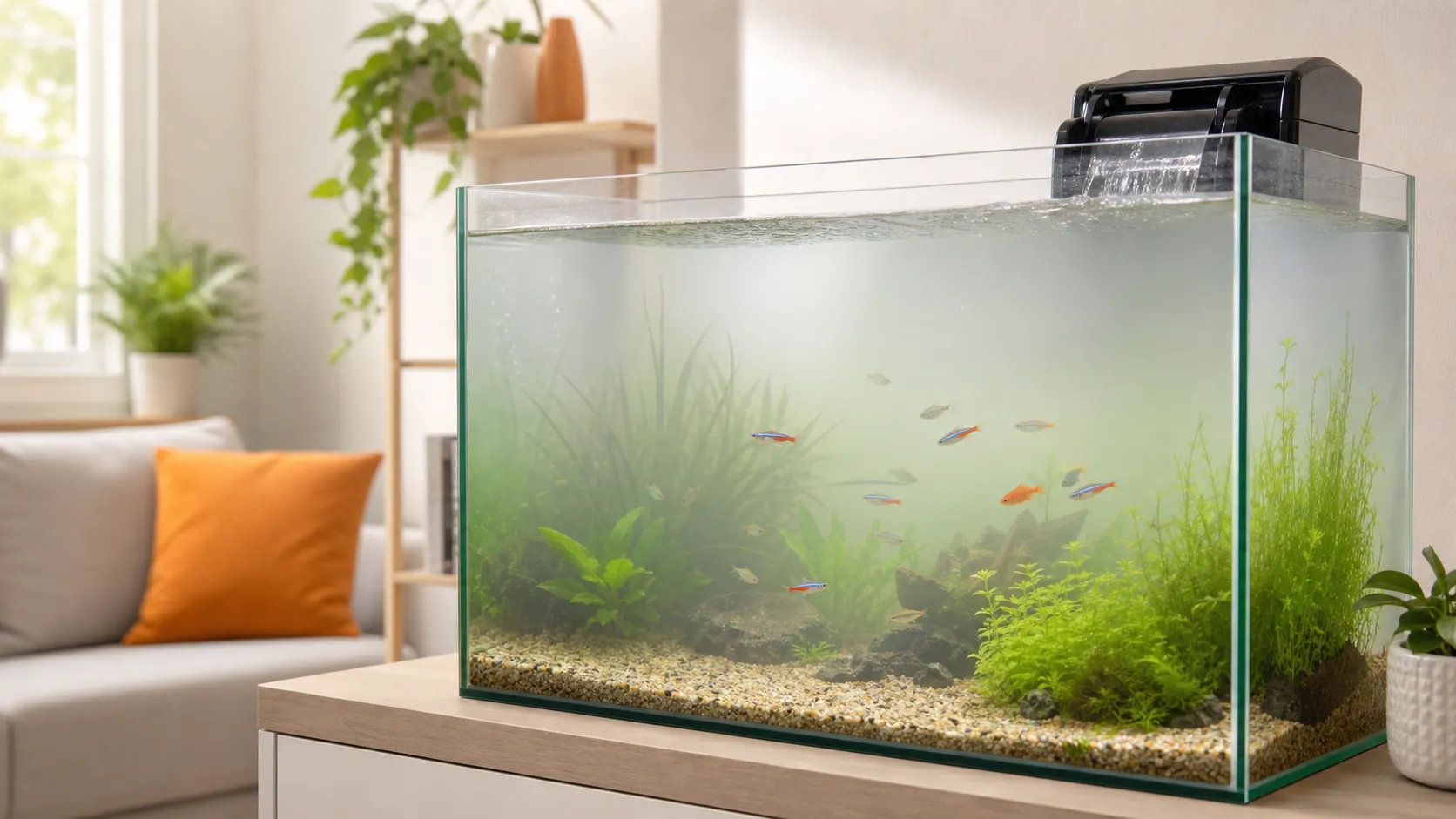
Cloudy aquarium water is usually a symptom, not a diagnosis. The fastest way to solve it is to identify the color and timing first, then check the water chemistry before adding a treatment.
Quick answer: Milky-white water in a new aquarium is most often a bacterial bloom while the biofilter is establishing. Cloudy white or gray water in an established tank usually points to excess waste, a disturbed filter, or suspended particles. Yellow or brown water is commonly caused by driftwood tannins, while green water is a suspended algae bloom. If fish are gasping, lethargic, or staying at the surface, treat the situation as a water-quality emergency and test ammonia and nitrite immediately.
This guide explains the common causes of cloudy aquarium water in freshwater and marine systems, what to do during the first 24 hours, and which products can help with diagnosis or a specific cause. Products are supporting tools; clear-looking water is never proof that ammonia and nitrite are safe.
In this guide, you will learn:
- How to distinguish a bacterial bloom from substrate dust, tannins, and green water
- Which aquarium water tests matter before you change anything
- How to clear a new tank without destroying the young biofilter
- What to do when cloudy water appears in an established aquarium
- When a bacteria starter, mechanical filter, or test kit is useful
- Which common “quick fixes” can make the problem worse
Start With the Color and Timing
The appearance of the water narrows the list of likely causes, but it does not replace testing. Look at the tank in daylight and note whether the change happened after setup, a water change, filter maintenance, new fish, or a lighting change.
| What you see | Most likely cause | First check | Best first move |
|---|---|---|---|
| Milky white in a new tank | Free-floating bacterial bloom during cycling | Ammonia and nitrite | Keep the filter running, feed very lightly, and allow the biofilter to mature |
| White or gray in an established tank | Excess organic waste or a disrupted biofilter | Dead livestock, uneaten food, filter flow, ammonia and nitrite | Remove the source, increase aeration, and perform a measured partial water change if tests require it |
| Hazy water immediately after maintenance | Fine substrate or décor particles | Whether the haze settles on surfaces | Use fine mechanical filtration and siphon the substrate gently |
| Yellow or brown water | Driftwood tannins or decaying organic matter | New wood, dead leaves, dead fish, or trapped debris | Remove decay; use activated carbon only when reducing tannin color is the goal |
| Bright green water | Suspended algae, often called green water | Light duration, nitrate, and phosphate | Reduce excess light and nutrients; consider a correctly sized UV sterilizer for a persistent bloom |
The 7 Most Common Cloudy Aquarium Water Causes
1. A New-Tank Bacterial Bloom
New aquariums begin with very little established biological filtration. Within the first days, many microorganisms compete for the nutrients released by fish waste, uneaten food, new substrate, and décor. Some of those organisms multiply in the water column and make the tank look white or gray.
This is often called a bacterial bloom. It is common during the nitrogen cycle and may clear on its own as the bacteria living on the filter media and surfaces become established. A clear aquarium can still have dangerous ammonia or nitrite, so do not use visibility as a cycling test.
The safest approach is usually patience, light feeding, good surface agitation, and regular testing. Replacing the filter cartridge or scrubbing all the décor can remove the very bacteria the tank needs to stabilize.
2. Overfeeding, Overstocking, or Decaying Matter
Fish waste, uneaten food, dead leaves, and a hidden dead fish all add organic material. That material feeds fast-growing bacteria and can create a white haze in an established tank. It can also push ammonia or nitrite above zero.
Inspect the substrate, plants, filter intake, and decorations. Remove anything that is clearly decomposing, then siphon out trapped food and debris. Feed only what the fish can finish quickly; if food remains on the bottom, the portion is too large.
Adding more fish is not a solution. A tank can look attractive and still be carrying more bioload than its filter and bacterial colony can process.
3. A Disturbed or Undersized Biofilter
The useful bacteria in an aquarium live mostly on filter media, substrate, and other hard surfaces. A filter that was washed under untreated tap water, left off for too long, or replaced all at once may lose part of that colony. A new filter can also be too small for the fish load or clogged with debris, so it cannot move enough water through its media.
Rinse reusable media in water removed from the aquarium, not under chlorinated tap water. Replace disposable media gradually when possible, and never assume that a new cartridge is biologically mature on day one.
If an established tank remains particle-heavy after the cause has been corrected, a properly sized hang-on-back or canister filter can improve mechanical filtration. The goal is better media contact and water movement, not simply the biggest pump you can buy. For larger systems, see our guide to the best canister filters for freshwater and marine aquariums.
4. Fine Substrate or Décor Dust
New gravel, sand, soil, crushed coral, and porous décor can release fine particles when they are not rinsed thoroughly. The haze often appears immediately after setup, aquascaping, or a deep substrate disturbance. It may look dramatic but is different from a bacterial bloom because particles can settle on leaves, glass, or the bottom.
Use a fine filter pad or filter floss to catch the particles, and change or rinse that mechanical layer as it loads. Siphon gently rather than stirring the entire bed. If the tank contains active soil, avoid repeated aggressive cleaning that strips away its intended nutrient layer.
Do not use a clarifier as the first response to every haze. A flocculant can make suspended particles clump together, but it will not solve ammonia, nitrite, overfeeding, algae growth, or an immature biofilter.
5. Green Water From Suspended Algae
Bright green water is usually a bloom of microscopic algae suspended throughout the water, not ordinary algae growing on the glass. The two most common triggers are too much light and too many available nutrients, especially when feeding, stocking, or maintenance has changed.
A short blackout can reduce the visible bloom, but it is only a temporary measure if the light and nutrient conditions remain the same. Reduce the photoperiod, keep the aquarium away from direct sun, and test nitrate and phosphate where those tests are appropriate for the system.
A UV sterilizer can be useful for persistent green water because it treats organisms moving through the water column. It does not replace a working biofilter, a sensible light schedule, or source control. Follow the manufacturer’s sizing and flow instructions, and avoid broad algae chemicals when the tank contains sensitive invertebrates unless the label specifically permits their use.
6. Yellow or Brown Tannins From Driftwood
Tea-colored water is commonly caused by tannins released from driftwood. Tannins are not automatically harmful; many blackwater fish naturally live in water with dissolved tannins. They can, however, lower pH in some setups and make the aquarium look cloudy or discolored.
If the color is unwanted, pre-soak or boil suitable aquarium wood before adding it, perform normal partial water changes, and use activated carbon when appropriate. Carbon can also remove medications and some plant supplements, so remove or replace it according to the product instructions and never use it blindly during medication.
Brown water can also come from decaying leaves, food, or livestock. If the water has a foul smell, surface foam, or rising ammonia, treat the organic source as the priority rather than assuming it is harmless tannin.
7. Poor Mechanical Filtration or Low Circulation
Mechanical filtration removes particles that make water look cloudy. If the prefilter, sponge, or floss is clogged, water may bypass the useful media or flow may drop sharply. If the filter is undersized for the bioload, the tank may collect fine waste faster than it can remove it.
Clean mechanical media in removed aquarium water and confirm that the intake and impeller are not blocked. A filter upgrade can help an established 20-50 gallon tank when the issue is suspended debris, but a stronger filter cannot compensate for overfeeding, overstocking, or toxic water chemistry.
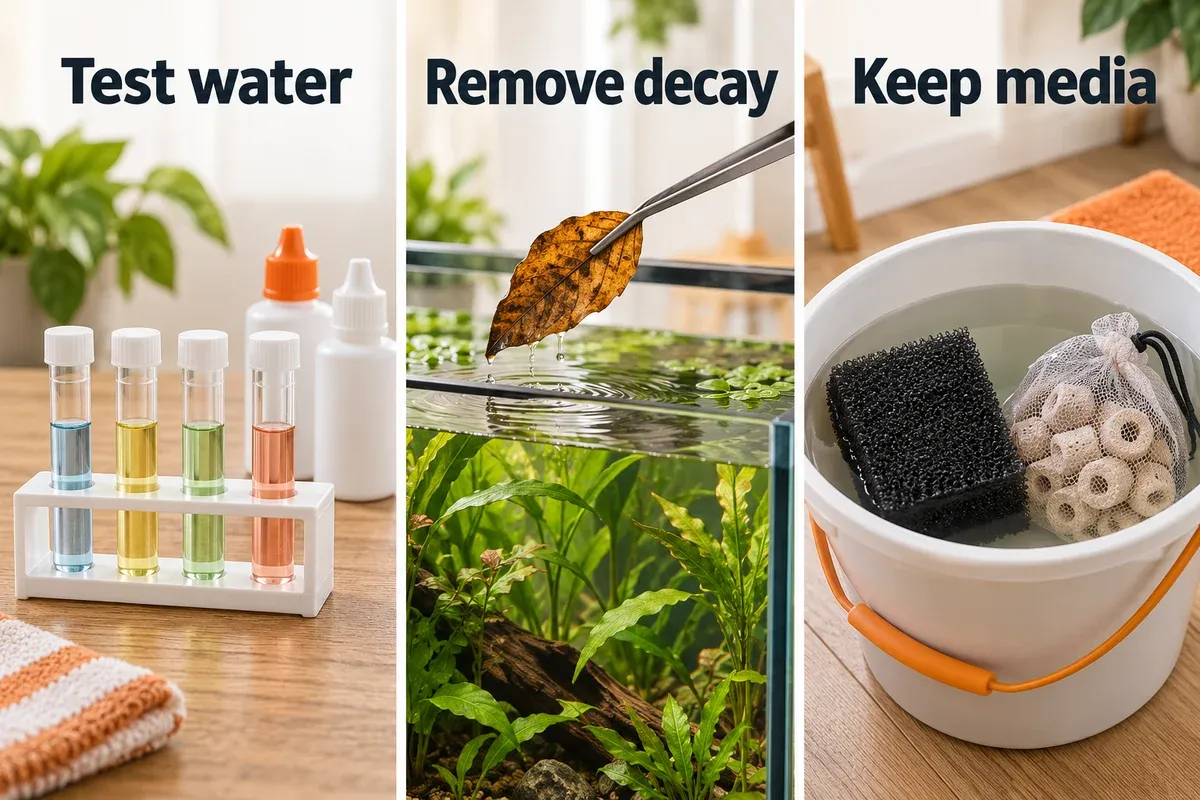
The checks below help you separate a visible haze from a water-quality problem before adding a treatment.
What to Do During the First 24 Hours
Follow these steps in order. They reduce the chance of turning a cosmetic problem into a cycling crash.
- Watch the fish first. Gasping, rapid gill movement, loss of balance, clamped fins, or unusual surface hanging can indicate poor water quality or low oxygen. Increase surface agitation immediately and test the water.
- Test ammonia and nitrite. In a healthy, established aquarium, both should be zero. Also record nitrate, pH, and temperature so you can compare the next test instead of guessing from appearance.
- Look for an obvious source. Check for a dead fish, rotting plant, uneaten food, clogged intake, or a filter that stopped running. Remove only what is clearly causing the problem.
- Make a measured partial water change when the tests or fish require it. Use temperature-matched, properly conditioned water. Avoid an automatic 100% reset, which can shock fish and remove much of the established biology.
- Keep the filter and heater operating. Do not replace every media layer at once. If mechanical media is dirty, rinse it in the water you removed from the aquarium.
- Reduce the inputs. Skip a feeding or feed a very small portion, pause new livestock additions, and shorten excessive lighting while you diagnose the cause.
- Re-test. Check ammonia and nitrite again after the change and continue monitoring daily or every other day while the tank is unstable.
If ammonia or nitrite remains above zero, the goal is to protect the fish and stabilize the nitrogen cycle. A bacteria starter may support that process, but it is not permission to stop testing or add more fish.
How to Clear Cloudy Water Without Making It Worse
New tank: protect the developing cycle
For a new aquarium with healthy-looking fish and zero ammonia and nitrite, the best treatment is often time. Keep the filter running, feed sparingly, avoid adding livestock, and leave the biological media alone. Large daily water changes may make the water look better for a few hours while repeatedly adding fresh nutrients to the bloom.
If ammonia or nitrite is detectable, the situation is no longer just cosmetic. Follow a partial-water-change plan, use a water conditioner for replacement water, increase gas exchange, and test again. Bottled bacteria can be used as a supporting step, but the aquarium still needs an ammonia source, oxygen, suitable surfaces, and time to develop a stable biofilter.
For readers starting from scratch, our aquarium starter kit guide covers the equipment decisions that make a new setup easier to maintain.
Established tank: remove the food source
In a mature aquarium, inspect before dosing. Remove rotting plants, dead livestock, and uneaten food. Vacuum the dirty areas of the substrate, clean the mechanical filter layer, and make a partial water change if ammonia, nitrite, odor, or fish behavior indicates a water-quality problem.
Keep some mature biological media in the filter. If a cartridge must be replaced, transfer the old media or replace only one layer at a time when the design allows it. Add aeration when the water is milky or fish are breathing rapidly because bacterial blooms can consume oxygen.
Fine particles: polish the water mechanically
If the haze appeared right after gravel, sand, or décor was moved and the chemistry is normal, focus on particle removal. Use filter floss or a fine pad for a short period, monitor the flow so the media does not clog, and siphon settled material gently.
Once the water clears, remove the polishing layer or service it according to the filter instructions. Leaving a clogged fine pad in place can reduce oxygenation and turn a simple dust problem into a circulation problem.
Green water: correct light and nutrients
Reduce direct sunlight and use a timer. A planted tank may need more light than a fish-only tank, so avoid a blanket schedule and match the duration to the plants and intensity. Check nitrate and phosphate, review feeding, and remove decaying material.
If a green-water bloom persists, a properly sized UV sterilizer is more targeted than an algaecide. Treat the cause at the same time; otherwise the green water often returns when the UV unit is removed.
Yellow or brown water: decide whether the color is a problem
If healthy fish are in a tannin-rich setup, tea-colored water may be intentional. If you want clearer water, use aquarium-safe activated carbon and normal partial water changes, while remembering that carbon is not a substitute for removing decaying matter or treating ammonia and nitrite.
Product Help: What Is Worth Buying?
The useful product depends on the cause. A test kit is the first purchase when the diagnosis is unclear. A bacteria starter is most relevant to a new or disrupted biofilter. A larger mechanical filter is relevant to suspended debris in an established tank, not to every white bacterial bloom.
Tools for diagnosing and clearing cloudy aquarium water
-
API Freshwater Master Test Kit
API
Liquid reagent kit for checking pH, ammonia, nitrite, and nitrate—the measurements that tell you whether a new tank is actually ready for fish.
- Tests the core nitrogen-cycle parameters
- Liquid color comparison is more useful for cycling than guessing from clear water
- Useful after stocking, filter changes, or unexplained fish stress
- Best for
- Fishless cycling and diagnosing water problems
-
Seachem Stability 250 ml
Seachem
Bacteria starter for freshwater and marine aquariums that supports biological filtration during setup, after filter changes, or after a disrupted cycle.
- 250 ml bottle
- Freshwater and marine use
- Supports biological filtration
- Best for
- New tanks and biofilter recovery
-
API QUICK START 16 oz
API
Live nitrifying-bacteria formula for freshwater and saltwater aquariums, intended to help start or maintain the biological filter.
- 16 fl oz bottle
- Freshwater and saltwater use
- Live nitrifying bacteria
- Best for
- New tanks, new fish, and filter-media changes
-
AquaClear 50 Power Filter
AquaClear
Hang-on-back filter with mechanical, chemical, and biological filtration and a large media chamber for routine water polishing and biofilter support.
- Rated for 20-50 US gallon tanks
- Mechanical, chemical, and biological filtration
- Large media volume
- Best for
- Established 20-50 gallon tanks with suspended debris
Review the linked product page before purchasing.
API Freshwater Master Test Kit - Best First Purchase
The API Freshwater Master Test Kit is the most useful starting point when the cause is unclear. It measures ammonia, nitrite, nitrate, pH, and high-range pH with liquid reagents, so you can distinguish a harmless-looking haze from a cycling problem that can injure fish.
Check current price on Amazon →What it does well:
- Tests the parameters that matter most during a new-tank bloom
- Helps connect a visible change with an invisible water-quality problem
- Reusable tubes and liquid reagents are practical for repeated checks
- The freshwater-only format keeps the kit focused and easy to understand
Limitations:
- It is not a saltwater test kit
- You must follow each reagent’s shaking and waiting instructions
- It diagnoses the problem; it does not remove ammonia, nitrite, or particles
Bottom line: If you can buy only one item before guessing at treatments, buy a way to test. The kit is useful during cycling, after filter maintenance, and whenever fish behavior changes.
Seachem Stability 250 ml - Best for a New or Disrupted Biofilter
Seachem Stability is a sensible option when the tank is new, a large filter change disturbed the cycle, or additional biological support is needed after maintenance. Seachem describes it for freshwater and marine aquariums and recommends dosing it alongside biological filtration rather than treating it as a stand-alone cure.
Check current price on Amazon →For a new aquarium, the manufacturer’s directions call for 5 ml per 10 US gallons on the first day, followed by 5 ml per 20 US gallons daily for seven days. The label also instructs users to turn off UV or ozone during the dosing period. Follow the bottle if the formula or instructions change.
Why it can help:
- Freshwater and marine compatibility is useful for mixed aquarium households
- The small 250 ml bottle is affordable for a first setup or occasional filter recovery
- The intended use matches the biological cause of many new-tank white blooms
Limitations:
- It does not make ammonia and nitrite testing optional
- It cannot remove substrate dust or suspended algae
- A tank can still need several weeks to complete its cycle
Bottom line: Choose this when biology is the suspected weak point. Do not use a bacteria starter to mask overstocking, overfeeding, or a dead fish.
API QUICK START 16 oz - Best Alternative Bacteria Starter
API QUICK START is an alternative bottled-bacteria product for freshwater and saltwater aquariums. API lists it for new setups, adding fish, water changes, filter-media changes, and detectable ammonia or nitrite. The official directions call for 10 ml per 10 US gallons in freshwater and double that dose for saltwater.
Check current price on Amazon →Why it can help:
- Large 16 fl oz size is practical for repeated use or larger tanks
- Freshwater and saltwater versions are available within the same product line
- The use cases include filter-media changes, a common trigger for cloudy water
Limitations:
- Use it as an alternative to another bacteria starter, not as a cocktail of multiple products
- The manufacturer’s “immediate addition” language still assumes correct water conditioning, filtration, temperature, and pH
- Test ammonia and nitrite before deciding that fish are safe
Bottom line: QUICK START is a reasonable choice when you want a bacteria starter and prefer API’s dosing system. It is not a shortcut around a complete nitrogen-cycle plan.
AquaClear 50 Power Filter - Best for Suspended Debris in 20-50 Gallon Tanks
The AquaClear 50 is a hang-on-back filter rated for 20-50 US gallon aquariums. Its mechanical, chemical, and biological stages make it relevant when an established tank has persistent particles, weak flow, or limited media capacity. It is not the right first purchase for milky water caused by an immature cycle if the existing filter is already functioning.
Check current price on Amazon →Why it can help:
- The media chamber supports mechanical polishing and biological media
- It is sized for common 20-50 gallon freshwater setups
Limitations:
- A stronger filter does not fix overfeeding, excessive stocking, or toxic ammonia
- Keep mature biological media when cleaning or upgrading the filter
Bottom line: Consider it when the water is full of suspended debris and the current filter is undersized or clogged. Match the filter to the tank and livestock, not just the maximum gallon number on the box.
What Not to Do
- Do not add several clarifiers, algaecides, and bacteria products at the same time.
- Do not replace all filter media because the water looks cloudy.
- Do not wash biological media under untreated tap water.
- Do not add fish while ammonia or nitrite is detectable.
- Do not do repeated 100% water changes for a purely cosmetic haze.
- Do not use a UV sterilizer as a substitute for testing, source control, or a mature biofilter.
- Do not assume a high-rated product is appropriate for every color or type of cloudiness.
A Simple 7-Day Clearing Plan
Day 1: Observe the fish, test ammonia and nitrite, inspect the tank, remove obvious decay, and correct urgent water-quality problems with conditioned water and increased aeration.
Days 2-3: Keep the filter running, feed sparingly, and avoid new livestock. If the tank is new and the tests are safe, resist the urge to deep-clean the filter.
Days 4-5: Re-test. If the haze is particle-based, service the mechanical layer. If it is green, reduce light and nutrients. If it is yellow-brown, investigate wood or decay.
Days 6-7: If the water is not improving, compare the test results and maintenance log. Check source water, stocking, filter flow, light duration, and temperature. A recurring bloom needs a cause corrected, not just another dose of clarifier.
This gradual approach is also useful when you are planning a larger setup. If lighting, filtration, and tank size are being chosen together, review our guides to LED aquarium lighting and aquarium starter kits before buying replacement equipment.
Frequently Asked Questions
Is cloudy aquarium water dangerous?
It can be, but cloudiness alone does not tell you how dangerous the water is. A new-tank bloom may clear without harming fish when ammonia and nitrite stay at zero. Gasping, rapid breathing, lethargy, or detectable ammonia or nitrite turns the problem into a water-quality emergency.
How long does a bacterial bloom last?
Many new-tank blooms clear in a few days to a couple of weeks as the biological filter matures. The timeline depends on the tank’s surfaces, oxygen, temperature, nutrient load, stocking, and maintenance history. If it keeps returning, look for overfeeding, decaying matter, or a disrupted filter rather than waiting indefinitely.
Should I change the water every day when the tank is cloudy?
Not automatically. A water change is appropriate when ammonia, nitrite, fish behavior, odor, or visible waste calls for it. For a harmless new-tank bloom with safe test results, repeated large changes can disturb the developing cycle and may only clear the water temporarily.
Can I use aquarium water clarifier?
A clarifier can help clump suspended particles so the filter can remove them. It does not cycle a new aquarium, detoxify ammonia, remove the source of green water, or replace water testing. Correct the cause first and follow the label closely if you use one.
Should I replace my filter cartridge when the water turns cloudy?
Usually not. A cartridge or sponge may contain much of the aquarium’s useful bacteria. If the media is dirty, rinse it in removed aquarium water and preserve the biological portion. When replacement is unavoidable, change media gradually where possible.
Does activated carbon clear cloudy water?
Activated carbon is most useful for dissolved color and some odors, including tannins from driftwood. It is not a complete solution for bacterial blooms, green water, poor filtration, or ammonia. Carbon can also remove medications, so follow the medication and carbon instructions together.
Can I add fish after using a bottled bacteria product?
Do not use a product claim as the only decision rule. Condition the water, run effective filtration, confirm suitable temperature and pH, and test ammonia and nitrite. Add livestock gradually only when the readings and the tank’s stability support it.
Final Verdict: Diagnose Before You Dose
Most cloudy aquarium water causes fit into four patterns: a new biofilter, excess organic waste, suspended particles, or an algae or tannin problem. Start with the color and timing, then test ammonia and nitrite before reaching for a product.
Best first step: Test the water and watch the fish. For a new or disrupted biofilter: Protect the media, feed lightly, and consider one bacteria starter. For particles in an established tank: Improve mechanical filtration and remove the source. For green water: Reduce light and nutrients; use UV only as a targeted tool. For yellow-brown water: Check driftwood and decaying matter before using carbon.
Clear water is a visual result. A stable aquarium is the real goal.