

 Published sources
 Product details checked
Aquarium water should not smell strongly foul. A faint pond-like or earthy scent can be normal around a mature tank, but a sudden fishy, sour, sewage-like, or rotten-egg odor is a clue that something in the aquarium, filter, substrate, livestock, or source water needs attention.
Quick answer: Start with the fish, not the smell. Check for a dead animal, uneaten food, rotting plant material, a clogged or stopped filter, and black or compacted areas in the substrate. Test ammonia and nitrite immediately; both should be zero in a stable freshwater aquarium. A rotten-egg odor is the exception that needs extra caution: hydrogen sulfide can form where organic matter decomposes without oxygen, and the gas is toxic to fish. Do not deliberately stir a smelly substrate pocket or repeatedly lean over a strong odor to identify it.
This guide uses the odor as a diagnostic clue, then moves to water testing and a controlled inspection. It also separates products that can help with a specific task from products that only make the water look or smell better for a short time.
If the smell is rotten egg or sewage-like, pause and escalate
A mild odor from a small aquarium is not automatically a hazardous-gas event. Still, a clear rotten-egg smell deserves more respect than an ordinary dirty-tank smell. The U.S. Geological Survey identifies hydrogen sulfide as a source of rotten-egg odor in water, and the FAO notes that hydrogen sulfide can form during anaerobic decomposition, collect around black bottom material, and be toxic to fish.
Hydrogen sulfide is also a human safety issue in general. ATSDR describes it as a colorless gas with a rotten-egg smell and warns that people can lose the ability to smell it after exposure to high concentrations. Smell is not a reliable safety meter.
Use this escalation sequence:
- Move people and pets away from the tank and ventilate the room. Do not repeatedly sniff the water, filter, or substrate. If the room itself smells strongly, leave it and get help rather than investigating alone.
- Treat symptoms as a health issue, not an aquarium problem. Headache, dizziness, nausea, eye or throat irritation, coughing, breathing difficulty, confusion, or fainting are reasons to get into fresh air and contact local emergency or poison-control services. Call emergency services immediately for severe breathing trouble, collapse, or loss of consciousness.
- Do not churn the substrate, open a stagnant canister over your face, or pour foul sludge into an enclosed room. Deep disturbance can release trapped gas and contaminated water at the exact moment you are closest to it.
- If the room is safe and fish are gasping, increase gas exchange from a safe position. Aim for gentle surface movement first. Avoid vigorous bubbling in an unventilated room because bubbling can transfer dissolved gas into the air.
- Protect the fish with testing and a measured water change. If ammonia or nitrite is detectable, use conditioned, temperature-matched replacement water, change a measured portion, and re-test. Keep established biological media wet and running if it can be done safely.
- Get experienced aquarium or environmental help for a persistent sulfur odor. A recurring odor from black substrate, a sump, a well-water source, or a plumbing connection may require a controlled teardown, source-water test, or professional assessment.
If the smell is strong enough that you are worried about breathing it, do not make a product purchase or a deep-cleaning project your first response. Leave the area, ventilate safely, and escalate the human-safety concern first.
Diagnose the odor before you buy anything
The smell narrows the possibilities, but it does not prove the cause. Compare the aquarium with a clean glass of source water from the same tap, a clean bucket, and the room around the stand without putting your face over any container. A smell that follows the source water points away from the aquarium; a smell that is strongest at the filter, lid, stand, drain, or wet floor may not be coming from the water column at all.
| Odor clue | Common aquarium causes | First safe checks | Urgency |
|---|---|---|---|
| Fishy, waste-like, or ammonia-like | Excess food or fish waste, a hidden dead fish or snail, rotting plants, clogged mechanical media, overstocking, or a new-tank cycle problem | Count livestock, inspect the intake and filter, look behind décor, then test ammonia and nitrite | Same-day water-quality check; urgent if fish are gasping or readings are above zero |
| Mild earthy or pond-like | Normal aquatic biology, driftwood, plant material, or naturally occurring odor compounds such as geosmin | Check whether the fish and tests are normal; inspect new wood, dead leaves, and algae or cyanobacteria | Usually observation if mild and stable; investigate a sudden strong change |
| Strong earthy, musty, or soil-like | Decaying plant matter, trapped detritus, algae or cyanobacteria growth, or a poorly oxygenated pocket | Look at the substrate and plant bases without deep stirring; test ammonia and nitrite; check for black areas | Same-day inspection; escalate if it becomes sulfur-like or fish show stress |
| Rotten egg, sulfur, or sewage | Hydrogen sulfide from oxygen-poor decomposition, a stagnant filter or sump, sewage-contaminated source water, or plumbing | Ventilate, keep your face away, do not churn the substrate, and separate tank water from source-water questions | Safety escalation; treat fish stress and human symptoms as urgent |
| Sour, chemical, or plastic-like | Cleaning product, air freshener, contaminated bucket, new décor or plastic, medication, or a decaying food source | Remove possible household contaminants, stop adding products, and compare tank water with conditioned source water | Immediate controlled water-quality response if fish are distressed or contamination is plausible |
What a fishy aquarium smell usually means
“Fishy” is often a polite description for dissolved organic waste. Healthy fish do not normally make an established aquarium smell like a fish market. The usual sources are uneaten food, feces, a dead fish or snail hidden behind hardscape, a melting plant, a clogged prefilter, or detritus trapped in a canister or overflow.
Start with a visual inventory. Count every fish, shrimp, snail, and other animal. Check the floor of the tank, the intake guard, plant thickets, caves, the lid rim, the overflow, and the first mechanical filter layer. A dead animal can be surprisingly difficult to see in a planted tank, and a blocked filter can hold a large amount of decomposing material.
Then test ammonia and nitrite before you decide that the odor is merely cosmetic. Aqueon explains that fish waste becomes ammonia, nitrifying bacteria convert it to nitrite, and both compounds are toxic to fish. The same guidance identifies uneaten food and dead plant material as biological waste sources. If either ammonia or nitrite is detectable in an established tank, the smell is secondary to the water-quality problem.
Remove only material that is clearly decaying. Siphon loose food and detritus, rinse mechanical media in removed aquarium water, and keep biological media wet. Do not replace every filter cartridge or scrub the entire aquarium with tap water; that can remove useful bacteria and prolong the problem.
What an earthy or musty aquarium smell usually means
A slight earthy scent when you lift the lid can be compatible with a normal aquatic ecosystem. A sudden or powerful earthy odor is different. It can come from decomposing plant matter, driftwood, algae or cyanobacteria, trapped detritus, or the source water itself.
The odor compounds geosmin and 2-methylisoborneol (2-MIB) are well-known in aquatic systems for musty or earthy taste and odor. The NordForsk project at Aarhus University links those compounds to microbial activity in aquaculture, while the USGS notes that decaying plant material in lakes and reservoirs can create musty, earthy odors. That does not mean every aquarium with an earthy smell has a dangerous bloom; it means the smell is a clue to inspect the biological material and water source rather than a reason to dose blindly.
Check these areas:
- Leaves that are translucent, melting, or collecting brown sludge
- Plant crowns, moss, wood, and décor where food can settle
- Algae or slimy films, especially if the odor is unusually strong
- A substrate surface that has become packed with detritus
- The filter’s first mechanical stage, intake, impeller chamber, and hoses
- A clean sample of tap or well water before it enters the aquarium
Driftwood tannins can make water tea-colored and give it a natural scent without being the main problem. If the smell is accompanied by dead plant material, fish stress, surface foam, or rising ammonia and nitrite, treat the decaying material and water quality—not just the color.
For a green, musty water column, see our guide to green aquarium water causes and nutrient checks. For brown or tea-colored water, use our brown aquarium water guide to assess the color separately; the smell and the color can have different causes.
What a rotten-egg aquarium smell usually means
Rotten egg is the classic warning clue for hydrogen sulfide, often written as H₂S. In aquarium-like bottom environments, it can form when sulfur-containing organic matter decomposes in low-oxygen or oxygen-free pockets. The FAO describes hydrogen sulfide in aquaculture as associated with anaerobic decomposition, black mud or sand, and a characteristic odor; it also warns that the gas is toxic to fish.
That makes a black patch under compacted substrate a useful clue, not an invitation to plunge a tool into it. A black color alone does not prove dangerous hydrogen sulfide, and not every sulfur smell comes from the tank. The source may be well water, plumbing, a stagnant filter, or a wet drain. Isolate the source without leaning into the odor.
If the odor is strong or fish are gasping, follow the safety sequence above. Once the room is safe, use testing and controlled water changes to protect the fish. Avoid a dramatic 100% reset by default: a large uncontrolled change can stress fish and remove established biological surfaces. A recurring, severe pocket may be safer to address with an experienced aquarist who can plan temporary housing, aeration, substrate removal, and cycle monitoring.
Activated carbon is not a first-aid treatment for a suspected hydrogen sulfide pocket. It may reduce some dissolved organic compounds after the source is removed, but it does not make a toxic substrate disturbance safe and does not replace ammonia and nitrite testing.
The checks below address routine waste and filtration problems after you have assessed the odor and room safety.
A safe 30-minute diagnosis
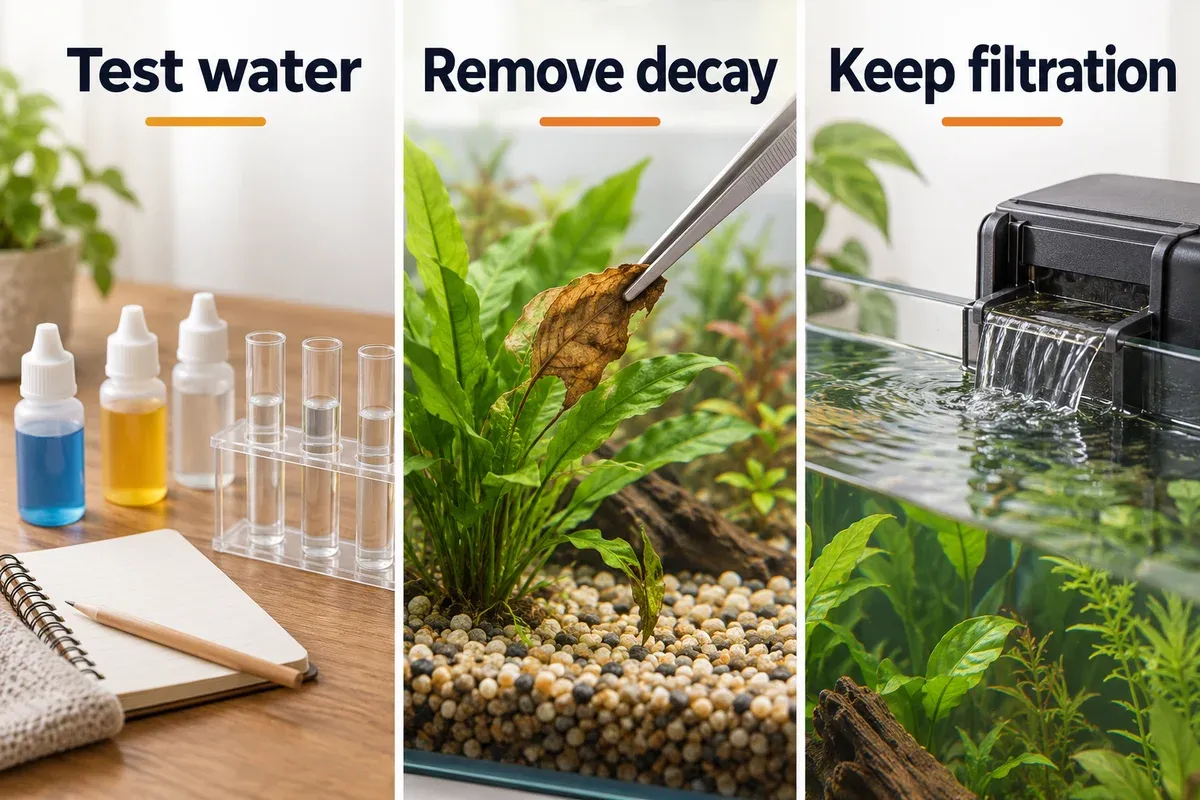
Use the following order when the odor is not strong enough to trigger the human-safety escalation above. Stop at any point if the smell becomes more intense or the fish deteriorate.
1. Watch the fish before touching the tank
Look for gasping, rapid gill movement, hanging at the surface, loss of balance, clamped fins, unusual hiding, or a sudden refusal to move. Those signs can have several causes, but they make the problem urgent. Increase safe surface movement, reduce feeding, and test ammonia and nitrite immediately.
2. Locate the odor without deliberate deep sniffing
Check the room, stand, floor, drain, lid, filter chamber, and water source from a distance. A wet cabinet, dead animal behind the stand, dirty canister hose, or floor drain can mimic aquarium-water odor. Compare tank water with source water in a clean container only if doing so does not expose you to a strong smell.
3. Test the nitrogen cycle
For a freshwater aquarium, test ammonia, nitrite, nitrate, pH, and temperature. Ammonia and nitrite should be zero in a stable established tank. A liquid test kit is useful because clear water cannot reveal an invisible ammonia or nitrite problem, and a strong odor is not a substitute for a number.
If the aquarium is marine, use a saltwater-compatible test method rather than assuming a freshwater kit covers every parameter. Record the result, time, and water-change history so you can see whether the problem is improving.
4. Inspect livestock and obvious decay
Remove dead animals and clearly decomposing leaves with aquarium tools. Look under rocks, inside caves, around the intake, and in the filter’s mechanical stage. Do not dismantle a stable aquascape or dig into a sulfur-smelling bottom simply to prove where the odor started.
5. Check filter flow without sterilizing it
Confirm that the filter is running, the intake is not blocked, and the return is moving the surface. If the mechanical pad is loaded, rinse it in removed aquarium water. Aqueon’s cleaning checklist also recommends keeping biological media in aquarium water while the filter is serviced, replacing chemical media according to its use, and matching the temperature of replacement water.
Never use dish soap, scented cleaner, bleach residue, or untreated tap water on aquarium filter media. If a canister has a strong internal odor and you cannot open it safely, unplug it from a dry position and get help rather than opening a stagnant container over the tank.
6. Make a measured partial water change when tests or fish require it
Use a water conditioner that treats your source water, match the new water’s temperature, and change a measured portion appropriate to the test result and fish condition. Re-test ammonia and nitrite after the change. If a reading remains detectable, repeat controlled changes and continue monitoring rather than assuming one change solved the source.
Do not add household deodorizers, fragrances, disinfectants, or unlabelled “odor killers” to the aquarium. Do not use a 100% water change as an automatic answer to a smell when the fish are stable and the source is still unknown.
7. Recheck after 24 hours
Remove the waste source, keep feeding light, and check the odor, fish behavior, filter flow, ammonia, and nitrite again. If the smell returns soon after a water change, the source is still present or is entering with the new water. A recurring odor is a reason to inspect the substrate, filter, source water, and room—not to keep adding carbon indefinitely.
Which products can actually help?
Products are useful only after the task is clear. Testing is the priority when the odor is unexplained. Aeration is a support measure when fish are short of oxygen, not a cure for decomposing material. Activated carbon can polish some dissolved organics after the source has been removed, but it cannot fix a dead fish, ammonia, nitrite, a sulfur pocket, or a contaminated water source.
Focused tools for diagnosing an aquarium odor
-
API Freshwater Master Test Kit
API
Liquid reagent kit for checking pH, ammonia, nitrite, and nitrate—the measurements that tell you whether a new tank is actually ready for fish.
- Tests the core nitrogen-cycle parameters
- Liquid color comparison is more useful for cycling than guessing from clear water
- Useful after stocking, filter changes, or unexplained fish stress
- Best for
- Fishless cycling and diagnosing water problems
-
Tetra Whisper Air Pump Up To 10 Gallons
Tetra
Single-outlet air pump intended for aquariums up to 10 gallons. It needs an air stone, airline tubing, and a check valve and supports gas exchange without replacing filtration or water changes.
- Selected model is intended for aquariums up to 10 gallons
- Air stone, airline tubing, and check valve are required separately
- Best for
- Emergency surface agitation for small freshwater tanks
-
Marineland Black Diamond Premium Activated Carbon
Marineland
Heat-activated carbon media that can adsorb some dissolved organic compounds and reduce discoloration or odor after the decaying source has been removed.
- Intended for dissolved organics, discoloration, and odor polishing
- Use in a media bag or filter compartment with unrestricted flow
- Best for
- Short-term odor and discoloration polishing after source removal
Review the linked product page before purchasing.
API Freshwater Master Test Kit: the first purchase when the cause is unclear
The API Freshwater Master Test Kit measures pH, high-range pH, ammonia, nitrite, and nitrate with liquid reagents. That combination cannot identify every cause of an odor, but it answers the most important first question: is the tank carrying a nitrogen-cycle problem that can harm fish?
Check current price on Amazon →Use it before and after a water change, after a filter interruption, or whenever the smell comes with unusual fish behavior. Follow the bottle instructions exactly, including shaking and waiting times. The kit is for freshwater; marine systems need saltwater-appropriate testing.
Tetra Whisper Air Pump up to 10 Gallons: a small-tank aeration backup
The selected Tetra Whisper model is intended for aquariums up to 10 gallons and requires an air stone, airline tubing, and a check valve. It is useful for increasing surface movement when fish are gasping and the room is safe to enter. It is not filtration, not a water change, and not a treatment for hydrogen sulfide.
Check current price on Amazon →Choose a correctly sized model for a larger tank rather than assuming the 10-gallon version is enough. If the aquarium has a strong rotten-egg odor, ventilate first and do not run vigorous bubbling in a closed room; the immediate goal is safe gas exchange, not forcing a suspected gas into the room air.
Marineland Black Diamond Carbon: temporary odor polishing after source removal
Marineland Black Diamond is heat-activated carbon media intended to remove some dissolved organic compounds, discoloration, and odor. It can be a useful finishing step after you have removed dead material, corrected the water quality, and restored normal filtration.
Check current price on Amazon →Rinse carbon according to its instructions and place it in a media bag or the filter compartment designed for it. Treat it as temporary chemical media, not as the biological foundation of the aquarium. Carbon can remove or reduce some medications and other treatments, so follow the medication label before adding it. Replace it when exhausted rather than leaving an unknown, dirty bag in a restricted filter.
If you need a gravel vacuum or water conditioner, choose an aquarium-specific product that matches your tank and source water. Our beginner aquarium checklist covers those maintenance basics; the equipment does not replace a test result or source inspection.
What not to do when an aquarium smells bad
- Do not cover the smell with fragrance. Air fresheners, essential oils, scented cleaners, and household disinfectants can contaminate aquarium water and make the human-safety problem harder to locate.
- Do not stir a deep, black, sulfur-smelling substrate pocket. Surface siphoning and a planned teardown are different from plunging a tool into an anaerobic area.
- Do not replace all filter media at once. Keep established biological media wet and preserve as much useful biofiltration as possible.
- Do not trust clear water. Ammonia and nitrite can be dangerous when the aquarium looks perfect.
- Do not keep adding activated carbon without removing the source. A temporary improvement can hide a dead animal, decaying plant, clogged filter, or contaminated source water.
- Do not make a large water change with untreated or temperature-mismatched water. Condition the new water and match its temperature.
- Do not repeatedly sniff the odor to decide whether it is still present. ATSDR warns that hydrogen sulfide can reduce the sense of smell at higher exposures.
For filter maintenance, see how to clean a canister filter without crashing the cycle. If the smell comes with hazy water, cloudy aquarium water causes can help separate suspended particles from a water-quality event.
Frequently Asked Questions
Is a faint earthy smell normal in an aquarium?
A faint pond-like scent can occur in a healthy aquarium, especially around plants, driftwood, and a mature filter. It is not a free pass: check fish behavior and test ammonia and nitrite if the odor is new, stronger than usual, or accompanied by decay, foam, cloudy water, or abnormal behavior.
Why does my aquarium smell fishy even though the water looks clear?
Clear water can still contain dissolved waste or toxic ammonia and nitrite. Look for a hidden dead fish or snail, uneaten food, rotting plants, a loaded mechanical filter, or a stocking and feeding level that exceeds the tank’s biological capacity. Test before buying a deodorizing product.
Does a rotten-egg smell always mean hydrogen sulfide?
No. Hydrogen sulfide is a serious possibility, but the odor can also come from well water, plumbing, a drain, or a stagnant filter. Isolate the source without deliberate deep sniffing. If the smell is strong, ventilate and escalate human-safety concerns before disturbing the tank.
Can activated carbon remove a bad aquarium smell?
It can reduce some dissolved organic compounds and odor after the source has been removed. It cannot make ammonia or nitrite safe, neutralize a trapped sulfur pocket, remove a dead animal, or correct contaminated source water. Use it as targeted temporary media, not as the diagnosis.
Should I do a 100% water change because the aquarium smells bad?
Not automatically. A measured, conditioned, temperature-matched partial change is usually easier on fish and preserves more biological continuity. If ammonia or nitrite is detectable or fish are distressed, prioritize repeated controlled changes and re-testing. A severe sulfur event may require an experienced, planned reset rather than an improvised total drain.
Can I vacuum the substrate if it smells like rotten eggs?
Do not aggressively plunge a gravel vacuum into a strong sulfur-smelling or black pocket. Deep disturbance can release trapped gas and foul water. Ventilate, protect the fish if the room is safe, and get experienced help for persistent or severe cases. A shallow, controlled clean of ordinary surface debris is different from disturbing an anaerobic pocket.
Why does the smell come back after a water change?
The source may still be trapped in the substrate, filter, hose, plant mass, décor, or a dead animal, or it may be entering with the tap or well water. Compare tank water with source water, inspect the filter’s mechanical stage, test ammonia and nitrite, and look for a recurring dead spot rather than adding more carbon.
Bottom line
Diagnose aquarium odor in this order: watch the fish, locate the source, test ammonia and nitrite, remove obvious decay, preserve the biofilter, and make a controlled water change when the results or fish require it. Fishy odors usually point to organic waste or filtration problems. Mild earthy odors can be normal, but a sudden strong earthy smell needs inspection. Rotten-egg odor is the safety boundary: do not stir the suspected source, do not rely on your nose, ventilate, and escalate human or fish distress promptly.
Sources and further reading
- Aqueon: Freshwater Aquarium Water Quality — the nitrogen cycle, ammonia, nitrite, and routine testing
- Aqueon: Aquarium Cleaning Checklist — safe filter-media handling and temperature-matched water changes
- U.S. Geological Survey: earthy and rotten-egg odors in water
- FAO: Hydrogen sulfide in aquaculture water
- ATSDR: Hydrogen Sulfide ToxFAQs
- NordForsk and Aarhus University: Taste and odor issues in aquaculture