

 Published sources
 Product details checked
Size a bird-room air purifier from room volume and particle CADR, then choose a fan setting you can keep running. In US units, the baseline is room volume in cubic feet × selected equivalent air changes per hour ÷ 60. In metric units, it is room volume in cubic metres × selected equivalent air changes per hour. The result gives you a capacity to compare with an exact purifier model.
The calculator starts at 4.8 equivalent air changes per hour, the room-size comparison used by AHAM Verifide. Its optional 5% reserve per bird, capped at 50%, is an unvalidated purchasing scenario. Neither number establishes how much filtration a particular bird needs to stay healthy.
If the immediate problem is smoke, cooking fumes, a chemical spill, or a bird struggling to breathe, move the bird away from the exposure and seek urgent veterinary advice. VCA’s household-hazard guidance explains why fumes can harm birds even when the room does not smell strongly. Adding CADR is not the first response to an active exposure.
Use the calculator first, then work through the details that affect your result:
- Measure the room and choose the CADR input
- Understand the baseline and optional reserve
- Follow the US and metric examples
- Compare purifier designs and exact variants
- Budget for filters and running costs
- Place the purifier and check its operation
- Troubleshoot dust, odors, and poor results
Bird room air purifier size calculator
Size a purifier for your bird room
Enter your room measurements and the particle CADR of the purifier you are comparing. See the volume-based result separately from an optional bird-count reserve. Neither result is a veterinary air-quality target or a health guarantee.
Compare required CADR with your setup
Room volume = floor area × ceiling height. Baseline CADR = volume in cu ft × selected eACH ÷ 60, or volume in m³ × selected eACH. Calculated particle eACH = total CADR in CFM × 60 ÷ volume in cu ft, or total CADR in m³/h ÷ volume in m³. The optional reserve multiplies the baseline CADR; it does not change the room volume or the purifier’s calculated eACH. The reserve-adjusted comparison divides calculated eACH by the reserve multiplier and is not a physical air-change rate. Annual filters = complete set price × 12 ÷ months × entered units. CADR describes particle removal, not outdoor ventilation, gas removal, or medical protection.
Choose US or metric measurements before entering your numbers. Switching units converts the area, ceiling height, and CADR already entered; it leaves the bird count and maintenance assumptions alone. The result shows both CFM and m³/h so you can compare a US specification with a metric one.
Leave CADR blank if you only want a room-based purchasing target. Add a per-unit CADR and unit count to see the calculated particle-cleaning rate and how many identical units would reach the selected target. Filter cost is optional and always uses the number of units you entered, not the suggested number.
Measure the room and choose the CADR input
Measure the space the purifier will serve
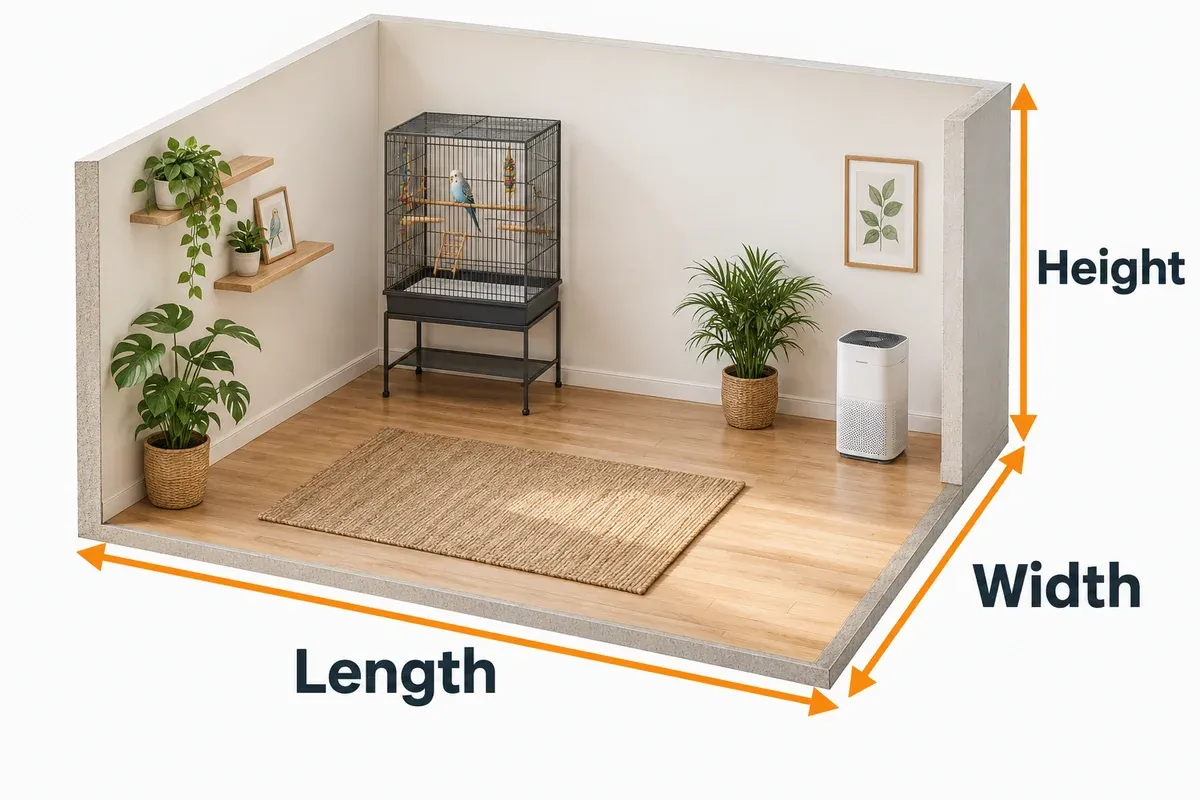
For a rectangular room, multiply length by width to obtain floor area. Then multiply that area by ceiling height. Enter the entire occupied room, including the space around the cage, rather than the cage footprint.
An L-shaped room is easier to measure as two rectangles. Add their floor areas. For a ceiling that slopes evenly from one wall to the other, use the average of the low and high heights. If the room has several ceiling levels, calculate each section’s volume, add the volumes, and divide by the total floor area to obtain the average height for the calculator.
Include an adjoining space when it is openly connected and the purifier is expected to serve it. A living room with a permanently open dining area has more air to clean than the living-room dimensions alone suggest. A shut door creates a separate space; do not add a bedroom’s volume and assume a purifier in the hallway will clean it effectively.
You normally do not need to subtract furniture, cage bars, or the volume of a bookshelf. Measuring the room’s full envelope keeps the calculation simple. The more useful placement question is whether the purifier can draw air from the occupied area without a sofa, curtain, cage cover, or cabinet blocking the route.
Use particle CADR, with its unit and fan setting
CADR means clean air delivery rate. It expresses particle removal as an equivalent volume of clean air delivered over time. AHAM’s air-filtration standards distinguish smoke, dust, and pollen CADRs. These are different test categories, so compare like with like.
Use smoke CADR when it is available for the exact model. It is the useful first comparison for smaller particles; the EPA’s air-cleaner guide also recommends a high smoke CADR when small-particle removal is the aim. The name describes the test particles. It does not mean the device makes tobacco smoke or cooking fumes acceptable around birds.
Write down these details with the number:
- Exact model number and market, such as the US rather than European variant.
- CADR category: smoke, dust, pollen, or an unspecified published particle CADR.
- Unit: CFM, meaning cubic feet per minute, or m³/h, meaning cubic metres per hour.
- Fan speed and any electronic cleaning function used during the test, when specified.
- Filter configuration, particularly if you are considering a different replacement filter.
A fan’s free-air flow is not CADR. Air passing through a fan is not necessarily cleaned to the same degree as air passing through the complete filter. Similarly, a reading beside the outlet from a handheld anemometer is an airflow measurement, not a room-scale particle CADR test. Enter a measured CADR only if it comes from a comparable particle-removal test with documented conditions.
An unspecified manufacturer’s CADR can still be useful for preliminary sizing, but keep its category visible when comparing it with a verified smoke rating. Look up the exact device in the AHAM Verifide directory where available.
Match the number to the setting you will actually use
Published CADR generally describes the highest speed. The EPA guide explains that lower speeds filter less air and longer operating times increase filtration. A quiet sleep mode should not be credited with the maximum-speed rating unless that mode has its own matching test result.
If only maximum CADR is available, treat the calculator’s eACH result as a maximum-speed comparison. Do not estimate half the CADR just because the control is at half speed: fan settings and delivered clean air need not scale proportionally.
A larger unit can be worth comparing if the smaller one meets the target only on a setting your household will regularly switch off. Before purchasing, check whether the model offers a usable intermediate setting and whether any CADR data exist for it. Sound level alone does not tell you that setting’s cleaning capacity.
Measure the whole served space, as shown below, rather than just the cage footprint. Use those dimensions with the calculator and the matching purifier rating.
How the calculation works
Room volume and the volume-based baseline
The calculation uses the same physical room in either system:
| Quantity | US calculation | Metric calculation |
|---|---|---|
| Room volume | Floor area in sq ft × height in ft | Floor area in m² × height in m |
| Baseline CADR | Volume in cu ft × selected eACH ÷ 60 | Volume in m³ × selected eACH |
| Total entered CADR | Per-unit CFM × units | Per-unit m³/h × units |
| Calculated particle eACH | Total CFM × 60 ÷ room volume in cu ft | Total m³/h ÷ room volume in m³ |
The factor of 60 converts the US rate from minutes to hours. Metric CADR is already an hourly rate, so dividing that result by 60 would undersize the purifier by a factor of 60.
For conversions, 1 ft is 0.3048 m, 1 sq ft is 0.09290304 m², and 1 cu ft is 0.028316846592 m³. Therefore 1 CFM = 1.69901079552 m³/h. Use the full values for calculation and round the final result for comparison.
The baseline tells you the CADR required to reach your selected particle eACH in the measured volume. It does not identify a medically necessary rate for the birds, measure current pollution, or prove that every part of the room receives equally effective cleaning.
Why 4.8 eACH is the starting comparison
AHAM’s equivalent-air-change white paper explains the assumptions behind its suggested room sizes. The familiar 4.8 eACH comparison concerns particle removal in a defined room model. It is not a species-specific housing recommendation.
The EPA consumer sizing chart gives a similar general-room starting point: 200 sq ft calls for a minimum 130 CFM with an eight-foot ceiling, with more CADR needed for higher ceilings. For that same room, this calculator’s 4.8 eACH arithmetic gives 128 CFM. The small difference reflects the chart’s sizing convention and rounding; neither result is a measured bird-room requirement.
You can change the baseline to explore capacity, noise, and unit-count tradeoffs. A lower setting produces a lower purchasing target; it does not establish that less filtration is appropriate for a dusty flock or an ill bird. Discuss a room with persistent respiratory concerns with an avian veterinarian, and seek qualified ventilation advice when the building itself is the problem.
The bird-count reserve is optional and unvalidated
With the reserve enabled, the multiplier is:
Reserve multiplier = 1 + the smaller of (bird count × 0.05) and 0.50.
Then:
Planning CADR = volume-based baseline CADR × reserve multiplier.
| Birds entered | Optional extra capacity | Multiplier |
|---|---|---|
| 0 | 0% | 1.00 |
| 1 | 5% | 1.05 |
| 2 | 10% | 1.10 |
| 4 | 20% | 1.20 |
| 10 or more | 50% | 1.50 |
Four birds do not imply a measured 20% increase in airborne dust. Ten birds reaching the cap does not mean ten and twenty birds have the same air-quality needs. The formula cannot account for species, feather powder, activity, cage cleaning, ventilation, or an individual bird’s health. The 50% cap limits this scenario; it is not a maximum safe flock size or evidence that the reserve is sufficient.
Use the checkbox to compare the baseline alone with a higher-capacity purchasing scenario. If the reserve changes your choice from one purifier to two, first check the exact CADR, operating speed, maintenance access, and room layout. A small mathematical margin is not a reason by itself to buy another machine.
Calculated eACH and the reserve-adjusted comparison mean different things
The calculated particle eACH comes directly from entered CADR divided by room volume, with the US time conversion where needed. That value remains the same when you turn the reserve on or off. A bird-count assumption does not change the purifier’s rated output or the room’s geometry.
The reserve-adjusted comparison divides calculated eACH by the reserve multiplier. It lets you compare spare capacity with your selected baseline. It is a purchasing comparison, not a second physical air-change rate.
For instance, a setup with 6.94 calculated eACH and a 1.20 reserve multiplier shows a comparison of 5.79. The purifier still has 6.94 calculated particle eACH. Its fan has not slowed down, and the reserve has not removed 1.15 air changes from the room.
Portable filtration also recirculates indoor air. It does not supply that many room volumes of outdoor air. AHAM’s white paper treats filtration’s equivalent air changes separately from ventilation. This calculator does not add an assumed window, HVAC, or natural-ventilation rate to your result.
Worked examples in US and metric units
These examples use assumed rooms and purifier ratings to show the arithmetic. They are not measurements of a particular home or recommendations for a particular flock.
US example: 240 sq ft, nine-foot ceiling, four birds
Assume a 240-sq-ft room with a nine-foot ceiling, a 4.8 eACH baseline, and the optional four-bird reserve enabled:
- Room volume: 240 × 9 = 2,160 cu ft.
- Baseline CADR: 2,160 × 4.8 ÷ 60 = 172.8 CFM.
- Reserve multiplier: 1 + (4 × 0.05) = 1.20.
- Planning CADR: 172.8 × 1.20 = 207.36 CFM.
Enter a 250-CFM purifier and one unit. Its calculated particle eACH is 250 × 60 ÷ 2,160 = 6.94. The reserve-adjusted comparison is 6.94 ÷ 1.20 = 5.79. One unit reaches the selected target on paper.
Changing to metric converts the same room to 22.2967296 m², a ceiling height of 2.7432 m, and a volume of approximately 61.16 m³. The baseline is 293.59 m³/h and the reserve-inclusive target 352.31 m³/h. The 250-CFM unit is approximately 424.75 m³/h. Its calculated eACH remains 6.94.
If the purifier delivers only 140 CFM at the setting you plan to use, one unit produces 3.89 calculated eACH. Two identical units total 280 CFM and 7.78 calculated eACH. The unit-count result assumes both run in the same served space with usable air paths.
Metric example: 25 m² and a 2.7 m ceiling
Assume a 25-m² room with a 2.7-m ceiling, four birds, and the same baseline and reserve:
- Room volume: 25 × 2.7 = 67.5 m³.
- Baseline CADR: 67.5 × 4.8 = 324 m³/h.
- Planning CADR: 324 × 1.20 = 388.8 m³/h, approximately 228.84 CFM.
A purifier rated at 400 m³/h gives 400 ÷ 67.5 = 5.93 calculated eACH. Its reserve-adjusted comparison is 4.94, so one unit reaches the selected purchasing scenario with little spare capacity at the entered rating. A lower-speed rating could change that result.
Turn off the reserve and the target becomes 324 m³/h. The same purifier still delivers 5.93 calculated eACH. Only the purchasing target and adjusted comparison change.
Room layout, cage access, and dust management
A purifier works on particles that remain airborne and reach its intake. Settled debris still needs cleaning. Plan enough space to reach the cage tray, the floor behind the cage, and the purifier’s pre-filter without rearranging the whole room each time. Our parrot-cage buying guide covers removable trays, access, and cage footprints that make daily care easier.
Bird count is a poor substitute for observing the room. A visible coating on the pre-filter, debris around food bowls, and inaccessible dust traps tell you more about maintenance demands than an extra 5% in a formula. Use those observations to review cleaning access and filter intervals; they do not measure the concentration of the smallest airborne particles.
Excessive feather powder and organic dust can matter to respiratory health. The veterinary reference Avian Medicine: Principles and Application, chapter on pneumonology, discusses environmental dust among factors involved in respiratory disease. It does not provide a per-bird CADR multiplier. A bird with symptoms needs veterinary assessment rather than a larger reserve chosen from this calculator.
Avoid reducing cage size or exercise opportunities simply to make the room easier to filter. Choose a usable cage, keep cleaning routes open, and position the purifier around that arrangement. A cage cover should not obstruct the purifier or be used to compensate for an unsuitable room.
Compare purifier designs and exact variants
The following options use documented particle filters and give useful capacity comparisons for medium and larger rooms. They are US variants, with US manuals and specifications; a matching brand name in another market may have a different model number, power supply, filter, or rating.
For the listed Levoit variants, the linked US manuals describe particle/carbon filtration and fan controls without an ionizer or plasma setting. Coway’s 400S manual describes pre-filters and Max2 particle/carbon filters. That model-specific distinction matters: a filter label by itself does not describe every electronic function a purifier might contain.
Mechanical purifier variants to compare
-
LEVOIT Vital 200S-P Smart Air Purifier
Levoit
A side-inlet three-stage purifier with a washable pre-filter, main particle filter, and activated-carbon layer. Its published CADR makes it a useful mid-size comparison for a single enclosed room.
- Levoit lists a 250 CFM CADR and a 388-square-foot room estimate at 4.8 air changes per hour
- Three-stage filtration includes a washable pre-filter, main filter, and activated carbon
- Published operating range is 23–54 dB; the US manual gives a 12-month main-filter starting interval, with earlier replacement under heavier loading
- Best fit
- Medium bird rooms where a washable pre-filter and narrow footprint matter
- Published particle CADR
- 250 CFM / 425 m³/h (published particle CADR; category unspecified)
- Filter design
- Washable pre-filter, main filter, and activated carbon
- Filter replacement starting point
- 12 months as the US manual starting interval; sooner under heavier loading
-
Levoit Core 600S-P Smart Air Purifier
Levoit
A tall three-stage purifier with a published 391 CFM CADR and a high-efficiency activated-carbon filter. The vertical body needs clear intake and outlet space, but it gives a large room a straightforward CADR comparison.
- Levoit lists 391 CFM CADR and a 606-square-foot estimate at 4.8 air changes per hour
- Three-stage filtration uses a pre-filter, main particle filter, and high-efficiency activated carbon
- Published operating range is 26–55 dB; the US manual recommends a 6–12 month filter replacement starting interval
- Best fit
- Large bird rooms, taller ceilings, or a single-unit CADR margin
- Published particle CADR
- 391 CFM / 664 m³/h (published particle CADR; category unspecified)
- Filter design
- Pre-filter, main particle filter, and high-efficiency activated carbon
- Filter replacement starting point
- 6–12 months as manufacturer guidance
-
Coway Airmega 400S Smart Air Purifier
Coway
A wide-format purifier with separate published smoke, dust, and pollen CADR values and two Max2 filter sets. It is a useful large-room comparison when filter access and floor width are acceptable.
- Coway lists 328 CFM smoke, 328 CFM dust, and 400 CFM pollen CADR
- Two washable pre-filters sit in front of the two Max2 particle and activated-carbon filters
- Published operating range is 22–52 dB; rated power is 66 W. The US manual’s approximately 12-month Max2 interval assumes 8 hours per day at maximum speed
- Best fit
- Large rooms where a broad intake and two-filter layout fit the floor plan
- Published particle CADR
- 328 CFM / 557 m³/h smoke; 328 CFM dust; 400 CFM pollen
- Filter design
- Washable pre-filter plus two Max2 particle and carbon filter sets
- Filter replacement starting point
- Approximately 12 months at 8 hours/day on maximum speed; adjust for actual use and loading
CADR values describe the stated model and test conditions. Lower fan settings and filter loading can change the capacity available in your room.
Levoit Vital 200S-P: accessible pre-filter for a medium room
The Vital 200S-P US specifications identify model LAP-V201S-WUS and a published particle CADR of 250 CFM, approximately 425 m³/h. The product page gives this as CADR without separate smoke, dust, and pollen values, so keep that distinction when comparing the table.
Its washable pre-filter is useful when visible feathers and coarse debris need frequent removal. The main particle/carbon filter is a separate replaceable part. The US manual gives a 12-month main-filter starting interval, with earlier replacement possible in more polluted conditions, and specifies that the main filter should not be washed.
This is a useful first comparison for the 240-sq-ft worked example because its published rating exceeds the 207.36-CFM planning target. It becomes less persuasive if your usable fan setting has materially lower capacity or the real served volume includes another room.
Levoit Core 600S-P: more capacity for a larger volume
The Core 600S-P US specifications identify LAP-C601S-WUS, a published particle CADR of 391 CFM, approximately 664 m³/h, and a three-stage particle/carbon filter. Like the Vital page, these specifications give an unseparated CADR number.
The extra capacity makes it worth comparing for a taller ceiling or a larger enclosed room. Its cylindrical intake and top outlet need open space: the Core 600S-P manual specifies 15 in / 38 cm of clearance on all sides and a 6–12 month filter replacement starting interval. A spare corner that barely fits the body may be a poor installation.
The US specification page gives 49 W rated power, while that linked manual gives 66 W. Use the rating label on your unit and the power at your chosen speed when estimating electricity use.
Read the model label carefully. Specifications and operating functions belong to the stated Core 600S-P model; do not transfer them to another 600S-labelled variant without checking its own manual.
For this larger-volume option: Check current price on Amazon →.
Coway Airmega 400S: two filter paths and a separate smoke rating
The Airmega 400S specifications give 328 CFM smoke, 328 CFM dust, and 400 CFM pollen CADR. Enter 328 CFM, approximately 557 m³/h, when making the smoke-CADR comparison used in this guide.
The US 300/400-series manual includes the 400S and describes washable pre-filters and Max2 filters on both sides, with no ionizing or plasma control in its 400S control panel. Those air paths need access for cleaning, and a replacement budget must cover the complete pair of Max2 filters. A pack that already includes both sides should be entered once per purifier, not doubled again.
The two-sided design is useful when the room has enough floor space and maintenance access. It offers less smoke CADR than the 391-CFM Levoit despite the larger 400-CFM pollen number. The manual’s approximately one-year Max2 interval assumes eight hours of daily use at maximum speed. Longer operation or heavier loading can change the interval, so do not automatically budget one set per year for continuous use.
Blueair Blue Pure 211i Max: integrated electrostatic charging
The 211i Max specifications give 435 CFM smoke CADR, approximately 739 m³/h. Its HEPASilent design combines particle filtration with electrostatic charging. Blueair explains that an ionizer charges particles inside the purifier so they adhere more readily to the filter.
The 211i Max manual for model 3613111100 lists fan, Auto, Night, display, and connectivity controls. It does not document a user control for disabling the electrostatic stage. Do not treat Night mode, turning off Wi-Fi, or dimming the display as a mechanical-only configuration.
That manual states compliance with a 0.050 ppm ozone concentration limit under its specified conditions. This is an emissions-compliance statement, not a measurement of your room or a veterinary exposure limit. The high CADR also belongs to the complete operating device; do not assume it remains valid after an undocumented alteration.
For a bird room where you want to avoid ionizing or electrostatic cleaning, choose a documented mechanical model. The 211i Max is a general-room capacity comparison here, not a default purchase recommendation for a room occupied by birds. Do not modify its internal charging system.
Ozone, certifications, and bird-health claims
Avoid devices that intentionally produce ozone. The EPA’s ozone-generator guidance explains that inhaled ozone can be harmful and that ozone generators have no federal approval for use in occupied spaces. It also explains why concentrations compatible with public-health limits do not make ozone an effective remedy for many indoor contaminants.
Read certifications according to what they evaluate:
| Evidence | What it can tell you | What it does not establish |
|---|---|---|
| AHAM Verifide CADR | Verified particle-removal performance and a suggested room-size comparison | A clinically suitable environment for a bird |
| CARB air-cleaner certification | Electrical-safety requirements and applicable ozone-emissions compliance | Bird safety, a zero-emissions guarantee, or pollutant-removal effectiveness |
| A manufacturer’s filter-efficiency claim | Capture performance under the stated filter or system test | The CADR at every speed, every gas being removed, or the absence of electronic cleaning |
The California Air Resources Board’s device directory explicitly says certification does not establish effectiveness or health safety. Its “Mechanical” category describes physical filtration without ozone or ion generation; “Electronic” includes technologies subject to an ozone concentration limit of 0.050 ppm. The category concerns cleaning technology, so a Wi-Fi radio or digital display alone does not make a filter-based purifier an electronic air cleaner in that sense.
Match any directory entry or certificate to the model number, not just the brand. A certificate for another size, older revision, different regional variant, or filter assembly cannot settle the question for the machine you are buying. If an optional ionizing stage is disabled, its full-system CADR should not automatically be credited to the resulting configuration.
Nothing in the cited room-air guidance establishes a safe ozone threshold for companion birds. For an individual bird with respiratory disease, discuss environmental choices with an avian veterinarian rather than treating a consumer certification as medical clearance.
Budget for filters and running costs
Enter the complete replacement set for one purifier
The calculator estimates annual filter expense using:
Complete replacement set price × 12 ÷ replacement interval in months × entered unit count.
For a purifier with two replaceable filters, use the price of both filters together. For a model with one combined particle/carbon filter, enter that single replacement’s cost. Washable pre-filters may not require scheduled replacement, but damaged parts and separate consumables are additional expenses.
The calculator displays USD regardless of the measurement system. Metric inputs change the geometry and CADR units, not the currency. Enter your own current US-dollar filter cost; this guide does not fix a seller’s price or assume a subscription discount.
As an illustrative US-dollar budget, assume a complete filter set costs $60, lasts six months, and serves one purifier. The annualized estimate is $60 × 12 ÷ 6 × 1 = $120. Two such units cost $240 annually. If the usable replacement interval falls to four months, the same two units require $360 annually. These are arithmetic assumptions, not quoted product prices.
An annualized estimate spreads replacement expense over time. A nine-month interval gives 1.33 sets per year on average; you do not physically buy a fraction of a filter. Your first year’s cash spending depends on the included filter, installation date, and actual replacement dates.
Base the interval on condition as well as the reminder
Record the installation date and inspect the pre-filter regularly. When loading is heavy, check it sooner than the maximum interval you would use in a lightly occupied room. Follow the model’s cleaning instructions: a washable pre-filter does not make the main particle filter washable.
Look for reduced airflow at the same setting, unusually rapid accumulation, damage, or the replacement signs described in the manual. A maintenance light is a reminder; it does not analyze every aspect of filter condition. The Vital 200S-P manual also explains that its particle sensor cannot detect gases. A reassuring indicator is not permission to ignore fumes.
Keep a replacement available if access is slow. A good maintenance plan needs an exact compatible filter and room to change it, not just a low annual estimate. Use the cost for the number of units you actually intend to run; if you adopt the calculator’s larger suggested count, update the unit input and recalculate.
Electricity is a separate estimate
Filter cost excludes electricity, the purchase price, repairs, and additional pre-filters. If you want a running-cost estimate, use:
Watts at your chosen speed ÷ 1,000 × hours per day × 365 × electricity price per kWh × units.
For example, an assumed 30 W at the selected speed, 24-hour daily operation, one unit, and $0.20/kWh gives 0.03 × 24 × 365 × $0.20 = $52.56 per year. This is an illustrative budget, not a measured draw or tariff. Use measured or published power for the relevant setting when available; rated maximum wattage can describe a different operating condition.
Place the purifier and check its operation
Follow the exact model’s minimum clearances. Cage position is part of the room decision; the bird-cage placement guide covers windows, household traffic, vents, and cooking areas.
- Prepare the filter. Remove shipping plastic, install every filter correctly, and close the housing before switching on. Filter packaging left inside can block airflow; the Levoit manuals specifically warn about this setup error.
- Leave the intake and outlet open. Avoid curtains, narrow cabinets, furniture pressed against side intakes, or storage piled around the base. Keep access to both sides of the Coway design.
- Keep the discharge away from the bird’s resting position. Arrange room circulation without a strong continuous stream through the cage. Use the model’s required clearance rather than assuming one universal purifier-to-cage distance.
- Protect the appliance and cable. Keep beaks away from cords, controls, and filter fabric. Use a stable location where a person, cage door, or rolling stand cannot knock the purifier over.
- Choose a repeatable operating setting. Establish which speed is tolerable during normal activity and sleep. Recalculate with a matching CADR if one is available.
- Inspect after use. Check the pre-filter, confirm the planned fan setting remains active, and make sure room changes have not blocked the intake. Clean or replace parts as directed before relying on the original comparison again.
An Auto mode can reduce fan speed in response to its sensor, and an Eco mode may stop the fan. Read the operating behavior rather than assuming an automatic mode continuously supplies maximum CADR. If you need a consistent comparison, a fixed setting with an appropriate published rating is easier to understand.
Ventilate with suitable outdoor air while preventing escape and direct drafts. Filtration cannot tell you how much fresh air the room receives. Windows, HVAC, weather, and outdoor pollution require a separate ventilation decision; opening a window is not always an improvement when smoke or exhaust is outside.
When two units make sense
For identical units, the planning count is the reserve-inclusive target divided by per-unit CADR, rounded upward to a whole unit. The filters’ annual cost still follows the count you enter.
Different models can be compared by adding their matching particle CADRs manually. Do not enter the strongest unit’s rating twice if the second model is smaller. Both need to run in the served space; a purifier behind a closed door does not contribute its full rating to the cage room.
Two units can be practical when a large room has separated occupied areas or one suitably sized unit is too loud at the necessary setting. Distribute them where they can draw air from those areas, while following each manual. Simply adding their CADRs is a planning sum, not a measurement of circulation around every cage. Include the extra filters, outlets, cleaning access, and appliance footprint in the decision.
Troubleshoot dust, odors, and poor results
| Observation | First checks | Next step |
|---|---|---|
| Feathers and dust still settle around the cage | Cage-tray access, debris removal, pre-filter condition | Improve cleaning access and remove settled debris; a purifier cannot collect dust already on the floor |
| Airflow is weaker at the same setting | Packaging, blocked intake, dirty pre-filter, filter installation | Follow the manual’s cleaning or replacement procedure before adding units |
| The room is larger than the original calculation | Open doors, adjoining spaces, ceiling height | Recalculate the served volume and reassess placement |
| The unit stays quiet in Auto mode despite a concern | Sensor cleanliness and the mode’s fan behavior | Check the manual; do not treat a particle indicator as a gas or health monitor |
| Persistent odor returns quickly | Waste, damp materials, ventilation, active fume sources | Address the source; do not assume a higher particle CADR solves a gas problem |
| A bird shows abnormal breathing or sudden weakness | Exposure history and the bird’s condition | Seek urgent avian veterinary care; do not wait for a filter change |
Activated carbon may adsorb some gases, with performance depending on the material and its amount. CADR rates particles, and the EPA guide describes gas removal as a separate task. A thin carbon layer and a disappearing smell cannot prove that fumes are harmless.
Keep birds away from smoke, air fresheners, essential-oil diffusers, cleaning fumes, and overheated nonstick cookware. VCA’s household-hazard guidance describes these exposure risks and explains that harmful chemicals can persist after odor fades. Treat a suspected exposure urgently even if the purifier is running.
VCA’s signs-of-illness guidance lists labored or open-mouth breathing, tail movement with each breath, and wheezing among respiratory warning signs. A bird displaying these signs at rest, collapsing, or becoming suddenly weak needs prompt veterinary attention. Move away from an active exposure, keep handling calm and limited, and contact an avian or emergency veterinarian for transport instructions. The calculator cannot diagnose the cause.
Frequently asked questions
What CADR should I choose for a bird room?
Calculate volume × selected eACH, dividing by 60 when volume is in cubic feet and CADR is in CFM. The 4.8 starting value is a general room-size comparison. You can compare the optional reserve separately, then use the exact model’s particle rating and realistic fan setting. There is no validated per-bird capacity requirement in this calculator.
Does reaching the target mean the room is safe?
No. It means the entered CADR reaches the chosen purchasing scenario for the measured volume. It does not measure pollution, ventilation, exposure at the cage, or an individual bird’s health. Fumes, dust sources, filter condition, and placement still require attention.
Can I use a purifier’s square-foot coverage number instead of CADR?
Check which air-change rate and ceiling height produced that number. A coverage claim at one air change per hour describes a much larger area than the same device at 4.8 eACH. CADR and measured volume let you make the comparison directly, without treating both coverage claims as equivalent.
Is HEPASilent the same as purely mechanical HEPA filtration?
HEPASilent combines mechanical filtration with electrostatic charging. For the Blue Pure 211i Max, the linked manual does not document an off control for that charging stage. Choose a documented mechanical variant if avoiding ionizing or electrostatic functions is part of your bird-room plan.
Should I increase the reserve for a particularly dusty bird?
The fixed per-bird scenario cannot model species or dust production. Turning up the general capacity comparison may help you assess equipment choices, but no percentage here is a veterinary prescription. Review cleaning access, pre-filter loading, ventilation, and symptoms before deciding whether a different purifier is the useful next step.
Does the reserve change the actual particle air-change rate?
No. Calculated particle eACH depends on total entered CADR and room volume. The reserve changes the purchasing target and the adjusted comparison. Switching it off leaves calculated eACH unchanged.
Can I use the metric setting with a US purifier?
Yes. Convert its CFM rating to m³/h using 1 CFM = approximately 1.699 m³/h, or enter it in US mode and switch units. A 250-CFM rating becomes approximately 424.75 m³/h. The measurement setting does not change model compatibility, electrical requirements, or the calculator’s USD cost display.
How much of the result is a measurement?
The room dimensions are your measurements; CADR is the rating or test result you enter. The calculator derives volume, required capacity, and equivalent particle air changes from those inputs. It does not measure your room’s particle concentration or delivered performance, and the bird-count reserve is an assumption.
Sources and further reading
Room-air performance and emissions
- AHAM Verifide: Air Changes per Hour FAQ — the 4.8 room-size comparison.
- AHAM: Consumer Room Air Cleaners and Equivalent Air Changes per Hour — equivalent particle air changes, ventilation, and room-model assumptions.
- AHAM Verifide: Air Filtration Standards and device directory — CADR categories and verified performance.
- US EPA: Guide to Air Cleaners in the Home — general room sizing, speed, particle versus gas removal, and filter condition.
- US EPA: Ozone Generators That Are Sold as Air Cleaners — intentional ozone generation and exposure limitations.
- California Air Resources Board: Certified Air Cleaning Devices — technology categories and the limits of certification.
Bird health and household exposure
- VCA Animal Hospitals: Household Hazards and Dangers to Birds — inhaled hazards, cookware fumes, and pollutants that may persist after odor fades.
- VCA Animal Hospitals: Recognizing the Signs of Illness in Pet Birds — respiratory warning signs and timely veterinary assessment.
- Avian Medicine: Principles and Application, Pneumonology — veterinary discussion of environmental dust and respiratory disease, without a bird-count CADR formula.