

 Published sources
 Product details checked
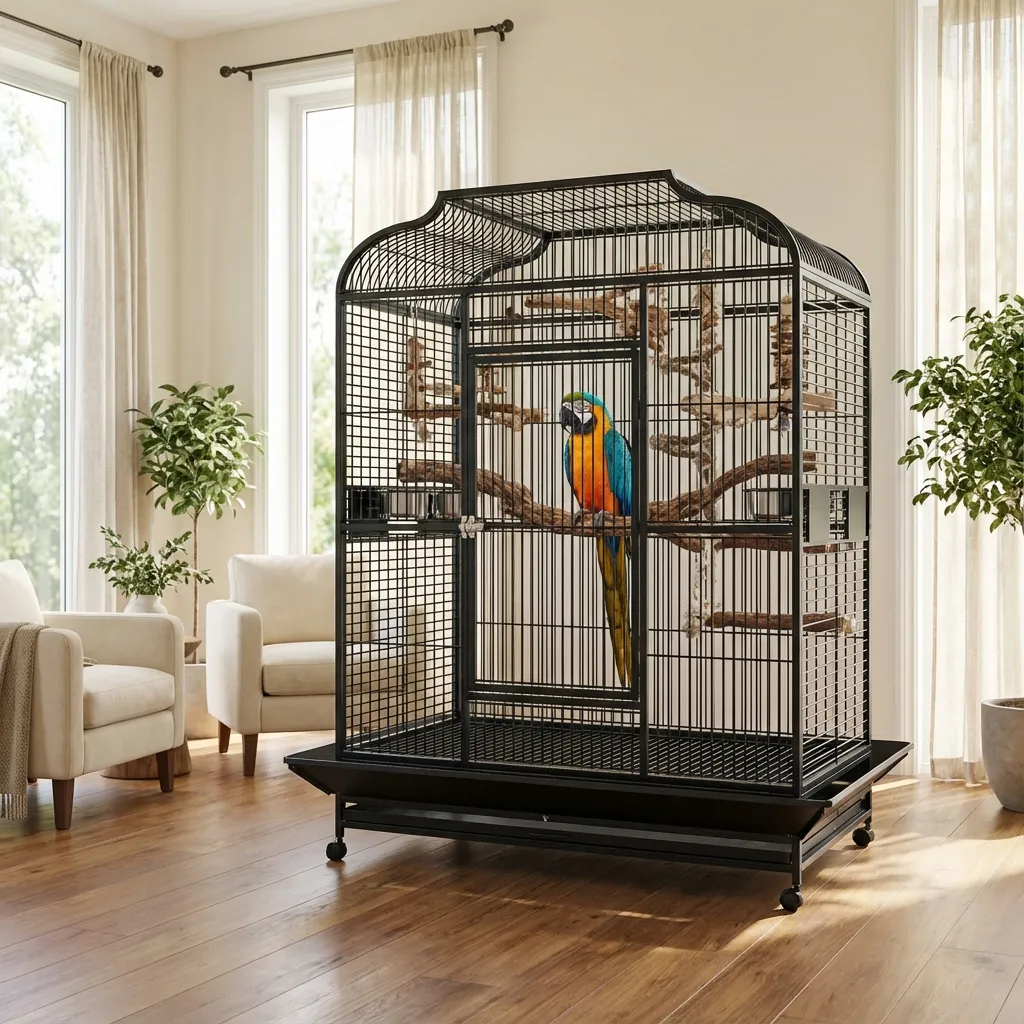
The best parrot cage is the largest suitable enclosure that gives your bird clear room to spread its wings, uses an appropriate bar gap, and withstands its beak. Start with the living space inside the cage. A tall stand, a rooftop play area, or a long list of accessories cannot compensate for a cramped interior.
For small parrots whose wing clearance and bar-spacing needs fit, the Prevue F050 offers more room than the smaller Prevue F040. For larger parrots with a suitable fit for 1-inch openings, the A&E WI8662 offers an indoor walk-in enclosure. None is a universal cage for every bird pictured in a store listing: small parrotlets may need tighter openings, and large macaws may need more space than even a walk-in model provides.
This comparison uses manufacturer specifications and veterinary housing guidance. It is a researched buying guide, with the limitations of each model explained below.
In this guide
- Choose the cage your bird actually needs
- Compare the three cages
- Which model makes sense for your home?
- Measure usable space and bar openings
- Materials, locks, and daily care
- Plan the room and the full setup
- Frequently asked questions
Choose the cage your bird actually needs
Choose a cage in this order: bar spacing and strength, usable dimensions, then access and convenience. An enclosure fails the purchase decision if any of the first three requirements fails. Wheels and attractive finishes come later.
Start with the individual bird
Species names help narrow the search, but birds within a species differ in size, activity, mobility, and chewing habits. The cage must allow comfortable turning, wing movement, and travel between perches after bowls and toys are installed. A cage sold for a “medium bird” can still have openings that are too wide for your particular parrot.
Use our bird cage size and bar spacing chart by species to establish a starting size and gap range. Then compare those requirements with the model’s interior measurements. That guide covers the detailed species ranges; this page helps you judge the actual cage you are considering.
Understand what a minimum size means
Veterinary size tables are starting points, not a promise that any bird will thrive in the smallest listed box. For example, the Merck Veterinary Manual’s minimum-size table lists these dimensions in length × width × height:
| Bird group | Minimum cage dimensions in Merck’s table | What this means when shopping |
|---|---|---|
| Budgerigar, cockatiel, lovebird, parrotlet | 20 × 20 × 30 in | A narrow tower can miss the minimum depth despite an impressive total height. |
| Conure, Poicephalus, caique, miniature macaw | 36 × 24 × 48 in | Many small-bird flight cages are too shallow for this group. |
| African Grey, Amazon, small cockatoo | 40 × 30 × 60 in | Stand height and the playtop must not be counted as enclosed living space. |
| Macaw, large cockatoo | 48 × 36 × 66 in | This is a minimum reference, not a generous exercise enclosure for every large bird. |
Merck’s pet-owner housing guide also recommends at least 1.5 times the bird’s wingspan in every direction. Apply that individual check as well as the species starting dimensions; the larger requirement should guide your search. Furnishings must still leave space for movement. Scheduled time outside the cage is valuable, but cannot enlarge the space your bird uses while you are away.
Match the opening and the wire strength separately
Bar spacing is the clear opening between adjacent bars. Bar thickness is the diameter of the metal. These are different measurements: narrow openings do not make thin wire strong enough for a cockatoo.
Published gap recommendations vary. Merck’s table uses 1/2 inch for its small-bird group, while LafeberVet’s caging handout gives a narrower 3/8–7/16 inch range for budgerigars, lovebirds, and parrotlets. A 1/2-inch cage therefore needs an individual fit check; it is not an automatic recommendation for every small parrot. For a tiny bird or an uncertain fit, choose a properly designed cage with a tighter opening and seek advice from an avian veterinarian.
Do not push a bird’s head through the bars to test the fit. Measure openings, inspect them throughout the enclosure, and check the bird’s needs before purchase. Strong chewers also need an enclosure whose bars, welds, door frame, and latches resist their beaks.
Parrot cages compared
The dimensions below distinguish the whole cage from the enclosed living space. Prevue provides all three interior measurements; A&E specifies the WI8662’s interior height but gives exterior length and depth. Allow additional room for doors, tray removal, and cleaning.
-
Prevue F050 Large Flight Bird Cage, Black Hammertone
Prevue Pet Products
A wider flight cage with about 30% more interior floor area than the F040. The 47-inch living-space height is separate from the 60-inch overall height.
- Two hinged front doors and six small side doors
- Pull-out grille and debris tray
- Rolling stand with a storage shelf
- Best fit
- More room for small parrots that fit a 1/2-inch gap
- Overall dimensions
- 37 × 23 × 60 in (L × D × H), including stand
- Living space
- 36.125 × 22.125 × 47 in (L × D × H)
- Clear bar gap
- 1/2 in / 12.7 mm
-
Prevue F040 Flight Bird Cage, Black
Prevue Pet Products
A rectangular small-bird cage with a rolling stand, two front doors, and a removable grille and tray. Its 40-inch interior height excludes the stand.
- Two hinged front doors and six small side doors
- Pull-out grille and debris tray
- Rolling stand with a storage shelf
- Best fit
- A smaller footprint for small parrots that fit a 1/2-inch gap
- Overall dimensions
- 31"L × 20.5"W × 53"H
- Living space
- 30.25 × 20.25 × 40 in (L × D × H)
- Clear bar gap
- 1/2 in / 12.7 mm
-
A&E Cage Co WI8662 Walk-In Bird Aviary, 86 × 62 × 79 in
A&E Cage Company
A walk-in indoor aviary with an 86 × 62-inch exterior footprint, a key-lock door, and external feeder access. Plan floor protection and room access before ordering.
- 1-inch bar spacing and a 69 × 25-inch entry door
- Key-lock front door and three feeder doors
- Three stainless steel bowls
- Best fit
- An indoor bird room for larger parrots that fit a 1-inch gap
- Overall dimensions
- 86 × 62 × 79 in exterior (L × D × H)
- Living space
- 79 in interior height; measure clear length and depth
- Clear bar gap
- 1 in / 25.4 mm
Dimensions are length × depth × height. A stand or open play area adds no enclosed living space.
Which parrot cage should you buy?
Prevue F050: more room for suitable small parrots
The F050 is the first model to consider here if your small parrot fits a 1/2-inch bar gap and the interior depth leaves enough wing clearance. Its enclosed space measures 36.125 × 22.125 × 47 inches, within an overall 37 × 23 × 60-inch unit. It has two hinged front doors, six small side doors, a removable grille and tray, and a rolling stand with a storage shelf. These measurements and features come from Prevue’s F050 specifications.
The useful advantage over the F040 is horizontal room. The F050’s interior floor area is about 799 square inches, compared with about 613 square inches for the F040—roughly 30% more. This calculation uses the manufacturers’ interior length and depth; it does not measure flight space after furnishing. The extra footprint gives you more options for positioning perches and food stations while leaving an open route between them.
The depth remains the limiting dimension. “Extra large” describes the model within this small-bird range, not its suitability for African Greys, Amazons, or large cockatoos. It also falls short of Merck’s 24-inch depth and 48-inch height starting dimensions for the conure group. A cockatiel with a wingspan that calls for more than 22.125 inches of depth needs a wider enclosure too.
Choose it when: a small bird’s individual gap and space requirements fit, and you can accommodate the larger footprint. Choose something else when: you need tighter openings, greater depth, or construction intended for a powerful beak.
Check current price on Amazon →Prevue F040: a smaller footprint with a clear space tradeoff
The F040 has 30.25 × 20.25 × 40 inches of interior space and measures 31 × 20.5 × 53 inches overall. It uses the same 1/2-inch bar spacing, with two large front doors, six small side doors, a pull-out grille and tray, and a wheeled stand. The black F040 is distinct from the white F041; the specifications are in Prevue’s F040 product information.
Its main reason to enter the shortlist is a room that cannot accommodate the F050. The smaller cage does not solve a fit problem simply by taking up less floor space. Its 20.25-inch interior depth gives a small bird less room for wings, bowls, and enrichment, so measure that dimension first.
If both models meet your bird’s requirements and fit your home, prefer the F050 for the extra room. If neither meets the requirements, look beyond these two models rather than removing essential furnishings to make the smaller one seem adequate.
Choose it when: its dimensions comfortably fit a small bird and the narrower footprint is necessary. Choose something else when: the bird needs the larger model’s space or stronger large-parrot construction. Neither Prevue model is a default choice for parrotlets just because a store lists them among suitable species.
Check current price on Amazon →A&E WI8662: an indoor walk-in enclosure for larger parrots
The WI8662 changes the room-planning problem. Its exterior measures 86 × 62 × 79 inches, with 79 inches of interior height, 1-inch bar spacing, and a 69 × 25-inch entry door. A keyed main-door lock, three swing-out feeder doors, and three stainless steel bowls allow access from outside the enclosure. A&E’s WI8662 specifications explicitly state that it is not recommended for outdoor use.
This model makes sense when a larger parrot needs a substantial indoor enclosure and your room can accommodate it. The 1-inch gap still excludes small parrots and any larger individual for whom that opening is too wide. Extra size also does not guarantee sufficient room for every macaw: check the bird’s wingspan against clear internal length and depth, rather than relying on the exterior footprint.
The floor needs a separate plan. A&E lists the WI8662BS base as a separate accessory. Confirm what the enclosure order includes, how the lower edges meet the floor, and how you will clean and protect the surface. A loose mat that the bird can pull up and chew is a poor substitute for a secure floor arrangement.
Choose it when: you have a dedicated indoor area, a suitable individual fit for 1-inch bars, and a workable floor and cleaning plan. Choose something else when: you need smaller openings, outdoor protection, more clear space for a very large bird, or an enclosure you can routinely roll between rooms.
Check current price on Amazon →How to measure a parrot cage
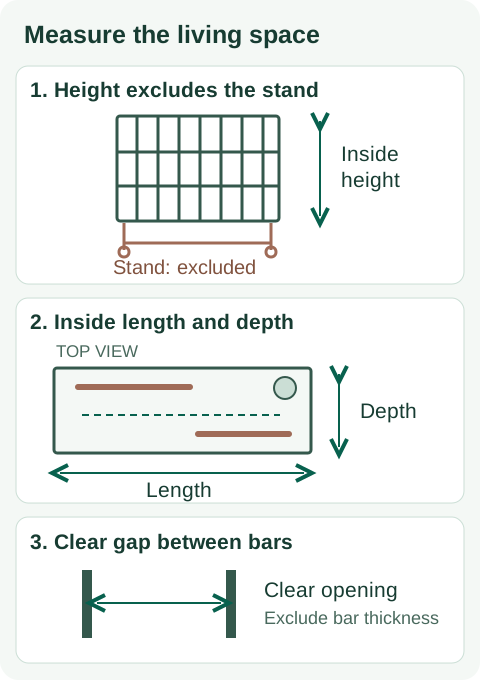
Measure the home and the cage before ordering. Product photographs rarely show how much space a tray, a door swing, or a seed guard needs.
1. Measure the enclosed interior
Record length, front-to-back depth, and height from the floor or grille to the roof. A dome’s peak height does not describe the clearance along its curved edges. Check where the bird’s tail will sit below its usual perch, and where its wings will extend beside the bars.
If only outside measurements are available, ask for the clear internal dimensions with the grille installed. Do not invent interior measurements by subtracting an arbitrary inch from each side.
As a worked example, a bird with a 15-inch wingspan has a 22.5-inch target in each direction under Merck’s 1.5-times rule. The F050’s 22.125-inch interior depth falls short, even though its overall depth is 23 inches. The F040’s 20.25-inch depth also fails that example. This is why the correct answer can be a different cage, despite either model looking large in a photograph.
Use an observed natural wing stretch, existing reliable measurements, or veterinary help to establish wingspan. Do not force your bird’s wings open for a shopping measurement.
2. Sketch the furnished cage
Mark the main sleeping perch, lower perches, food and water stations, and the largest toy on a simple plan. Keep a clear route for movement and a place for unobstructed wing stretching. Do not create a vertical stack of perches over bowls where droppings will fall into food and water.
The supplied perches and cups are a starting set, not a complete layout. Our parrot cage setup checklist helps you place them, and the bird perch size and material guide helps you choose appropriate diameters and surfaces.
3. Measure the widest opening
Use a ruler or caliper to measure the clear gap between bars; 1 inch equals 25.4 mm. Check doors, feeder frames, roof joints, corners, and any decorative panels as well as the main wall. An irregular opening can defeat an otherwise appropriate nominal gap.
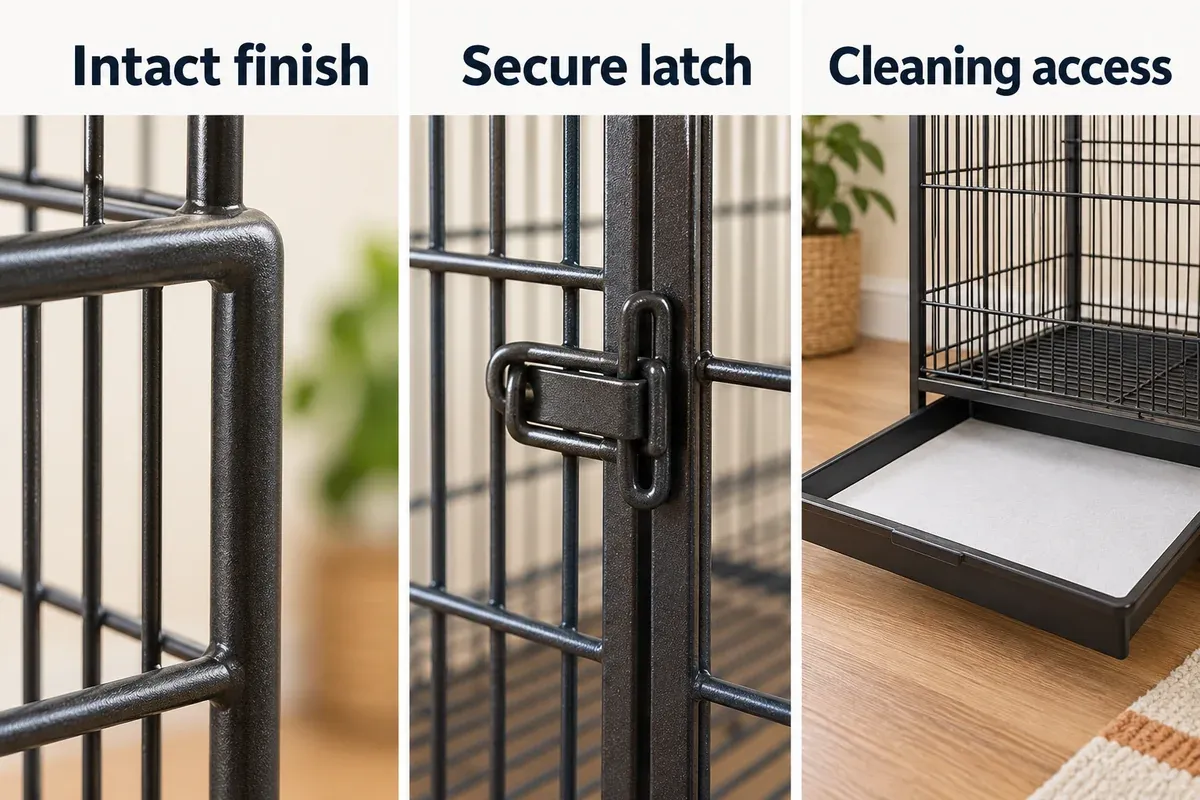
Inspect again after assembly. Do not use a cage with bent panels, missing fasteners, sharp welds, or a door that leaves a larger opening when latched. Contact the manufacturer for the correct replacement part instead of improvising a patch with uncertain metal or solder.
4. Measure the access space outside
Tape the full footprint on the floor, including seed guards if fitted. Open the nearest room door and check the route past the cage. Allow the tray to slide completely out, the main cage door to open, and a person to reach the rear panels.
For a walk-in enclosure, check ceiling clearance, entry into the room, assembly space, and the position of feeder doors. Exterior size on a floor plan is only the first check: you must also be able to reach and clean it once installed.
Materials and hardware that matter
Powder-coated steel or stainless steel?
Powder-coated metal cages can be practical when their finish is intact and the frame suits the bird. Stainless steel avoids a painted coating, but “stainless” does not establish the size, strength, or quality of every component. Ask about the cage body, welds, locks, and accessible hardware; stainless feeding bowls do not make the entire enclosure stainless steel.
VCA’s housing guidance favors rectangular metal cages and explains the problems with chewable, porous wooden enclosures and damaged coatings. For a bird that persistently strips coating or bends bars, reconsider the construction rather than treating repeated damage as normal wear.
Lead and zinc can cause poisoning when birds ingest contaminated cage or toy material. Avoid unknown repaired welds, questionable coatings, and improvised galvanized-wire additions. Merck’s guidance on heavy-metal poisoning identifies cages and hardware as potential sources. If your bird has swallowed coating or metal, or develops weakness, regurgitation, tremors, or seizures after chewing hardware, contact an avian veterinarian promptly. Seizures or collapse require emergency care.
Inspect every latch and small access door
Check the main latch, feeder locks, small side doors, and the tray or grille restraint. A clever parrot can investigate a simple sliding closure; a main-door lock does not secure the rest of the cage automatically. Operate each door during assembly and ensure that it fully closes without leaving an enlarged gap.
Use the manufacturer’s appropriate securing hardware where needed. Avoid makeshift clips with sharp ends, exposed springs, or openings that could trap a toe or beak. A door must remain secure during feeding as well as between meals.
Choose access you will use every day
A large front door helps you reach the back of the cage and move furnishings. External feeders reduce the need to reach around the bird, but their doors and bowl holders still need inspecting. Test whether a tray can be removed without opening a route for escape and whether you can clean the grille without disturbing the whole setup.
The Prevue models’ rolling stands help with floor access. Wheels do not turn them into outdoor enclosures or transport cages. A large indoor aviary needs a cleaning plan for a fixed location instead.
The close-ups below focus on details worth checking on the assembled cage. Test each door and the full tray movement before your bird moves in.
Cleaning and the cost of keeping the cage
Plan for replacement perches, bowls, tray liners, cleaning supplies, and damaged hardware alongside the cage purchase. Add floor protection and any necessary base for a walk-in enclosure. A model with obtainable replacement trays and latches is easier to keep in service than one whose small broken part requires replacing the whole unit.
Prevue provides parts-request facilities for the F040 and F050 and identifies replacement cups for the F050. Keep the model number and assembly instructions so that a replacement matches the correct cage.
| Task | What to do | Cage feature that helps |
|---|---|---|
| Daily food, water, and debris care | Wash dishes, replace dirty liner, and remove spoiled food and obvious waste. | Accessible bowls and a tray that slides out completely. |
| Regular thorough cleaning | Remove the bird to a secure temporary space; wash soiled surfaces, rinse, and dry before reuse. | Large doors, removable grille, and reachable corners. |
| Inspection during cleaning | Look for rust, damaged finish, sharp edges, loosened bolts, worn locks, and warped trays. | Accessible joints and manufacturer replacement parts. |
For the Prevue models, follow the manufacturer’s instructions for mild soap, warm water, non-abrasive cleaning, and thorough drying. Strong fumes and residues should not be part of a bird’s cleaning routine. If disinfection is needed because of illness, ask the treating veterinarian for the product, dilution, contact time, and rinsing requirements appropriate to that situation.
Plain paper lining makes droppings and spilled food easy to see and remove; LafeberVet’s caging guidance recommends paper and cautions against wood-chip or corn-cob bedding. A seed guard catches some debris but does not replace cleaning around and beneath the enclosure.
Plan the room before you order
Choose a position away from cooking fumes, direct blasts from vents, and temperature extremes. Leave the bird a quieter retreat while allowing suitable household interaction. Merck’s home and exercise guidance also recommends supervised exercise outside the cage. Make the surrounding room safe for those sessions, including doors, windows, other pets, and running fans.
Use our guide to where to place a bird cage for room planning, and the parrot play-stand placement guide if you want a separate supervised activity area. A playtop or stand supplements the enclosure; the open area cannot be included in its living-space dimensions.
Keep cleaning routes open around particle-filtration equipment too. The bird-room air purifier size calculator helps compare room size, airflow, and filter upkeep. An air purifier cannot make a kitchen a suitable cage location or replace removal of settled food and feather debris.
A second bird needs more than a bigger label
Do not infer a safe capacity from “multi-bird” in a cage name. More birds need more space, access to food and water, and a compatible relationship. Merck notes that birds may fight when housed together. Discuss introductions with an avian veterinarian, and have separate housing available rather than depending on a divider or a single shared feeding station.
Outdoor housing needs its own design
An indoor cage’s finish, wheels, or “aviary” name do not establish protection from weather or predators. The WI8662’s manufacturer specifically advises against outdoor use. Outdoor housing needs suitable mesh, a protected base and roof, a sheltered retreat, secure access, and protection against animals reaching through the sides.
Use our predator-proof outdoor aviary guide to plan those requirements. Do not leave an indoor cage on a patio as a substitute for a purpose-designed outdoor enclosure.
Inspect the cage before moving your parrot in
- Assemble and inspect it without the bird inside. Account for every fastener and check that panels are square, doors close correctly, and the stand is stable.
- Measure critical openings again. Inspect seams and access doors, not just the bars on the largest panel. Resolve damage or missing parts before use.
- Clean according to the manufacturer’s instructions. Rinse and dry the enclosure, bowls, and washable accessories.
- Fit a simple, usable interior. Add suitable perches, accessible food and water, and selected enrichment while preserving movement space.
- Introduce the cage gradually. Let the bird investigate without being chased into it. Keep familiar, clean accessories where they help the transition, and monitor feeding and movement once it starts using the cage.
For an older bird, a bird with mobility problems, or one recovering from illness, ask your avian veterinarian about perch height, platforms, and fall risk before transferring it into a much taller enclosure. Extra height should support the bird’s abilities.
Frequently asked questions
Is a taller cage always better for a parrot?
No. The enclosed length and depth need to accommodate wing movement and travel between perches. Total height may include a stand or an open playtop. Compare the interior in all three directions, then check clearance after furnishing it.
Can a cockatiel use the Prevue F040 or F050?
Only if the individual bird’s space and opening requirements fit. Both have 1/2-inch gaps, but depth can be the problem: the F040 provides 20.25 inches and the F050 22.125 inches. Under Merck’s 1.5-times wingspan guidance, a cockatiel with an 18-inch wingspan would need 27 inches in each direction, so neither model meets that example. Choose a deeper enclosure when needed.
Is 1/2-inch bar spacing safe for every small parrot?
No. Tiny birds, particularly parrotlets and smaller individuals of other species, can need narrower openings. Guidance differs between veterinary references. Use the species guide as a starting point, inspect the widest actual opening, and get an avian veterinarian’s advice when the fit is uncertain.
Can I use the A&E WI8662 outdoors?
The manufacturer does not recommend outdoor use. Its indoor walk-in format does not provide a complete predator, weather, or ground-protection system. Plan a separate outdoor aviary for that job.
Is a used parrot cage a sensible purchase?
It can be if you can identify the model, establish its dimensions and materials, and inspect every part. Reject a cage with rust, flaking finish, uncertain solder repairs, bent bars, enlarged openings, or faulty locks. Check replacement-part availability and clean it appropriately before use. Ask your veterinarian about disinfection if the previous bird’s health history is unknown.
Can a travel cage be my parrot’s everyday home?
A transport cage serves a different purpose and is usually too restricted for permanent housing. Keep it for appropriate short trips, veterinary visits, or a planned emergency evacuation. Its dimensions, ventilation, bar gap, and latches must still suit the individual bird.
Sources and further reading
- Merck Veterinary Manual: Providing a Home for a Bird
- Merck Veterinary Manual: Minimum and Bar Spacing Recommendations
- LafeberVet: Caging the Companion Parrot
- VCA Animal Hospitals: Housing Large Birds
- Merck Veterinary Manual: Disorders Affecting Multiple Body Systems of Pet Birds
- Prevue Pet Products: F050 dimensions and care
- Prevue Pet Products: F040 dimensions and care
- A&E Cage Company: WI8662 specifications
- A&E Cage Company: WI8662BS base