

 Published sources
 Product details checked
A cold-pressed dog food transition should usually be treated like any other complete diet change: introduce the new food gradually, keep the dog’s total daily calories reasonably consistent, and record tolerance before increasing the new-food share. A practical baseline is seven days. Use 10 to 14 days when the dog has a history of sensitivity, when the two foods differ substantially in calorie density, or when your veterinarian wants a slower change.
The critical detail is portion math. “Half old, half new” should describe the share of daily calories, not two equal scoops. If the new food contains more calories per cup, replacing one cup with one cup can overfeed the dog even while the mixing ratio looks correct.
This guide gives you both schedules, a calorie-based portion calculator, a daily stool log, and a stoplight system for deciding whether to advance, hold, or call the veterinarian. It does not assume that cold-pressed food is inherently healthier or more digestible than extruded kibble. Processing style is only one part of the decision; the current label, life-stage adequacy, manufacturer quality controls, and the individual dog matter more.
Before day one: copy five facts from both labels
Do not start with the scoop. Start with the labels and the dog’s current routine.
- Nutritional adequacy statement: confirm that the new food is complete and balanced for the dog’s life stage. “Intermittent or supplemental feeding only” is not a replacement for a complete daily diet. AAFCO calls the adequacy statement one of the most important parts of the label in its pet food label guide.
- Calorie content: record kcal/kg and kcal per familiar unit, such as a cup. AAFCO explains that the calorie statement should provide both values, which makes energy-based comparison possible.
- Feeding directions: copy the starting range for your dog’s current weight and life stage. Feeding charts are guidelines, not a diagnosis of the dog’s energy requirement.
- Grams per cup or unit: weigh a level cup if the label does not provide the conversion. The same cup can hold very different weights of two foods.
- Current baseline: write down the exact amount currently fed, treats, table food, medications given with food, meal times, body weight, appetite, bowel frequency, and usual stool texture for three normal days.
The AAHA nutrition and weight-management guidance recommends a specific feeding plan that includes the diet, amount, frequency, treats, supplements, and monitoring. It also notes that changing a diet over roughly four to seven days may reduce negative gastrointestinal responses. That is a useful starting point, not a guarantee that every dog should finish on day seven.
Ask the veterinarian for a tailored plan before switching a dog with pancreatitis, chronic enteropathy, kidney disease, diabetes, a known food allergy, recurrent vomiting or diarrhea, pregnancy or lactation, poor growth, or a veterinary therapeutic diet. A puppy—especially one expected to mature above 70 lb—also needs a life-stage-appropriate feeding plan rather than an adult portion copied from the front of a bag.
For the growth-specific label and portion checks, use our large-breed puppy food guide. For an older dog, the senior dog food guide explains why body condition and diagnosed disease matter more than a generic age label.
Calculate portions by calories, not matching cup volume
Use this equation to estimate the energy in the current ration:
Current daily food calories = old amount per day × old kcal per unitThen calculate the full new-food portion:
New amount at 100% = daily calorie target ÷ new kcal per unitOn a 50/50 day, divide the calorie target between the foods before converting each share back to its own unit:
Old units = (daily target × 0.50) ÷ old kcal per unit
New units = (daily target × 0.50) ÷ new kcal per unit
This preserves energy while the volume in the bowl changes. If a veterinarian has prescribed a different calorie target for weight loss, growth, or disease, do not silently combine that reduction with the food switch. Ask whether to change calories before, during, or after the transition so that any reaction is easier to interpret.
Calorie-based transition planner
Convert the ratio into real portions
Enter the calorie statement from both labels. The planner divides a daily calorie target between the old and new foods, so a “50/50” day does not accidentally become 50/50 by cup volume.
Your portion schedule
Enter both label calorie statements to calculate the daily portions.
This tool preserves a calorie target; it does not determine how many calories a dog should eat. Confirm the target, life-stage adequacy statement, and feeding plan with your veterinarian when weight, growth, pregnancy, disease, or a therapeutic diet is involved.
Worked example: why equal scoops can be wrong
Suppose a dog currently eats 1.25 cups of a food labeled 400 kcal/cup:
1.25 cups × 400 kcal/cup = 500 kcal/dayThe current Nextrition Chicken Recipe page lists 504.8 kcal/cup. At the same 500-kcal target, the calculated full portion is about 0.99 cup/day, not 1.25 cups. On a 50/50 calorie day, the portions would be approximately:
- 0.625 cup of the 400-kcal old food; and
- 0.495 cup of the 504.8-kcal new food.
The bowl contains less than 1.25 cups, yet the planned energy remains about 500 kcal. Recheck the delivered bag before using those figures: formulas, labels, and feeding directions can change.
A cold-pressed product reference for the schedule
Nextrition’s current Chicken Recipe page describes a 4.5-lb bag as containing 12 cups, lists 504.8 kcal/cup, and states that the recipe is formulated to meet AAFCO Dog Food Nutrient Profiles for all life stages, including growth of large-size dogs. It also recommends a seven-day transition and says dogs with sensitivities may need 10 to 14 days. Those are current manufacturer statements, not proof that the format will suit every dog. Verify the adequacy statement, calorie content, lot information, and feeding chart on the food you receive.
Cold-pressed food used in this transition example
-
Nextrition Cold-Pressed Chicken Dog Food
Nextrition
A chicken-based cold-pressed dog food whose current label states AAFCO adequacy for all life stages, including growth of large-size dogs.
- Current label states all-life-stages adequacy including large-size growth
- 4.5 lb bag contains 12 cups according to the product page
- Manufacturer recommends a gradual 7-day transition, or longer for sensitive dogs
- Planning role
- A premium cold-pressed food budget reference for dogs and growing puppies
Confirm the current label, calories, ingredients, feeding chart, bag size, and life-stage statement before ordering or feeding.
Seven-day cold-pressed dog food transition schedule
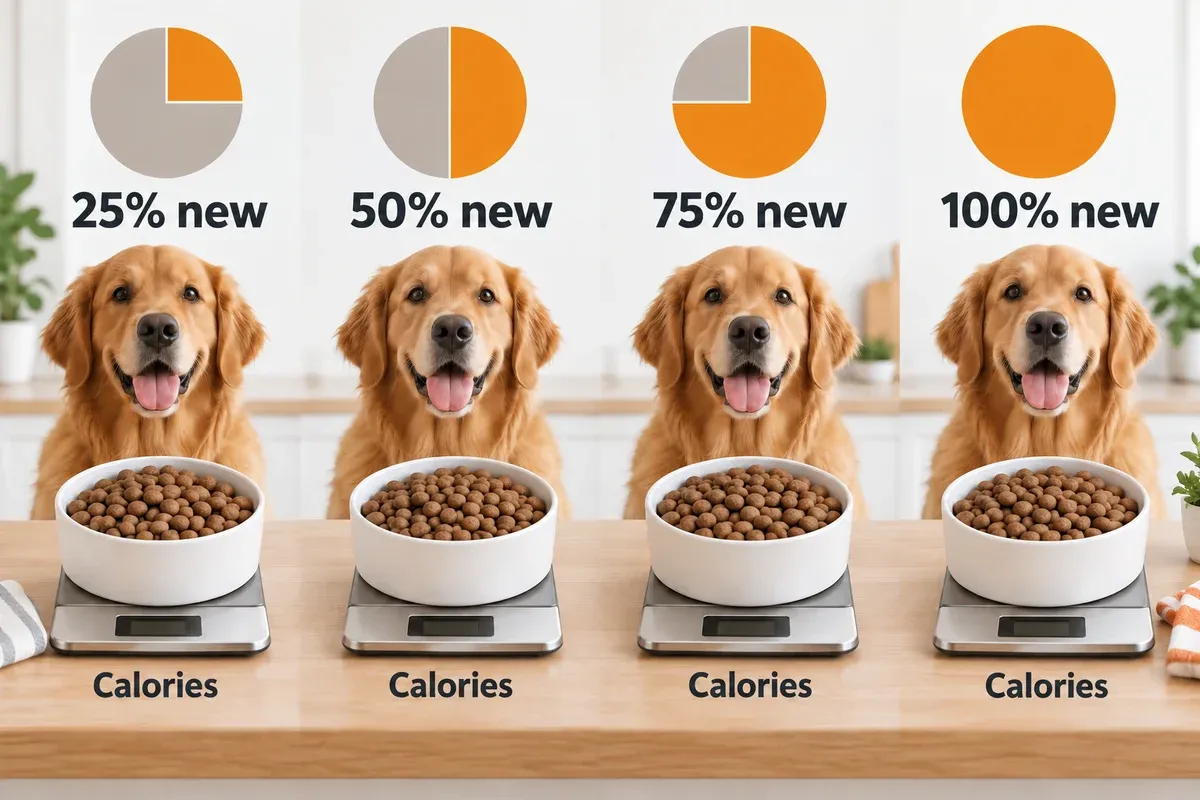
The baseline schedule uses four stages. Percentages are shares of daily food calories. Divide the resulting daily amounts across the dog’s usual number of meals; do not make one meal all-new and the next all-old unless the veterinarian specifically recommends that approach.
| Days | Old food | New cold-pressed food | Advance only when |
|---|---|---|---|
| 1–2 | 75% | 25% | Appetite, behavior, bowel frequency, and stool remain close to baseline |
| 3–4 | 50% | 50% | No repeated vomiting or progressive stool softening |
| 5–6 | 25% | 75% | The dog is comfortable and the log is stable |
| 7 | 0% | 100% | The full new portion matches the planned calories and is tolerated |
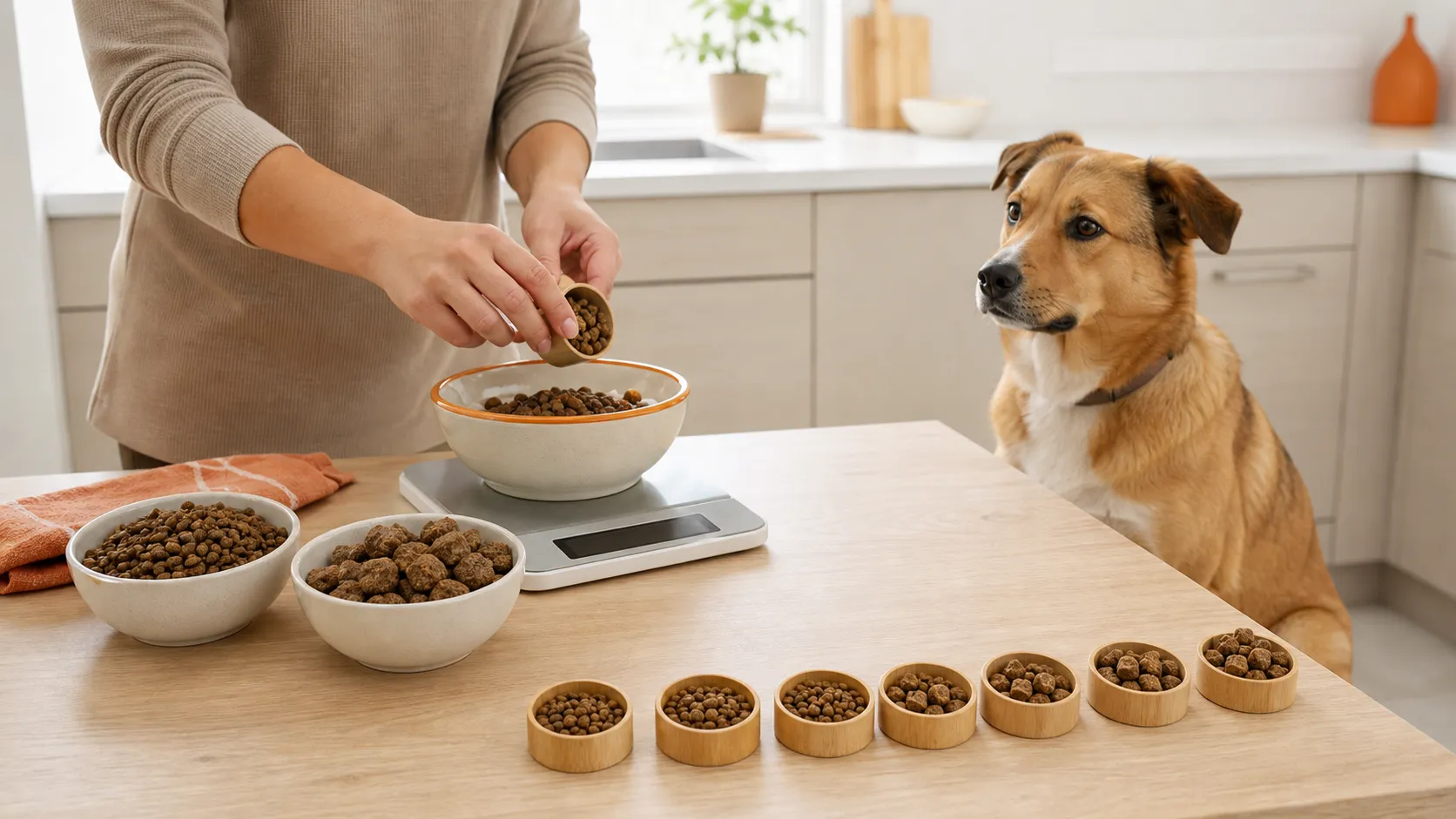
Prepare one day’s food at a time at first. A kitchen scale is especially helpful for dense pieces and partial cups. Mix thoroughly enough that a selective dog cannot eat only the preferred pieces, but do not add rich toppers, new supplements, chews, or table scraps to “help” during the same week. Every extra variable makes the stool log harder to interpret.
If training treats are part of the normal routine, keep the product and daily allowance consistent. Count meaningful treat calories in the feeding plan. The transition percentages apply to the complete foods, not to treats.
Use the stages below with the portion calculator; equal calorie shares can require different food amounts.
The slower 10- to 14-day schedule
Use a slower schedule when the manufacturer recommends it, the dog has previously developed mild stool changes during food switches, or your veterinary team wants smaller increments. A 14-day template is easier to follow than an improvised series of “just a little more” scoops:
| Days | Old food | New food |
|---|---|---|
| 1–2 | 90% | 10% |
| 3–4 | 75% | 25% |
| 5–6 | 60% | 40% |
| 7–8 | 50% | 50% |
| 9–10 | 40% | 60% |
| 11–12 | 25% | 75% |
| 13 | 10% | 90% |
| 14 | 0% | 100% |
This is not a treatment for gastrointestinal disease. It simply makes each change smaller. A dog that is already vomiting, passing blood, refusing food, or acting unwell needs an assessment—not a more elaborate mixing chart.
Daily stool and tolerance log
Record each day before deciding to increase the new-food share. “Fine” is difficult to compare later; a few consistent fields are much more useful.
Use this simple five-point texture key for household tracking:
| Log score | What you observe | How to record it |
|---|---|---|
| 1 | Dry, hard pieces or straining | Hard / dry |
| 2 | Formed, firm, easy to pick up | Baseline target for many dogs |
| 3 | Formed but soft; leaves some residue | Soft-formed |
| 4 | Unformed or pudding-like | Loose |
| 5 | Watery | Diarrhea |
This is a practical log, not a validated diagnostic fecal score. The trend matters: a dog moving from its normal 2 to repeated 4–5 stools needs attention even if a different dog normally has softer stools.
Copy or print this table for the transition:
| Day | Old amount | New amount | Stool score and count | Appetite | Vomiting / regurgitation | Energy, itching, pain, other notes |
|---|---|---|---|---|---|---|
| 1 | ||||||
| 2 | ||||||
| 3 | ||||||
| 4 | ||||||
| 5 | ||||||
| 6 | ||||||
| 7 | ||||||
| 8–14 if used |
Distinguish vomiting from regurgitation when possible. Vomiting normally involves nausea or abdominal effort; regurgitation is often more passive and may occur soon after eating. Record the time, appearance, and relation to the meal without trying to diagnose the cause yourself.
When to advance, hold, pause, or seek urgent care
Green: advance on schedule
Advance when the dog is bright, eating and drinking normally, passing stool at its normal frequency, and staying close to its baseline texture. Normal enthusiasm for the new food is useful, but appetite alone does not prove tolerance or nutritional suitability.
Amber: repeat the same ratio and reassess
If there is one mildly soft stool while the dog otherwise seems completely normal, do not automatically increase the new food at the next meal. Keep other foods unchanged, record the event, and repeat the current stage for an extra day while monitoring. If normal stool returns, continue with smaller increments or the 14-day schedule.
Contact the veterinarian rather than continuing to experiment if loose stool repeats, appetite declines, symptoms recur whenever the new-food share rises, or the dog has a medical condition, is very young, is elderly or frail, or takes medication affected by food. Do not give human antidiarrheal or stomach medication unless a veterinarian directs it.
Red: stop advancing and call the veterinarian
Pause the food experiment and get veterinary advice for repeated watery diarrhea, repeated vomiting, refusal to eat, lethargy, weakness, obvious abdominal discomfort, dehydration, fresh blood, or black/tarry stool. Cornell’s canine diarrhea guidance advises veterinary care when a pet stops eating, becomes lethargic, has black or tarry diarrhea, vomits along with diarrhea, or the diarrhea does not resolve within 48–72 hours.
Seek urgent or emergency care for severe or protracted vomiting, severe bloody diarrhea, collapse, marked weakness, a swollen or painful abdomen, or repeated unproductive retching. Those signs cannot safely be assigned to “the new food” at home.
Pausing does not mean withholding food or water on your own. It means stopping the planned increase and asking what to feed next. The veterinarian may want the previous food, a prescribed gastrointestinal diet, testing, fluids, or a completely different plan depending on the dog and the signs.
Portion errors that look like intolerance
Not every soft stool during a transition proves that an ingredient is unsuitable. Check these common confounders before drawing a conclusion:
- Equal-volume substitution: the new food is more calorie-dense, but the old number of cups was copied.
- Uncounted extras: new treats, chews, toppers, table food, or supplements started during the same week.
- Inconsistent measuring: household cups are heaped on one day and leveled on another.
- Meal-size change: a dog accustomed to two meals receives the entire ration once daily.
- Abrupt storage change: food is exposed to heat, moisture, pests, or a container that no longer carries the lot and date information.
- Unrelated illness or exposure: garbage, parasites, infection, medication, stress, or a swallowed object happens during the same period.
Keep the food in its original packaging or retain the full label and lot code if the bag sits inside a storage container. If several animals become ill, the product smells or looks abnormal, or packaging is damaged, stop using it, preserve the label and lot information, and contact the manufacturer and veterinarian.
Special cases need a different transition conversation
Puppies and large-breed growth
“All life stages” should be verified on the delivered label, including whether the statement covers growth of large-size dogs. Even with the correct adequacy statement, the feeding amount needs regular adjustment as the puppy grows. Avoid adding meat, calcium, vitamins, or other toppers that can unbalance a complete growth diet without veterinary direction.
Food-allergy or elimination trials
A diagnostic elimination trial is not a casual food swap. The ingredient selection, duration, treats, flavored medications, and exposures all affect the result. Follow the veterinary plan exactly; a transition calculator cannot determine whether a diet is appropriate for diagnosis.
Therapeutic diets and chronic disease
Do not replace a veterinary diet merely because another product is complete and balanced. Therapeutic foods may be formulated around disease-specific nutrient targets that a general all-life-stages diet does not provide. Ask the prescribing team how quickly to switch and which signs or measurements to track.
Dogs needing a weight change
The old ration may not be the right calorie target. Ask for calories per day and a recheck schedule, then enter that target in the planner. Weigh the dog on the same scale and monitor body condition rather than reacting to one day of appetite or stool.
The first two weeks after reaching 100%
Continue the log for at least several days after the last old-food portion disappears. A transition is not complete merely because the bowl reaches 100% new food.
Track:
- measured food and treat amounts;
- stool texture and frequency;
- appetite and water intake;
- vomiting, regurgitation, gas, or abdominal discomfort;
- body weight and body-condition trend; and
- skin or ear signs if those were part of the original concern.
Recalculate before assuming the feeding-chart midpoint is correct. Individual energy needs vary with age, neuter status, body condition, activity, environment, and health. The WSAVA Global Nutrition Toolkit provides label and nutrition-assessment resources that can support a more complete discussion with the veterinary team.
Check the current Chicken Recipe label and feeding guide →Frequently Asked Questions
How long does it take to switch a dog to cold-pressed food?
Seven days is a practical baseline for a healthy dog when the labels and calorie target are known. Use 10–14 days when a slower schedule is appropriate, or follow a veterinary plan for a dog with medical or gastrointestinal concerns. The goal is stable tolerance, not finishing by a deadline.
Can I mix cold-pressed dog food with kibble?
The transition schedule deliberately mixes the old and new complete foods. There is no general rule that two processing formats cannot share a bowl. What matters is the combined calorie amount, nutritional plan, food safety, and the dog’s response. A therapeutic or diagnostic diet may be an exception.
Should the percentages be by weight, cups, or calories?
Use calorie share when the foods have different energy densities. Convert each calorie share into that food’s cups or grams. A 50/50 mix by weight or volume is only energy-equivalent when both foods happen to provide the same calories per measured amount.
Is soft stool normal when changing dog food?
A single mildly soft stool can occur during a change, but it should not be dismissed automatically. Hold the ratio, monitor the whole dog, and contact the veterinarian if loose stool repeats, worsens, comes with vomiting or poor appetite, contains blood, turns black/tarry, or persists.
Should I switch back immediately if my dog has diarrhea?
Stop increasing the new-food share and call the veterinarian for guidance. Returning to the old diet may be reasonable in some mild cases, but vomiting, blood, pain, dehydration, infection, a foreign object, or another illness needs a different response. Do not fast the dog or give human medication without advice.
Does cold-pressed food need a smaller portion than kibble?
Sometimes, but not because “cold-pressed” guarantees a particular density. Compare the two calorie statements. A more calorie-dense food needs a smaller volume for the same calories; a less dense one needs more. The current Nextrition Chicken Recipe figure is a product-specific manufacturer value, not a rule for all cold-pressed foods.
Final checklist
- Verify the new food’s nutritional adequacy statement and life stage.
- Copy kcal per cup or familiar unit from both current labels.
- Confirm the dog’s daily calorie target instead of copying the old cup count.
- Choose the seven-day or slower 10–14-day schedule.
- Weigh partial portions when possible and keep treats unchanged.
- Complete the stool and tolerance log before increasing the ratio.
- Hold for a mild isolated change; call the veterinarian for repeated or worsening signs.
- Seek urgent care for severe vomiting, bloody diarrhea, collapse, marked weakness, a painful swollen abdomen, or unproductive retching.
- Recheck weight, body condition, stool, and appetite after the dog reaches 100% new food.
A good cold-pressed dog food transition schedule is deliberately uneventful. Accurate calories, small changes, and a written log give you more useful information than rushing to an all-new bowl—or assuming every digestive sign is simply part of the switch.
Sources and further reading
- AAFCO: Reading Labels
- AAHA: Feeding Plans for Healthy, Appropriate-Weight Cats and Dogs
- WSAVA: Global Nutrition Guidelines and Toolkit
- Cornell University College of Veterinary Medicine: Diarrhea in Dogs
- Nextrition: Chicken Recipe product page — current manufacturer label and transition information