

 Published sources
 Product details checked
A dog birthday treat box should be screened like food, not chosen only because it photographs well. The exact flavor ingredients, calorie content, texture, the individual dog’s diet, and the number of other treats served that day all matter more than the shape of the gift box.
Quick answer: read the complete label for the exact flavor, confirm every guest dog’s dietary restrictions with the owner, keep all treats and extras below 10% of each dog’s daily calories, and do not guess a portion when calories per treat are missing. Hard treats should be broken into an appropriate size and given one dog at a time under direct supervision. Keep the original package, lot code, and best-by date, and follow its storage directions.
This article does not diagnose allergies or declare a treat safe for every dog. It combines the FDA’s animal-food label rules, the WSAVA guide to feeding treats, veterinary dental guidance, and current manufacturer information. Product-specific ingredient, texture, and storage statements are identified as Bonne et Filou claims; the delivered package label takes priority.
The Six-Gate Dog Birthday Treat Checklist
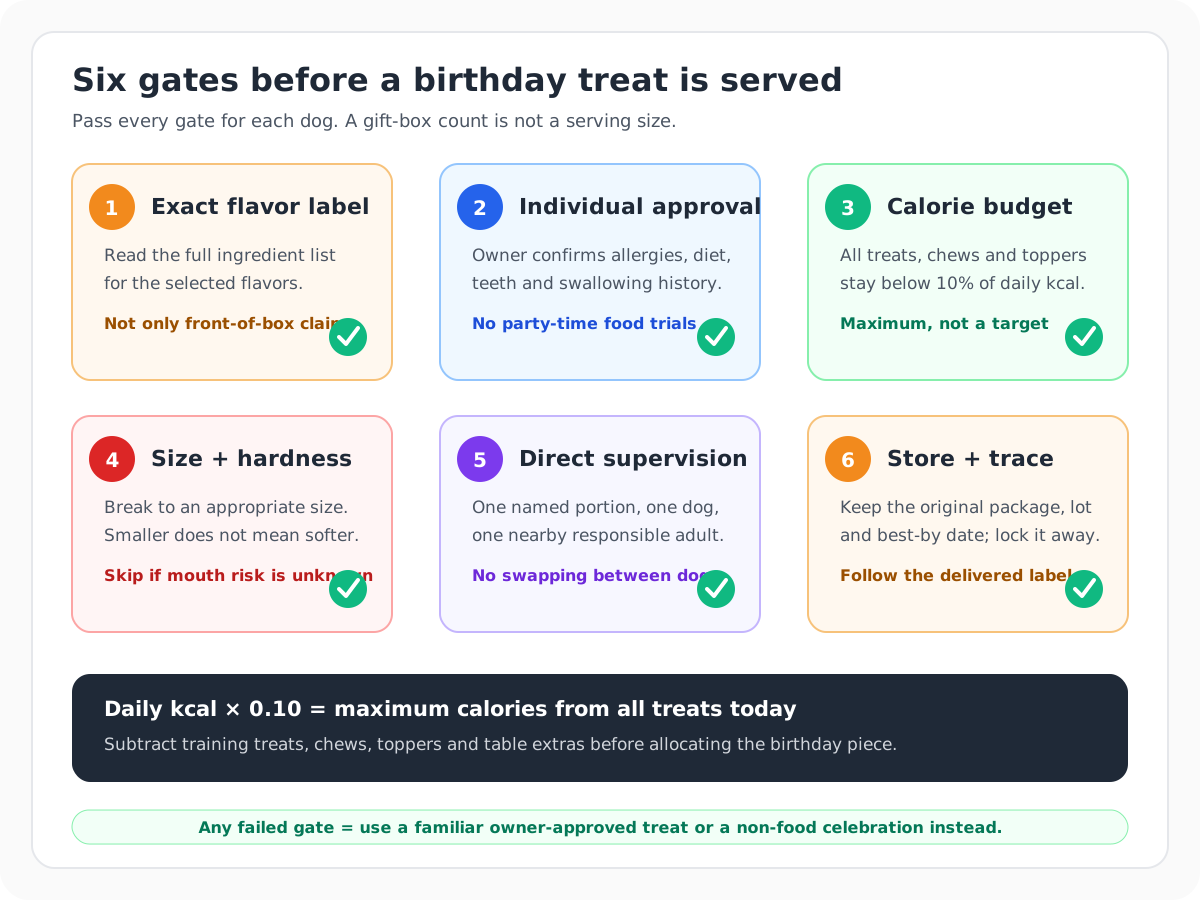
Use this checklist before ordering and repeat it when the box arrives:
- Exact label: I have the full ingredient list for the exact flavors being served, not only a front-of-box claim.
- Individual approval: Each owner has confirmed allergies, intolerances, veterinary diets, dental problems, and swallowing concerns.
- Calorie budget: I know the dog’s daily calorie allowance and the calories in the planned piece; all extras remain below 10%.
- Size and texture: The piece is an appropriate size and not too hard for this dog’s mouth, teeth, age, and chewing style.
- Direct supervision: One responsible adult watches the dog take and finish the treat; dogs are not swapping or guarding food.
- Storage and traceability: The treats stay in their original package, secured from pets, with the lot and best-by information available.
If one box is unchecked, choose a familiar owner-provided treat or a non-food birthday activity instead.
Advertisement / Affiliate disclosure: This article contains paid affiliate links. We may earn a commission at no extra cost to you.
Celebration gift box to evaluate with the checklist
-
Bonne et Filou Dog Macaron Combo Gift Box, 18 Count
Bonne et Filou
A gift box containing 18 hard dog macarons in three six-count boxes, intended as supervised treats rather than food.
- 18 hard dog macarons in three boxes
- Manufacturer lists corn-free and wheat-free ingredients
- Positioned for birthdays and occasional celebrations
- Best for
- An occasional dog-birthday or celebration gift
Choose the exact flavor combination only after reviewing the current product page and the delivered package label. Treats are occasional extras, not complete food.
1. Read the Exact Flavor Label, Not the Gift-Box Front
The FDA explains that animal-food ingredients must be listed by their common or usual names in descending order of predominance by weight. That ingredient panel is the starting point. Marketing phrases such as “natural,” “human-grade,” “wheat-free,” or “corn-free” do not answer every allergy, calorie, or suitability question.
For any dog birthday treat box, record:
| Label item | Why it matters |
|---|---|
| Exact product and flavor | Different flavors in the same range can use different fillings, proteins, fats, colors, or flavorings. |
| Complete ingredient list | Identifies every declared ingredient you need to compare with the dog’s history or veterinary diet. |
| Calorie content | Makes the daily treat budget calculable. Count alone and treat size are not calorie values. |
| Feeding statement | Confirms whether the product is a treat or a complete food and may provide serving limits. |
| Net weight and number of pieces | Helps allocate pieces, but does not establish a safe portion for an individual dog. |
| Lot code and best-by date | Lets the manufacturer and FDA trace a problem or recall. |
| Storage instructions | Determines whether the product stays cool and dry, needs refrigeration after opening, or has another requirement. |
Take a clear photograph of the label when the box arrives. If the website and delivered label differ, use the delivered label and ask the manufacturer about the change before serving it.
What the current Bonne et Filou pages disclose
The current 18-count Dog Macaron Combo Gift Box page describes three boxes of six hard dog macarons. It lists a base recipe of oat flour, honey, coconut oil, and flavored yogurt filling, says the treats are intended as a reward rather than food, and instructs owners to break them into an appropriate size and supervise.
The manufacturer’s separate ingredient page shows that fillings vary by flavor. For example, some published flavor recipes list milk ingredients and soy lecithin, while the peanut-butter flavor lists peanut butter. This makes the exact selected combination important. A “wheat-free” front claim does not mean dairy-free, soy-free, peanut-free, gluten-free, or free from cross-contact.
Those are manufacturer ingredient disclosures, not a conclusion that the treats are appropriate for a dog with an allergy. Confirm the actual package label, and contact the veterinary team for a dog with a diagnosed food allergy, an elimination diet, chronic gastrointestinal disease, pancreatitis history, diabetes, kidney disease, or another diet-sensitive condition.
2. Build an Allergen and Diet Screen for Each Dog
An ingredient is not a universal allergen simply because it appears on a checklist. The question is whether this dog has a known or suspected reaction, is undergoing a diagnostic food trial, or must avoid an ingredient under a veterinary plan.
Use a one-line owner form before the party:
Dog’s name: ____ · Known food allergies/intolerances: ____ · Veterinary or elimination diet: yes / no · Dental or swallowing concern: ____ · Owner-approved treat and maximum amount: ____
For the Bonne et Filou box, compare the selected label with at least these ingredient groups:
| Ingredient group to check | Why it may change the decision |
|---|---|
| Oat flour and other grains | A wheat-free statement does not answer an individual reaction to oats or a strict diagnostic diet. |
| Yogurt, milk, or nonfat dry milk | Some published fillings contain dairy ingredients; dogs can have individual sensitivities or diet restrictions. |
| Soy lecithin | It appears in several flavor fillings on the manufacturer’s ingredient page and should be checked against the dog’s plan. |
| Peanut butter or peanuts | Relevant to peanut-containing flavor choices and any household handling concern. Confirm that any separate peanut-butter topper is xylitol-free. |
| Coconut oil and palm-kernel oil | These fats belong in the full calorie and tolerance discussion; “natural” does not make the amount irrelevant. |
| Flavor-specific colors and flavorings | The exact variant can differ, so a label from another flavor is not a substitute. |
Do not “test” a questionable ingredient at the party. An unfamiliar celebration is the wrong time to challenge a suspected allergy or reintroduce food during an elimination trial.
3. Keep All Treats Below 10% of Daily Calories
The World Small Animal Veterinary Association’s current dog-treat guide says treats should make up less than 10% of a dog’s daily calorie intake, should not replace a meal, and should be appropriate in size and shape. The remaining calories should come from a complete and balanced diet unless the veterinary team has prescribed something different.
Calculate the ceiling this way:
Maximum calories from all treats today = dog's daily calorie allowance × 0.10
Birthday-box allowance = that maximum − every other treat, chew, topper, and table extra today
For example, if a veterinary plan or feeding calculation gives a hypothetical dog 600 kcal per day, all extras together should remain below 60 kcal. If breakfast training treats used 20 kcal and a dental chew used 25 kcal, fewer than 15 kcal remain—not 60 kcal—for the birthday item.
This is an illustration, not a universal feeding amount. Daily energy needs vary with body size, body condition, age, neuter status, activity, growth, pregnancy, disease, and weight goals. Ask the veterinary team when the correct daily allowance is unclear.
What if the box does not list calories per macaron?
Do not estimate from size, color, or a human macaron. WSAVA advises contacting the manufacturer when calorie information for a commercial treat is not stated. Ask for kcal per piece or kcal per gram for the exact flavor, then weigh the portion if needed.
Breaking a treat into four pieces changes bite size, not total calories. The calorie intake decreases only when the unused pieces are saved for another day or discarded.
For everyday reward timing and low-distraction practice, use small portions of a familiar approved food within the plan in our dog training basics guide. A decorative birthday treat is a poor substitute for repeatable training rewards.
4. Treat Hardness as a Separate Safety Question
The Bonne et Filou product page explicitly calls the dog macarons a hard treat and warns about choking or gastrointestinal blockage when a dog consumes one too quickly, especially for small or elderly dogs. It tells owners to break the treat into an appropriate size and supervise. That is a material limitation, not fine print.
There are two separate checks:
- Piece size: Can the dog take and chew the piece without trying to swallow it whole?
- Hardness: Is the texture appropriate for the dog’s teeth and mouth even after the piece is made smaller?
Making a very hard object smaller does not make it softer. The American Animal Hospital Association’s dental guidance cautions that hard treats and chews can damage tooth structure. Its practical chew-safety guide recommends avoiding items that cannot be indented with a thumbnail or do not bend slightly.
For a puppy, small dog, senior dog, dog with missing or fractured teeth, recent dental work, gum pain, or a history of gulping, ask the veterinarian or use a familiar soft treat instead. Skip the macaron if it cannot be divided safely without sharp fragments, if the dog tries to swallow chunks, or if chewing appears uncomfortable.
5. Supervise One Dog and One Portion at a Time
“Supervised” means an adult is close enough to stop access, not watching from across the room while several dogs trade treats.
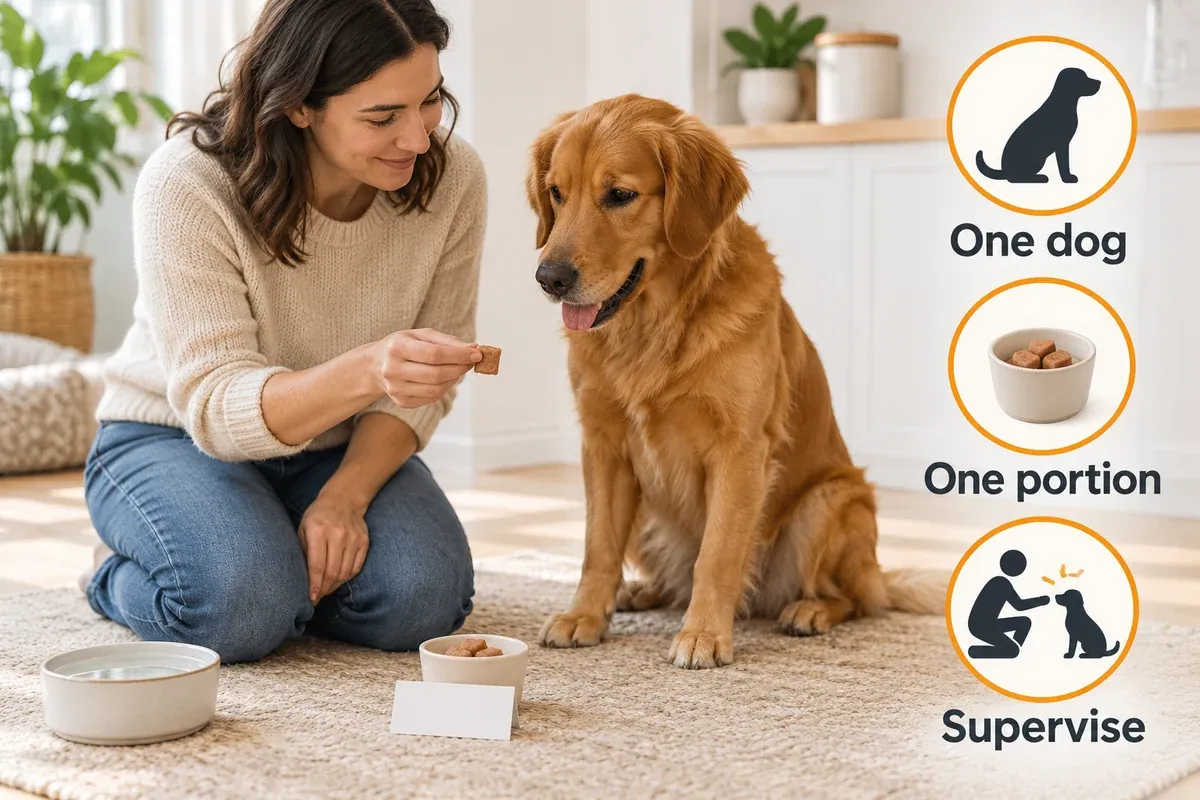
Use this serving sequence:
- Separate dogs with gates, rooms, crates, leashes, or adequate distance before food appears.
- Put each owner-approved portion in a cup labeled with that dog’s name.
- Give one dog one piece while one adult watches.
- Wait until the piece is fully chewed and swallowed before offering anything else.
- Remove dropped pieces immediately so another dog cannot take them.
- Keep fresh water available and close the remaining box.
Stop serving if a dog coughs repeatedly, gags, paws at the mouth, drools unusually, struggles to breathe, or cannot swallow normally. Breathing difficulty or suspected choking is an emergency; contact an emergency veterinarian immediately rather than searching for instructions during the event.
The WSAVA guide also warns that an inappropriate treat can contribute to trauma or obstruction and recommends supervision with treats, chews, and toys. A beautiful gift is not worth testing a dog’s ability to gulp a hard object.
6. Screen Human Party Foods for Toxic Ingredients
A dog-labeled treat does not make the rest of the birthday table safe. Keep human cake, candy, drinks, gum, and garnishes out of reach.
The ASPCA Animal Poison Control list identifies several foods that should not be shared with dogs, including:
- chocolate, coffee, caffeine, and cocoa;
- grapes, raisins, currants, and sultanas;
- onions, garlic, chives, leeks, and shallots;
- xylitol-sweetened products, including some peanut butters and baked goods;
- macadamia nuts;
- alcohol and raw yeast dough; and
- excessively salty or fatty table foods.
Do not decorate dog treats with human chocolate or use an unlabeled “sugar-free” spread. If a dog eats a potentially toxic item, note the ingredient and amount and contact the veterinarian or animal poison-control service promptly. Do not wait for symptoms.
Planning an 18-Count Box for Multiple Dogs
An 18-count gift box is an inventory count, not a feeding recommendation. It does not mean one macaron per guest, one per day, or that the birthday dog should receive all 18 over a weekend.
Plan backward from individual approval:
| Party step | Practical control |
|---|---|
| RSVP | Ask every owner about diet, allergies, calories, dental health, and whether the dog may receive a new treat. |
| Before guests arrive | Review each label, obtain missing calorie information, and assign an owner-approved portion. |
| Portioning | Break or weigh pieces away from the dogs; place portions in clearly named containers. |
| Serving | Use one treat server and one dog at a time. Prevent crowding, guarding, and swapping. |
| Leftovers | Return unused treats to their original box and send none home without the ingredient and storage information. |
If only three of six dogs have approval, serve only those three and give the others their familiar owner-provided reward or a toy-based activity. Fairness does not require identical food.
Food can add tension even among friendly guests. Keep dogs that do not already share space calmly apart during the party; a celebration is no place for their first meeting. If one will be joining your household, plan that meeting separately with our guide to introducing two dogs. Do not use treats to force proximity.
The Bonne et Filou combo box can fit a planned celebration because it contains three six-count boxes and is positioned by the manufacturer as an occasional gift. Its main limits are equally important: flavor ingredients vary, the treats are hard, and the number in the box does not establish a portion.
View the 18-count dog macaron gift box →Store Treats for Safety and Traceability
Bonne et Filou currently describes these dog macarons as having a long shelf life with no refrigeration needed. Treat that as a manufacturer claim and follow the exact package after opening, since formulas and storage instructions can change.
The FDA’s pet-food and treat storage guidance recommends keeping treats in the original package so the product name, manufacturer, UPC, lot number, and best-by date remain available. FDA also recommends a cool, dry place below 80°F for dry pet food and unopened canned food, clean and dry storage containers, and a secure location pets cannot access.
For a birthday box:
- keep each flavor in its labeled inner box rather than mixing colors in an unlabeled jar;
- close the package after portioning and protect it from moisture, heat, and direct sun;
- store it in a latched cabinet, not on a low party table or counter edge;
- photograph the lot code and best-by date before discarding decorative packaging;
- do not combine a new batch with old crumbs in a container; and
- discard treats that smell unusual, show moisture or mold, contain a foreign object, or have damaged packaging.
If a dog becomes ill after a treat, stop feeding it and contact the veterinarian. FDA advises retaining the package details and reporting a suspected product problem to both the manufacturer and FDA.
When This Gift Box Fits—and When It Does Not
A reasonable fit
This box may suit an adult dog celebration when the exact ingredients are approved, the calorie value is known, the dog can safely handle the texture, and portions will be supervised and spread across appropriate days. The presentation and 18-piece format make more sense as a planned occasional gift than as a routine training treat.
Choose another option when
- the exact flavor label is unavailable before the party;
- calorie information cannot be obtained;
- the dog is on a veterinary or elimination diet without approval;
- the dog has a dairy, soy, peanut, oat, or other relevant ingredient restriction;
- hard texture is unsuitable for the dog’s teeth, age, mouth, or swallowing behavior;
- several dogs will be loose around food and cannot be safely separated; or
- the host wants a frequent, low-calorie training reward rather than an occasional gift.
A soft, single-ingredient owner-approved treat, a portion of the dog’s regular food, a new toy, a sniff walk, or quiet one-to-one play may be the better birthday choice.
Frequently Asked Questions
How many birthday treats can my dog have?
There is no safe universal count. Add the calories from every treat, chew, topper, and table extra and keep the total below 10% of the dog’s individual daily calorie allowance. Use the package’s kcal per piece or kcal per gram; ask the manufacturer if it is missing.
Are wheat-free dog treats safe for dogs with allergies?
Not automatically. Wheat-free answers only one ingredient question. The current Bonne et Filou ingredient information shows that flavor fillings can include ingredients such as milk, soy lecithin, or peanut butter. Check the exact delivered label and the individual dog’s veterinary plan.
Can a small or senior dog eat a hard dog macaron?
The manufacturer specifically warns that its hard treats can pose choking or gastrointestinal-blockage risk, especially for small or elderly dogs, and advises breaking them into an appropriate size under supervision. Smaller does not mean softer; dogs with dental or swallowing concerns may need a different treat.
Do dog macarons need refrigeration?
Bonne et Filou currently says these macarons have a long shelf life and do not require refrigeration. Follow the delivered package’s unopened and after-opening instructions, keep the original box, and store it cool, dry, and inaccessible to pets.
Can all party dogs share from the same box?
Only after each owner approves the exact ingredient and portion. Pre-portion into labeled cups and serve dogs separately. Do not allow free access, treat swapping, or food competition.
Can dog treats replace the birthday dog’s dinner?
No. WSAVA says treats should not replace a meal and should stay below 10% of daily calories. The Bonne et Filou product page also identifies the macarons as treats or rewards, not food.
Sources and Further Reading
- US Food and Drug Administration: Animal Food Labeling and Pet Food Claims — required label information and ingredient-order rules.
- US Food and Drug Administration: Proper Storage of Pet Food and Treats — original-package storage, lot information, temperature, secure storage, and problem reporting.
- WSAVA: Feeding Treats to Your Dog — the less-than-10% calorie rule, supervision, appropriate size, and hard-treat cautions.
- ASPCA: People Foods to Avoid Feeding Your Pets — toxic and hazardous party-food ingredients.
- AAHA: Nutrition and Dental Health — veterinary guidance on hard treats and tooth damage.
- Bonne et Filou: 18-count Dog Macaron Combo Gift Box — current manufacturer count, base recipe, hardness, feeding warning, and storage statements.
- Bonne et Filou: Ingredient Details — current manufacturer-published flavor-specific filling ingredients.
Ingredient lists, flavors, and storage directions can change. Review the exact delivered label before every serving.