

 Published sources
 Product details checked
Choose the UVB exposure first, then the kit. Find a credible basking UV-index (UVI) target for your exact reptile, measure the distance from the proposed lamp to the animal’s highest accessible position, and check whether a reflector and screen sit between them. A 5.0, 10.0, or 14% label does not tell you the UVI in the finished enclosure. The animal also needs a genuine route into shade.
For a compact habitat with a suitable lower-exposure target, the 14-inch Zoo Med ReptiSun 5.0 bundle is a candidate. The 24-inch Zoo Med ReptiSun 10.0 bundle gives a longer, higher-output option. The 39W Arcadia ProT5 Dragon 14% kit has the longest lamp here and needs particular care with distance and access to shade. None is a universal choice for a species. The Merck Veterinary Manual explains why UVB matters for vitamin D and calcium metabolism; Arcadia’s species lighting guide then relates proposed UVI to the animal’s behavior and the distance to its head or shell.
What this comparison covers
These are complete linear T5 high-output (T5-HO) UVB systems: each named version has a fluorescent UVB tube, powered hood or fitting, and reflector. A tube alone needs a compatible fixture. A fixture alone produces no UVB. A heat lamp and a visible-light LED are different equipment again. Keeping those purchases distinct makes it easier to check what will actually reach the reptile.
The choices below cover different lamp lengths and output families. Compare the included tube and exact model before comparing the numbers printed on the box. The links go to the named product versions; packaging for a similarly named hood can differ.
-
Zoo Med 5.0 T5-HO 14" Terrarium Hood with ReptiSun T5 HO 5.0 UVB Lamp
Zoo Med
A 14-inch T5-HO fixture listing an included ReptiSun 5.0 lamp and reflector; verify distance, mesh, and species-specific UVI before use.
- Included ReptiSun T5-HO 5.0 lamp listed
- Low-profile 14-inch format
- Reflector and electronic ballast listed
- When to consider it
- A compact T5-HO system when the species calls for its lamp and coverage
- Included UVB tube
- ReptiSun 5.0, 15W, 12-inch T5-HO tube
- Fixture format
- 14-inch hood (LF-70) with reflector
-
Zoo Med ReptiSun T5 HO Terrarium Hood with 10.0 Bulb 24" L
Zoo Med
Complete 24-inch ReptiSun T5-HO hood with a 10.0 lamp and curved polished reflector for a straightforward fixture-and-bulb setup.
- 24-inch T5-HO hood with an included ReptiSun 10.0 lamp
- Curved polished reflector helps direct light downward
- Complete fixture reduces the risk of buying an incompatible ballast
- When to consider it
- A 24-inch hood when its 10.0 lamp meets the species' measured UVI target
- Included UVB tube
- ReptiSun 10.0, 24W, 22-inch T5-HO tube
- Fixture format
- 24-inch hood (LF-76) with reflector
-
Arcadia ProT5 Dragon 14% UVB Kit, 39W (34" lamp)
Arcadia
The Dragon 14% ProT5 kit pairs a 34-inch, 39W UVB tube with its fitting and removable curved reflector. Set exposure by measured UVI, not the 14% label.
- 34-inch, 39W Dragon 14% T5-HO lamp included
- Removable curved reflector
- Linkable system listed
- When to consider it
- A larger habitat when the 14% lamp and measured distance fit the species' UVI target
- Included UVB tube
- Dragon 14%, 39W, 34-inch T5-HO tube
- Fixture format
- 36-inch fitting with reflector
Hood length and tube length differ. The percentages and 5.0/10.0 names are product labels, not readings at the animal.
Find the animal’s target before choosing a lamp
UVI is a measurement of ultraviolet exposure at a particular place. The useful number is at the reptile’s head, back, or shell in the basking position, not at the lid or at an empty enclosure floor. A lamp can be appropriate at one height and unsuitable after a platform or branch moves closer to it.
The original Ferguson and colleagues field study grouped the voluntary UV exposure of 15 snake and lizard species into four broad zones. Those zones help explain why a single setting cannot suit every reptile; they are not a complete prescription for every captive species or every life stage. Use a current species-specific veterinary or specialist care guide to establish a target and a shaded lower-exposure area. Arcadia’s lighting guide is one practical starting point because it gives suggested basking UVI by species and measures distance to the animal, while stating that its lamp advice assumes a suitable reflector inside the enclosure.
Write down the scientific name if a common name covers several species. Then note how the animal uses light: does it bask openly, expose only part of its body from cover, or spend most of the day in shade? A bearded dragon’s open basking arrangement should not be copied for a leopard gecko simply because both are lizards. The Arcadia guide’s leopard gecko discussion specifically accounts for partial exposure and a retreat to UVI zero. Tortoises also differ by species, age, enclosure, and opportunities to hide.
For an albino or unusually light-pigmented animal, an animal with limited mobility, or one being treated for a calcium-related disorder, ask a reptile veterinarian to help set the exposure. Changing to the strongest lamp is not a treatment plan.
Three complete T5-HO kits
Zoo Med ReptiSun 5.0, 14-inch LF-70 bundle
What arrives: The named 14-inch hood bundle pairs an LF-70 fixture and polished curved reflector with a 12-inch, 15W ReptiSun 5.0 T5-HO UVB tube. Zoo Med identifies the LF-70 size and its 5.0 bundle. The linked product is the bundle; the LF-70 hood instructions also describe hood-only packaging in which the lamp is sold separately. Check that the actual box or product title explicitly includes the 5.0 tube. A bare LF-70 hood is not the same purchase.
When it makes sense: A short fixture is easier to position over a defined part of a small enclosure. The 5.0 tube may be a reasonable starting candidate when the species plan calls for a lower basking UVI and the manufacturer’s chart shows the desired exposure at the actual distance. It can also be easier to preserve a shaded area in a compact enclosure, provided the animal cannot climb dangerously close to the tube.
Where it falls short: A 12-inch tube may not cover the useful basking area of a long habitat. The 5.0 name does not guarantee a gentle dose at close range, and mesh may reduce output enough to miss the target at a greater distance. Choose it for the measured geometry, not because an animal is described loosely as “tropical” or “nocturnal.”
Zoo Med ReptiSun 10.0, 24-inch LF-76 bundle
What arrives: The 24-inch LF-76 hood holds an included 22-inch, 24W ReptiSun 10.0 T5-HO tube and has a curved reflector. Zoo Med lists LF-76 under its 10.0 hood range and publishes model-specific distance charts. The 24-inch LF-71 hood belongs to the 5.0 range; the same outer length does not mean the same included lamp.
When it makes sense: This is a practical complete-kit option when a 22-inch tube covers the planned basking zone and the species target can be met at the available height. It may suit an enclosure where the 14-inch system would leave too little useful lit space, without choosing a 34-inch tube that extends across much of the habitat.
Where it falls short: The 10.0 label is not a UVI value or an automatic “desert reptile” setting. If the basking surface is close to the hood, or the reptile can climb toward it, the exposure may be too high. Conversely, a dense top and greater distance may leave it too low. Use Zoo Med’s chart for LF-76 with its included tube as a starting point, then verify the finished enclosure.
Arcadia ProT5 Dragon 14%, 39W kit
What arrives: The selected Dragon version includes a 34-inch, 39W T5-HO 14% UVB tube, powered fitting, removable curved reflector, cable, and mounting hardware. The fitting is roughly 36 inches long; the 34-inch measurement describes the tube. Arcadia documents the ProT5 kit contents, lamp choices, and reflector. The Dragon 14%, Desert 12%, and Forest 6% options are distinct lamps, even where the fittings look alike.
When it makes sense: The longer tube can serve a larger basking area when the species’ target, enclosure height, reflector, and shade layout support it. The removable reflector and published UVI distance table give a clear starting point for planning. This is especially relevant when you have enough height to keep the animal out of the strongest part of a high-output beam.
Where it falls short: The Dragon 14% version can be far too strong at a close perch. Arcadia’s published ProT5 chart gives peak-center UVI 10.5 at 12 inches (300 mm) and 4.6 at 20 inches (500 mm) for its 14% lamp with the specified reflector. Those are Arcadia’s reference readings, not measurements in your terrarium or recommended UVI targets. A screen, different reflector arrangement, lamp age, and the animal’s position change the result. If the enclosure cannot provide both appropriate distance and an accessible shaded retreat, choose another lamp or layout.
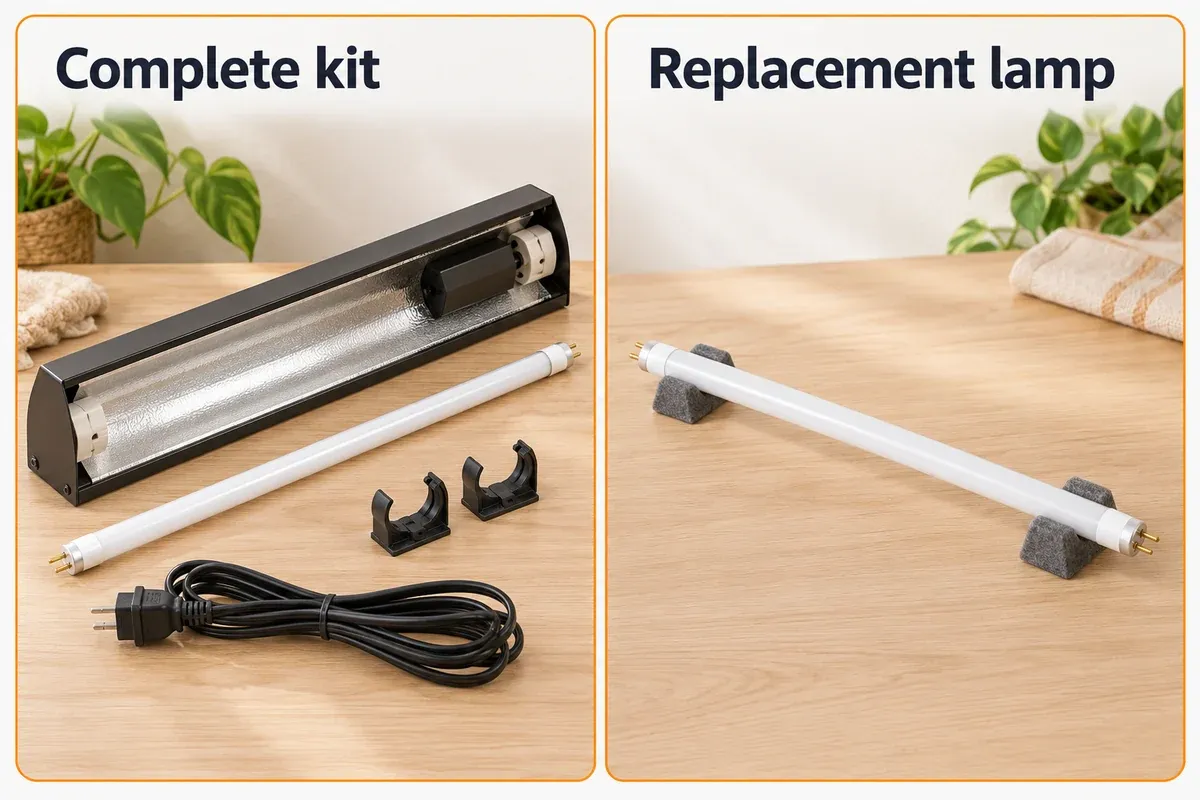
The illustration below distinguishes the whole lighting system from the tube you buy when replacing its lamp.
How to decide between them
1. Measure the usable distance and area
Measure from the UVB tube to the highest point the reptile can occupy under it, including the animal’s head, back, or shell above a rock or branch. Record the proposed hood length and the portion of the enclosure you intend to light. Do not use the empty tank height as the lamp distance. The 14-inch, 24-inch, and roughly 36-inch fixtures have different physical footprints, but fixture length alone is not the width of the usable UVI zone. Reflector shape and distance affect that footprint.
A longer lamp is useful only if it lights the intended basking area while the animal can still reach real shade. Arcadia’s light-and-shade method places lighting near the heat zone and maintains a retreat. For a complete bearded dragon placement walkthrough, use the bearded dragon UVB setup guide after choosing a candidate here.
2. Read the chart for the exact lamp and reflector
Find the manufacturer’s distance chart for the included tube in the named fixture. Start with the published value at the distance you measured. The Arcadia figures above show why a percentage alone is unhelpful: moving the same 14% kit from 12 to 20 inches changes its published peak-center reading substantially. A 5.0 value from one manufacturer is not directly interchangeable with a 6% label from another. Merck notes large performance differences among UVB bulbs despite similar claims.
Treat the chart as a planning tool. It may describe a bare fixture, a particular reflector, or a measurement directly below the middle of the tube. It does not prove the UVI at a branch near the edge of the beam. Keep the chart’s measurement conditions with your notes rather than copying a distance from another keeper’s enclosure.
3. Account for the enclosure top
Merck states that most glass and plastic filter out useful ultraviolet light. A lamp above a closed glass or plastic lid cannot be treated like an unobstructed lamp. Mesh lets some UVB through, but its wire thickness, opening size, and position alter the result; there is no reliable universal “mesh removes half” correction. A guard, dust, or misplaced décor can alter the reading too.
If the chart assumes an unobstructed lamp and yours sits above mesh, measure below the installed mesh or obtain guidance for that exact configuration. The UVB-through-mesh-and-glass guide covers barrier and mounting questions in detail. Do not solve an unknown mesh loss by automatically buying the strongest tube.
4. Check the whole kit, not just the tube label
Before ordering, confirm the exact model number, included tube, tube wattage and length, reflector, mounting method, and electrical rating for your region. A 24-inch hood can hold a 22-inch tube, and a 14-inch hood can hold a 12-inch tube. A replacement tube must match the fixture’s supported length, wattage, and type. The Zoo Med LF-70 instructions list its supported 12-inch, 15W T5-HO lamps; Zoo Med’s LF-76 product page specifies the 22-inch tube for the 24-inch hood.
If you already have a working, compatible hood and reflector, a replacement UVB tube may be all you need. Confirm the lamp model before buying rather than replacing the whole fitting. Budget for future tubes and, ideally, access to a UVI meter; a kit is not a one-time purchase.
Why a dual dome is a different purchase
The Zoo Med Mini Combo Deep Dome LF-19 is a pair of small lamp holders. It has no included UVB tube or T5-HO ballast and cannot replace any of the three linear systems in the table. A compatible screw-in UVB bulb could make one socket a UVB source, but then the specific bulb, its focused beam, distance, and measured UVI become the comparison. The second socket can serve a compatible heat or light bulb under the fixture’s instructions. Buying the holder alone leaves the animal without UVB.
Likewise, a regular basking bulb supplies heat but should not be counted as UVB unless that exact bulb is documented to emit it. Linear UVB tubes supply little basking heat. Plan temperature and UVB as separate checks; the heat mat guide and thermostat types guide explain the heating side without treating temperature as a UVB measurement.
Verify the finished enclosure
A Solarmeter 6.5 UV-index meter reads instantaneous UVI at the sensor’s position. The maker instructs users to aim the sensor toward the source and record the distance so later readings are comparable. It does not choose the biological target for you.
Once the lamp, reflector, screen, basking structure, and hides are in their final positions:
- Measure at the reptile’s highest accessible basking position beneath the useful part of the tube. Record the sensor’s distance from the lamp and whether the screen is in place.
- Check the edge of the basking area and a place the animal actually uses between basking and retreat. A single peak reading misses a steep fall-off.
- Check an accessible shaded retreat. Shade needs to be available without forcing the animal into unsafe heat or another hazard.
- Compare those readings with the species plan. If the peak is too high, prevent access to that perch while you adjust the lamp, height, or lower-output option. If it is too low, inspect barriers, placement, the exact tube, and the reflector before buying a stronger lamp. Re-measure after every change.
- Record the tube model, install date, reflector, mesh, measurement points, and readings. Repeat at the same positions after changing a lamp, screen, branch, or basking platform. Merck recommends regular UVB measurement because output declines with use.
If a meter is unavailable, use the exact manufacturer’s chart as a provisional starting point and leave a secure shaded retreat. You cannot claim the enclosure meets a numerical UVI target without a measurement in that configuration. A visible-light meter, phone sensor, or temperature probe answers a different question.
Maintenance and health checks
Keep the reflector and mesh clear of dust, check mounting and cords, and replace the tube according to its manufacturer’s guidance or earlier if measurement shows a significant decline. Visible light can remain after useful UVB output falls; Merck advises following lamp instructions and monitoring UVB over time. Do not set one replacement month for every lamp type.
Prevent contact with hot lamps and unstable fixtures, keep electrical fittings away from water, and make sure the animal can leave both the UVB beam and the heated spot. Merck’s husbandry guidance calls for protected heat sources and a thermal gradient. A correct UVI does not prove the basking temperature is safe.
Weakness, poor appetite, reluctance to move, or a suspected fracture need prompt assessment by a reptile veterinarian. Merck describes these as possible signs among several serious calcium and bone problems. Give the veterinarian the diet and lighting record; a new lamp alone cannot diagnose or treat the cause.
Frequently Asked Questions
Is 10.0 better than 5.0 for reptiles?
It is a different lamp family, not a universal upgrade. Compare the manufacturer’s UVI at the planned distance, using the right reflector and enclosure top, against your species’ target. A nearby 5.0 can provide more exposure than a distant 10.0 in a different setup.
Is a 14% tube too strong through mesh?
Mesh can reduce exposure, but the amount varies. Arcadia’s 14% ProT5 has a high published peak at close range; measure through your installed screen at the animal’s height before deciding it is suitable. The availability of shade matters as much as the basking peak.
Should I choose T5-HO over T8 or a compact UVB bulb?
The linear T5-HO kits here make it straightforward to plan a defined strip of exposure. Merck distinguishes the broader, more even gradient of fluorescent tubes from the focused gradient of compact fluorescents. A T8 or compact lamp can still be appropriate where its exact output, distance, coverage, and shaded retreat fit the species. Do not transfer a T5-HO distance chart to a T8 or compact bulb.
Can I leave the UVB lamp above a glass lid?
No ordinary glass-lid arrangement should be assumed to deliver useful UVB. Merck notes that glass and most plastic filter ultraviolet light. Use a suitable open or screened mounting arrangement under the fixture instructions and verify the exposure at the animal’s position.
What is the simplest buying decision?
Pick the species target and physical layout first. Buy the shortest complete system that adequately covers the intended basking area and can reach that target at a safe distance while leaving real shade. If an existing compatible hood already does this, replace the tube instead of buying another kit.