

 Published sources
 Product details checked
Starting your first aquarium is much easier when you separate buying the equipment from adding the fish. The tank, filter, heater, and light can be assembled in an afternoon. The biological filter that makes the water safe needs time to develop.
Quick answer: For most first-time freshwater keepers, a properly supported 20-gallon rectangular aquarium is the most forgiving starting point. A 10-gallon kit can work when space is tight, but smaller volumes change temperature and water chemistry faster. Before fish arrive, you need conditioned water, working filtration, a thermometer, a test kit for ammonia and nitrite, and a completed fishless cycle—not just clear-looking water.
This checklist focuses on a practical freshwater setup. Saltwater, reef, planted high-tech, and species-specific aquariums need additional equipment and different water targets.
The beginner aquarium checklist at a glance
Use this as your shopping and setup order. The boxes are intentionally separated into before filling, during cycling, and after the tank is ready so you do not accidentally treat “the tank is assembled” as “the tank is ready for fish.”
Buy before filling the tank
- Aquarium with a lid or cover
- Aquarium stand or furniture rated for the filled tank
- Filter and the correct replacement media
- Heater and a separate thermometer for tropical species
- Aquarium light and a timer if the light has no schedule
- Substrate, smooth décor, and species-appropriate plants or hiding places
- Water conditioner that treats your tap water
- Liquid test kit for ammonia, nitrite, nitrate, and pH
- Fish net, dedicated bucket, and gravel vacuum or siphon
Complete before adding fish
- Filter is running continuously
- Tap water is treated before it enters the aquarium
- The tank has been fishlessly cycled with an ammonia source
- Tests show the cycle is processing ammonia and nitrite reliably
- The chosen fish fit the tank’s adult size, temperature, hardness, and behavior requirements
Keep for normal maintenance
- Species-appropriate food
- Replacement filter media or sponge
- Algae scraper and a clean towel
- A simple log for water tests and water changes
- Optional quarantine tank for new fish or illness
1. Choose the tank before you choose the fish
The tank size determines almost every other decision. A 20-gallon long or similarly shaped rectangular tank gives a beginner more stable water volume and more swimming length than a tiny bowl or novelty aquarium. It also gives you more room to position the filter outlet, heater, plants, and hiding places without crowding the fish.
It simply leaves less room for error. Evaporation, missed maintenance, overfeeding, or an undersized heater can affect a 10-gallon tank quickly.
Do not choose fish first and then try to make them fit. Research the adult size, minimum tank footprint, temperature, water hardness, swimming level, and social needs of the species. Schooling fish usually need a group, while territorial fish may need more floor space or separate territories. “Small fish” does not automatically mean “small tank.”
Place the aquarium safely
Water weighs about 8.34 pounds per US gallon. A filled 20-gallon aquarium therefore contains roughly 167 pounds of water before you add glass, substrate, rocks, and décor. Put it on a level, stable surface that is designed to support an aquarium, away from direct sun, heating vents, vibration, and high-traffic corners.
Keep a power outlet and a water source nearby. Make a drip loop in every electrical cord so water runs to the floor rather than into the outlet. Leave enough space behind the tank to remove filter media and route hoses without bending them sharply.
2. Buy the equipment that keeps water safe
Tank, lid, and stand
The tank holds the environment, but the lid prevents fish from jumping, reduces evaporation, and keeps dust out. A stand matters because an aquarium’s weight is concentrated and a normal bookshelf may not support it evenly. Use a stand made for the tank’s footprint and follow the aquarium manufacturer’s instructions about leveling.
Filter
The filter performs two jobs: it moves water through mechanical media that catches debris, and it provides a home for beneficial bacteria. Biological filtration is what turns toxic fish waste into less toxic nitrate over time. A filter that is technically “rated” for the tank but produces a strong, stressful current may not be the right choice for every species. For bettas or shrimp, compare the low-flow aquarium filter guide with the actual media and flow needs of the setup.
If a kit includes a filter, start with it rather than buying a second filter immediately. If you are building a setup from individual parts, the Fluval AquaClear 50 is a reasonable 20- to 50-gallon hang-on-back option, but it is unnecessary when your kit already has adequate filtration.
Never replace all biological media at once. If a sponge or ceramic media is dirty, gently swish it in water removed from the aquarium during a water change. Tap water can contain chlorine or chloramine that damages the bacteria you are trying to preserve.
Heater and thermometer
Tropical fish need stable heat, but the correct temperature depends on the species. Use a heater rated for your actual tank volume and verify it with a separate thermometer. A preset heater can be convenient for a small, uncomplicated setup; an adjustable heater gives you more control when your livestock needs a specific range.
The 50-watt Tetra HT described below is for small 2- to 10-gallon tanks and is not a universal 20-gallon recommendation. Always follow the heater’s minimum-water-line and submersion instructions, and unplug it before a water change lowers the water level.
Light, substrate, and décor
Fish need a consistent day/night rhythm, not an aquarium light running all day. Start with a modest schedule—around 6 to 8 hours of light is a practical beginning—and adjust based on algae and plant growth. A plug-in timer is often more useful than a more expensive light.
Rinse new gravel or sand with plain water until the rinse water is mostly clear. Never use soap or household cleaners. Choose smooth décor without sharp edges, unstable rock piles, or openings in which a fish can become trapped. Artificial plants are fine if they are soft and aquarium-safe; live plants can add cover and help use nutrients, but they are not a substitute for filtration or cycling.
3. Do not skip water preparation
Tap water is not automatically safe for fish. Municipal water may contain chlorine or chloramine, both of which are used for disinfection and can damage fish and beneficial bacteria. Use a conditioner every time you add tap water, and dose it according to the amount of new water and the label directions.
Seachem Prime is one current, concentrated option. Its manufacturer says it removes chlorine and chloramine and can be used when setting up a tank or changing water. The important principle is broader than one brand: conditioner removes disinfectants; it does not create a biological filter and does not make an uncycled aquarium safe for fish.
If your water is unusually hard, soft, acidic, or alkaline, test it before choosing livestock. Do not chase a “perfect” pH with random additives. Stable, species-appropriate water is usually safer than constant swings caused by trying to force a universal number.
If your setup uses RO/DI as part of a remineralization or blending plan, check that source water before preparing the replacement batch. An unexpected output reading is a reason to use the RO/DI three-point TDS measurement sheet, which separates membrane performance from the final DI stage. Zero TDS is not a universal freshwater target; the prepared water still needs the mineral content and buffering appropriate for your fish.
4. Test the water before you trust it
Clear water can still contain ammonia or nitrite. A beginner test kit should cover at least:
- Ammonia: produced by fish waste and decaying organic matter; toxic in a new tank
- Nitrite: produced as bacteria process ammonia; also toxic to fish
- Nitrate: the later product of the cycle; managed through water changes, plants, and sensible stocking
- pH: useful for understanding your source water and choosing compatible species
Liquid tests are particularly useful while cycling because they let you track small changes more clearly than visual inspection. Test strips can be convenient for routine screening, but if you are trying to decide whether a new aquarium is ready for fish, a liquid ammonia and nitrite test is a better foundation.
The API Freshwater Master Test Kit is a practical choice for this stage. It is not exciting equipment, but it answers the question that matters: “Is the biological filter processing waste yet?”
A practical equipment list for a first freshwater setup
The products below are included as examples of how to complete the checklist, not as a requirement to buy everything from one brand.
-
Tetra 20 Gallon Complete Tropical Fish Tank Kit
Tetra
Complete 20-gallon glass kit with LED hood, filter, heater, thermometer, samples, and décor to reduce compatibility decisions for a first setup.
- 20-gallon volume is more forgiving than tiny desktop tanks
- LED hood, filter, heater, and thermometer included
- Rectangular footprint is easy to place and aquascape
- Best for
- A steadier 20-gallon freshwater start
- Key feature
- Complete freshwater starter kit
-
Aqueon 10 Gallon SmartClean LED Starter Kit
Aqueon
Compact 10-gallon glass kit with SmartClean internal filtration, LED hood, preset heater, thermometer, net, and starter samples.
- All-in-one package keeps the first shopping list short
- SmartClean internal filter is designed for simple water changes
- Preset 50W heater is set for approximately 78°F
- Best for
- Small spaces that still need a real freshwater setup
- Key feature
- Compact all-in-one kit
-
API Freshwater Master Test Kit
API
Liquid reagent kit for checking pH, ammonia, nitrite, and nitrate—the measurements that tell you whether a new tank is actually ready for fish.
- Tests the core nitrogen-cycle parameters
- Liquid color comparison is more useful for cycling than guessing from clear water
- Useful after stocking, filter changes, or unexplained fish stress
- Best for
- Fishless cycling and diagnosing water problems
- Key feature
- Liquid freshwater water testing
-
Seachem Prime 500 mL Water Conditioner
Seachem
Concentrated freshwater and saltwater conditioner that removes chlorine and chloramine before tap water reaches the fish.
- Treats chlorine and chloramine in municipal tap water
- Concentrated 500 mL bottle lasts through many water changes
- Dose for the amount of new water, not just the tank label
- Best for
- Treating tap water for setup and water changes
- Key feature
- Chlorine and chloramine treatment
-
Tetra HT 50-Watt Submersible Aquarium Heater
Tetra
Preset 50W submersible heater with electronic thermostat for small tropical aquariums; choose a tank-rated model rather than matching wattage by guesswork.
- product documentation rates this 50W version for 2-10 gallon tanks
- Preset thermostat targets approximately 78°F
- Compact wall-mount design is simple for a first 10-gallon setup
- Best for
- Small tropical tanks from 2 to 10 gallons
- Key feature
- Preset tropical aquarium heating
-
Python No Spill Clean and Fill 25-Foot System
Python
25-foot gravel-cleaning and water-changing system that can reduce bucket carrying for routine maintenance.
- Combines gravel vacuuming and water changes in one system
- 25-foot hose works for many rooms and nearby sinks
- Makes weekly water changes easier to repeat consistently
- Best for
- Less-messy water changes when a faucet is nearby
- Key feature
- Gravel vacuum and water changer
-
Fluval AquaClear 50 Power Filter
Fluval
Hang-on-back filter with mechanical, chemical, and biological filtration for beginners who are buying a tank and equipment separately.
- product documentation rates the filter for 20-50 gallon aquariums
- Three filtration stages give beginners a clear maintenance routine
- Separate filter media can be rinsed and replaced by type
- Best for
- Build-your-own freshwater setups from 20 to 50 gallons
- Key feature
- Three-stage hang-on-back filtration
Review the linked product page before purchasing.
My practical buying order
For the simplest 20-gallon start: the Tetra kit keeps the first purchase focused on one compatible package. It is the better default when you have room for a proper stand and want more water volume to buffer small beginner mistakes. Check current price on Amazon →
For a small-space setup: the Aqueon SmartClean kit includes the core equipment for a 10-gallon aquarium, but you still need to add substrate and décor and you must be more disciplined about testing and maintenance. Check current price on Amazon →
For the part that prevents guesswork: buy the API liquid test kit before buying fish. It is the item that tells you when patience has paid off. Check current price on Amazon →
For routine maintenance: the Python system is convenient when your aquarium is near a compatible faucet. For a nano tank or a setup far from a sink, a basic siphon and dedicated bucket cost less and work perfectly well.
For a build-your-own aquarium: use the Fluval AquaClear 50 only if you are buying a bare tank or replacing an undersized filter. Do not add it just because a product list says more equipment is always better; flow, media space, and species needs matter more than the number of devices.
5. Set up the aquarium in the right order
Step 1: Rinse and inspect
Rinse substrate and décor with water only. Check the tank for cracks, make sure the lid fits, and read the filter and heater instructions before placing anything in the water.
Step 2: Build the hardscape
Add the substrate, then place stable décor and plants. Leave open swimming space and make sure rocks cannot slide into the glass. It is much easier to make these changes before the aquarium is full.
Step 3: Install equipment before filling
Position the filter and heater according to their instructions. Plan the return flow so it creates surface movement without blasting the fish. Keep the heater fully submerged whenever it is powered on.
Step 4: Fill with conditioned water
Add a plate, plastic bag, or clean container while pouring so the substrate does not shift. Treat the new water with conditioner according to the label. Check for leaks, then turn on the filter and heater once the equipment is safely submerged.
Step 5: Let the equipment run
Confirm that the filter is moving water, the heater is maintaining the intended temperature, and the thermometer agrees with the heater setting. Fix bubbles, rattles, leaks, or unsafe cord placement now—before livestock is involved.
Step 6: Start the fishless cycle
Add an appropriate ammonia source according to a fishless-cycling method and test regularly. Keep the filter running 24/7. Beneficial bacteria need a continuous source of oxygenated water and waste to establish in the filter media.
Step 7: Add livestock gradually
Only add fish after the tests—not a calendar—show that the tank can process the chosen ammonia load. Start with a sensible first group, feed lightly, and test more often after each addition. Adding a whole community at once can overwhelm a young biological filter even when the initial cycle looked good.
The nitrogen cycle: the step beginners most often miss
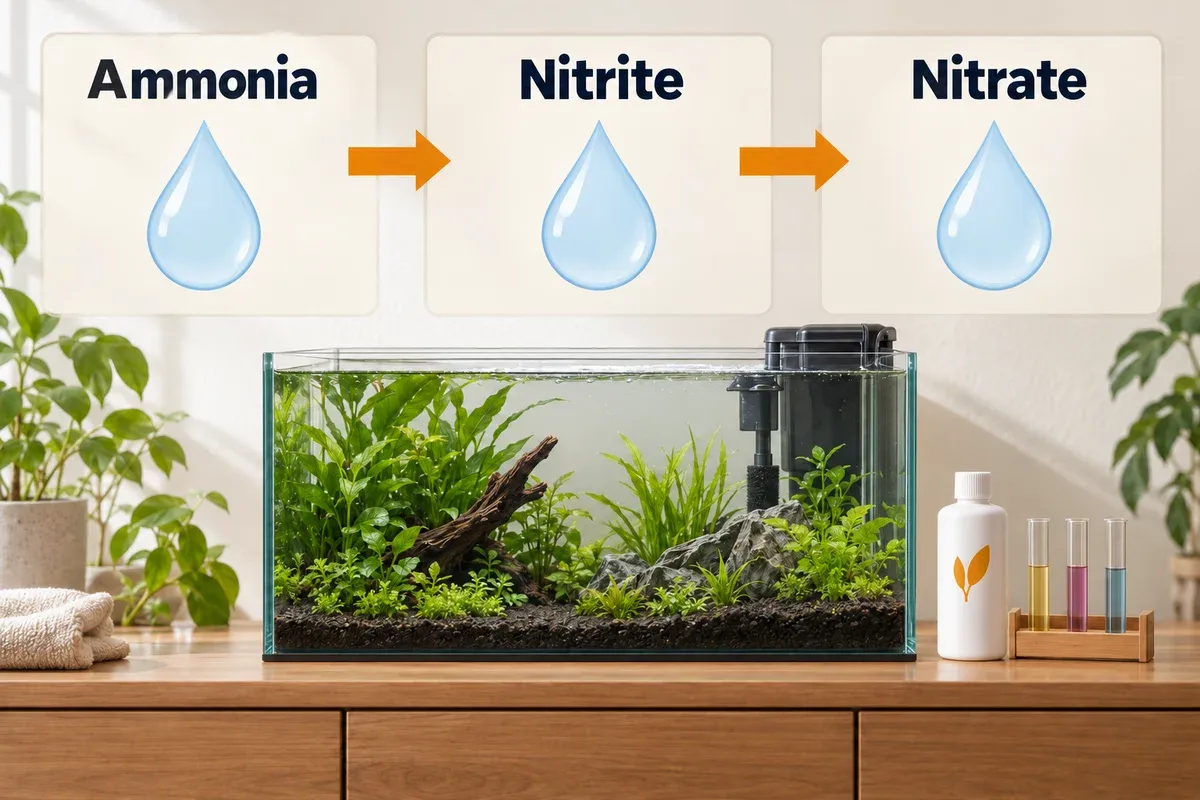
Cycling is the process of establishing bacteria that convert ammonia into nitrite and then nitrite into nitrate. Aquarium Co-Op explains the process as a biological filter developing enough bacteria to consume ammonia and nitrite; the RSPCA likewise recommends fishless cycling and testing during the process.
There is no honest universal “your tank will be ready in seven days” promise. A new aquarium often takes several weeks, and the timeline changes with temperature, surface area, the ammonia source, seeded media, plants, and testing method. A bottle labeled “instant cycle” can be useful as a source of bacteria, but it cannot replace test results.
The sequence below explains what your cycling tests are tracking, rather than setting a deadline for adding fish.
A practical readiness check
Use the instructions for your chosen fishless method, then look for all of these signals:
- You can measure the ammonia source you added rather than starting from an unknown zero.
- Ammonia and nitrite return to zero within the method’s expected processing window, commonly 24 hours after the measured dose.
- Nitrate is present or otherwise explained by your plants and water changes.
- The tank remains stable through repeated tests, not just one lucky reading.
- You can perform a water change and bring nitrate down before livestock arrives.
If ammonia or nitrite is still measurable, do not add fish. If fish are already in the tank, test daily, feed sparingly, and use appropriately conditioned water changes to protect them while you get help from an experienced aquatics shop or aquatic veterinarian.
What to do after the first fish arrive
Acclimate new fish according to the retailer’s instructions and avoid pouring store water into the aquarium when possible. Keep the light low at first, provide hiding places, and watch breathing, posture, and appetite without tapping on the glass.
For the first week, test ammonia and nitrite frequently. Feed only what the fish can consume promptly; uneaten food becomes waste. If the parameters move in the wrong direction, pause stocking and correct the water before adding anything else.
A simple weekly routine is enough for many beginner freshwater tanks:
- Test the water, especially after stocking or a filter change.
- Remove the volume of water your maintenance plan calls for with a siphon.
- Vacuum a section of the substrate rather than trying to sterilize the tank.
- Add temperature-matched, conditioned water slowly.
- Wipe the glass with an aquarium-safe scraper.
- Rinse mechanical media in removed tank water when it is clogged; do not replace all biological media at once.
Common beginner mistakes to avoid
Adding fish on setup day
The tank may look beautiful and the water may look clear, but the biofilter is not established. Waiting protects the fish and makes the hobby much less frustrating.
Buying a bowl because the fish is small
Small containers are harder to keep stable and often cannot hold a proper filter or heater. Choose the smallest tank that genuinely supports the species, not the smallest container that holds water.
Replacing filter media on a calendar
A disposable cartridge is not the same thing as the entire biological filter. Replace media when it is worn out or cannot be cleaned, and preserve established sponge or biological media whenever possible.
Treating conditioner as a cycle-in-a-bottle
Water conditioner handles tap-water disinfectants. It does not convert fish waste into safe water and it does not prove that bacteria have colonized the filter.
Overfeeding or adding too many fish
Both mistakes add waste faster than a young filter can process it. Stock slowly, feed modestly, and let the test results guide the next step.
Chasing a universal pH number
Fish species have different preferences, and local water chemistry varies. Research the fish first, test your source water, and avoid rapid pH swings caused by unnecessary additives.
Frequently Asked Questions
Is a 10-gallon aquarium big enough for a beginner?
It can be, when the species, equipment, and maintenance routine are appropriate. A 20-gallon aquarium is often more forgiving because it holds more water, but size alone does not make a tank safe. The adult fish, footprint, temperature, water chemistry, and stocking plan still determine whether the setup works.
How long should I wait before adding fish?
Wait until the fishless cycle is confirmed by repeated ammonia and nitrite tests. That may take several weeks or longer. A fixed number of days is not a reliable substitute for test results.
Do I need a water conditioner if I use tap water?
Usually, yes. Unless you have verified that your source water contains no chlorine or chloramine, use an aquarium conditioner that treats the disinfectant used by your water utility. Follow the product label for every water change.
Do I need a heater for every aquarium?
No. Tropical species generally need stable heat, while some temperate species may not. Choose the fish and temperature range first, then use a heater and thermometer when the species requires them. Never rely on the heater’s dial without checking the actual water temperature.
Can I clean the aquarium with household soap?
No. Rinse new equipment with plain water and use aquarium-safe tools. Soap residue can harm fish and beneficial bacteria.
What is the one item beginners forget most often?
A real water test kit. Tanks, lights, and décor are visible, but testing is what reveals the invisible ammonia and nitrite problems that cause many new-tank losses.
Sources and further reading
- Aqueon SmartClean LED kit details for the included equipment and manufacturer setup guidance.
- Aquarium Co-Op: The Beginner’s Guide to the Nitrogen Cycle for a plain-language explanation of ammonia, nitrite, nitrate, and fishless cycling.
- RSPCA: Choosing an Aquarium for Pet Fish for fishless-cycling and filter-maintenance guidance.
- PetMD: Setting Up a Freshwater Aquarium for a veterinary-reviewed equipment and water-quality overview.
- Seachem Prime directions for conditioner use and dosing instructions.