

 Published sources
 Product details checked
A 20 gallon aquarium setup usually costs about $300-$500 before fish when you include a safe stand, basic equipment, substrate, décor, water care, and a test kit. A kit-first build can come in lower if you already have a suitable stand, while a planted display with stronger lighting and live plants can easily reach $500-$800 or more.
The tank itself is only the beginning. The price that matters is the cost of a stable, maintainable system: a level support, dependable filtration, correctly sized heating, a light that matches your plants, and enough testing equipment to know whether the tank is ready for fish. This guide shows where the money goes, which parts are worth buying once, and where a budget choice is perfectly reasonable.
Quick Answer
For a standard 20-gallon freshwater aquarium in the United States, plan on:
- $250-$400 for a lean kit-first setup if you keep the décor simple and already have a sturdy stand or furniture that is genuinely rated for the load.
- $320-$550 for a balanced custom setup with separate equipment, a proper stand, and more flexibility to upgrade.
- $450-$800+ for a planted display with a better light, live plants, richer substrate, and additional hardscape.
- $10-$30 per month after setup for food, water conditioner, filter media, electricity, and small replacements. Fish, medications, and emergency purchases can add more.
The numbers above assume a freshwater aquarium and exclude livestock. A saltwater 20-gallon build is a different budget because it needs marine salt, stronger circulation, reef-capable lighting if corals are planned, and additional testing.
20 Gallon Aquarium Cost at a Glance
| Setup path | What it normally includes | Realistic upfront budget |
|---|---|---|
| Kit-first freshwater | Tank, lid, basic light, filter, heater, simple substrate and décor, stand, water care, testing | $250-$400 |
| Balanced custom freshwater | Separate tank and stand, quieter or more flexible equipment, substrate, décor, water care, testing and maintenance tools | $320-$550 |
| Planted freshwater display | Custom equipment plus stronger light, live plants, planted substrate or hardscape, and more visual finishing | $450-$800+ |
| Small saltwater or fish-only marine build | Marine tank equipment, salt mix, refractometer, circulation and saltwater testing | $650-$1,200+ |
These are planning ranges, not a promise of a checkout total. Tank dimensions, local shipping, seasonal sales, and whether you buy the stand locally can move the number substantially. A standard 20-gallon high tank and a 20-gallon long tank are also not interchangeable when you are choosing a stand or light.
Where the Money Goes
The following breakdown is the most useful way to budget because it exposes the costs that starter-kit boxes often leave out.
| Component | Typical US range | What to check before buying |
|---|---|---|
| Glass tank, lid, and basic light | $70-$210 | Confirm the tank footprint and whether the lid/light are included. |
| Aquarium stand | $40-$140 | It must match the tank footprint, stay level, and support the filled system. |
| Filter | $20-$60 | Look at real media capacity and replacement-media cost, not only advertised gallons. |
| Heater and thermometer | $18-$50 | Match wattage to room temperature and verify the actual water temperature. |
| Substrate | $20-$60 | Inert gravel is economical; planted substrates and specialty sands cost more. |
| Water conditioner and test kit | $40-$70 | Budget for ammonia, nitrite, nitrate, and pH testing from the start. |
| Décor or live plants | $25-$100 | Hardscape, hides, and plants should leave swimming space and be aquarium-safe. |
| Net, siphon, bucket, scraper, and small tools | $15-$50 | A dedicated bucket and gravel vacuum prevent many maintenance headaches. |
A low checkout price often means one of these categories has been postponed. That is not automatically a problem, but it is better to label the missing item than to call the aquarium “ready” before it is actually ready.
The three groups below show why a tank box alone does not cover the full setup budget.
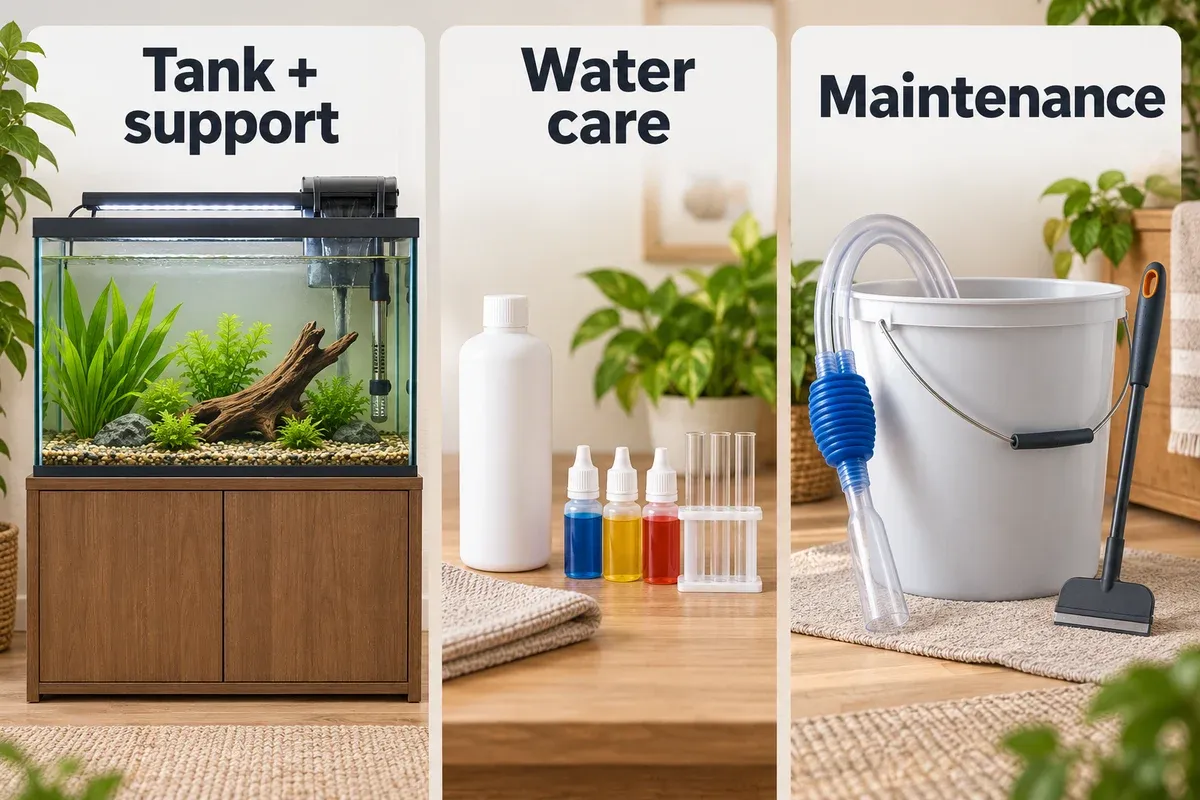
Example Equipment for a 20-Gallon Freshwater Setup
The products below are useful reference points for a US freshwater build.
Reference products for a 20-gallon freshwater build
-
Aqueon 20 Gallon Starter Kit
Aqueon
Freshwater starter kit that can teach aquarium basics before a later saltwater upgrade.
- 20 gallon tank
- Freshwater starter gear
- Rectangular footprint
- Best fit
- Freshwater-first learning
-
Tetra Whisper IQ Power Filter 20 Gallons
Tetra
Hang-on-back filter with 130 GPH flow, StayClean technology and a sound barrier designed to reduce motor noise.
- 130 GPH flow
- Rated for 20-gallon tanks
- StayClean maintenance feature
- Best fit
- Quiet, simple filtration for a standard 20-gallon freshwater tank
-
Tetra HT Submersible Aquarium Heater 100W
Tetra
Fully submersible 100W heater for 10-30 gallon aquariums with a preset 78°F electronic thermostat.
- 100W output
- 10-30 gallon range
- Preset 78°F thermostat
- Best fit
- A standard 20-gallon tropical tank in a cool or variable room
-
AQQA LED Aquarium Light 24-32 Inch
AQQA
Affordable full-spectrum LED light with 24/7 auto mode and DIY customization. IP68 waterproof aluminum construction. Perfect for planted tanks and beginner reef setups 24-32 inches wide.
- 9 adjustable light colors
- 10 brightness levels
- 24/7 automatic mode simulates sunrise/sunset
- Best fit
- Budget-conscious aquarists wanting DIY color control on smaller tanks
-
API Freshwater Master Test Kit
API
Liquid reagent kit for checking pH, ammonia, nitrite, and nitrate—the measurements that tell you whether a new tank is actually ready for fish.
- Tests the core nitrogen-cycle parameters
- Liquid color comparison is more useful for cycling than guessing from clear water
- Useful after stocking, filter changes, or unexplained fish stress
- Best fit
- Fishless cycling and diagnosing water problems
-
Seachem Prime 500 mL Water Conditioner
Seachem
Concentrated freshwater and saltwater conditioner that removes chlorine and chloramine before tap water reaches the fish.
- Treats chlorine and chloramine in municipal tap water
- Concentrated 500 mL bottle lasts through many water changes
- Dose for the amount of new water, not just the tank label
- Best fit
- Treating tap water for setup and water changes
Review the linked product page before purchasing.
The convenient baseline: Aqueon 20 Gallon Starter Kit
A kit is often the simplest way to control the first purchase because the tank, hood, light, filter, heater, thermometer, net, and sample supplies arrive as one package. The Aqueon 20-gallon kit is a sensible starting point for a freshwater-first setup, but it is not a complete room-ready aquarium: you still need a properly sized stand, substrate, décor, water conditioner, a test kit, and maintenance tools. It also does not include fish.
The included preset heater is rated for the kit, yet room temperature matters. Aqueon’s freshwater setup guidance uses a 50-watt heater for a 20-gallon aquarium when the water only needs to rise a few degrees above a 68-72°F room, and a 100-watt heater when a larger temperature increase is needed. Use a thermometer rather than assuming a preset heater is accurate in every room.
It is best for someone who values a quick, compatible starting point and does not need a planted or reef-specific light immediately.
Check current price on Amazon →The standalone filtration choice: Tetra Whisper IQ 20
If you already own a tank or are assembling the system piece by piece, the Tetra Whisper IQ 20 is a straightforward hang-on-back filter to price out. Tetra’s official Whisper IQ specifications confirm the model sizes and flow rates.
The trade-off is ongoing media cost. This filter uses large Tetra Bio-Bag cartridges, so include replacement cartridges in your monthly or quarterly budget. During maintenance, rinse reusable biological media in water removed from the aquarium rather than under chlorinated tap water. That keeps the useful bacterial colony from being needlessly damaged.
This is a good fit for a lightly to moderately stocked community tank.
Check current price on Amazon →Heating without paying for a premium controller: Tetra HT 100W
The Tetra HT 100W is an inexpensive reference point for a 20-gallon tropical setup in a cool or variable room. The 10-30 gallon model is fully submersible and preset to 78°F, which keeps the initial equipment budget low. The limitation is equally important: the temperature is preset, so it is not the right choice for fish that require a different target or for aquarists who want fine adjustment.
Whichever heater you choose, place it where water circulates past it and add a separate thermometer. For the detailed vertical-versus-horizontal and filter-flow decision, see our aquarium heater placement guide. A heater that is correctly labeled for the tank can still struggle in a cold room, and any heater can malfunction. A thermometer costs far less than replacing fish after an unnoticed temperature problem.
Check current price on Amazon →Lighting: spend according to the plants you want
For a fish-only aquarium or easy plants, the light included with a kit may be enough. A stronger, adjustable light becomes useful when you want carpeting plants, red plants, a longer photoperiod, or more control over the appearance of the display. The AQQA 24-32-inch model is a budget reference for a standard 20-gallon footprint and includes adjustable color, brightness, timer, and 24/7-style modes.
Do not buy a reef light for a freshwater fish tank simply because its wattage looks impressive. More light can mean more algae if plant growth, photoperiod, and nutrients are not balanced. For an intentional planted layout, compare the options in our aquarium LED lighting guide and match the fixture to the tank’s actual length.
Check current price on Amazon →Testing and water preparation: the least exciting part of the budget
The API Freshwater Master Test Kit is useful during a new tank’s cycle because it checks ammonia, nitrite, nitrate, pH, and high-range pH with liquid reagents. API recommends weekly testing and explains why these readings matter in its official Freshwater Master Test Kit guide. Test strips are convenient for quick checks, but a liquid kit gives a beginner much more useful information when the numbers are changing quickly.
You also need a water conditioner for tap water. Seachem Prime is a concentrated freshwater and saltwater conditioner; use the label dose for the amount of new water you are adding. Conditioner makes treated tap water safer, but it does not cycle a new aquarium, remove the need for water changes, or make an overstocked tank safe.
Three Realistic Ways to Build the Aquarium
1. The lean, safe freshwater setup: about $250-$400
This is the lowest budget I would recommend for a new owner who needs to buy almost everything. Start with a kit or a tank-and-lid package, use plain inert gravel, choose a few simple decorations, and buy a test kit before buying fish. The budget can stay near the lower end if you have a suitable stand and can source the tank locally, because shipping large glass aquariums is often poor value.
Typical allocation:
- Tank or 20-gallon kit: $160-$220
- Stable stand or correctly rated furniture: $40-$90
- Substrate and simple décor: $35-$70
- Conditioner and freshwater test kit: $40-$55
- Siphon, bucket, net, and thermometer: $20-$45
This setup does not need an expensive light, CO2, a canister filter, or a cabinet full of additives. It does need a level base and enough testing to confirm that the aquarium is cycled before livestock goes in.
2. The balanced custom setup: about $320-$550
Choose this route when you care about quieter equipment, a cleaner appearance, or the ability to replace one component without replacing an entire kit. A separate filter and heater also make it easier to select a model that suits your room and stocking plan.
Typical allocation:
- Tank, lid, and basic light: $80-$160
- Aquarium stand: $60-$140
- Filter and heater: $45-$100
- Substrate: $25-$50
- Décor or easy live plants: $45-$100
- Water care, testing, and maintenance tools: $60-$100
The balanced build is often the best long-term value because the money goes into the parts that affect stability and maintenance rather than into decorative electronics. If you are considering a canister filter, compare its upfront cost and replacement media with a good hang-on-back filter in our canister filter guide. For many 20-gallon community tanks, a canister is an upgrade choice rather than a requirement.
3. The planted display: about $450-$800+
A planted aquarium can be beautiful without being extravagant, but plants add a second design and maintenance layer. The budget increases when you choose a stronger light, nutrient-rich substrate, more hardscape, tissue-culture plants, or CO2 equipment. CO2 is optional; it should not be treated as a hidden requirement for a beginner’s first aquarium.
The most efficient planted budget is usually to spend first on a light that fits the tank, then choose plants that match that light. Start with hardy plants such as anubias, Java fern, crypts, or Vallisneria if you want to reduce the risk of replacing a full planting after the first month.
One-Time Costs vs. Monthly Running Costs
The initial purchase gets the most attention, but running costs decide whether the aquarium remains enjoyable.
| Ongoing item | Typical monthly planning range | Notes |
|---|---|---|
| Fish food | $3-$10 | Depends on species, feeding habits, and container size. |
| Water conditioner | $1-$4 | Usually a small cost when dosed only for new water. |
| Filter media | $2-$8 | Reusable biological media can lower the recurring cost. |
| Electricity | $2-$8 | Depends on heater duty cycle, light schedule, room temperature, and local rates. |
| Plant or décor replacement | $0-$10 | Optional once the layout is established. |
| Typical routine total | Excludes fish purchases, medications, and emergencies. |
The first year therefore often lands for a typical freshwater setup and routine supplies, depending on the upfront build and how many replacement items you buy. A three-year ownership budget of is a reasonable planning range for a healthy, uncomplicated aquarium. These totals are intentionally broad: a stable tank that needs little replacement can cost less, while livestock losses, disease treatment, upgrades, or frequent plant purchases can cost much more.
Costs People Commonly Forget
The stand
Twenty gallons of water weighs about 167 pounds before the glass, gravel, décor, and equipment are added. Do not place a filled aquarium on a random bookshelf, an unbraced desk, or a stand that is only “close” to the tank dimensions. The tank base needs full, even support, and the stand should be level from front to back and side to side.
Buying the tank and stand locally can reduce shipping damage and make it easier to confirm that the footprints match. If you are comparing a standard 20-gallon high tank with a 20-gallon long tank, measure both the length and depth; the gallon label alone is not enough.
Substrate and hardscape
Plain aquarium gravel is usually the lowest-cost, lowest-maintenance choice. A planted substrate can make sense for a heavily planted layout, but it is not automatically better for every aquarium. Stones, driftwood, caves, and artificial décor also add cost, and they reduce the usable swimming area. Buy fewer pieces that create shelter and visual structure rather than filling the whole tank on day one.
Maintenance tools
A gravel vacuum, dedicated bucket, algae scraper, net, and thermometer are small purchases that save time every week. The bucket should never have been used for soap, cleaners, or chemicals. If your sink is far from the aquarium, a longer siphon hose can be worth more than another decorative accessory.
Fish and a quarantine plan
Livestock is excluded from the setup totals because the correct budget depends on the species. A community of small peaceful fish has different needs from a single centerpiece fish, shrimp, or a territorial species. Set aside money for a quarantine container if you can; preventing one disease introduction is cheaper and less stressful than treating an entire display aquarium.
How to Save Money Without Making the Tank Fragile
- Buy the tank locally when practical. Large glass boxes are expensive to ship and easy to damage. Local pickup also lets you inspect the corners and seams before carrying the tank home.
- Keep the first layout simple. Inert gravel, a few aquarium-safe hides, and easy plants can look intentional without a premium substrate or a full aquascaping order.
- Spend on support and testing first. A level stand, dependable heater, thermometer, water conditioner, and test kit protect the livestock more directly than a smart feeder or color-changing light.
- Price replacement media before choosing a filter. A cheap filter with expensive proprietary cartridges may cost more over a year than a slightly pricier filter with easy-to-find media.
- Use one good light on a timer. Extra light is not a substitute for plant selection and can create an algae problem that leads to more products and more work.
- Do not rush the stocking date. Fish added before the nitrogen cycle is established can create emergency water changes, illness, and replacement costs that overwhelm any initial saving.
A Setup Order That Prevents Expensive Mistakes
- Measure the tank footprint and verify the stand. Check the top dimensions, load rating, floor level, and access to a nearby outlet and water source.
- Rinse the substrate and inspect the hardscape. Use plain water only; do not use soap or household cleaners.
- Install the empty tank, substrate, décor, filter, heater, and thermometer. Leave enough clearance to remove the lid and service the filter.
- Fill with conditioned water and start the equipment. Make a drip loop in every power cord and confirm that the heater is fully submerged before powering it.
- Cycle the aquarium before adding fish. Use a test kit to watch ammonia and nitrite, and follow a fishless cycling plan. Aqueon’s freshwater aquarium setup guide explains equipment sizing, water conditioner, testing, and the basic setup sequence.
- Add livestock gradually. Stocking slowly gives the biological filter time to adjust and makes it easier to notice whether the system can handle the waste load.
- Set a weekly maintenance routine. Test when the tank is new or behavior changes, perform partial water changes as needed, and clean filter media in removed aquarium water.
Freshwater vs. Saltwater: Why the Budget Changes
A 20-gallon freshwater aquarium is a manageable beginner project because the equipment is relatively simple and the consumables are inexpensive. A marine tank can use the same glass volume, but it normally adds salt mix, a refractometer, stronger circulation, marine test kits, and more specialized lighting if corals are planned. Small saltwater tanks can also be less forgiving when salinity or temperature changes quickly.
If you are deciding between the two, price the complete system rather than comparing tank prices. Our guide to saltwater aquarium kits covers the marine-specific trade-offs. For a first fish tank on a controlled budget, freshwater is usually the clearer starting point.
Frequently Asked Questions
How much does a 20 gallon aquarium setup cost?
Budget $300-$500 for a sensible freshwater setup before fish. A kit-first aquarium with an existing suitable stand can cost less, while a planted display, custom cabinet, or premium equipment can push the total past $800.
Is a 20 gallon aquarium a good beginner size?
Yes. It offers more stable water volume than a nano tank while remaining affordable and easy to maintain. It is still small enough that overfeeding, overstocking, and missed maintenance can cause problems quickly, so the tank size is not a substitute for cycling and testing.
Do 20 gallon aquarium kits include a stand?
Usually not. Many kits include the tank, lid, light, filter, heater, thermometer, net, and small sample supplies, but the stand, substrate, décor, water conditioner, test kit, and fish are commonly separate purchases. Read the exact contents for the selected kit rather than relying on the product name.
What size heater do I need for a 20 gallon tank?
A 50-watt heater can be appropriate when the room is already close to the target temperature, while a 100-watt heater gives more capacity in a cooler room. Aqueon’s heater guidance shows that the required wattage depends on how far the water must be raised above room temperature. Use a thermometer and follow the heater manufacturer’s sizing chart.
How much does a 20 gallon aquarium cost per month?
Plan on $10-$30 per month for food, conditioner, filter media, electricity, and small replacements. The amount can be higher during a planted-tank build, after a disease problem, or when you keep species with specialized food.
Can I set up a 20 gallon saltwater aquarium on a beginner budget?
You can, but do not use a freshwater kit as a complete marine solution. A realistic saltwater budget is often $650-$1,200 or more after marine testing, salt, circulation, and appropriate lighting are included. Fish-only marine systems can cost less than reef systems, but they still need saltwater-specific planning.
Bottom Line
The best 20-gallon budget is not the lowest number on a product page; it is the lowest number that includes safe support, reliable temperature control, filtration, water treatment, testing, and a maintenance plan. For most beginners, $350-$450 before fish is a comfortable target for a stable freshwater setup with simple décor. Start with a kit if compatibility and convenience matter most, or build around separate components if you want quieter equipment and an easier upgrade path.
Once the tank is cycled, keep the routine simple. Spend on water quality and consistency before adding gadgets, and your 20-gallon aquarium will usually cost less—and be much more enjoyable—over its first year.