

 Published sources
 Product details checked
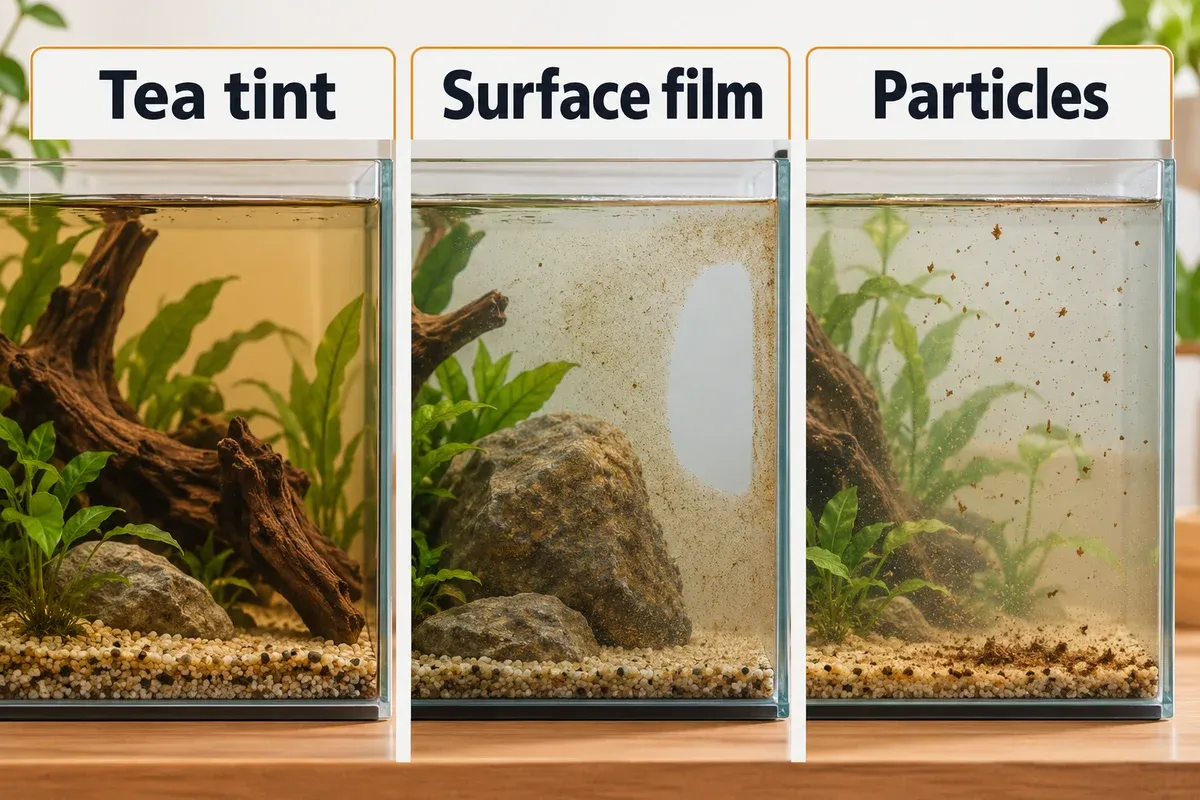
Brown aquarium water is not one diagnosis. A transparent tea-colored tint usually comes from tannins leaching from wood or leaves. A dusty brown coating on the glass, plants, or substrate is more likely diatoms. Brown particles that swirl, settle, or smell bad point toward dirt, mulm, or decaying organic matter.
Quick answer: Look at the water itself before you reach for a treatment. If the water is uniformly amber and the tank contains new driftwood, tannins are the leading explanation and may be harmless. If the brown is attached to surfaces, wipe a small patch: a soft, dusty film suggests diatoms. If the water contains visible particles or the fish are stressed, remove the source, test ammonia and nitrite, and clean the mechanical waste before polishing the color.
This guide stays focused on brown discoloration and brown deposits. If your water is milky white, gray, yellow, or green without a clear brown pattern, use our broader guide to cloudy aquarium water causes instead.
Start With the Brown-Water Triage
Use the appearance, timing, and texture together. Color alone is not a water-quality test, and two causes can happen at the same time—for example, new driftwood can release tannins while a new substrate develops a diatom film.
| What you see | Most likely cause | Useful clue | First response |
|---|---|---|---|
| Clear water with an even amber or tea tint | Driftwood, leaf litter, or peat tannins | Started after adding natural material; no visible particles | Decide whether you want to keep the blackwater tint; otherwise remove the source, change water normally, and use carbon or Purigen |
| Brown dust on glass, leaves, rocks, or substrate | Diatoms, often called brown algae | Wipes off easily and returns as a thin film; water may remain clear | Wipe or siphon it out, keep light and feeding consistent, and give a new tank time to mature |
| Muddy water with specks, sediment, or a cloud after maintenance | Substrate dust, mulm, or filter debris | Appeared after aquascaping, gravel cleaning, feeding, or filter work; particles settle | Remove obvious waste, vacuum the affected area, and service the mechanical media |
| Brown water plus foul odor, foam, gasping, or lethargy | Decay or a water-quality problem | Dead livestock, rotting plants, uneaten food, or a blocked filter may be present | Test immediately, increase gas exchange, remove decay, and make a measured partial water change with conditioned water |
The comparison below separates three common brown appearances before you choose a clearing method.
A Five-Minute Check Before You Change Anything
- Put a white card behind the tank. A uniform amber tint looks transparent against white. Suspended dirt produces specks or a hazy, uneven layer.
- Wipe one small area of glass or a leaf. If a rust-colored powder comes off the surface, you are looking at a deposit rather than dissolved color. Do not use this test on delicate leaves with a rough scraper.
- Look at the bottom and the filter intake. Brown piles around the intake, under hardscape, or in a clogged prefilter are clues for mulm and trapped waste.
- Check what changed. Note new driftwood, catappa leaves, aqua soil, sand, a deep gravel clean, a filter rinse, a new food, or a dead plant. The timing is often more useful than the shade of brown.
- Test the water if livestock is present. Check ammonia and nitrite first, then nitrate, pH, and temperature. The API Freshwater Master Test Kit is designed to measure pH, high-range pH, ammonia, nitrite, and nitrate; API lists those parameters on its official product page. A clear or brown tank can still have unsafe chemistry.
Brown Water From Tannins
What tannin water looks like
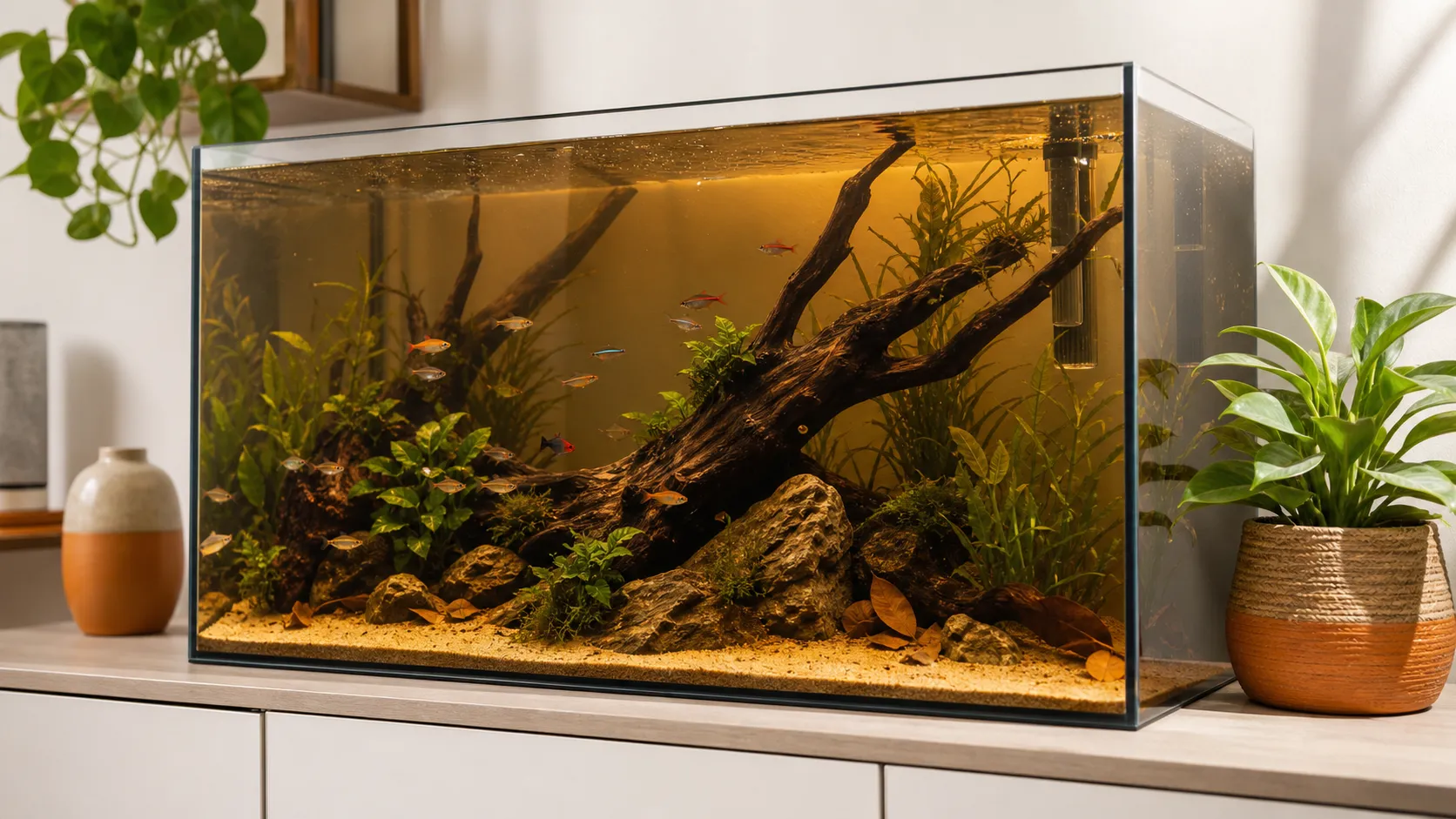
Tannin-rich water is usually transparent but yellow, amber, or tea-brown. You can still see through the tank, and the color is strongest when you look through the longest dimension of the aquarium. It often appears after adding driftwood, catappa leaves, peat, cones, or other botanical material.
Natural blackwater aquariums intentionally use this look. Tannins and related humic compounds can make the water softer or more acidic in some setups, although the change depends on the material, the amount, and the aquarium’s buffering capacity. A blackwater fish may be perfectly comfortable in a tint that looks alarming to someone expecting crystal-clear water.
Aqueon describes brown-tinted water from driftwood as common and notes that tannins can benefit fish and plants from natural blackwater regions. That does not mean every brown tank is safe: decaying food, a dead fish, or a collapsing plant can create a similar color while also degrading water quality.
How to reduce unwanted tannins
If the tint is intentional, you do not have to remove it. Keep the wood stable, monitor pH and hardness if those parameters matter for your livestock, and avoid sudden chemistry changes. The color is an aesthetic choice only when the rest of the aquarium is healthy.
If you want clearer water, use a gradual sequence:
- Inspect the wood and botanicals. Remove loose, rotting material. Do not remove every leaf from a blackwater setup just because it looks brown; remove it when the livestock plan or water chemistry calls for it.
- Pre-soak suitable aquarium wood before adding it. Boiling or soaking can reduce the first release of color, but large pieces may continue to leach tannins for weeks or months. Use only wood sold or prepared for aquariums; unknown outdoor wood can carry pesticides, sap, or contaminants.
- Make normal, temperature-matched partial water changes. Water changes dilute tannins, but a large reset may only create temporary clarity if the wood is still releasing them.
- Add one targeted chemical medium if needed. Activated carbon is a conventional option. Purigen is a reusable synthetic organic-scavenging resin that Seachem says absorbs organics such as tannins and polishes water. Place either medium where water flows through it, and follow the label.
- Remove chemical media during medication when the medication label requires it. Carbon and organic-resin media can remove treatments. A clear tank is not worth undermining a necessary course of medication.
Do not use a pH buffer just to make brown water look clear. Treating the color and changing pH at the same time can create a more stressful swing than the original tint.
Brown Diatoms: A Film, Not Brown Water
How to recognize diatoms
Brown diatoms are a soft, dusty film that coats surfaces. The glass may look lightly rusted, the sand may have a cinnamon-colored layer, and slow-growing plant leaves or rocks may look dirty. A finger, algae pad, or gentle siphon usually removes a patch easily.
The water itself can remain clear. If the film is disturbed, some of it may float temporarily and make the tank look brown, but the source is still attached growth. Diatoms are single-celled algae with silica-based cell walls; the US EPA describes diatoms as photosynthetic organisms with silica cell walls. In aquariums, the dusty brown phase is especially common in new setups and when silicate or phosphate is available.
Aquarium Co-Op’s brown-diatom FAQ notes the typical dusty appearance, the connection with new planted tanks, and the role of phosphates and silicates. That is a useful match for a brown film, but it is not proof that every brown surface deposit has the same cause.
How to clear a diatom film
- Wipe the glass and hardscape. Use an aquarium-safe pad or scraper that matches the surface. Never use household cleaners, soap, or a razor on acrylic.
- Siphon the substrate lightly. Vacuum the brown layer without repeatedly turning the whole bed over. Aquarium Co-Op recommends a siphon for brown diatoms on substrate.
- Keep the light schedule stable. Do not respond with a dramatic blackout every time a new tank gets a dusty film. Shorten excessive lighting or block direct sun, but keep planted tanks supplied with enough light for the plants.
- Review feeding and decay. Extra food and dead plant material add nutrients that can support more than just diatoms. Feed what the livestock can finish and remove obvious decay.
- Give new tanks time. As plants establish and the aquarium’s nutrient balance changes, diatoms often become less dominant. Adding an algae-eating animal is not a substitute for species-appropriate stocking, water volume, and mature filtration.
If the brown film keeps returning in an established tank, compare tank water with source water and consider testing phosphate and, where relevant, silicate. Do not chase a perfectly zero nutrient reading in a planted aquarium without considering plant health.
Brown Dirt, Mulm, and Decaying Organic Matter
What the water looks like
Particulate brown water is usually uneven. You may see tiny flecks in the water column, a cloud after moving the substrate, or brown sediment settling on leaves and the bottom. The filter pad may be coated in sludge. A small amount of mulm is normal in many aquariums, but a sudden load of trapped food, feces, dead plant material, or a hidden dead fish can create a real water-quality problem.
Aquarium Co-Op describes mulm as decomposed organic material and warns that large amounts of uneaten food or other organics should be removed with a gravel vacuum. Use that distinction: brown sediment is not automatically dangerous, but the source of a new or excessive load matters.
The safe cleanup order
- Find the source. Check behind decorations, under wood, inside dense plants, around the intake, and in the filter chamber. Remove only material that is clearly dead, spoiled, or out of place.
- Vacuum the dirty zone. A gravel vacuum removes settled waste while leaving most of the substrate in place. Work in sections rather than stripping a planted or biologically active bed all at once.
- Service mechanical media. Rinse a sponge or fine pad in water removed from the aquarium so you do not expose the biological media to untreated tap water. Replace a disposable polishing layer when it is clogged, but do not replace every filter cartridge at the same time.
- Restore circulation and oxygen. Confirm that the intake, impeller, and return are not blocked. Increase surface agitation if fish are breathing rapidly or the water is heavily loaded with organic waste.
- Test and change water based on evidence. If ammonia or nitrite is detectable, fish are stressed, or the water smells foul, use conditioned, temperature-matched replacement water and retest. Do not wait for the brown color to disappear before protecting the livestock.
If the debris appeared after canister maintenance, our guide to cleaning a canister filter without crashing the cycle covers the media-cleaning sequence in more detail.
The Python No Spill Clean and Fill system can make repeated gravel vacuuming and partial water changes easier when the tank is near a compatible faucet. It is a maintenance tool, not a reason to drain a tank completely.
When Brown Water Is an Emergency
Brown color by itself does not tell you whether fish are safe. Treat it as urgent when it appears with gasping, rapid gill movement, lethargy, loss of balance, clamped fins, surface hanging, a rotten smell, or a sudden filter failure.
Test ammonia and nitrite immediately. If either is detectable, protect the fish with increased gas exchange, remove the source of decay, and make a measured partial water change with conditioned water at a suitable temperature. Continue testing rather than assuming the color has been fixed. If a fish is dead or visibly decomposing, remove it promptly; carbon or Purigen cannot undo the source of the waste.
Avoid a blind medication or algaecide dose. A chemical can change the appearance while adding risk to plants, shrimp, snails, or the biofilter. If your main symptom is green water, use the separate guide to green aquarium water, algae blooms, and lighting; brown diatom film and suspended green algae need different responses.
Product Help: Match the Tool to the Cause
The products are not interchangeable: test first, use carbon or resin for dissolved color, and use a gravel vacuum for physical waste.
Targeted tools for brown aquarium water and deposits
-
API Freshwater Master Test Kit
API
Liquid reagent kit for checking pH, ammonia, nitrite, and nitrate—the measurements that tell you whether a new tank is actually ready for fish.
- Tests the core nitrogen-cycle parameters
- Liquid color comparison is more useful for cycling than guessing from clear water
- Useful after stocking, filter changes, or unexplained fish stress
- Best for
- Fishless cycling and diagnosing water problems
-
Seachem Purigen 100 ml
Seachem
Reusable synthetic organic-scavenging resin for freshwater or marine filters; a targeted option when driftwood or botanicals make the water tea-colored.
- Seachem says it absorbs organics such as tannins
- 100 ml size is a low-cost starting point for a typical aquarium
- Darkens as it exhausts and can be regenerated according to the label
- Best for
- Reducing unwanted tannin color and dissolved organic waste
-
Seachem MatrixCarbon 100 ml
Seachem
Spherical activated carbon for aquarium filtration; a broad, simple chemical-media option when dissolved color is unwanted and medication is not being run.
- Seachem describes a spherical bead format designed for water contact
- Low-ash formulation is marketed for limited pH impact
- 100 ml size keeps the initial cost modest
- Best for
- Conventional activated-carbon removal of tannin color and some odors
-
Python No Spill Clean and Fill 25-Foot System
Python
25-foot gravel-cleaning and water-changing system that can reduce bucket carrying for routine maintenance.
- Combines gravel vacuuming and water changes in one system
- 25-foot hose works for many rooms and nearby sinks
- Makes weekly water changes easier to repeat consistently
- Best for
- Less-messy water changes when a faucet is nearby
Review the linked product page before purchasing.
API Freshwater Master Test Kit — Best First Step When the Cause Is Unclear
Brown water is a visual symptom. This liquid-reagent kit checks pH, high-range pH, ammonia, nitrite, and nitrate, which helps separate harmless tannin color from a tank carrying too much waste. It is especially useful after a filter disturbance, a new setup, a dead fish, or a sudden change in fish behavior.
Check current price on Amazon →Why it earns a place here:
- It checks invisible risk. Brown water can look natural while ammonia or nitrite is still unsafe.
- The format is reusable. Liquid reagents and a color chart are practical for cycling and repeated troubleshooting.
Limitations: It does not measure tannins, diatoms, silicate, or phosphate, and it does not fix a dirty tank. Read the instructions carefully, especially for shaking and wait times, and compare colors in consistent light.
Seachem Purigen 100 ml — Best for Unwanted Tannin Color
Purigen is a synthetic organic-scavenging resin rather than activated carbon. Seachem says it absorbs organics such as tannins, darkens as it exhausts, and can be regenerated. That makes it a good fit when the tank has an amber tint from driftwood or botanicals and you want to reduce color without treating the aquarium as if it were full of suspended dirt.
Check current price on Amazon →Use the resin in a fine mesh bag with strong water flow through the media. Start with the amount appropriate for your water volume and follow the product directions. If the color returns quickly, the wood is still releasing tannins; replacing exhausted media without addressing the source becomes an expensive loop.
Pros:
- Targets dissolved organic color and can be regenerated according to the manufacturer instructions
- Small 100 ml size is inexpensive for a typical freshwater aquarium
Cons:
- It will not vacuum mulm, remove a diatom film, or replace water testing
- Regeneration requires careful rinsing and dechlorination; never return media that still smells of bleach
- It may exhaust faster when a large piece of wood or decaying material keeps releasing organics
Seachem MatrixCarbon 100 ml — Best Conventional Activated Carbon Option
MatrixCarbon is an activated carbon in a spherical bead format. Seachem describes it as low-ash carbon with high capacity and minimal pH impact compared with many carbons; those are manufacturer claims, so treat them as product specifications rather than independent test results. It is a straightforward choice when you want to reduce tannin color, odor, or medication residue and do not need the more selective behavior of a resin.
Check current price on Amazon →Rinse carbon before use and place it where water passes through it. Remove it when a medication label tells you to, and do not run it as a substitute for removing rotting food or dead livestock.
Pros:
- Conventional, easy-to-understand medium for dissolved color and some odors
- The 100 ml size keeps the first purchase relatively low-cost
- Spherical media is designed to reduce packing and improve water contact
Cons:
- Activated carbon is broad-spectrum and may remove medications or some supplements
- It does not solve diatom growth, suspended substrate dust, or a decaying organic source
- Carbon needs replacement or reactivation according to the product instructions
Python No Spill Clean and Fill 25-Foot System — Best for Brown Sediment and Mulm
This is a gravel-cleaning and water-changing system rather than a filter medium. The 25-foot version includes a hose, gravel tube, switch, connectors, faucet pump, and brass faucet adapter according to the product documentation. It makes localized substrate cleaning and regular partial water changes easier when a suitable faucet is nearby.
Check current price on Amazon →That is a strong practical signal, but the system is not ideal for every room or nano tank: measure the distance to the faucet, and use conditioned, temperature-matched water rather than sending untreated tap water straight into a tank with livestock.
Pros:
- Removes brown sediment and mulm at the source instead of masking it with chemical media
- Combines gravel vacuuming with draining and refilling
Cons:
- Higher upfront cost than a basic hand siphon
- Requires a compatible faucet and enough hose length
- A fast water change can still disturb sand, plants, or fish if the tube is used aggressively
Three Short Clearing Plans
If the water is tea-colored
Keep the tint if it suits the livestock. If not, remove or pre-soak the source, make normal partial water changes, and choose either Purigen or activated carbon. Check pH and hardness when the species is sensitive to chemistry changes, and do not expect one media bag to stop a piece of wood that is still leaching.
If the brown is a surface film
Wipe the glass and hardscape, siphon the substrate lightly, and keep the light and feeding schedule consistent. Let a new tank mature rather than adding an unplanned cleanup animal. If the film returns for weeks in an established aquarium, compare source and tank water and investigate phosphate, silicate, flow, and decay.
If the water contains particles
Remove dead or uneaten material, vacuum the affected zone, and clean the mechanical filter layer in removed aquarium water. Test ammonia and nitrite, then make a measured partial water change if the readings, odor, or fish behavior call for it. Use chemical media only after the physical source is under control.
Prevent Brown Water From Returning
- Prepare new wood and botanicals. Rinse and soak aquarium-safe materials, and expect some continued leaching from large pieces.
- Rinse new substrate carefully. Follow the substrate maker’s instructions; active soils are not meant to be aggressively washed like inert gravel.
- Feed with a measurable portion. Uneaten food becomes a brown-water problem quickly in a small or newly stocked tank.
- Keep mechanical and biological maintenance separate. Clean the dirty sponge or floss when flow drops, but protect mature biological media from untreated tap water and avoid replacing every layer at once.
- Keep a simple log. Record water changes, new materials, filter work, feeding, lighting, and test results. The next brown tint is easier to diagnose when you know what changed.
- Use source control before polish. Carbon, resin, and fine filter media are useful tools; none of them replaces removing a dead fish, rotting plant, or trapped food.
If this is a new setup, the beginner aquarium checklist is a useful companion for planning substrate, filtration, testing, and maintenance before adding livestock.
Frequently Asked Questions
Is brown aquarium water dangerous for fish?
Not necessarily. Transparent tannin water can be compatible with healthy blackwater livestock, and a brown diatom film is usually a cosmetic or maintenance issue. Brown water becomes more concerning when it comes with foul odor, visible decay, gasping, lethargy, or detectable ammonia or nitrite. Test the water and watch the fish instead of judging safety by color.
Why did my aquarium turn brown after I added driftwood?
The wood is probably releasing tannins or other dissolved organic color. This is common, especially with a large or newly soaked piece. Keep it if the look and water chemistry suit the aquarium, or reduce the tint with soaking, normal partial water changes, activated carbon, or Purigen. If the water is muddy rather than transparent, inspect the wood and substrate for loose debris as well.
Are brown algae and tannins the same thing?
No. Tannins dissolve into the water and create an even tea tint. Brown diatoms grow on surfaces as a dusty film and wipe away. A tank can have both at once, so check the water and the glass separately.
Will water changes remove tannins permanently?
They dilute tannins but may not remove the source. If wood or leaves continue to leach, the color can return after every change. Pre-soaking, removing the source, and using a suitable chemical medium can speed the visual change, but gradual progress is normal.
Does activated carbon remove brown aquarium water?
It can reduce dissolved color from tannins and some odors. It will not remove brown diatom film or settled mulm, and it can remove medications. Use it after identifying the cause, place it in a high-flow media path, and follow the product directions.
Should I add a pleco, snail, or shrimp for brown diatoms?
Do not add an animal solely to solve a color problem. A cleanup animal must match the tank’s size, temperature, water chemistry, adult size, diet, and existing livestock. Manual wiping, substrate siphoning, stable light, and time are safer first steps.
Does brown water mean my aquarium has ammonia?
No. Tannins can make healthy water brown, while ammonia can be present in water that looks perfectly clear. Test ammonia and nitrite whenever the color appears with decay, a filter interruption, new livestock, or unusual fish behavior.
Final Verdict: Identify the Brown Before You Treat It
Brown aquarium water is easiest to solve when you ask what is brown: the water, the surfaces, or the particles moving through it.
Tea-colored and transparent: think tannins from driftwood or botanicals. Keep the tint if it fits the aquarium, or use normal water changes plus carbon or Purigen to reduce it.
Dusty brown on surfaces: think diatoms. Wipe, siphon, review light and nutrients, and give a new tank time to mature.
Muddy, particle-filled, or foul-smelling: think dirt, mulm, or decay. Remove the source, vacuum and service mechanical filtration, test ammonia and nitrite, and protect the fish first.
The right product is the one that matches the physical cause. A test kit tells you whether the water is safe, a carbon or resin medium can polish dissolved color, and a gravel vacuum removes brown waste that no chemical bag can fix.
Sources and Further Reading
- Aqueon: Maintaining a Planted Aquarium
- Aqueon: How to Fix Cloudy Water in a New and Existing Tank
- Aquarium Co-Op: How to Get Rid of Brown Diatom Algae
- Aquarium Co-Op: Top Ways to Clean Algae From a Fish Tank
- Aquarium Co-Op: What Is Mulm and Should You Remove It?
- US EPA: Sediment Diatoms
- Seachem: Purigen
- Seachem: MatrixCarbon
- API Fishcare: Freshwater Master Test Kit
- Python No Spill Clean & Fill product details