

 Published sources
 Product details checked
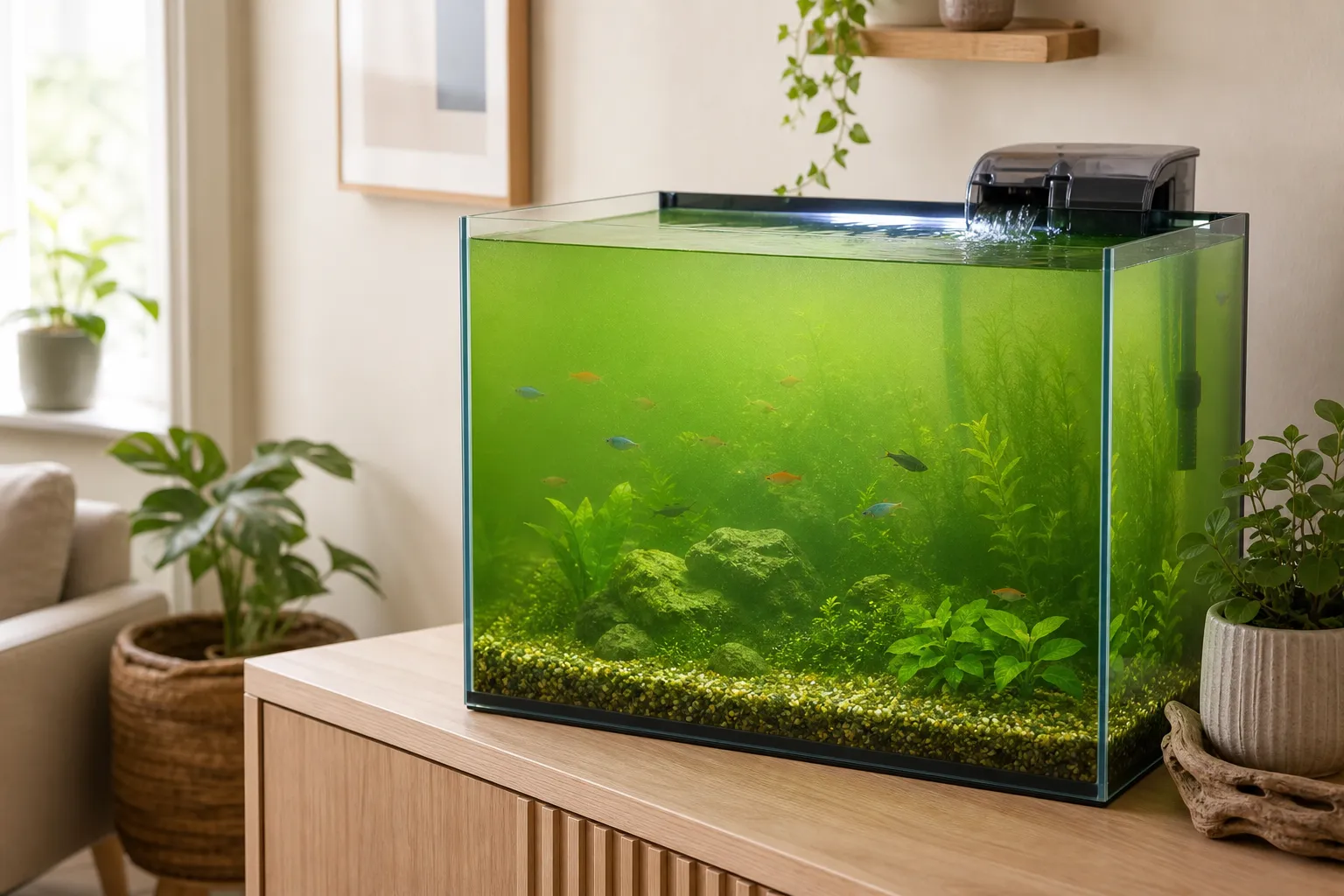
Green aquarium water is usually not a dirty filter or a white bacterial bloom. It is a rapid increase in microscopic, free-floating algae that turns the entire water column green, often with a pea-soup appearance. The usual combination is usable light plus available nutrients, sometimes after direct sunlight, overfeeding, a fertilizer mistake, or an ammonia spike in a new tank.
Quick answer: First confirm that the water itself is green rather than the glass or décor. Test ammonia and nitrite for fish safety, then check nitrate, phosphate, the light schedule, direct sun, feeding, fertilizer, and decaying material. A short light reduction or blackout can slow the bloom, but a correctly sized UV clarifier is usually the fastest way to make persistent green water clear. It treats the free-floating algae; it does not remove the reason the bloom started.
This page is intentionally narrower than our general cloudy aquarium water guide. It covers green water only. If the water is milky white, gray, yellow, brown, or merely dusty after maintenance, use the symptom-specific diagnosis in that broader guide instead.
The distinction is supported by Aqueon’s green-water guide, which describes green water as suspended algae that multiply in the water column, and Aquarium Co-Op’s green-water FAQ, which separates free-floating phytoplankton from algae growing on surfaces.
In this guide, you will learn:
- How to confirm a suspended algae bloom instead of confusing it with film algae, cyanobacteria, or a bacterial bloom
- Why light, nitrate, phosphate, fish waste, fertilizer, tap water, and new-tank instability can combine to make water green
- Which water tests matter first and why a zero-looking nitrate result does not prove nutrients are absent
- A safe 48- to 72-hour response plan, including when a blackout or UV clarifier makes sense
- How to choose between an internal UV pump and an inline clarifier without buying a stronger filter blindly
- Which optional products are useful for diagnosis or targeted cleanup, and what each one cannot do
Is It Really Green Water?
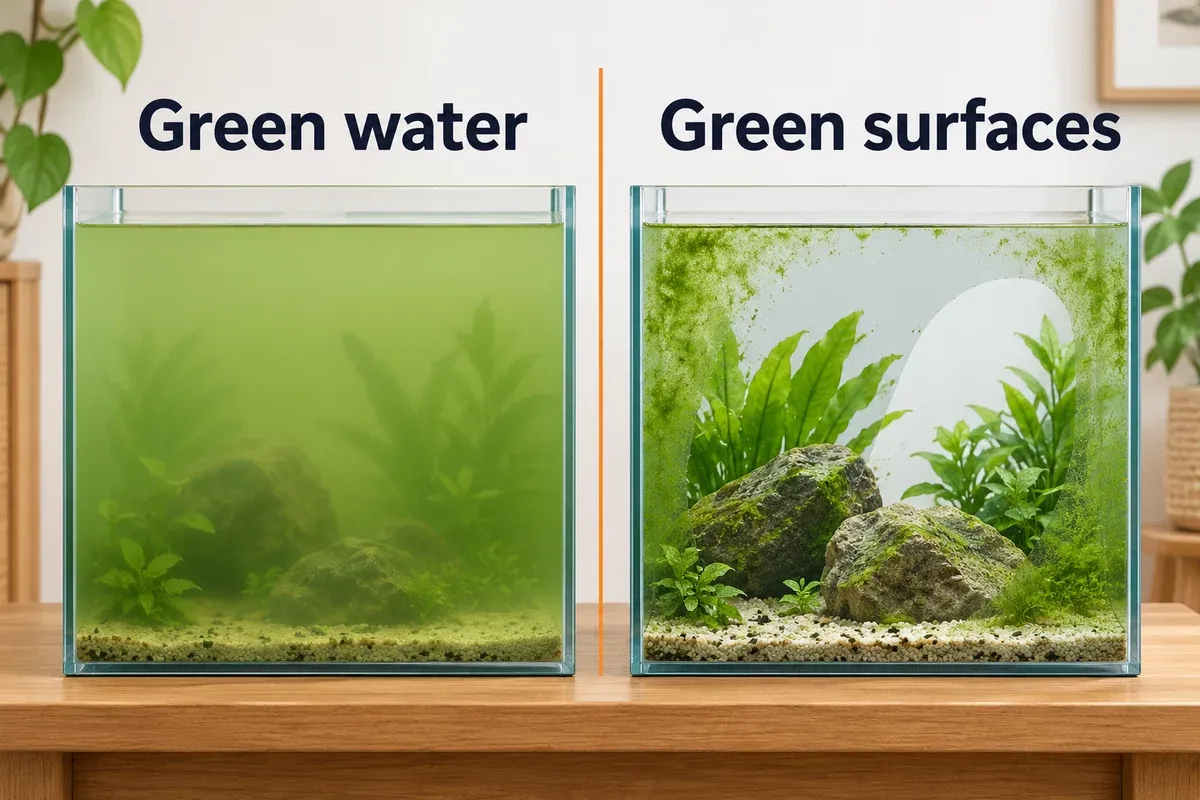
Before changing anything, look at the aquarium in daylight and compare the water column with the glass, substrate, and décor. The key question is whether the green color is suspended throughout the water or attached to a surface.
| What you see | Most likely explanation | What to do first |
|---|---|---|
| The whole tank looks evenly pea-green and fish are hard to see from the front or side | Free-floating algae, commonly called green water | Test ammonia and nitrite, reduce light, and inspect nutrient inputs |
| Water is clear but the glass, rocks, or décor have a green film or spots | Attached green algae | Scrape or brush the surfaces and review the light schedule; this is not the same problem |
| Dark green or blue-green sheets, slime, bubbles, or a strong odor | Possible cyanobacteria rather than a simple green-water bloom | Remove affected material, increase observation, and identify the growth before dosing anything |
| Water is milky white or gray, especially after a new setup | Bacterial bloom or suspended particles | Use the cloudy-water diagnosis and test ammonia and nitrite |
| Water is tea-colored, yellow, or brown | Tannins, dissolved organics, or decaying material | Check wood, leaves, livestock, and source water rather than treating it as green water |
The color alone does not tell you whether the aquarium is safe. A green-water bloom may be mostly cosmetic in a stable, well-oxygenated tank, but the same tank can also have detectable ammonia or nitrite, a hidden dead fish, or an overloaded filter. If fish are gasping, breathing rapidly, losing balance, or clustering at the surface, increase surface agitation and test immediately. Do not wait for the water to clear before protecting the fish.
The comparison below shows where the green color sits: throughout the water or on a surface.
What Causes Green Aquarium Water?
Green water appears when free-floating algae can multiply faster than grazing, filtration, plants, and maintenance remove them. There is rarely one single cause. More often, a change in light or nutrients gives the algae an opening, and the bloom then hides the original trigger.
1. Too Much Light, Too Long a Photoperiod, or Direct Sun
Algae use light to grow. A tank near a sunny window can receive several extra hours of usable light even when the aquarium LED is switched off. A new fixture, a higher brightness setting, or a photoperiod that quietly increased from six to ten hours can be enough to tip the balance when nutrients are already available.
Aqueon notes that direct sunlight, long light periods, and a fixture that is too strong for the aquarium can drive green-water outbreaks. It also recommends a timer for a consistent day/night cycle. The important point is not that every tank needs the same number of hours; it is that the light schedule should be deliberate and repeatable.
For a fish-only aquarium, the light is usually for viewing, not for growing demanding plants. A planted tank needs enough light for its plants, but more light is not automatically better. If plant growth, CO₂, fertilization, and light are not balanced, the free-floating algae can use the surplus first.
2. Nitrate, Phosphate, or Organic Waste Is Available
Fish food, fish waste, dead leaves, dead livestock, and decaying debris all add organic material. As that material breaks down, it can contribute nitrogen and phosphorus compounds that algae can use. Tap water can also contain nitrate or phosphate, so a water change may add to the problem if the source water is already nutrient-rich.
Review what changed during the previous week: feeding amounts, stocking, fertilizer dose, filter maintenance, plant pruning, a new substrate, or a different water source.
Phosphate is not a contaminant that should be driven to zero in every aquarium. Plants and corals need nutrients, and a planted or reef system has different operating goals from a lightly stocked fish-only tank. Use a phosphate test to find an unusual input or trend, not as permission to strip the water without a plan.
3. A New Tank or Ammonia Spike Fed the Bloom
New aquariums can develop green water while the biological filter is still stabilizing. Overfeeding, adding too many fish at once, a filter that was left off, or a large media replacement can create an ammonia spike or an organic surge. The algae may respond to that instability even when the tank looks otherwise clean.
This is why ammonia and nitrite come before phosphate products or UV equipment. If either is detectable in a stocked aquarium, protect the fish with conditioned, temperature-matched replacement water, good gas exchange, restrained feeding, and repeated testing. Do not replace all filter media simply because the water is green; mature surfaces hold the bacteria the aquarium needs.
4. Plant Mass or Nutrient Competition Changed
Green water often appears after a planted tank loses fast-growing plants, floating plants, or dense stems. Pruning, melting plants, a failed CO₂ system, or a fertilizer change can leave the algae with more light and nutrients than before. The same can happen when a fish-only tank is moved into a brighter room.
Plants are helpful competition, not a guaranteed cure. Do not add a large amount of fertilizer to “help the plants beat the algae” during an active bloom. Stabilize the light and test the water first. If the plants are healthy and compatible with the livestock, floating cover can reduce light penetration, but it should not block gas exchange or cover the entire surface.
5. Maintenance Changes Masked the Source
Large water changes can make a tank look better briefly, but they may not remove enough microscopic algae to outpace regrowth. If the replacement water carries nitrate or phosphate, the bloom can return immediately. A new filter cartridge can also remove some debris while doing nothing about the light or nutrient source.
The goal is not to make the aquarium sterile. Keep the filter running, preserve established biological media, remove obvious decay, and record the tank’s light and feeding pattern. Green water that returns after every water change points toward a recurring input, not a need for increasingly large water changes.
The Water-Testing Plan: Ammonia, Nitrite, Nitrate, and Phosphate
Use tests to answer separate questions instead of searching for one magic number.
| Check | Why it matters during green water | How to interpret it |
|---|---|---|
| Ammonia | Detects a direct fish-safety problem from cycling, waste, or a dead animal | In an established stocked aquarium, any detectable result deserves action and a retest; do not use clear-looking water as proof of safety |
| Nitrite | Shows that the nitrogen cycle is not processing waste normally | A detectable result can impair fish respiration; increase monitoring and make a measured water change when needed |
| Nitrate | Helps reveal waste accumulation or a nutrient-rich source | Use the trend and compare tank water with tap or premixed water; algae can consume nitrate quickly |
| Phosphate | Helps identify fertilizer, food, waste, or source-water input that may support algae | A result is a clue, not a universal freshwater or reef target; correct the source before choosing media |
The API Freshwater Master Test Kit measures pH, high-range pH, ammonia, nitrite, and nitrate with liquid reagents. That makes it the practical first test for a freshwater tank when the color change is unexplained. It does not measure phosphate, so persistent green water may require a separate phosphate test.
The API Phosphate Test Kit is designed for freshwater and saltwater and reads phosphate from 0 to 10 ppm. Test the aquarium and the source water if the bloom returns after water changes. If you keep a planted tank or reef, interpret the number with the system’s plant or coral goals rather than chasing a zero reading.
A Safe 48- to 72-Hour Response Plan
The fastest route to clear water is a combination of safety checks, light control, source correction, and—when needed—targeted UV. Follow the steps in this order.
1. Watch the fish and increase gas exchange if needed
Check breathing, swimming, appetite, and surface behavior. A dense bloom can reduce visibility and, like other photosynthetic organisms, can change oxygen demand across the light cycle. If fish are gasping, add surface agitation or an air stone and test ammonia and nitrite immediately.
Do not diagnose fish safety from a pH or nitrate result alone. If the fish look distressed, prioritize oxygenation and water chemistry over the cosmetic color.
2. Stop the extra light
Move the aquarium out of direct sun if possible. Otherwise, block the window during the hours when sunlight hits the tank. Put the aquarium light on a timer and shorten the schedule while you diagnose the bloom.
A temporary blackout can work when the fish are stable and the plants can tolerate it. Options range from several days with the aquarium covered to a shorter period of lights-off treatment followed by a reduced schedule. Aqueon describes a few-day blackout, while Aquarium Co-Op describes a longer blackout as an option. The safe choice depends on the livestock, plant density, and severity of the bloom; do not cover the tank so tightly that gas exchange is compromised.
After the blackout, do not return immediately to the old photoperiod. Resume at a shorter, consistent schedule and change only one lighting variable at a time so you can see what helps.
3. Remove the obvious nutrient sources
Look for uneaten food, a dead fish or snail, rotting leaves, clogged intake areas, and waste trapped in the substrate. Pause new livestock additions. Feed lightly rather than repeatedly adding food that the tank cannot process, and pause or reduce fertilizer until you know what the plants and tests require.
Do not tear down the aquarium or sterilize every surface. Rinse reusable mechanical media in removed aquarium water and preserve mature biological media. A green-water bloom is a water-column problem; destroying the biofilter can create a second, more dangerous problem.
4. Test both the aquarium and the source water
Record ammonia, nitrite, nitrate, phosphate if available, pH, temperature, and the time of the last water change. If the aquarium tests lower than expected after a bloom, compare the result with tap water or premixed saltwater before assuming the nutrients are absent.
Make a measured partial water change when ammonia, nitrite, fish behavior, odor, or visible waste calls for it. Do not rely on repeated large changes as the sole green-water treatment; free-floating algae can multiply faster than a water change removes them.
5. Use UV when visibility or persistence makes it worthwhile
UV works well for green water because the algae pass through the UV chamber. The light damages the cells so they cannot continue reproducing, while most beneficial nitrifying bacteria remain attached to filter media and tank surfaces. Aquarium Co-Op explains this water-column distinction.
Run the UV according to the manufacturer’s flow, installation, and operating instructions. An inline unit is normally placed in the return path of a compatible canister filter; an internal unit contains its own pump and sits in the aquarium. If the tank contains medication, check the medication instructions before running UV because UV can reduce the effectiveness of some treatments. Fluval specifically advises switching its UVC clarifier off during medication.
6. Remove the dead biomass and monitor the cycle
When the water changes from green to clearer or darker, some of the dead algae will be captured by mechanical media or settle into the tank. Service the mechanical layer before it clogs, siphon visible debris during a normal water change, and keep testing ammonia and nitrite while the tank recovers.
UV can make the glass look clear while the underlying nutrient input remains. Keep the shorter light schedule and corrected feeding or fertilizer routine in place for at least the next week.
Blackout, UV, or Source Correction?
The right response depends on the problem you are trying to solve.
| Situation | Best first choice | Why |
|---|---|---|
| First bloom after a sunny-window or lighting change, fish are stable | Block direct sun and shorten the photoperiod | Removes the trigger without adding equipment |
| Plants can tolerate it and you need a temporary non-equipment option | Short, carefully monitored blackout | Can suppress the active bloom, but does not correct nutrients or light afterward |
| Water is opaque green and you need it clear quickly | Correctly sized UV clarifier plus source control | Targets free-floating algae directly and preserves visibility |
| Bloom returns after water changes | Test tank and source water for nitrate and phosphate | The replacement water or an uncorrected input may be feeding the recurrence |
| Water is clear but surfaces are green | Scrape, brush, prune, and adjust lighting | UV treats water-column organisms, not attached algae on décor or glass |
| Ammonia or nitrite is detectable | Water-quality response first | A UV unit cannot detoxify the water or replace a functioning biofilter |
Product Help: What Is Worth Buying?
Tools for diagnosing and clearing green aquarium water
-
API Freshwater Master Test Kit
API
Liquid reagent kit for checking pH, ammonia, nitrite, and nitrate—the measurements that tell you whether a new tank is actually ready for fish.
- Tests the core nitrogen-cycle parameters
- Liquid color comparison is more useful for cycling than guessing from clear water
- Useful after stocking, filter changes, or unexplained fish stress
- Best for
- Fishless cycling and diagnosing water problems
-
API Phosphate Test Kit
API
Liquid phosphate test for freshwater and saltwater aquariums that reads 0–10 ppm and helps identify a nutrient source that can support green-water blooms.
- 150-test liquid reagent kit
- Reads phosphate from 0–10 ppm
- Freshwater and saltwater compatible
- Best for
- Checking phosphate when green water keeps returning
-
Fluval UVC In-Line Clarifier
Fluval
3W UVC inline clarifier for compatible 5/8-inch canister hoses; Fluval rates the A203 unit for aquariums up to 100 US gallons and includes a timer.
- 3W UVC clarifier with a 4–24 hour timer
- For 5/8-inch / 16 mm hose setups
- Fluval lists compatibility with 107/207/307/407 canister filters
- Best for
- Canister-filter owners who need a compact inline UV option
-
COODIA Internal Green Water Killer UV Pump
COODIA
Submersible internal UV pump with a built-in 5W water pump; the product documentation claims green-water clearing for freshwater or saltwater tanks up to 75 gallons.
- Built-in 5W pump and submersible placement
- intended for freshwater and saltwater aquariums
- product documentation claims up to 75-gallon coverage
- Best for
- Tanks without a canister filter that need a temporary internal UV unit
Review the linked product page before purchasing.
API Freshwater Master Test Kit – Best First Diagnostic
The API Freshwater Master Test Kit is the most useful first purchase when you cannot tell whether green water is only cosmetic or part of a cycling problem. It checks pH, high-range pH, ammonia, nitrite, and nitrate with liquid reagents, so it covers the fish-safety checks that a green-water photo cannot answer.
Check current price on Amazon →Why it fits this problem:
- It separates a green-water bloom from an ammonia or nitrite emergency
- Liquid tests are practical for comparing the aquarium with source water over several days
Limits:
- It does not measure phosphate, so recurring algae may need a separate test
- Results depend on following the bottle shaking, timing, and color-matching instructions
- It cannot remove algae or correct an excessive light schedule
Bottom line: Buy this before a UV unit if you do not already have a reliable way to test ammonia and nitrite. A clear tank is not proof that the cycle is stable.
API Phosphate Test Kit – For Recurring Nutrient Questions
The API Phosphate Test Kit is useful when the bloom keeps returning after you reduce light and correct obvious waste. It reads phosphate from 0 to 10 ppm in freshwater and saltwater, and the manufacturer specifically lists fish waste, decaying organic matter, and uneaten food as possible phosphate sources that can contribute to green-water blooms.
Check current price on Amazon →Why it fits this problem:
- It tests a nutrient that the master kit does not cover
- The 150-test format is practical when you want to compare aquarium water and tap water
- It helps identify a recurring input before you buy phosphate-removing media
Limits:
- There is no single phosphate number that is correct for every planted, freshwater, or reef system
- A result can be low because algae already consumed the available phosphate
- Testing cannot tell you whether the real source is food, fertilizer, waste, or the water supply without a comparison sample
Bottom line: Use it to investigate a pattern, not to chase zero phosphate blindly. Correct the input and keep enough nutrients for the plants or corals you intentionally keep.
Fluval UVC In-Line Clarifier – For Compatible Canister Filters
The Fluval UVC In-Line Clarifier is the cleaner installation when you already run a compatible canister filter and want the UV unit hidden in the cabinet. Fluval lists the 3W model for 107, 207, 307, and 407 canister filters and aquariums up to 100 US gallons, with 5/8-inch (16 mm) hose connections and a 4–24 hour timer.
Check current price on Amazon →Why it fits this problem:
- Inline placement keeps a bulky internal pump out of the display
- The UVC targets suspended algae and bacteria in the return path
- The replaceable-bulb design and included timer make intermittent use practical
Limits:
- It is not the Fluval FX-series clarifier; do not assume FX hoses or fittings fit
- It will not remove algae growing on glass or décor and it does not solve a nutrient source
Fluval’s official UVC clarifier information also recommends using the unit after mechanical filtration when possible. Suspended debris can shield algae from the UVC light, so a clean mechanical stage matters.
Bottom line: Choose this when you already have a compatible canister and want a compact, serviceable UV solution. Confirm the model, hose size, and flow path first.
COODIA Internal Green Water Killer UV Pump – For Tanks Without a Canister
The COODIA Internal Green Water Killer is the more accessible option for a tank without a canister filter. It is a submersible unit with a built-in 5W pump; the manufacturer describes freshwater and saltwater use and coverage for aquariums up to 75 gallons.
Check current price on Amazon →Why it fits this problem:
- It does not require an external canister or hose adapters
- The pump circulates water through the UV chamber while the unit is submerged
Limits:
- The housing takes up display space and the return flow may be too strong for delicate fish or plants
- It treats free-floating algae only; attached algae will remain on surfaces
- The 75-gallon coverage is a manufacturer claim, not a universal performance guarantee
Bottom line: Consider it for a persistent bloom in a tank with no compatible canister. Keep it fully submerged, follow the instructions, and correct the light and nutrient conditions while it runs.
How to Choose a UV Clarifier Without Overbuying
Choose the installation type first
An internal UV pump is simple when the aquarium has no external filter. It is visible, adds a pump and return flow to the display, and needs enough space around the intake. An inline unit is tidier, but it requires compatible hose diameter, a suitable filter, and a safe mounting position.
Match the unit to the actual water volume and use case
Manufacturer gallon ratings are not interchangeable. A product may be rated for green-water clarification, general sterilization, or pond use at different flow rates. For green water, the goal is enough exposure as water passes the UV lamp; more wattage does not automatically mean better results if the water moves too quickly or bypasses the chamber.
Use the manufacturer’s recommended flow and mounting instructions. Keep the filter running, check that the bulb indicator or lamp is operating, and clean or replace parts according to the manual. Never look directly at an exposed UVC lamp.
Place UV after mechanical filtration when possible
Fine particles can block the light from reaching the algae. A clean prefilter or mechanical stage gives the UVC a better chance to treat the water column. It also makes it easier to remove dead algae after the bloom collapses.
Treat UV as a cleanup tool, not a maintenance plan
UV will not correct an overlong photoperiod, a fertilizer overdose, nutrient-rich tap water, or a dead fish. It can make the tank clear while the conditions that caused the bloom remain unchanged. Keep testing and keep the corrected light and feeding routine in place after the water clears.
How to Prevent Green Water From Coming Back
Once the aquarium is clear, keep the fix boring and consistent.
- Use a timer. Set a repeatable photoperiod instead of switching the aquarium light on whenever the tank looks dark.
- Block direct sun. If the aquarium must stay near a window, use shades or a background that reduces direct exposure.
- Feed deliberately. Give only what the livestock can consume promptly and remove food that settles uneaten.
- Check source water. Test tap or premixed water for nitrate and phosphate when a bloom returns after water changes.
- Dose plant fertilizer from plant demand. Do not increase fertilizer during a bloom without test results and a clear plant-growth reason.
- Keep biological media stable. Clean mechanical media when flow drops, but do not replace or sterilize every filter layer at once.
- Log changes. Note light hours, brightness, feeding, fertilizer, water-change source, and test results so the next bloom has a traceable trigger.
For a planted tank, the aim is a balanced supply of light, carbon, nutrients, and healthy plant mass—not a permanently nutrient-free aquarium. For a fish-only tank, there is usually no reason to run a powerful plant light for long hours. Match the light to what you are keeping and to how much ambient sunlight reaches the tank.
Frequently Asked Questions
Is green aquarium water dangerous for fish?
The green color alone does not establish danger. Aqueon describes green-water algae as typically not harmful to fish and aquarium animals, but a dense bloom can block light to plants and hide a separate water-quality problem. Watch fish behavior and test ammonia and nitrite; those results matter more than appearance.
Can a water change fix green water?
A water change can reduce nutrients and remove some dead algae, but it may not stop a live bloom because free-floating algae reproduce quickly. Test the replacement water if the green color returns after each change. A measured water change is still important when ammonia, nitrite, odor, or fish behavior indicates a water-quality problem.
Will a UV sterilizer kill beneficial aquarium bacteria?
Most established nitrifying bacteria live attached to filter media and hard surfaces, while a UV clarifier treats organisms that pass through the water column. That is why UV can clear green water without replacing the biological filter. Keep the filter running, preserve mature media, and follow medication or bottled-bacteria instructions about UV use.
How long does UV take to clear green water?
The timing depends on bloom density, water volume, flow, bulb condition, and the unit’s actual exposure. Use the manufacturer’s setup and flow instructions rather than treating a single timeline as a guarantee.
Why is my aquarium water green when nitrate is zero?
Algae can consume nitrate as it grows, so a zero-looking test may reflect rapid uptake rather than an absence of nutrients. Check phosphate, test the source water, review recent feeding and fertilizer, and look for decay. Also confirm the test technique, reagent age, and color match.
Does a blackout permanently solve green water?
A blackout can suppress the active bloom, but it does not remove the light or nutrient imbalance that started it. When the tank is uncovered, use a shorter and consistent schedule, block direct sun, and correct the source. A recurring bloom needs diagnosis, not repeated blackouts alone.
Can I use an algae chemical instead of UV?
Chemical treatment should be a last resort, not the first answer to unidentified green water. Product labels can restrict use with shrimp, crabs, lobsters, corals, or plants, and a mass die-off can add organic waste back into the aquarium. Test first, correct light and nutrient inputs, and use UV or a carefully monitored blackout when those options fit the system.
Is green water the same as blue-green algae?
No. Uniform pea-green water is usually suspended green algae or phytoplankton. Blue-green sheets, slime, bubbles, or odor may indicate cyanobacteria, which requires a different diagnosis and cleanup approach. Do not assume that a UV pump or algaecide will solve every green-looking growth.
Final Verdict: Diagnose the Bloom, Then Clear the Water
Green aquarium water is usually a water-column algae bloom driven by the interaction of light and nutrients. Start with the fish, ammonia, and nitrite. Then check direct sun, the light schedule, feeding, fertilizer, decaying material, nitrate, phosphate, and source water.
Best first step: Test ammonia and nitrite, reduce excess light, and remove obvious decay. For a recurring nutrient question: Add a phosphate test and compare tank water with source water. For fast visibility in a stable aquarium: Use a correctly sized UV clarifier that matches your filter or choose an internal pump for a tank without a canister. For prevention: Keep the light schedule, feeding, maintenance, and water source consistent after the green color disappears.
Green water is a symptom that can be cleared. The lasting fix is making sure the next combination of light and nutrients no longer gives the bloom an advantage.