

 Published sources
 Product details checked
Aquarium heater placement is not just a cosmetic choice. A heater in a stagnant corner can warm a small pocket of water while the far end of a long tank stays cool. A heater surrounded by gravel or décor can also develop uneven heat around the tube. The best location is the one that keeps the heater fully submerged, lets water move freely around it, and sends warmed water through the whole aquarium.
Quick answer: For most rectangular freshwater aquariums, place a fully submersible heater in a clear-flow area near the filter return, low in the tank, and use a horizontal or diagonal position if the heater manual allows it. Vertical mounting is perfectly reasonable when the model requires it or the tank geometry leaves no safe horizontal space. For long tanks, cold rooms, or valuable livestock, two correctly sized smaller heaters on opposite ends usually distribute heat more evenly and provide limited backup if one stops heating. Two heaters are not a fail-safe against a heater that sticks on, so use an independent thermometer and consider an external controller.
In this guide, you’ll learn:
- When horizontal, diagonal, or vertical placement makes the most sense
- Whether the heater belongs near the filter inlet, filter outlet, or a circulation pump
- How tank length and water movement affect the one-heater versus two-heater decision
- How to split total wattage without simply buying two oversized heaters
- Where to put the thermometer, controller probe, and heater guard
- Which linked products fit a small tank, a medium tank, or a redundant two-heater setup
The 30-second placement decision
| Aquarium situation | Default placement | Heater count | What to verify |
|---|---|---|---|
| Small tank with one filter and good circulation | Near the filter return, clear of décor | One correctly sized heater | Thermometer at the opposite end |
| Medium rectangular tank with a strong return path | Low and horizontal or diagonal if permitted | One is often enough | No stagnant corner or blocked flow |
| Long tank, 48 inches or more, or a cold room | One heater in flow at each end | Two smaller heaters | Total wattage, independent temperature check, controller if appropriate |
| Tall tank or cramped rear compartment | Vertical in a stable, well-circulated area | One or two depending on heat loss | Model manual, minimum water line, full submersion |
| Aquarium with an EHEIM Jäger heater | Vertical, in brisk flow | Follow the model’s rating | The Jäger manual’s vertical-only instruction |
There is no universal gallon threshold where a second heater suddenly becomes mandatory. A 55-gallon tank that is short, covered, and well mixed may be easier to heat evenly than a tall 40-gallon aquarium in a drafty room. Think in terms of distance the heat must travel, not just water volume.
Vertical vs. horizontal aquarium heater placement
Horizontal: usually the best default when the manual allows it
A horizontal heater placed low in the tank gives the warmed water more room to rise and mix before the thermostat sees the same warm pocket again. It also works well in a long aquarium because the heating element runs along part of the tank’s length rather than concentrating heat in a short vertical column.
Aqueon specifically says that submersible heaters can be installed horizontally for more efficient heat distribution. Its heater tips also recommend a horizontal position near the bottom, with free circulation around the heater. Tetra’s own heater instructions likewise allow vertical or horizontal mounting and suggest the horizontal, low position when you want to avoid removing the heater during normal partial water changes.
Horizontal placement is a good fit when:
- The heater is fully submersible and the manual permits horizontal mounting
- The aquarium has enough open space near the bottom or rear glass
- The heater can sit above the substrate without touching gravel, rocks, or décor
- A filter return or circulation pump moves water across its length
- Evaporation will not expose the heater during normal operation
Do not bury a heater in gravel or place it directly against the glass. The surrounding water must carry heat away from the tube. If plants or hardscape grow around it, leave enough room to inspect the whole heater and remove it safely during maintenance.
Vertical: safe when it matches the model and the water flow
Vertical placement is not automatically wrong. It is often the cleanest option in a small aquarium, an all-in-one rear chamber, or a tank where the manufacturer’s bracket is designed for vertical mounting. The key is that the entire required heating area stays below the minimum water line and that water moves past the heater rather than sitting still around it.
The important model-specific exception is the EHEIM Jäger manual. It instructs owners to mount the thermostatic heater vertically in a place with brisk water flow, such as near filter outlets or vents. That is a good reminder that a general internet rule never overrides the instructions for the heater in your hand.
Vertical placement works well when:
- The heater manual requires or clearly recommends it
- The aquarium is too short or crowded for a safe horizontal position
- The heater is in a filter chamber with a stable water level and steady flow
- The filter return carries the warmed water across the tank
- The heater can be kept away from gravel, rocks, and fish that may become trapped behind it
If a vertical heater repeatedly switches off while the far side of the tank is cool, do not immediately turn up the dial. Check the independent thermometer, inspect the flow, and test a different safe position. A local warm pocket can make the thermostat behave differently from the temperature in the rest of the aquarium.
Diagonal: a useful compromise, not a universal rule
A 30- to 45-degree angle can combine the compact footprint of a vertical heater with more horizontal exposure to the tank’s flow. It is a practical option when the manual allows multiple orientations and the rear glass does not provide enough length for a truly horizontal installation. It is not inherently safer than either vertical or horizontal mounting, and it should never be used to ignore a model’s position requirement.
Should the heater be near the filter inlet or outlet?
The short answer is: near moving water, with the filter outlet usually being the easiest default.
Aqueon recommends placing a heater near a filter inlet, filter outlet, or air diffuser to distribute heat evenly. Fluval’s E-Series manual is more specific: it calls for the heater to be near a source of water movement, specifically near a filter or pump output, and says the heater must be unobstructed. Aqueon’s small aquarium setup guides also show the heater just to one side of the filter rather than isolated on the opposite wall.
Near the filter outlet
This is the most straightforward layout for a hang-on-back, internal, or canister filter. The return water sweeps across the heater and carries warmed water through the tank. Aim the outlet across the back or long side of the aquarium so heat does not simply rise into one corner.
Keep the heater beside the outlet rather than directly in a waterfall that can expose it during evaporation or a low-water event. Leave the outlet unobstructed, and do not wedge the heater between the return and a tight piece of décor.
Near the filter inlet
An inlet can still be a useful high-flow location, especially in a canister or all-in-one system where the intake pulls water through the heater’s area. The risk is putting the heater in a dead zone beside the intake rather than in the actual current. Watch the water movement around the heater and check the temperature at the far end before deciding that the location works.
In a filter chamber or sump
An in-chamber position can hide equipment and provide strong flow, but only if the water level remains safe. Avoid a return chamber where evaporation can lower the water below the heater’s minimum line. BRS’s aquarium heater installation guide makes the same point for sump and all-in-one setups: choose a chamber with steady flow and a stable water level, and secure the heater so it cannot rest against the glass or acrylic.
For a canister filter, an inline heater is a separate equipment category. Do not treat an inline unit like a submersible heater; follow its own required flow direction and orientation.
Where should the thermometer go?
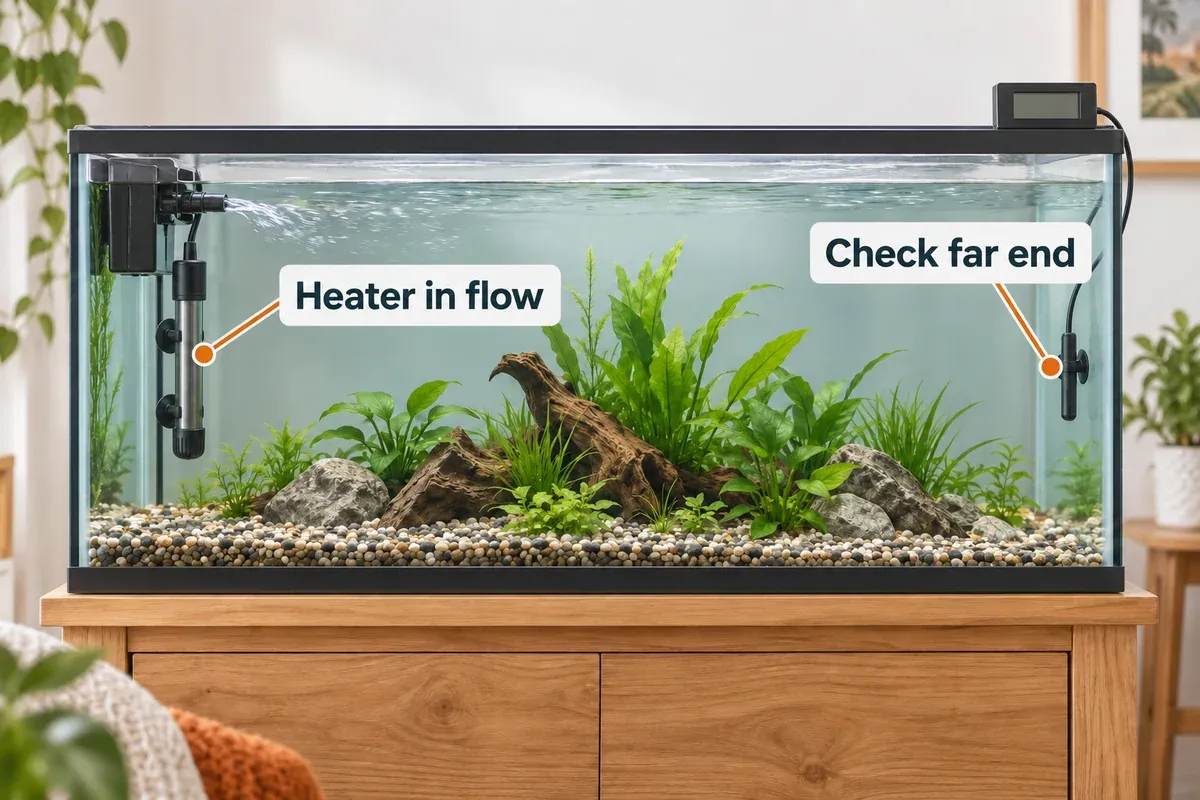
Put the thermometer where it tells you whether the whole tank is warm, not where it merely confirms that the heater is on. For a single heater, the opposite end of the aquarium is a useful default. Both Aqueon’s heater tips and its freshwater setup guide recommend an independent temperature check away from the heater.
For a long tank, position the thermometer in the middle or at the end that is furthest from the primary heater. During the first 24 hours, take readings at both ends if possible. A controller probe should sit in representative flow, away from the heater and out of the substrate; otherwise it may switch the heater off based on a local warm spot.
The heater’s dial and indicator light are not a temperature measurement. EHEIM’s manual says the selector ring is only a guide and calls for an accurate thermometer, while Fluval’s manual includes a low-flow warning because inadequate circulation can limit heat distribution.
The layout below separates heat delivery from temperature verification. Check the far end after installation instead of relying on the heater dial or indicator.
One heater vs. two heaters
One heater is sensible for many small and medium tanks
Use one correctly sized heater when the tank is short enough for the return flow to mix the full length, the room is reasonably stable, and the heater can be installed in a clear, high-flow area. This is often the simplest setup for a 5- to 30-gallon aquarium and for a covered 20- to 55-gallon community tank with good circulation.
One heater is also easier to troubleshoot. There is one setpoint, one power connection, and one location to inspect. The trade-off is that a failed heater can leave the whole tank without heat until you notice it, and a stuck-on thermostat can affect the whole tank quickly.
Two smaller heaters make more sense as tanks get longer or riskier
Two heaters are worth considering when:
- The tank is long enough that one heater cannot mix heat through the full length
- The room is cold, drafty, or subject to overnight temperature drops
- The aquarium is tall or divided into areas with different flow patterns
- The livestock is valuable, sensitive, or difficult to replace
- You want limited backup if one heater fails in the off position
Place the heaters at opposite ends of a long aquarium, with each one in its own clear-flow zone. Do not place both heaters together and call that even heating; the far end can still be cold. Keep the thermometer in the middle or at the end that would reveal a circulation problem first.
Two heaters do not protect against a stuck-on failure by themselves. If one remains powered continuously, the tank can still overheat. A separate thermometer, a properly configured temperature controller, and a daily glance at the actual water temperature are more meaningful safety layers than heater count alone.
If a chiller cannot hold the target while a heater keeps adding heat, check the heater’s control and settings before increasing cooling capacity. Our aquarium chiller troubleshooting guide helps you separate unwanted heating, restricted water flow and poor heat rejection.
How to split the wattage
Start with the manufacturer’s sizing chart and the conditions around your aquarium. Aqueon gives a starting rule of about 5 watts per gallon for tanks up to 55 gallons and about 3 watts per gallon for tanks over 60 gallons, while BRS uses a broader 3- to 5-watts-per-gallon range and says the total can be split between two heaters. These are starting points, not guarantees: room temperature, lid coverage, tank shape, water movement, and the target temperature all matter.
If your chosen sizing range calls for about 200 watts total, a reasonable two-heater design is two 100-watt units, provided each model’s range fits the tank. Do not automatically buy two 200-watt heaters for a tank that needs 200 watts total. Oversizing increases the amount of heat a failed thermostat can add before you notice the problem.
For a 75-gallon tank, the final selection might be one model rated for the aquarium or two smaller models whose combined rating fits the manufacturer’s chart. The correct answer changes if the tank sits against an exterior wall in a cold room, if the aquarium is uncovered, or if the return flow reaches only one end.
Tank-length layouts that work in practice
5- to 20-gallon tanks
Use one heater sized for the model’s stated range. In a short aquarium, vertical placement beside the filter return is often tidy. If the heater allows it, horizontal placement low on the rear glass can keep the device submerged during partial water changes. Put the thermometer away from the heater and make sure the filter creates a gentle, continuous sweep rather than a stagnant back corner.
20- to 55-gallon tanks
One adjustable heater near the return is often enough when the tank is covered and the flow crosses the full length. Horizontal or diagonal placement is useful if the heater manual permits it. If the aquarium is a long 55-gallon design, the room is cold, or the filter return reaches only one side, two smaller heaters can provide more even coverage.
75 gallons and larger
Do not size by gallon label alone. Long 75-, 90-, and 125-gallon tanks often benefit from two heaters at opposite ends, especially when the room temperature drops at night. Each heater still needs its own clearance and water movement. If the tank is unusually tall or has a sump, prioritize stable water level and real flow over hiding the equipment.
All-in-one and divided aquariums
Use the chamber with the most stable water level and enough flow to distribute heat. If the display area and filter chamber are separated by baffles, the display thermometer should guide the final setting. A heater that is warm in the rear chamber does not prove that the display is at the target temperature.
Equipment options for a safe layout
The products below are not ranked as universal “best” heaters. They cover different roles: a small-tank replacement, an adjustable medium-to-large heater, a two-outlet controller, an independent thermometer, and a physical guard. Choose the role that matches the layout above, then verify the exact wattage and model in the product documentation.
US options for heater placement and temperature control
-
Tetra HT Submersible Aquarium Heater 100W
Tetra
Fully submersible 100W heater for 10-30 gallon aquariums with a preset 78°F electronic thermostat.
- 100W output
- 10-30 gallon range
- Preset 78°F thermostat
- Best use
- A standard 20-gallon tropical tank in a cool or variable room
- Role
- Small preset heater
-
Aqueon Adjustable Pro Aquarium Heater, 200W
Aqueon
Adjustable, fully submersible heater with an electronic thermostat, red heating indicator, and automatic shutoff if it overheats or is removed from the water.
- Adjustable 68-88°F setting
- Electronic thermostat described at ±1°F
- Automatic overheat shutoff and reset
- Best use
- Direct replacement when an adjustable heater has failed
- Role
- Adjustable replacement heater
-
Inkbird ITC-306T Aquarium Temperature Controller
Inkbird
Aquarium-focused heat-only controller with a waterproof probe, two heating outlets, day/night temperature cycles, sensor-fault and over-temperature alarms, and a 10A maximum output.
- Two heating outlets with on/off control
- Day and night temperature settings
- Sensor-fault and over-temperature alarms
- Best use
- Independent on/off control when heater temperature drifts
- Role
- Heat-only external controller
-
Petbank LCD Digital Aquarium Thermometer
Zacro
Compact LCD thermometer with a suction-cup probe. the product documentation describes 0.1-degree display resolution and a broad measurement range; use it as an independent trend check, not as a substitute for comparing two thermometers when readings disagree.
- Water probe stays submerged; display stays dry
- Large LCD display
- described 0.1-degree resolution
- Best use
- A separate water-probe reading next to the heater's own control
- Role
- Independent digital water thermometer
-
Xiaoyztan 17in Aquarium Heater Guard Cover
Xiaoyztan
Detachable 17-inch plastic sleeve with three suction cups, intended to create a physical gap between active heater surfaces and fish or decorations.
- 17-inch guard length
- Detachable multi-section design
- Three suction cups for mounting
- Best use
- Protecting fish from contact with a correctly sized glass heater
- Role
- Physical heater-contact guard
Review the linked product page before purchasing.
Tetra HT 100W: a small-tank starting point
The Tetra HT 100W is a practical option for a 10- to 30-gallon tropical aquarium when a preset 78°F target fits the livestock. Its fixed temperature is the important limitation: it is not the right choice when your species needs a different target or when you are replacing a heater that has already overheated.
Use it in one clear-flow location, fully submerged, and confirm the actual water temperature with the thermometer at the opposite end. Check current price on Amazon →
Aqueon Adjustable Pro 200W: adjustable coverage for a medium tank
The Aqueon Adjustable Pro 200W is the more flexible choice when you need to tune the temperature instead of accepting a preset. Those are product information details, not a reason to skip an independent thermometer.
The 200W models is not a universal recommendation. Match the wattage to the tank and room, and use a lower-wattage model if you are building a two-heater system that needs roughly 200 watts total. Check current price on Amazon →
Inkbird ITC-306T: an extra control layer for two heaters
The Inkbird ITC-306T is useful when you want one controller to monitor the water and switch two heating outlets. Place its probe in representative flow, not touching either heater and not buried in the substrate.
A controller does not make a damaged heater safe, and it does not replace a dry plug, a drip loop, or a separate visual temperature check. Keep the live load within the controller’s rating and follow the controller’s own probe and calibration instructions. Check current price on Amazon →
Zacro digital thermometer: verify the far end of the tank
The Zacro LCD thermometer has a separate water probe and a dry display. Its 0.1-degree display resolution is convenient, but resolution is not the same as laboratory accuracy, so use the reading as a trend check and compare suspicious readings with a second thermometer.
Place the probe away from the heater, preferably at the opposite end or in the middle of a long tank. Check current price on Amazon →
Xiaoyztan heater guard: contact protection only
A heater guard can reduce the chance that a fish, turtle, plant, or décor item touches the hot tube. Measure the heater’s length and diameter before ordering, and keep the guard’s openings clear during maintenance.
A guard cannot fix poor circulation, an exposed heater, a failed thermostat, or an overheating controller. It is an accessory for a correctly sized and correctly placed heater, not a substitute for one. Check current price on Amazon →
A safe installation sequence
- Read the model manual first. Confirm whether the heater may be horizontal, whether it must be vertical, and where the minimum water line is.
- Choose the flow path. Put the heater near a filter return, intake with real circulation, air diffuser, or circulation pump. Do not hide it in a dead corner.
- Secure the heater above the substrate. It should not touch gravel, rocks, décor, or the glass. Use the supplied bracket or a compatible guard.
- Fill and wait before powering. The heater must be completely submerged. Follow the model’s acclimation time; manufacturer guidance commonly calls for about 15 to 30 minutes before plugging in.
- Create a drip loop. Keep the plug and receptacle dry. If water reaches an electrical connection, cut power safely before touching it.
- Install the thermometer away from the heater. For one heater, the opposite end is a good starting point; for two heaters, check the middle and both ends during setup.
- Run the aquarium and watch the trend. Give the tank time to stabilize before changing the dial. Make one change at a time.
- Recheck after maintenance. Turn the heater off before lowering the water below its minimum line. Unplug it and let it cool before exposing a glass heater to air.
If the filter is too forceful, do not solve the heater problem by shutting off circulation. Use the flow tests and outlet fixes in Aquarium Filter Too Strong? Signs, Flow Tests & Safe Fixes. If the temperature remains wrong, see Aquarium Heater Not Heating—or Overheating? Diagnose It Safely before buying a larger heater.
Common placement mistakes
Putting the heater in the calmest-looking corner
Clear glass does not mean good heat distribution. If the heater sits away from the return flow, the thermostat may react to its local water while the far end drifts. Move the heater into a visible, open flow path and check the far-end temperature.
Assuming every heater can be laid flat
Some submersible heaters allow horizontal placement; others have a vertical-only instruction. The EHEIM Jäger manual is an example of the latter. If the manual is missing, look up the exact model before changing orientation.
Placing the thermometer beside the heater
That reading can look reassuring while the rest of a long tank is cold. Keep the thermometer independent and away from the heating tube. A second thermometer is worthwhile when the tank houses sensitive or expensive livestock.
Buying two full-size heaters “for safety”
Two heaters only help when their combined output matches the tank’s requirements and their placement improves coverage. Two oversized units can add heat too quickly if a thermostat fails. Split the required total wattage instead of duplicating it.
Treating a heater guard as a controller
A guard protects against contact. It does not sense temperature or cut power. If the concern is overheating, use a controller and independent temperature measurement, and replace equipment that shows damage or repeated control failure.
Frequently Asked Questions
Can every aquarium heater be installed horizontally?
No. Many fully submersible heaters allow horizontal or vertical mounting, but the exact manual wins. Tetra’s instructions allow both positions, while the EHEIM Jäger manual instructs vertical mounting. Do not infer orientation from the shape of the tube alone.
Is it better to put an aquarium heater near the filter inlet or outlet?
The best location is near genuine water movement. The outlet is usually the simplest choice because it carries warmed water through the aquarium, but an inlet can work when the flow around the heater is strong. Keep the heater unobstructed and prevent a low water level from exposing it.
Should an aquarium heater touch the bottom?
No. Keep it above gravel and away from rocks, décor, and dense plants. The heater needs water around the tube and must remain accessible for inspection and safe removal.
How many heaters does a 75-gallon aquarium need?
There is no single answer. A long 75-gallon aquarium in a cold room is a strong candidate for two smaller heaters at opposite ends. A shorter, covered, well-circulated tank may work with one correctly sized heater. Use the manufacturer’s range, room conditions, actual temperature readings, and the tank’s flow pattern together.
Should two aquarium heaters be on opposite ends?
Usually, yes, when the goal is even heating in a long tank. Put each heater in a clear-flow area rather than both beside the same filter. If the tank has a strong central circulation loop or separate chambers, follow the water path and verify both ends with a thermometer.
Can I put a heater inside an aquarium filter box?
Sometimes. It can be a tidy, high-flow location, but only when the heater is designed for that installation and the chamber’s water level stays safely above the minimum line. A return chamber that drops with evaporation is a poor location.
Is a heater controller necessary with two heaters?
Not for every aquarium, but it adds a useful independent control layer, especially with valuable livestock or a history of temperature drift. The controller still needs correct probe placement, calibration, load limits, and a separate temperature check.
Bottom line
For most 20- to 55-gallon aquariums, use one correctly sized, fully submersible heater near the filter return, low and horizontal or diagonal when the manual permits it. Put the thermometer at the opposite end and keep the heater clear of gravel and décor.
For a long aquarium, a cold room, or a setup where a single heater failure would be especially costly, split the required total wattage across two smaller heaters at opposite ends. Give each heater real water flow, use an independent thermometer, and add an external controller when the risk justifies it. The reliable setup is not “vertical” or “horizontal” by itself; it is the combination of the correct model orientation, free circulation, stable water level, measured temperature, and a wattage plan that matches the tank.
Related reading: How to Clean a Canister Filter Without Crashing the Cycle and Best Canister Filters.
Sources and further reading
- Aqueon: Setting Up a Freshwater Aquarium - heater position near the filter, horizontal installation, and thermometer placement.
- Aqueon: Fish Tank Heater Tips for Cold Weather - wattage starting points, safe cooling time, placement, and independent checks.
- Fluval E-Series Heater Manual - unobstructed flow, minimum water level, acclimation, and low-flow warnings.
- EHEIM Jäger Thermostatic Aquarium Heater Manual - vertical mounting in brisk flow and thermometer-based calibration.
- Bulk Reef Supply: How to Install a Heater in Your Aquarium - practical guidance on wattage ranges, controllers, and dual-heater redundancy.