

 Published sources
 Product details checked
An aquarium filter should have a steady, low hum at most. A new rattle, buzz, or gurgle is useful information: the sound often tells you whether to inspect the impeller, restore the water level, reseat a hose, isolate vibration, or replace a worn part.
Quick answer: A rattling or clicking filter most often has debris in the impeller well, a worn impeller shaft or bushing, or an impeller cover that is not seated correctly. A loud buzz that changes when you touch the housing usually comes from vibration being transferred to the glass, cabinet, or tubing. Gurgling or slurping usually means air is entering the pump path through a low water level, an intake vortex, an airlock, or a canister that has not been fully primed. A splash or trickle may simply mean the return is above the water line.
The safest repair is sound-specific. Do not buy a universal impeller or force a random hose onto a fitting: aquarium filters use model-specific shafts, seals, tubing diameters, and impeller shapes. This guide shows what to check first, which faults are reasonable DIY fixes, and when a complete replacement filter is safer. If the noise comes from a reef overflow or sump drain rather than the filter body, use our reef overflow gurgling guide for Durso, Herbie, and BeanAnimal drain checks.
Start With Safety
Before opening a filter, protect yourself and the aquarium:
- Unplug the filter before touching the impeller, intake, motor head, or wet connections.
- Dry your hands before reaching near a plug or power strip, and keep every connection above possible splash paths.
- Never let a filter pump run dry while you are testing it. A dry impeller chamber can overheat or wear quickly.
- If you smell burning plastic, see melted insulation, feel abnormal heat, or find water near an electrical connection, unplug the filter and stop troubleshooting.
- If fish are gasping, losing balance, or gathering at the surface, restore aeration with a safe backup method and test water quality. Noise is secondary to oxygen and water-quality problems.
The Sound-to-Cause Map
Use the sound as your first branch. The same filter can make different noises when the water level, intake, or impeller condition changes.
| What you hear | Most likely area | First check | Usually worth trying |
|---|---|---|---|
| Rattle, chatter, or clicking | Impeller, ceramic shaft, bushings, or debris | Unplug, remove the cover, and inspect the impeller well | Clean the well and replace the matched impeller if the shaft or magnet is worn |
| Grinding or rough vibration | Worn impeller, cracked bushing, or failing motor bearing | Compare the impeller with the manual or old part | Replace the correct impeller; replace the unit if the motor housing is damaged |
| Steady electrical buzz or hum | Motor vibration transferred to glass, cabinet, or tubing | Press gently on the filter housing and check contact points | Level the filter and use a thin vibration pad under the external filter only |
| Gurgling or slurping | Low water, intake vortex, airlock, or air leak | Check water level, intake depth, hose connections, and priming | Top off safely, reseat the intake, and prime the canister according to its manual |
| Splashing or trickling | Return outlet above the water line or excessive surface agitation | Look at the return lip and tank water level | Raise the water level or reposition the return; do not eliminate all surface movement |
| Buzz starts after maintenance | Trapped air, mis-seated cover, dry start, or displaced media | Re-check what was opened and whether the pump chamber is full | Reassemble carefully and remove trapped air without running the pump dry |
The table is a starting point, not a reason to ignore water testing. If the filter stopped or flow dropped at the same time as the noise, inspect the tank and filter immediately rather than treating the sound as a cosmetic nuisance.
A 30-Second Isolation Test
You can often separate transmitted vibration from a pump problem before buying anything.
- Listen from a short distance. A soft, even hum is different from a repeating rattle or irregular grinding sound.
- Check whether the sound follows contact. With dry hands and without opening the filter, gently steady the external housing or move a hose a few millimeters. If the pitch changes when the housing touches the glass or cabinet, vibration transfer is likely.
- Look at the water line. A hang-on-back filter can become noisy when the tank level drops and the return falls farther. A canister can gurgle when air enters the intake or when its return line is not fully flooded.
- Check the return and intake. Confirm that the intake strainer is submerged, the tubing is not kinked, and the return is not drawing a surface whirlpool.
- Unplug before opening. If the noise remains unexplained, inspect the impeller, cover, shaft, bushings, seals, and any debris in the pump chamber.
This sequence matters because a silicone pad can reduce a buzz caused by cabinet resonance, but it cannot repair a chipped impeller. Likewise, a new impeller cannot cure a filter that is simply sucking air because the water level is too low.
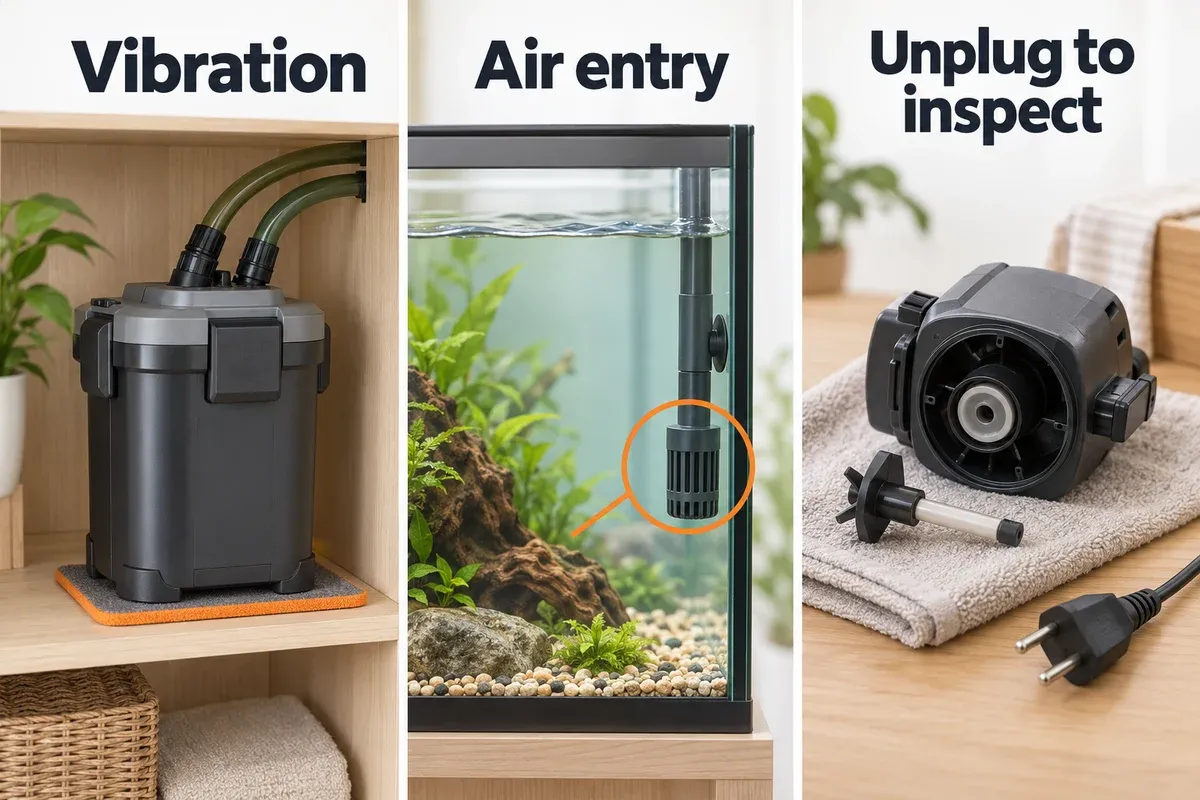
The three close-ups below separate common noise sources so a vibration fix does not get mistaken for an impeller repair.
Rattling, Chattering, or Clicking: Inspect the Impeller First
The impeller is the small magnetic rotor that moves water through many aquarium filters. A piece of gravel, plant matter, snail shell, or hardened mineral deposit can make it chatter. A worn ceramic shaft, rubber bushing, or impeller magnet can create a repeating rattle even when the filter still moves water.
After unplugging the filter, inspect these points:
- Is the impeller cover fully seated, with no gap or cracked tab?
- Is the shaft straight and intact rather than chipped, bowed, or loose in its rubber seats?
- Does the rotor spin freely without scraping the well?
- Is there sand, plant debris, hair algae, or calcium buildup around the magnet and shaft?
- Did the noise begin immediately after a cartridge or media change, when a small part may have been displaced?
Clean the impeller well with a soft aquarium brush and rinse removable parts in aquarium water or conditioned water. Avoid forcing a hard object into the shaft seats. If the shaft is visibly worn or the magnet is swollen or cracked, cleaning is unlikely to be a lasting fix.
Replacement impellers are not universal
The part number and filter model matter more than a popularity score. An impeller described for a Tetra Whisper filter will not be a safe substitute for a Marineland Penguin, Fluval canister, or a small internal pump.
The Tetra 25870 replacement magnetic impeller is a useful example for owners of the compatible Whisper 3, 4, 60, or Triad 3000 filters.
Check current price on Amazon →For a compatible Penguin 350 setup, the Marineland PRIM350B impeller assembly is the more relevant model-specific choice. Confirm that your filter is the 350 series before ordering; the part is not a universal aquarium rotor.
Check current price on Amazon →If the noise returns with a correctly matched, clean impeller, or the motor head feels hot or rough, stop escalating part swaps. A failing motor or cracked pump housing is a complete-filter decision, not an impeller-cleaning problem.
Buzzing or Humming: Find the Vibration Path
A low hum is normal for a powered pump. The problem is usually the amplification: a filter body touching the glass, a hard hose resting against the stand, a cabinet panel acting as a soundboard, or a pump sitting on a rigid surface.
Try these fixes in order:
- Make sure the filter is level and its mounting bracket is not twisted.
- Separate the housing, intake tube, and return hose from the glass and cabinet where possible.
- Check that the impeller chamber is full of water and that the impeller cover is seated.
- Rinse a clogged mechanical pad in removed aquarium water if reduced flow is forcing the pump to work against back pressure.
- Add a thin, non-slip damping layer under the external filter or pump if the surface itself is amplifying the hum.
A silicone mat can isolate vibration—but not support a tank
A thin silicone sheet can be cut to the footprint of an external filter or small pump. It should stay on the dry side, remain flat, and not block ventilation or make the filter unstable. Never use a generic soft mat to level or support a full aquarium: a tank needs a properly designed, level support surface, and a soft or uneven layer can create dangerous stress.
The WochiTV translucent silicone rubber sheet is a generic 18-by-36-inch, 1/8-inch-thick sheet sold for pads, sealing, and cushioning rather than as a filter-specific accessory. Treat it as a cut-to-size dry-side damping material, not as a certified aquarium component or an item to submerge.
Check current price on Amazon →If the sound is a sharp electrical buzz, the filter vibrates even when isolated, or the motor housing becomes hot, unplug it. A mat is not a repair for an electrical fault.
Gurgling, Slurping, or Burbling: Look for Air
Gurgling usually means the pump is moving a mixture of water and air. The cause depends on the filter style.
Hang-on-back filters
Check the tank level first. Evaporation can lower the water enough for the intake or return to draw air. Top off with temperature-appropriate, conditioned water and keep the intake strainer fully submerged. If the surface forms a funnel around the intake, move the strainer or adjust the flow so it is not pulling air from the surface.
Some HOB filters also become noisy when the return falls farther than usual. Raising the water level reduces the waterfall, but leave enough surface movement for gas exchange.
Canister filters
Air can enter through a loose intake connection, a damaged hose, an incorrectly seated motor-head seal, or an incomplete prime. Check the hose route for kinks and feel each connection for a loose fit. A dry tissue held around an external connection while the filter is unplugged can help reveal moisture; dry everything before restoring power.
If the lid seal is flattened or damaged, replace it with the correct O-ring and follow the filter manual for cleaning and lubrication. Do not use household oil or an unverified sealant on a water path.
The Captain O-Ring A20063/A20064 two-pack is intended for Fluval 304, 305, 306, 307, 404, 405, 406, and 407 canister filter motor-head lid seals. Match the part number and filter family before ordering; an O-ring for a different Fluval series may look close and still leak.
Check current price on Amazon →An O-ring normally explains a leak or recurring air entry more readily than a pure motor buzz. If replacing the seal does not stop air from entering, inspect the hoses, quick-connects, intake strainer, and canister lid for cracks or poor seating.
Trickle or Splash: The Return May Be Above the Water Line
A return that splashes into the aquarium can be louder than the motor itself. This is common after a water change or evaporation. Raise the water to the correct operating level, or position the outlet so it creates gentle surface movement rather than a high waterfall.
Do not silence every ripple. A little surface agitation supports gas exchange. The goal is a stable return that does not suck air, throw water onto the lid, or create a constant waterfall in a room where the sound matters.
When the Hose Is the Problem
Old tubing can harden, flatten, split, or lose its grip on a fitting. A kinked intake hose can restrict flow and make a pump louder; an intake-side gap can introduce air and create gurgling. Hose replacement is a measurement job:
- Measure the inside diameter (ID), not only the outside diameter.
- Compare the filter manual, original hose, and connector size.
- Replace the full run when the material is brittle or cloudy with cracks.
- Use clamps or connectors only when the filter manufacturer allows them; do not force an oversize hose over a small fitting.
- Keep water-path tubing separate from 3/16-inch airline tubing used for air pumps.
If you have a 5/8-inch-ID water path and need bulk replacement tubing, the FZONE 3-meter aquarium tubing is the broader option in this group. The diameter is the important detail: it is not a drop-in hose for every HOB or canister filter.
Check current price on Amazon →When to Repair a Part—and When to Replace the Filter
Use the following decision rule:
| Situation | Better choice |
|---|---|
| Noise began after maintenance, the model is known, and there is no heat or leak | Clean and reseat the existing part |
| Impeller shaft, magnet, or bushing is visibly worn but the motor housing is sound | Replace the matched impeller assembly |
| Canister lid seal is flattened or leaking but the head and hoses are intact | Replace the exact O-ring and re-prime carefully |
| Buzz changes when the filter touches the cabinet or glass | Isolate the vibration and correct hose contact |
| Hose is hard, split, kinked, or too loose at a connector | Replace the hose after measuring the ID |
| Motor smells hot, electrical noise persists, casing is cracked, or water reaches the power connection | Unplug it and replace or professionally service the filter |
| A small HOB is beyond economical repair and the tank needs a reliable replacement | Choose a correctly sized replacement filter and preserve mature media |
For a 20- to 50-gallon freshwater tank, the existing AquaClear 50 Power Filter is a possible complete-filter replacement path.
Check current price on Amazon →If you replace a working filter because of noise, do not throw away all mature biological media at once. Transfer compatible established media to the new filter or run the old and new systems together when the setup allows it, and monitor ammonia and nitrite during the transition. A new motor does not come with a mature biofilter.
The product details below are supporting options, not a universal parts list.
Model-specific parts and replacement options for a noisy aquarium filter
-
Tetra 25870 Replacement Magnetic Impeller for Whisper Filters
Tetra
Model-specific magnetic impeller assembly for compatible Tetra Whisper power filters. It is a sensible first replacement when a clean impeller well still produces a repeating rattle or click.
- Replacement magnetic impeller assembly
- product information names Whisper 3, 4, 60, and Triad 3000 compatibility
- Low-cost part compared with replacing a complete filter
- Use
- Compatible Tetra Whisper 3, 4, 60, and Triad 3000 filters
-
Marineland PRIM350B Penguin 350 Impeller Assembly
Marineland
Replacement impeller assembly for the Marineland Penguin 350 family. Its model-specific fit makes it more useful than a generic rotor when the filter chatters after cleaning or begins to grind.
- Penguin 350 replacement part product information
- Useful for a worn shaft, magnet, or rotor assembly
- Cheaper and less disruptive than replacing a working filter body
- Use
- Compatible Marineland Penguin 350 filters
-
Captain O-Ring A20063/A20064 Fluval Canister Seal (2-Pack)
Captain O-Ring
Two replacement lid O-rings for the described Fluval canister filter families. A correctly sized seal can stop air entry and leaks that present as recurring gurgling after priming.
- Two replacement seal rings
- A20063/A20064 part references in the product documentation
- Fluval 04, 05, 06, and 07 series compatibility stated
- Use
- Fluval 304/305/306/307 and 404/405/406/407 motor-head lid seals
-
WochiTV Translucent Silicone Rubber Sheet, 1/8 Inch
WochiTV
An 18-by-36-inch, 1/8-inch-thick silicone rubber sheet sold for pads, sealing, and cushioning. It can be cut under a dry external filter to reduce transmitted cabinet vibration, but it is not a filter-specific or submerged aquarium part.
- 18 x 36 inch sheet
- 1/8-inch described thickness
- Cut-to-size silicone rubber material
- Use
- Cut-to-size dry-side damping under an external filter or small pump
-
Penn-Plax CCF201 Cascade Black Hose
Penn-Plax
Model-specific black replacement hose described as the CCF201 Cascade filter part. Replacing brittle or loose tubing can remove an intake-side air leak, kink, or vibration path that makes a canister noisy.
- CCF201 Cascade replacement part
- Black hose for a cleaner canister setup
- Useful when original tubing is hard, split, or loose
- Use
- Compatible Penn-Plax Cascade canister filter hose replacement
-
FZONE Aquarium Tubing, 3 Meter, 5/8 Inch ID
FZONE
A 3-meter clear aquarium hose with a described 5/8-inch inside diameter. It is a flexible bulk replacement option when the original hose is damaged, but the diameter must match the filter fitting exactly.
- 3-meter clear tubing
- 5/8-inch inside diameter described
- Useful for a measured water path rather than a guessed universal fit
- Use
- Filters and water paths that specifically require 5/8-inch ID tubing
-
AquaClear 50 Power Filter
AquaClear
Hang-on-back filter with mechanical, chemical, and biological filtration and a large media chamber for routine water polishing and biofilter support.
- Rated for 20-50 US gallon tanks
- Mechanical, chemical, and biological filtration
- Large media volume
- Use
- Established 20-50 gallon tanks with suspended debris
Review the linked product page before purchasing.
Frequently Asked Questions
Is a quiet hum normal for an aquarium filter?
Usually, yes. A steady low hum can be normal for a powered motor, especially when the filter is level and isolated from the cabinet. A new rattle, grinding sound, irregular clicking, or sound that gets louder over time deserves an inspection.
Why did my filter start making noise after a water change?
The water level may now be low enough for a HOB return or intake to draw air. A canister may also have trapped air after its intake or motor head was opened. Check the water line and connections first, then unplug the filter before inspecting the impeller or re-priming it.
Can a dirty filter cartridge make the motor buzz?
It can contribute indirectly. A clogged mechanical layer reduces flow and can increase pressure or cause the filter to run with an unstable water path. Clean reusable media in removed aquarium water and replace disposable media according to the filter design, but do not replace every mature biological surface at once.
Will a new impeller always make the filter quiet?
No. It can solve a worn shaft, damaged magnet, or noisy rotor, but it will not fix a cracked motor head, an air leak, a low water level, a loose bracket, or vibration transmitted through the cabinet. Match the impeller to the exact filter model.
Can I put a silicone mat under the aquarium to stop the noise?
No—not a generic mat as a soundproofing experiment. A full aquarium needs even, purpose-designed support. A thin damping sheet may be appropriate under an external filter or small pump on the dry side, but never use it to compensate for an uneven stand or a soft, unstable base.
When should I stop using the filter immediately?
Unplug it if you smell burning, see a damaged cord, feel abnormal heat, see water near the electrical connection, hear a persistent electrical buzz, or find a cracked housing. Move fish-protection and aeration to a safe backup plan and replace or professionally service the unit.
Bottom Line
Start with the sound, then isolate the fault. Rattling points you toward the impeller well and rotor parts; buzzing often follows a vibration path; gurgling points to air, water level, intake, hose, or priming; splashing may only require a higher water line. Clean and reseat before buying, verify the exact model before ordering a part, and reserve a complete filter replacement for electrical, structural, or uneconomical failures.
For related aquarium maintenance decisions, see our guides to cloudy aquarium water causes and the best canister filters.