

 Published sources
 Product details checked
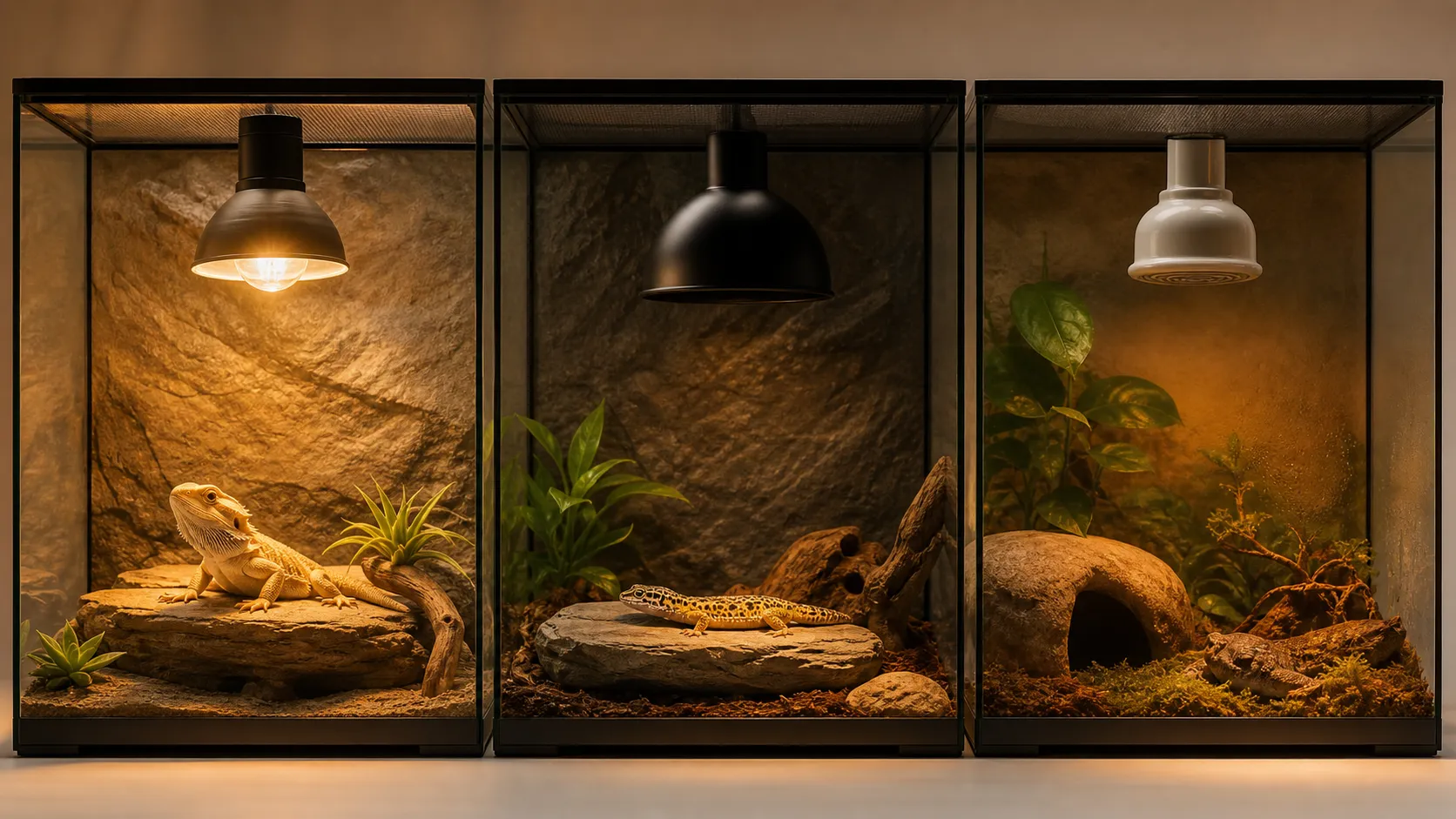
Choosing between a halogen bulb, a deep heat projector (DHP), and a ceramic heat emitter (CHE) is not a simple “which one is hottest?” question. The three sources differ in visible light, infrared output, beam shape, nighttime usefulness, thermostat compatibility, and the kind of thermal gradient they create.
Quick answer: Choose a halogen flood bulb for bright daytime basking when your species benefits from a sun-like overhead heat source. Choose a DHP when you need strong overhead radiant heat with virtually no visible light, including a lightless nighttime option when the care plan requires one. Choose a CHE when the priority is lightless ambient or supplemental heat rather than the most natural primary basking beam.
None of these bulbs supplies a complete reptile lighting system. A halogen bulb provides visible light and heat, but it should not be counted as UVB. A DHP and a CHE provide little or no visible light, so they will not create a daytime photoperiod or replace a species-appropriate UVB system. The final choice still depends on the animal, enclosure, room temperature, target gradient, and the manufacturer’s instructions.
In this guide, you’ll learn:
- Which source is best for daytime basking, night heat, or ambient warmth
- How visible light and infrared output change the practical setup
- Which thermostat mode fits each heater
- Which species groups commonly point toward halogen, DHP, or CHE
- How to install and test any overhead heat source safely
The Short Decision Matrix
| Heat source | Visible light | Heat pattern | Night use | Preferred thermostat | Best starting use |
|---|---|---|---|---|---|
| Halogen flood bulb | Bright visible light | Fast, focused overhead radiant heat with a broad basking beam | No—turn it off with the daytime schedule | Dimming | Daytime basking for diurnal lizards, tortoises, and turtles when the care plan calls for overhead heat |
| Deep heat projector (DHP) | Virtually none | Overhead radiant heat with deeper-penetrating IR-A/IR-B output according to the manufacturer | Yes, if heat is needed and the exact bulb remains effectively dark | Dimming | Lightless overhead heat, colder rooms, and species that need heat without a glowing bulb |
| Ceramic heat emitter (CHE) | None | Long-wave, broad ambient heat; less useful as a tight primary basking beam | Yes, if heat is needed | Pulse proportional or compatible on/off | Supplemental air and enclosure warmth, especially when light must remain off |
The one-line rule
Visible-light heater = daytime schedule and dimming control. Lightless heater = choose DHP or CHE according to whether you need overhead radiant basking or mainly ambient warmth.
That rule is more useful than shopping by wattage. A 1,000W on/off controller is still a poor match for a visible basking bulb, while a correctly rated 300W dimming controller can control one 50W DHP or 75W halogen lamp very well.
Halogen: The Daytime Basking Choice
A halogen flood bulb is an incandescent heat source with a visible, bright beam. It warms the basking surface and the animal from above, responds quickly to changes in power, and creates the clearest visual “sun” in this comparison.
Arcadia’s halogen guidance describes its flood lamps as IR-A-rich, bright, quick-warming, and fully dimmable with suitable control. It also recommends pairing the heat lamp with a separate UV-producing system. That distinction matters: visible light and UVB are not the same thing.
Where halogen works best
Halogen is the strongest default for many diurnal basking reptiles—for example, bearded dragons, uromastyx, and many tortoises—when their species-specific plan calls for a bright overhead basking zone. ReptiFiles likewise recommends incandescent or halogen flood bulbs as the primary short-wave infrared source for bearded dragons, with a separate UVB system and enough basking width for the animal’s body.
It can also be useful for a nocturnal or crepuscular species during the enclosure’s daytime period if the animal’s care guide calls for a daytime basking cycle. “Nocturnal species” does not automatically mean “no daytime heat”; it means the light schedule needs to respect the species’ behavior and the animal needs a dark retreat.
What halogen does not do
- It does not provide a reliable UVB dose. Use a measured, species-appropriate UVB system separately.
- It is not a night heater. Even a dimmed halogen still emits visible light.
- It does not remove the need for a thermal gradient. The animal must be able to leave the beam and reach a cooler, shaded zone.
- It is not safe to run unguarded where the reptile can touch it or where water can splash onto the hot glass.
Thermostat and schedule
Use a dimming thermostat with a halogen bulb. Dimming keeps the lamp continuously lit while reducing output as the basking surface approaches the target. On/off cycling can make the light flash and subjects the filament to repeated hard starts. Pulse control is also a poor default for a visible bulb because it can create visible flicker.
Use a timer or a thermostat with a properly configured day/night schedule to switch the visible bulb off at night. If the species still needs heat after the lamp goes out, add a separate lightless source rather than leaving the halogen glowing.
DHP: Strong Overhead Heat Without a Glowing Bulb
A deep heat projector is an overhead infrared source designed to deliver radiant heat with virtually no visible light. Arcadia describes its DHP as providing IR-A and IR-B, maintaining a wider heat beam, and remaining suitable through the day and night because it does not disturb the normal light cycle.
The practical advantage is flexibility. A DHP can create an overhead basking or warm zone without adding a bright spot to a nocturnal enclosure. It is often a sensible alternative when the room cools at night, the enclosure is tall, or an animal needs overhead radiant heat but the keeper wants the enclosure to stay dark.
Where DHP works best
DHPs are especially useful for light-sensitive, nocturnal, or crepuscular setups when supplemental heat is required after the visible daytime lamp is off. They can also provide primary overhead heat in some enclosures if the species-specific care plan, surface temperatures, and photoperiod are correct.
For a leopard gecko, for example, a DHP may be a useful lightless overhead option when the room is too cool for the desired nighttime range. For a bearded dragon or other diurnal basker, a DHP can supplement a daytime halogen and UVB system, but it does not replace the visible daytime environment or UVB plan.
DHP trade-offs
- A DHP is usually more expensive than a basic CHE or budget halogen bulb.
- “No visible light” does not mean “no UVB” and does not create a daytime photoperiod.
- A DHP still gets extremely hot and needs a ceramic-rated fixture, a guard, and safe clearances.
- Wattage comparisons are not universal. A 50W DHP may heat one enclosure well and fail to reach the same surface temperature in another.
Thermostat and schedule
Use a dimming thermostat. Arcadia specifically recommends dimming control for the DHP so the thermostat can regulate the thermogradient without repeatedly switching the source fully on and off.
If the DHP is used at night, set a species-appropriate nighttime target rather than copying the daytime basking target. The animal still needs a cooler zone and a dark retreat. Check the actual surface temperature with an independent infrared thermometer; the thermostat display only tells you what its probe is sensing.
CHE: Lightless Ambient and Supplemental Heat
A ceramic heat emitter is a ceramic heating element that emits heat without visible light. Zoo Med describes its ReptiCare CHE as a 24-hour heat source, with 60W, 100W, and 150W options and a ceramic socket requirement. The manufacturer lists the 100W model for 30–40 gallon enclosures and recommends its wire cage clamp lamp.
In practical terms, a CHE is best understood as a lightless ambient or supplemental heater. It can warm air, enclosure surfaces, and a broad area, which is useful when the room is cold or a nighttime temperature floor must be maintained. It usually does not create the same focused, sun-like basking experience as a well-positioned halogen or DHP.
Where CHE works best
CHEs are useful for night heat, background warmth, and supplemental heating in snake, gecko, and other reptile enclosures when the care plan calls for heat without visible light. They can be practical in high-humidity setups, but the enclosure’s humidity must be measured again after installation because any added heat can change evaporation and ventilation.
They are usually not the first choice as the only basking source for a strongly heliothermic lizard. ReptiFiles’ explanation of infrared wavelengths places CHEs primarily in the long-wave IR-C category, while halogen bulbs supply the short-wave infrared associated with natural sunlight. That is a useful way to understand why “it makes the enclosure hot” is not the same as “it creates the best basking environment.”
CHE trade-offs
- The element and fixture become extremely hot even though the bulb does not glow.
- A CHE can dry the enclosure or raise ambient temperatures without creating a precise basking beam.
- It provides no visible light and no UVB.
- It needs a porcelain or other ceramic-rated socket and a protective guard.
Thermostat and schedule
A pulse proportional thermostat is the preferred control pattern for a lightless CHE when the controller supports it. Pulse control can reduce broad temperature swings without creating visible flicker. A compatible on/off thermostat can also work for a CHE when its cycling range is acceptable for the species and enclosure.
Do not connect a CHE to a household dimmer. A reptile thermostat must read the enclosure temperature, stay within the heater’s load rating, and be installed according to both manuals.
Compatible Product Options
Heat sources at a glance
-
REPTI ZOO 75W Intense Basking Spot Heat Lamp Bulbs (2-Pack)
REPTI ZOO
A two-pack of 75W visible-heat basking bulbs for daytime overhead heating when paired with a suitable dimming thermostat and UVB system.
- Two 75W basking bulbs provide a ready replacement
- Bright visible light suits a daytime basking schedule
- Heat / light
- Visible light + radiant heat
- Best for
- Budget daytime basking with a spare bulb
-
Pangea 50W Deep Heat Projector Infrared Heater
Pangea
A USA-voltage 50W deep-heat-projector-style bulb designed to provide overhead infrared heat with low to no visible light.
- Low-to-no visible light supports a dark night cycle
- 50W format is a practical starting point for smaller overhead setups
- Designed for USA outlets and voltage according to the product documentation
- Heat / light
- Overhead infrared heat
- Best for
- Lightless overhead heat when nighttime warmth is needed
-
Zoo Med ReptiCare 100W Ceramic Infrared Heat Emitter
Zoo Med
A flat-faced 100W ceramic emitter from Zoo Med that produces heat without visible light and is intended for 30–40 gallon enclosures by the manufacturer.
- No visible light for nighttime or 24-hour supplemental heating
- Flat-faced ceramic design and a manufacturer-described two-year warranty
- Heat / light
- Long-wave radiant / ambient heat
- Best for
- Established lightless ambient or supplemental heat
Review the linked product page before purchasing.
1. REPTI ZOO 75W Halogen 2-Pack — Budget Daytime Basking
Best for: A visible daytime basking beam when you want a spare bulb in the drawer
Check current price on Amazon →The main reason to choose this product information is value. It is a reasonable starting point for a small or medium daytime basking setup when the wattage and beam distance fit the enclosure.
The important limitation is the same as with any generic basking bulb: the product documentation’s “natural sunlight” or UVA wording should not be treated as UVB proof. Use a separate linear UVB system where the species requires it, and verify basking surface temperature after the bulb has run long enough to stabilize.
Pros:
- Low estimated cost for a two-bulb pack
- Visible daytime heat for a clear basking schedule
Cons:
-
Not a UVB lamp
-
Not suitable for night heat because it produces visible light
Bottom line: A practical budget halogen if you already have a safe ceramic-socket fixture, guard, dimming thermostat, and separate UVB plan. Skip it as a standalone “full-spectrum” solution.
2. Pangea 50W Deep Heat Projector — Lightless Overhead Heat
Best for: Overhead radiant heat when the enclosure must stay dark
Check current price on Amazon →This Pangea 50W product information is a sensible middle ground when you want a DHP-style heat source without buying a high-wattage bulb for a smaller enclosure. It is described as designed for US outlets and low to no visible light, which makes it useful for night heat when a species-specific plan says the enclosure should not fall below its nighttime minimum.
The 50W number is not a target temperature. Distance, mesh, reflector, room temperature, enclosure height, and basking material determine the result. Start with the lowest wattage that can reach the required surface temperature under thermostat control, then test the warm and cool zones independently.
Pros:
-
Lightless overhead heat for day or night when heat is needed
-
50W format can be easier to manage in smaller terrariums than a 100W source
Cons:
- No visible daylight and no UVB
- Requires a dimming thermostat, not a basic household dimmer
Bottom line: Choose it when the priority is overhead radiant heat without a glowing bulb. It is the strongest fit of the three for a cold nighttime room where a CHE’s broader ambient heat is not enough.
3. Zoo Med ReptiCare 100W CHE — Established Lightless Supplemental Heat
Best for: Ambient or supplemental heat with a well-documented, no-light emitter
Check current price on Amazon →Zoo Med publishes wattage and enclosure-size guidance, a two-year warranty, and a specific ceramic fixture recommendation. It is a straightforward choice when a snake, gecko, or other reptile needs lightless supplemental warmth and the enclosure is large enough for the selected wattage.
It is not automatically the best primary basking source. A CHE can raise the warm-side and ambient temperature, but it does not give you the same visible, overhead basking signal or short-wave infrared profile as a halogen. Use it to solve the actual problem—ambient or nighttime warmth—and keep a separate basking and UVB plan when the species needs one.
Pros:
- No visible light for nighttime or 24-hour supplemental heat
- Manufacturer publishes a two-year warranty and fixture guidance
Cons:
- Less targeted as a primary basking beam than a halogen or DHP
- 100W may be excessive for a small enclosure
- Requires a ceramic-rated socket, guard, thermostat, and careful humidity checks
Bottom line: The sensible established CHE pick when the job is lightless ambient heat. Choose a lower wattage if the enclosure is small, and do not rely on the CHE alone for a diurnal basking species.
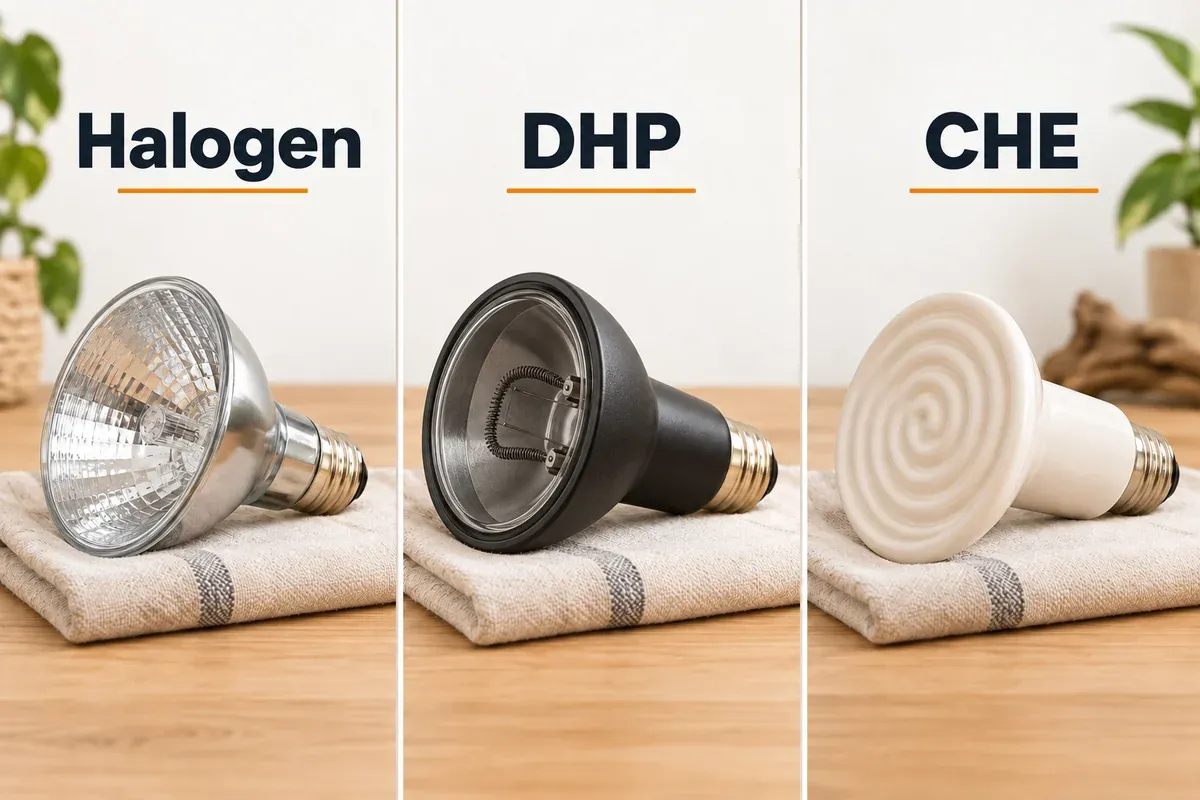
These generic forms help identify the three heater types; use the exact model’s instructions to choose its fixture and control mode.
Thermostat Matching: The Part That Prevents Most Problems
The thermostat is not an optional accessory. MSD Veterinary Manual guidance says reptile heaters should be thermostat controlled, protected from the animal, and positioned toward one end to create a thermal gradient.
Halogen and DHP: use dimming control
Both are lamp-style overhead sources. Dimming control reduces power while keeping the output continuous, which avoids a visible on/off rhythm and gives the basking surface a steadier temperature.
The existing REPTIZOO TC02 dimming thermostat is a budget-oriented option intended for compatible overhead halogen and DHP control.
Check current price on Amazon →CHE: use pulse proportional control when possible
Pulse proportional control sends short bursts of power to a lightless heater. Because a CHE does not glow, those pulses do not create visible flicker. Exo Terra’s thermostat guide explains the difference between on/off, dimming, and pulse control; its North American operating instructions identify dimming as the preferred setting for incandescent or infrared heat bulbs and include pulse control for compatible lightless equipment.
The Exo Terra PT2459 600W Dimming & Pulse Thermostat is the more flexible option when one controller must cover a compatible halogen, DHP, or CHE setup.
Check current price on Amazon →On/off control: simple, but not the universal answer
On/off control can be suitable for a CHE or heat mat when the temperature swing is acceptable and the heater is explicitly compatible. It is not the right default for a visible halogen bulb. If a visible source flashes, goes dark, or restarts repeatedly as it regulates, use a compatible dimming thermostat instead.
The Zoo Med ReptiTemp RT-600 is an established on/off controller for compatible lightless heaters. It is a useful reference option, not a reason to force on/off control onto a visible basking lamp.
Check current price on Amazon →How to Match the Source to the Animal
Start with activity pattern, not the product label
Diurnal baskers: Start by evaluating a halogen flood bulb plus species-appropriate UVB. Bearded dragons, uromastyx, many tortoises, and other sun-basking lizards generally benefit from an overhead basking zone that is bright, warm, and wide enough for the body. A DHP can supplement ambient heat, but it does not replace the visible daytime and UVB parts of the setup.
Nocturnal or crepuscular species: A DHP or CHE becomes useful when the enclosure needs heat after the visible daytime lamp turns off. A DHP is the more targeted overhead option; a CHE is the simpler ambient or supplemental option. Leopard geckos and many snakes are examples where the nighttime light question matters, but the actual temperature targets must come from the current species care plan.
Tropical and arboreal species: Do not assume a high-wattage CHE is safer just because it does not glow. Measure humidity, surface temperatures, and the animal’s access to shaded retreats. A small, controlled overhead source is often easier to manage than a broad heater that warms every part of a compact enclosure.
Large or tall enclosures: A DHP or halogen may create a more usable overhead zone than a CHE, but beam width, mounting height, and the basking platform matter more than the label on the box. A larger enclosure may need more than one controlled source, with each source placed so the animal can move away from the combined heat.
Do not choose by species name alone
“Bearded dragon,” “leopard gecko,” or “ball python” is only a starting point. Age, morph, enclosure size, mesh, room temperature, seasonal cycle, health, and the keeper’s UVB setup all affect the correct heat source. Use a current care sheet or exotics veterinarian for the target temperatures and photoperiod, then use the heat source to achieve those targets safely.
Setup and Safety Checklist
Before the reptile enters the enclosure, run the complete heating system empty for at least one full day/night cycle.
- Place heat on one end. The warm zone and cool zone must be distinct. MSD’s enclosure guidance recommends at least two thermometers, one near the warm end and one at the cool end.
- Use a guard. A reptile can burn itself on a hot bulb, ceramic element, or fixture. Keep the source inaccessible and follow the manufacturer’s clearances.
- Use the correct socket. Halogen, DHP, and CHE fixtures must be rated for the wattage and heat. A CHE needs a ceramic-rated socket; a plastic household lamp holder is not a safe shortcut.
- Secure the probe at the control point. For an overhead source, that is usually the hottest usable basking surface or the location specified by the thermostat instructions. Keep the probe from being moved, buried, or chewed.
- Measure surfaces and air separately. An infrared thermometer measures surfaces. Pair it with digital air-temperature probes at the warm and cool ends.
- Check humidity again. Heat changes evaporation. If the humidity falls outside the species-appropriate range, adjust ventilation, water access, substrate, or heat output rather than covering the enclosure.
- Test the night schedule. Confirm that visible light turns off at night and that any DHP or CHE set point is lower than the daytime target when the care plan calls for a nighttime drop.
- Recheck after every change. A different basking rock, substrate depth, mesh lid, room temperature, or lamp height can change the result.
Common Mistakes to Avoid
Treating “no light” as “full spectrum”
DHPs and CHEs can be useful in darkness, but darkness is not UVB. Keep the visible-light and UVB schedule separate from the lightless heat decision.
Leaving a halogen on at night
If the bulb is visible, it is part of the photoperiod. Use a timer or a day/night controller to turn it off. If the enclosure becomes too cold, add a lightless source only if the species actually needs supplemental night heat.
Buying the biggest wattage “for safety”
More wattage increases the maximum heat available; it does not make regulation easier. Start with a source and wattage that can reach the target under the available mounting height, then confirm with independent measurements.
Using a manual dimmer as the safety device
A manual dimmer changes power but does not sense the temperature. It cannot respond to a hot afternoon, a moved basking surface, or a failed ventilation fan. Use a real thermostat with a secured probe.
Using a CHE as a basking shortcut
A CHE can make the enclosure warm while still producing a poor basking gradient. If the animal needs a strong overhead basking zone, compare a halogen or DHP first and then use a CHE only for the supplemental job it is good at.
Frequently Asked Questions
Is a halogen bulb better than a DHP?
Neither is universally better. Halogen is usually the better daytime basking source when bright visible light and a sun-like beam are appropriate. A DHP is usually the better lightless overhead source when the enclosure must stay dark or the room needs supplemental radiant heat.
Can a DHP be used at night?
Yes, when the species-specific plan calls for nighttime heat and the exact DHP produces virtually no visible light. Use a lower nighttime target, retain a cool retreat, and verify that the bulb is not visibly glowing in the enclosure.
Can a ceramic heat emitter be used 24 hours a day?
Zoo Med describes its ReptiCare CHE as a 24-hour, no-light heat source. That does not mean every reptile needs continuous heat. Follow the species’ nighttime temperature range and use the thermostat to create the correct day/night pattern.
Does a halogen bulb provide UVB?
Do not count on it. Halogen bulbs are useful for visible light and heat, but a species that requires UVB needs a separate UVB source installed at the correct distance and exposure zone.
Which thermostat should I use with a DHP?
Start with a compatible dimming thermostat. DHP manufacturers such as Arcadia specifically recommend dimming control. Confirm the controller’s voltage, maximum load, probe instructions, and mode before connecting the bulb.
Which thermostat should I use with a CHE?
A pulse proportional thermostat is a strong fit because the CHE is lightless. A compatible on/off thermostat can also work if its temperature swing is acceptable for the species and enclosure. Do not use an unregulated household dimmer as a substitute.
Does a DHP replace a basking lamp and UVB light?
Not automatically. A DHP can replace the heat function in some setups, but it does not create the same visible photoperiod as a halogen and it should not be assumed to provide the UVB your species needs. Treat heat, visible light, and UVB as separate design decisions.
Can I use a CHE for a bearded dragon?
It can be useful as supplemental or nighttime heat if the enclosure would otherwise fall below the species-appropriate minimum. It is usually not the best only basking source for a bearded dragon; a controlled halogen basking zone and a separate UVB system are generally the more natural starting point.
Final Verdict
Choose halogen when you want bright daytime overhead basking and the species benefits from a visible sun-like heat source. Choose DHP when you want more targeted overhead radiant heat without visible light, especially when nighttime heat is needed. Choose CHE when the job is lightless ambient or supplemental warmth and you do not need the tightest basking beam.
The safest setup is not the bulb with the most impressive label. It is the source that matches the animal’s behavior, is controlled by the correct thermostat mode, and creates a measured warm-to-cool gradient with secure hardware and independent temperature checks.
Sources and Further Reading
- MSD Veterinary Manual: Management and Husbandry of Reptiles
- MSD Veterinary Manual: Providing a Home for a Reptile
- Arcadia Reptile: Halogen Infrared Heater
- Arcadia Reptile: Deep Heat Projector
- Arcadia Reptile: Ceramic Heater
- Zoo Med: ReptiCare Ceramic Infrared Heat Emitter
- Exo Terra: On/Off, Dimming or Pulse Proportional?
- ReptiFiles: Bearded Dragon Temperatures and UVB Requirements
Related Reptile Guides
- Dimming vs Pulse vs On/Off Reptile Thermostats
- Reptile Heat Mats Guide: Safe Sizing, Thermostats & Setup
- Leopard Gecko Tank Setup: A Practical 36 x 18 x 18 Guide
- Bearded Dragon UVB Setup: Fixture, Distance and Measurement
- Does UVB Pass Through Mesh or Glass?