

 Published sources
 Product details checked
An aquarium heater that is not heating can leave tropical fish in a cold, stressful tank. A heater that keeps heating past its setpoint is more urgent: it can injure livestock, damage the aquarium, and create an electrical hazard. The first step is to separate normal thermostat cycling from a real failure.
Quick answer: Confirm the water temperature with an independent thermometer, then check the heater’s setpoint, water level, placement, circulation, and tank-size rating. If the temperature is rising above the target, stop the heater safely and do not keep testing it in the aquarium. A replacement heater is the right fix for a cracked tube, damaged cord, failed thermostat, or repeated overheating; an external temperature controller can add a second control layer, but it is not an electrical repair.
In this guide, you’ll learn:
- How to tell a normal heating cycle from a heater that has failed
- Which checks are safe while the aquarium equipment is powered
- Why low water, scale, poor circulation, and wrong wattage can look like a bad heater
- What to do when the thermometer says the tank is overheating
- When a replacement heater, controller, thermometer, or guard actually solves the problem
- Which symptoms mean you should stop troubleshooting and replace the electrical device
Safety boundary: Temperature, water level, placement, and visible-condition checks are reasonable. Do not open a heater, splice its cord, test a cracked tube in water, or keep using equipment with a burning smell, melted plastic, damaged insulation, water in the plug, or unexplained repeated overheating. If a plug or wall receptacle is wet, do not pull it out by hand; cut power at the breaker first and get qualified help.
Quick triage: cold water, hot water, or damaged equipment?
Use the symptom rather than the product label as your first decision point. A red indicator light only tells you what the heater is trying to do; it does not prove that the water is at the correct temperature.
| What you observe | Safe first check | Likely direction | Immediate action |
|---|---|---|---|
| Water remains below the target after the tank has had time to stabilize | Compare two thermometers, then check water level, flow, wattage, and the room temperature | Wrong size, low circulation, scale, no power, or a failed heating element | Correct the setup if it is clearly wrong; replace the heater if the basics are sound |
| Heater light is on but the water is cold | Read the water, not the glass, with a separate thermometer | The light may show a heating demand while the element or thermostat is failing | Do not assume the light proves the heater works |
| Temperature climbs above the setpoint | Use an independent thermometer and stop the heating source safely | Stuck thermostat, failed relay, bad probe placement, low water, or controller fault | Unplug while the connection is dry, or switch off the breaker if water reached the connection |
| Glass is cracked, cloudy inside, swollen, leaking, or the cord is damaged | Look from outside the tank; do not handle the unit while powered | Physical or electrical failure | Disconnect power safely and replace the unit |
| Fish are being burned by contact with the heater | Check whether a correctly sized guard can fit without blocking flow | Contact hazard, not necessarily a thermostat fault | Add a compatible guard only after confirming the heater itself is safe |
The safe diagnostic sequence
1. Read the actual water temperature first
Do not diagnose from the heater’s dial or display alone. Put an independent thermometer in a representative area of the tank, away from the heater and away from the strongest return flow. If the reading is surprising, take a second reading with another thermometer before making a large temperature change.
A heater may be off because it has reached its setpoint. “Not heating right now” is not the same as “not maintaining temperature.” Watch the trend over the next several hours when the tank is stable, but do not wait if the water is already climbing above the safe target.
2. Make the electrical area safe
If the plug, power strip, or wall receptacle is dry, switch off or unplug the heater before putting your hands in the water. Arrange a drip loop so water cannot run down the cord into the receptacle. The Aqueon instruction manual specifically warns that immersed electrical equipment must be disconnected before you place your hands in the aquarium.
If water has reached an electrical connection, do not grab the wet plug. The manual’s safety procedure is to disconnect the circuit at the breaker first, then deal with the connection. If you are not confident identifying the correct circuit or the connection looks damaged, stop and call an electrician.
3. Check water level and full immersion
Look for the heater’s minimum-water line. Evaporation can leave an adjustable heater partly exposed, while a low tank level can also make a hang-on-back filter splash and distribute heat poorly. A heater that is not designed to run outside water can overheat or crack when exposed.
Top off with conditioned water that is close to the tank temperature when the water level is the only problem. Do not use an abrupt ice-water correction to fight an overheated tank; sudden temperature swings can stress fish. If the aquarium is very hot, prioritize safe power isolation and gradual stabilization.
4. Check placement and circulation
Place a submersible heater where water can move freely around it, often near a filter return or circulation pump. Keep it away from gravel, rocks, décor, and dense plant growth that can trap heat against the glass. A heater hidden in a stagnant corner may satisfy its local thermostat while the rest of the tank remains cold.
The Fluval E-Series manual likewise calls for unobstructed placement and free water flow. A guard should protect fish from the heating surface without turning the heater into a sealed tube; clear its openings whenever you clean the tank.
5. Compare wattage with the tank and room
Aqueon gives a useful starting point of about 5 watts per gallon for aquariums up to 55 gallons and about 3 watts per gallon for aquariums over 60 gallons. Treat that as a starting range, not a universal rule. A cold room, a tank near an exterior door, an uncovered aquarium, or a large temperature difference can change the required heating capacity.
Too little power can look like a broken heater because it runs for long periods without catching up. Too much power can change the water temperature quickly if the thermostat fails or the circulation is poor. Follow the specific heater’s tank-range label and consider two correctly sized heaters with independent protection for a large system rather than choosing one oversized unit by guesswork.
6. Check scale, debris, and the visible condition
Mineral deposits can insulate the heating surface and interfere with thermostat sensing. Only clean the heater after it is unplugged and has cooled. Aqueon recommends waiting at least 30 minutes before removing a heater from the water; Fluval gives the same cooling interval in its maintenance instructions.
Look for:
- Cracks, chips, cloudy glass, swelling, or water inside the tube
- Brittle insulation, a split cord, a loose plug, or melted plastic
- A missing bottom rubber guard or damaged mounting hardware
- Scale covering the heating area or sensor
- A heater that shifts into gravel, touches a rock, or rests against a decoration
If any damage is visible, do not clean and re-test the unit. Replace it.
7. Recheck the trend before changing settings
Make one change at a time. If the heater has been installed for at least 24 hours and the water is still well below the target, Aqueon’s troubleshooting guidance points you back to the thermometer, setpoint, power, minimum water line, circulation, tank volume, and scale. If those checks pass, a failed heater or controller becomes the reasonable conclusion.
Do not keep turning the dial higher to compensate for a heater that cannot maintain temperature. That can hide a failed thermostat and make the eventual overshoot worse.
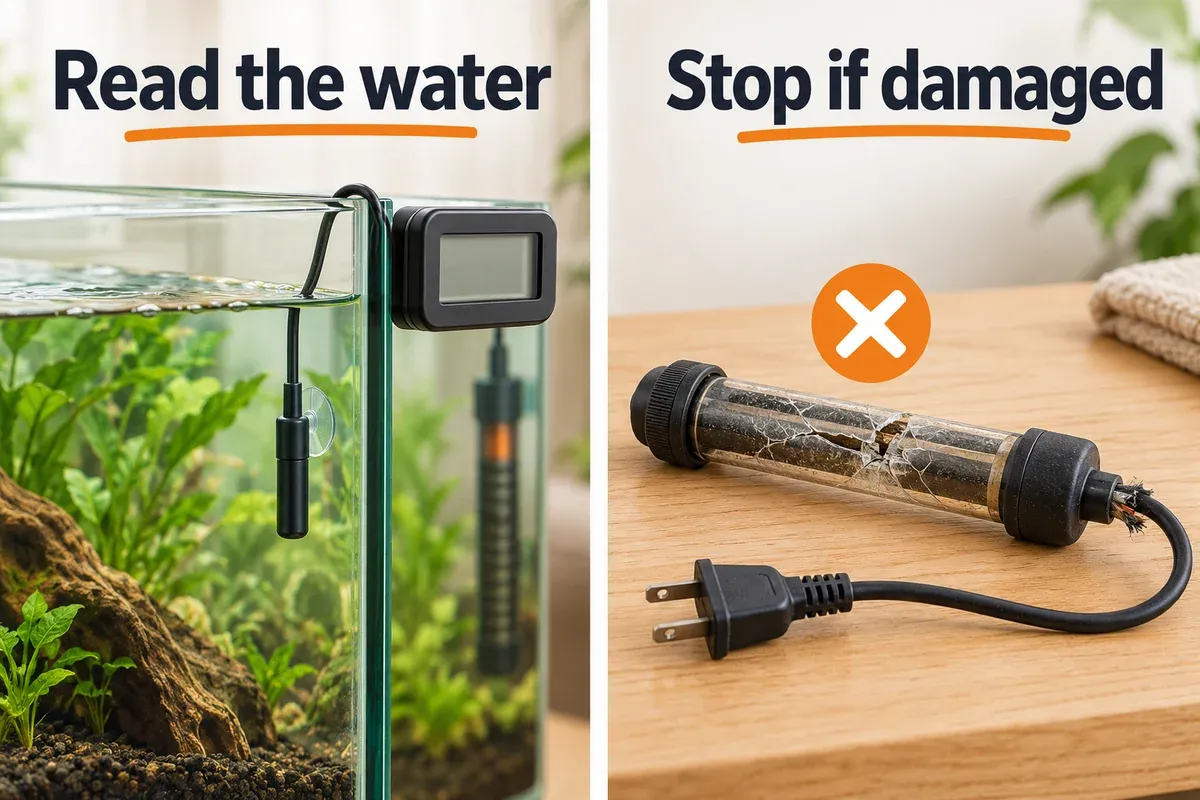
Keep temperature checks separate from equipment damage. The examples below show what to verify and what calls for replacement rather than another powered test.
If your aquarium heater is not heating
Normal thermostat cycling
The heater should not be on continuously in a stable tank. It switches off after reaching the target and switches back on as the water cools. A separate thermometer should show a relatively stable range rather than a steady climb or fall.
Wrong target, wrong measurement, or low circulation
Check that the temperature scale is Fahrenheit or Celsius as intended. A setting of 78°F is not 78°C, and a controller or heater that was accidentally switched between units can create a dramatic mismatch. Confirm the tank thermometer is not stuck to a cold glass corner or sitting directly in the heater’s warm plume.
If the heater works but the far end of the aquarium is cold, improve circulation rather than immediately buying a larger heater. The same logic applies when the tank feels cold near the surface but the thermometer is positioned near the bottom. Measure first, then change placement.
No power or a failed heating element
With the heater disconnected from the water and the electrical area dry, check the power strip, GFCI, switch, and controller output from the dry side. Do not bypass a tripped safety device repeatedly. If the outlet is live but the heater does not maintain temperature, or if the unit has visible damage, replacement is safer than opening the housing.
The Aqueon Pro Adjustable Heater product page describes an adjustable heat setting, a heating indicator, and safety shutoff features. Those are useful features, but no heater should be trusted without a separate temperature reading.
Wrong size for a cold room
If the heater is correctly placed, undamaged, powered, and cycling normally but cannot raise the tank, compare the room temperature and tank volume with the model’s label. A 10-degree room-to-water difference in a drafty room may be too much for a small heater even if its nominal tank range looks close. Move the aquarium away from drafts, reduce heat loss with a lid where appropriate, or select a correctly rated replacement.
If your aquarium heater is overheating
Treat a rising temperature as an active fault until an independent thermometer proves otherwise.
- Confirm the reading without touching the heater. Use a separate thermometer in the main water flow. If a second thermometer disagrees, check both against a known reference rather than choosing the warmer reading because it is more alarming.
- Stop the heat source safely. Unplug only when the plug and receptacle are dry. If water is present at the connection, switch off the breaker first.
- Inspect from outside the tank. Look for a stuck “heating” light, a cracked tube, a low water level, a misplaced probe, or a controller that is continuously supplying power.
- Do not restart a damaged heater. A heater that has cracked, leaked, melted, or repeatedly overshot the setpoint should be replaced, not given another trial run.
- Stabilize gradually. Avoid ice or a sudden large cold-water change. If the temperature is far outside the livestock’s safe range or fish show distress, contact an aquatic veterinarian or experienced fish professional while you restore stable, conditioned water.
The common causes are a thermostat that no longer opens the circuit, an external controller probe that is too far from the heater or out of the water, an incorrect temperature scale, a heater operating below its minimum water line, or a relay that has stuck on. A guard helps with contact burns; it cannot fix any of these control failures.
Which product fixes which problem?
Do not buy a controller when the heater’s cord is damaged. Do not buy a guard when the water is overheating. Start with the fault, then choose the tool that addresses it.
US options for heater replacement, control, measurement, and protection
-
Aqueon Adjustable Pro Aquarium Heater, 200W
Aqueon
Adjustable, fully submersible heater with an electronic thermostat, red heating indicator, and automatic shutoff if it overheats or is removed from the water.
- Adjustable 68-88°F setting
- Electronic thermostat described at ±1°F
- Automatic overheat shutoff and reset
- Best use
- Direct replacement when an adjustable heater has failed
-
Tetra 200W Preset Aquarium Heater
Tetra
Preset 200W heater with an electronic thermostat intended to hold 78°F.
- Preset at 78°F
- Rated for 40-55 gallon tanks in the product documentation
- Electronic thermostat and heating indicator
- Best use
- A low-cost 78°F replacement for compatible 40-55 gallon setups
-
Inkbird ITC-306T Aquarium Temperature Controller
Inkbird
Aquarium-focused heat-only controller with a waterproof probe, two heating outlets, day/night temperature cycles, sensor-fault and over-temperature alarms, and a 10A maximum output.
- Two heating outlets with on/off control
- Day and night temperature settings
- Sensor-fault and over-temperature alarms
- Best use
- Independent on/off control when heater temperature drifts
-
Petbank LCD Digital Aquarium Thermometer
Zacro
Compact LCD thermometer with a suction-cup probe. the product documentation describes 0.1-degree display resolution and a broad measurement range; use it as an independent trend check, not as a substitute for comparing two thermometers when readings disagree.
- Water probe stays submerged; display stays dry
- Large LCD display
- described 0.1-degree resolution
- Best use
- A separate water-probe reading next to the heater's own control
-
Xiaoyztan 17in Aquarium Heater Guard Cover
Xiaoyztan
Detachable 17-inch plastic sleeve with three suction cups, intended to create a physical gap between active heater surfaces and fish or decorations.
- 17-inch guard length
- Detachable multi-section design
- Three suction cups for mounting
- Best use
- Protecting fish from contact with a correctly sized glass heater
Review the linked product page before purchasing.
Aqueon Adjustable Pro 200W — the adjustable replacement
This is the most direct replacement choice when an adjustable heater has failed but the aquarium needs a controllable target temperature.
Product documentation describes a 68–88°F adjustment range, an electronic thermostat rated at ±1°F, a fully submersible design, and automatic shutoff if the heater overheats or is removed from the water. Match the wattage and tank range to your aquarium; “200W” is the example here, not a recommendation for every tank.
Best for: Replacing a damaged or unreliable adjustable heater in a medium-to-large aquarium. Skip if: You have not measured the tank, the current heater is still safe and only needs better circulation, or your controller requires a different voltage/load.
Check current price on Amazon →Tetra 200W Preset — the low-cost fixed-temperature option
Product documentation describes a 78°F preset, electronic thermostat, heating indicator, and heat- and shock-resistant glass for 40–55 gallon tanks.
That fixed temperature is also the reason not to use it everywhere. It is a fit only when 78°F is appropriate for the livestock and the tank falls inside the described range. It is not a troubleshooting tool for a tank that needs a different setpoint or has a history of overheating.
Best for: A straightforward, low-cost replacement for a compatible tropical community aquarium. Skip if: You need adjustable temperature, keep species with a different target, or are replacing a heater because the tank overheated.
Check current price on Amazon →Inkbird ITC-306T — a second control layer for recurring drift
An external controller is useful when the heater itself is intact but you want an independent device to switch power based on a separate probe. Inkbird’s official ITC-306T specification page identifies it as a heat-only on/off controller with dual day/night settings, a waterproof probe, sensor-fault and over-temperature alarms, and a 10A maximum output.
The important limitation is that it is not a repair and it does not control cooling. Place the probe where it measures representative tank water, keep it away from the heater’s direct heat plume, and stay below the voltage and load rating. Use the heater’s own thermostat and the controller as separate limits according to both manuals; never assume one plug-in box makes a damaged heater safe.
Best for: A healthy heater that regularly drifts, a valuable livestock setup, or a tank where an independent cutoff is worth the extra complexity. Skip if: The heater or cord is physically damaged, the probe cannot be mounted safely, or you need cooling control rather than heating control.
Check current price on Amazon →Petbank LCD Digital Aquarium Thermometer — the independent reading
The thermometer is the most important purchase when the existing heater display is the only temperature reference. It has a dry LCD body and a submersible probe; product documentation describes 0.1-degree display resolution.
Resolution is not the same as accuracy. Keep the body out of the water, place the probe away from the heater, and use a second thermometer when the reading would change a livestock or electrical decision. A separate reading can reveal that the heater is fine and the original thermometer is the part that failed.
Best for: Verifying actual water temperature independently from a heater dial or controller. Skip if: You plan to submerge the entire display, need laboratory-grade calibration, or will place the probe directly against the heater.
Check current price on Amazon →Xiaoyztan 17-inch Guard — protection from contact burns
A heater guard is a physical barrier for fish that rest against glass heaters, for large cichlids that move decorations, or for tanks where plants and décor keep touching the heating tube. It is a detachable 17-inch plastic sleeve with three suction cups.
Measure the heater’s length and diameter, leave the minimum water line visible, and make sure the openings stay free of debris. A cover that blocks circulation can make temperature distribution worse. A guard also does not protect against a stuck thermostat, a failed relay, or a wet electrical connection.
Best for: Preventing fish contact with a known-safe, correctly installed glass heater. Skip if: The heater is overheating, cracked, leaking, or missing its own manufacturer-required guard.
Check current price on Amazon →When to repair the setup—and when to replace the heater
| Situation | Better decision |
|---|---|
| Heater is safe, temperature is stable, but one end of the tank is cooler | Improve flow and move the thermometer before replacing equipment |
| Heater is below target, correctly sized, powered, fully submerged, and free of scale | Replace the heater or test with a known-safe spare |
| Heater is cracked, leaking, swollen, smells hot, or has damaged insulation | Disconnect power safely and replace it; do not repair the housing or cord |
| Temperature rises above the setpoint | Stop heating, verify with an independent thermometer, and replace the failed control device |
| Heater works but fish can touch it | Add a correctly sized guard after checking that flow remains open |
| Thermometer disagrees with the heater display | Treat the thermometer disagreement as a measurement problem; compare a second independent reading |
| Controller shows a sensor error or alarm | Stop relying on that controller until the probe and wiring are replaced or verified |
If you replace a heater, keep the aquarium stable during the change. Do not remove a working filter’s mature biological media at the same time, and monitor the tank after any large equipment change. If the heater problem followed a broader maintenance event, our aquarium filter noise troubleshooting guide and cloudy aquarium water diagnosis can help separate temperature trouble from circulation or water-quality trouble. If fish are also struggling against the return, use the aquarium filter flow guide rather than solving every symptom with a larger heater. For a new setup, the beginner aquarium checklist helps you match equipment before stocking the tank.
Common mistakes that make heater problems worse
Turning the dial higher and waiting indefinitely
If the element or thermostat is failing, a higher setting does not restore it. It can also increase the overshoot when the control finally responds. Make the setpoint match the livestock and let the independent thermometer show what the water is doing.
Touching or moving a powered heater
Do not put a hand into the tank with immersed electrical equipment powered. Unplug first, allow the heater to cool, and only then remove or clean it. Aqueon and Fluval both make this cooling step part of their safety instructions.
Treating a guard as an electrical safety device
A guard prevents contact with a hot surface. It does not detect overheating, turn off a stuck thermostat, or make a damaged cord safe. It must also be clean and correctly fitted so water can circulate around the heater.
Using a random controller or exceeding its load
The controller must match the heater’s voltage and current. A controller intended for a small heat mat is not automatically suitable for a high-wattage aquarium heater. Keep the controller body and outlets dry, use a drip loop, and follow the model’s manual.
Making a sudden temperature correction
Do not add ice or make a large, abrupt water change simply because the thermometer is high. First stop the faulty heat source. Then stabilize the aquarium gradually while watching fish behavior and the independent temperature reading.
Frequently Asked Questions
Is it normal for an aquarium heater to turn off?
Yes. A thermostat should cycle the heater on and off as the water reaches and falls below the target. The important question is whether the independent thermometer shows a stable temperature range. A heater that never cycles, stays on while the water rises, or fails to recover from a normal temperature drop deserves investigation.
Why is my aquarium heater on but the tank is still cold?
Check the actual water temperature, then look at the tank size, room temperature, water level, circulation, and scale on the heater. The heater may be undersized for a cold room, placed in stagnant water, or showing an indicator light even though its heating element is failing. If those checks pass and the tank remains cold after a full stabilization period, replace the unit.
Can I touch an aquarium heater to see if it is warm?
Not while it is plugged in or while any immersed equipment is powered. Disconnect the equipment, keep plugs and hands dry, let the heater cool for at least 30 minutes, and use the thermometer as your primary test. Do not use a hand test to justify running a cracked or damaged heater.
How long should an aquarium heater take to warm the tank?
There is no single time for every aquarium. Tank volume, starting temperature, room temperature, wattage, lid, and circulation all matter. Aqueon’s troubleshooting guidance uses a 24-hour operating period before judging an installed heater that is still far below target, but an overheating tank is an immediate stop condition and should not be left for 24 hours.
Can an external temperature controller prevent aquarium heater overheating?
It can add an independent on/off control layer when the heater and controller are both safe and correctly rated. It cannot prevent every failure: a misplaced probe, stuck relay, damaged cord, or controller fault can still create risk. Use a separate thermometer, keep the probe in representative flow, and replace any heater that has already overheated or shows damage.
Does a heater guard stop a heater from overheating?
No. A guard reduces the chance that fish or decorations touch the hot surface. It does not regulate temperature or replace an intact thermostat. If the water is overheating, remove power safely and diagnose the heater or controller first.
How many watts should my aquarium heater be?
Start with the tank-size range printed on the specific heater and consider the room temperature. Aqueon’s general starting point is about 5 watts per gallon for tanks up to 55 gallons and 3 watts per gallon for tanks over 60 gallons, with conditions such as a cold room changing the requirement. Do not use the wattage of another tank as a universal answer.
What should I do if the heater plug gets wet?
Do not pull a wet plug from the receptacle. Switch off the appropriate circuit breaker first, then keep the equipment out of service until the connection has been inspected. If there is melted insulation, a damaged receptacle, or any uncertainty about the circuit, use a qualified electrician.
Bottom line
When an aquarium heater is not heating, begin with the water temperature—not the dial. Confirm the reading independently, check water level, circulation, placement, tank range, room temperature, and scale, then replace the heater if it remains unable to maintain the target.
When a heater is overheating, stop the heat source safely and treat the unit as failed if it has a stuck thermostat, damage, or repeated overshoot. A separate thermometer is the first useful safeguard, an external controller can add another control layer, and a guard only addresses physical contact. None of them makes a damaged electrical device safe.